
Every organisation, regardless of size or industry, depends on external parties to keep its operations running. Software providers, law firms, logistics partners, IT service companies, and consultants are all vendors that businesses engage with on a regular basis.
Managing these relationships in a structured, accountable way is what vendor management is about. Without a formal process in place, organisations often find themselves dealing with missed contract renewals, untracked expenses, compliance gaps, and poor service delivery.
This blog explains the vendor management meaning, covers the full vendor management process, and outlines best practices that legal teams, procurement professionals, and business leaders can apply across their organisations.
What Do You Mean by Vendor?
Before understanding vendor management, it helps to clarify what a vendor actually is.
A vendor is an external individual, business, or entity that supplies goods, services, or solutions to an organisation in exchange for payment. Vendors operate outside the organisation but are directly connected to its operations through contractual agreements.
In a business context, the term vendor is used broadly. It can refer to:
- A software company providing a SaaS platform
- A law firm offering legal advisory services
- A cloud infrastructure provider
- A staffing agency supplying contract workers
- A logistics partner managing deliveries
- A marketing agency handling campaigns
Vendors are different from suppliers in a technical sense. Suppliers typically provide raw materials or components used to manufacture a product. Vendors, on the other hand, usually deliver finished goods or services directly to the end business.
However, in everyday usage within legal and procurement contexts, the terms are often used interchangeably.
What is Vendor Management?
Vendor management is the structured process of identifying, evaluating, onboarding, monitoring, and maintaining relationships with third-party vendors throughout the duration of their engagement with an organisation.
The vendor management meaning goes beyond simply signing a contract and making payments. It covers the entire lifecycle of a vendor relationship, from the initial sourcing and due diligence stage to contract negotiation, performance monitoring, risk assessment, and eventual offboarding.
At its core, effective vendor management aims to:
- Ensure vendors deliver what was agreed upon, on time and to the required quality standard
- Control costs and avoid unnecessary or duplicate spending
- Identify and mitigate risks arising from third-party relationships
- Maintain compliance with legal and regulatory requirements
- Build long-term relationships that create operational and strategic value
Vendor management is not a one-time activity. It is an ongoing function that requires regular attention from legal, procurement, finance, and operations teams working in coordination.
Why Vendor Management Matters for Legal and Procurement Teams
Vendor relationships carry real legal and financial exposure. A vendor that fails to deliver, breaches data security standards, or violates regulatory requirements does not just create an operational problem. It creates a legal one.
Here is why structured vendor management matters across functions:
For in-house legal teams:
- Vendor contracts define obligations, liabilities, and dispute resolution mechanisms
- Poor contract tracking leads to automatic renewals, missed termination windows, and unfavourable terms being carried forward
- Non-compliant vendors can expose organisations to regulatory penalties
For procurement teams:
- Without visibility into vendor performance, cost optimisation is difficult
- Duplicate vendor engagements result in fragmented spending
- Lack of centralised records creates inconsistency in how vendors are evaluated and selected
For business leaders:
- Operational continuity depends on vendors performing reliably
- Vendor failures can disrupt customer delivery, financial reporting, and strategic initiatives
According to a 2024 report referenced by Ncontracts, 98% of organisations have a relationship with at least one third-party vendor that has experienced a data breach in the last two years. This makes proactive vendor oversight a business-critical priority.
Types of Vendors Organisations Work With
Understanding the categories of vendors an organisation engages helps in building the right vendor management framework.
1. Technology and Software Vendors
Providers of enterprise software, cloud services, cybersecurity tools, and IT infrastructure. These vendors often handle sensitive data and require strict compliance monitoring.
2. Professional Services Vendors
Law firms, consulting agencies, accounting firms, and advisory services. These relationships are usually governed by retainer agreements or project-based contracts.
3. Goods and Product Vendors
Suppliers of physical products used within the organisation, such as office supplies, equipment, or packaging materials.
4. Staffing and Workforce Vendors
Agencies that provide contract employees, freelancers, or managed service teams. These engagements require careful compliance with labour regulations.
5. Logistics and Distribution Vendors
Third parties responsible for transportation, warehousing, and supply chain operations.
6. Marketing and Creative Vendors
Agencies handling brand communications, content, advertising, and design work.
Each vendor type comes with its own set of risks, contractual requirements, and performance benchmarks. A mature vendor management programme accounts for these differences rather than applying a one-size-fits-all approach.
The Vendor Management Process: Step by Step
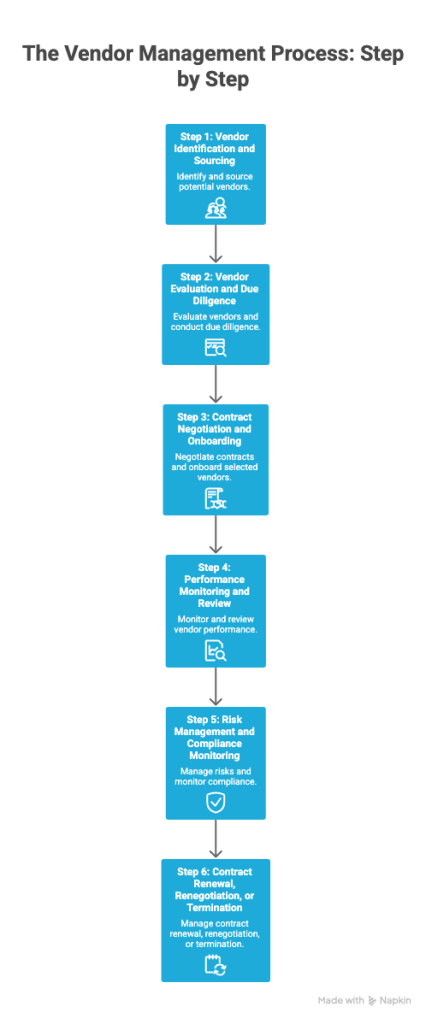
The vendor management process is a structured lifecycle that governs how an organisation engages with vendors from start to finish. Below are the key stages:
Step 1: Vendor Identification and Sourcing
The process begins by identifying what the organisation needs and finding vendors that can fulfil those requirements. This may involve:
- Defining the scope of services or goods required
- Researching potential vendors in the market
- Issuing a Request for Proposal (RFP) or Request for Quotation (RFQ)
- Building a shortlist of candidates based on preliminary criteria
Step 2: Vendor Evaluation and Due Diligence
Once a shortlist is prepared, each vendor undergoes a formal evaluation. This step is critical for legal and compliance teams, as it surfaces potential risks before a relationship is formalised.
Evaluation criteria typically include:
- Financial stability and business continuity
- Regulatory compliance and certifications
- Data security practices and privacy policies
- Track record, client references, and industry reputation
- Capacity to meet service level requirements
In industries such as banking, healthcare, or legal services, this stage may involve a detailed third-party risk assessment and formal sign-off from compliance or legal teams.
Step 3: Contract Negotiation and Onboarding
After selecting a vendor, the next step is to formalise the engagement through a contract. This is where legal teams play a direct role in protecting the organisation’s interests.
Key elements covered in a vendor contract include:
- Scope of work or services
- Pricing, payment terms, and invoicing schedules
- Delivery timelines and milestones
- Service Level Agreements (SLAs) and quality benchmarks
- Data handling and confidentiality obligations
- Liability limits and indemnification clauses
- Termination rights and exit procedures
- Dispute resolution mechanisms
Once the contract is signed, the vendor is onboarded. This includes providing system access, completing compliance checks, and aligning on communication protocols and reporting expectations.
Step 4: Performance Monitoring and Review
This is one of the most important, and most commonly neglected, stages of the vendor management process. Once a vendor is active, their performance should be tracked against the agreed terms.
Monitoring activities typically include:
- Reviewing SLA compliance reports on a regular basis
- Tracking delivery timelines and quality standards
- Conducting periodic vendor review meetings
- Logging and resolving service issues or incidents
- Measuring vendor performance against predefined Key Performance Indicators (KPIs)
Regular performance reviews create accountability and provide an evidence base for contract renewals, renegotiations, or termination decisions.
Step 5: Risk Management and Compliance Monitoring
Vendor risk does not remain static. It changes as the vendor’s business evolves, regulatory requirements shift, or the nature of the engagement changes. Ongoing risk management includes:
- Monitoring for changes in the vendor’s financial health or ownership structure
- Reviewing compliance with data protection regulations such as GDPR or India’s DPDP Act
- Conducting periodic security assessments for technology vendors
- Tracking regulatory and industry-specific compliance requirements
Step 6: Contract Renewal, Renegotiation, or Termination
As contracts approach their expiry date, organisations need to make a deliberate decision about whether to renew, renegotiate, or exit the relationship.
This decision should be based on performance data, cost benchmarking, and changing business requirements. It is not advisable to allow contracts to auto-renew without a review, as this can lock organisations into outdated terms.
If a vendor relationship is being terminated, the exit process should be managed carefully to ensure continuity of service, data retrieval, and handover of obligations.
Key Components of Vendor Management
Beyond the process steps, effective vendor management relies on several core components working together:
Vendor Register or Database A centralised record of all active vendors, including contract details, contact information, compliance status, and renewal dates. This prevents duplication and provides visibility across the organisation.
Contract Repository A secure, searchable location where all vendor contracts and associated documents are stored. Legal teams depend on this to track obligations, deadlines, and key contractual terms.
Performance Scorecards Structured frameworks for measuring vendor performance against agreed standards. These are used in review meetings and renewal decisions.
Risk Classifications Vendors are often categorised by their risk level, typically critical, high, medium, or low, based on the impact they have on operations, the sensitivity of data they handle, and their geographic and financial risk profile.
Governance and Escalation Framework Clear ownership of vendor relationships within the organisation, along with a defined escalation process for issues that require senior involvement.
Common Challenges in Vendor Management
Even organisations with formal vendor management programmes run into recurring challenges. Understanding these challenges helps teams build more resilient processes.
1. Lack of Centralised Visibility When vendor records, contracts, and performance data are scattered across different teams, spreadsheets, and email threads, it becomes difficult to get a clear picture of the organisation’s vendor landscape.
2. Contract Tracking Gaps Missing contract renewal dates, overlooked SLA breaches, and outdated terms that have never been updated are common issues in organisations that manage contracts manually.
3. Inconsistent Vendor Evaluation Without a standard evaluation framework, different teams may select vendors based on varying criteria. This leads to inconsistency in quality and compliance across the vendor base.
4. Vendor Dependency and Concentration Risk Over-reliance on a single vendor for a critical function creates real operational risk. If that vendor experiences financial difficulties, cyber incidents, or service failures, the impact on the organisation can be severe.
5. Data Security and Privacy Risks Vendors that handle personal data or sensitive business information must comply with applicable data protection laws. Without proper due diligence and contract clauses, organisations remain exposed to liability from vendor-side breaches.
6. Compliance Drift Vendors that were compliant at the time of onboarding may fall out of compliance as regulations evolve. Without periodic reassessment, organisations may not identify these gaps until an issue arises.
7. Communication Breakdowns Poor communication between the organisation and its vendors, or between internal teams responsible for managing different aspects of vendor relationships, leads to misaligned expectations and slower issue resolution.
Vendor Management Best Practices
The following best practices reflect what well-functioning vendor management programmes across industries tend to have in common.
1. Maintain a Centralised Vendor Register
Every vendor relationship should be recorded in a single, accessible system. This register should capture vendor contact details, contract dates, service categories, risk classifications, and compliance status. Having this information in one place reduces duplication, improves oversight, and makes audits considerably easier.
2. Standardise the Vendor Evaluation Framework
Define a consistent set of criteria for evaluating new vendors before onboarding. This should include financial checks, compliance verification, data security assessments, and reference reviews. Applying the same framework across all evaluations ensures fairness and comparability.
3. Draft Contracts That Protect Organisational Interests
Contracts should not just confirm pricing and timelines. They should clearly define SLAs, data handling obligations, liability limits, audit rights, termination conditions, and dispute resolution procedures. Legal teams should review all vendor contracts before execution, not just the high-value ones.
4. Set Clear Performance Expectations from Day One
Before a vendor begins work, both parties should agree on performance metrics and reporting requirements. This avoids disputes later and gives the organisation a clear basis for holding vendors accountable.
5. Conduct Regular Performance Reviews
Schedule structured vendor review meetings at appropriate intervals: monthly for critical vendors, quarterly for others. Use performance data, not just subjective impressions, as the basis for these conversations.
6. Classify Vendors by Risk Level
Not all vendors require the same level of oversight. A vendor that processes sensitive customer data requires much more rigorous monitoring than one that supplies stationery. Tiering vendors by risk allows teams to allocate their management resources appropriately.
7. Avoid Over-Reliance on Single Vendors
Where possible, maintain at least one alternative vendor option for critical services. This reduces concentration risk and gives the organisation leverage in negotiations.
8. Track Contract Expiry Dates Proactively
Set automated alerts for contract renewal or expiry dates well in advance, ideally 90 to 180 days before the contract ends. This provides enough time for a proper review and renegotiation, rather than a rushed auto-renewal.
9. Monitor Vendor Compliance on an Ongoing Basis
Do not treat compliance as a one-time check at onboarding. Build periodic compliance reviews into the vendor management process, especially for vendors operating in regulated environments.
10. Document Everything
Keep records of performance reviews, escalation communications, compliance assessments, and contract amendments. This documentation is invaluable in disputes, audits, or when transitioning between vendors.
Legal Vendor Management: What It Means for In-House Teams
Legal vendor management refers specifically to how in-house legal teams select, contract with, and oversee external legal service providers, from law firms to legal process outsourcing partners, alongside the broader vendor base.
For in-house legal teams, vendor management has a particularly important role to play.
Managing External Law Firms and Legal Service Providers In-house teams often work with multiple external law firms, legal process outsourcing (LPO) providers, and specialised counsel. Managing these relationships requires tracking billing arrangements, engagement letters, conflict checks, and performance against matter timelines.
Vendor Contracts as Legal Documents Every vendor agreement is a legally binding document with obligations on both sides. In-house lawyers are responsible for ensuring that contract language protects the organisation’s interests, limits liability exposure, and addresses key risks such as data breaches, regulatory non-compliance, and service failures.
Supporting Procurement in Vendor Negotiation Legal teams frequently support procurement in structuring and negotiating complex vendor deals. This includes reviewing commercial terms, assessing liability clauses, and advising on data processing agreements where personal data is involved.
Regulatory Considerations In regulated industries such as financial services, healthcare, or pharmaceuticals, vendor management is directly connected to regulatory compliance. Regulators expect organisations to have documented evidence of how they assess, onboard, and monitor third-party vendors.
Platforms like Legistify support in-house legal and procurement teams in managing the contract side of vendor relationships, offering capabilities for contract storage, renewal tracking, and workflow-based approvals, helping teams stay on top of obligations without relying on manual tracking.
The Role of Technology in Vendor Management
As the number of vendors an organisation works with increases, manual management becomes increasingly difficult to sustain. Contract management and vendor management software helps address this by centralising information and automating routine tasks.
Key functions that technology can support include:
- Centralised contract storage: All vendor agreements accessible in one secure location, searchable by vendor name, category, or expiry date
- Automated renewal alerts: Notifications triggered well before contract expiry dates, reducing the risk of unwanted auto-renewals or service lapses
- Vendor onboarding workflows: Digital workflows that route new vendor documents through the appropriate approval chains
- Performance tracking dashboards: Visual reporting on vendor SLA compliance and key metrics
- Risk monitoring: Alerts triggered when vendor compliance status changes or risk indicators are flagged
- Audit trail: A complete record of all actions taken in relation to a vendor relationship
For legal teams in particular, contract management technology removes much of the administrative burden associated with vendor oversight. Instead of searching through email threads or spreadsheets to find a contract, teams can access documents, track obligations, and monitor renewals from a single interface.
Conclusion
Vendor management is a core operational and legal function, not just a procurement formality. As organisations expand their reliance on third-party providers, the complexity of managing these relationships grows in parallel.
A well-structured vendor management process helps organisations control costs, maintain compliance, reduce third-party risk, and build vendor relationships that support long-term business objectives. For legal and procurement teams, it provides the structure needed to manage contractual obligations consistently and defensibly.
The fundamentals remain consistent whether an organisation manages ten vendors or ten thousand: standardise evaluation, formalise contracts, track performance, manage risk, and maintain clear records. Building these habits early pays dividends as the vendor base grows.
Frequently Asked Questions (FAQs)
What is the difference between vendor management and supplier management?
Vendor management and supplier management are closely related but have a subtle distinction. Supplier management typically refers to overseeing entities that provide raw materials or components used in production. Vendor management is broader and often refers to third-party providers of finished goods and services. In practice, many organisations use the terms interchangeably, and the management principles are largely the same.
Who is responsible for vendor management in an organisation?
Vendor management is typically a shared responsibility. Procurement teams lead vendor selection and contract negotiation. Legal teams review and advise on contractual terms. Finance teams manage vendor payments and spending. Operations or IT teams monitor day-to-day performance. In larger organisations, a dedicated vendor management or third-party risk function may coordinate these efforts.
What should a vendor contract always include?
A vendor contract should at minimum include: the scope of services or goods being provided, pricing and payment terms, SLAs and performance benchmarks, data handling and confidentiality obligations, liability limits and indemnification provisions, termination rights, and dispute resolution procedures. Legal teams should review all vendor contracts before they are executed.
How often should vendor performance be reviewed?
The frequency of vendor performance reviews depends on the criticality of the vendor relationship. High-risk or critical vendors should be reviewed monthly. Standard vendors are typically reviewed quarterly or semi-annually. The review process should involve structured scorecards and documented outcomes, not just informal conversations.
What is a Vendor Management System (VMS)?
A Vendor Management System is a software platform that helps organisations manage their vendor relationships in a structured, centralised way. It typically includes features for vendor onboarding, contract storage, performance tracking, compliance monitoring, and spend management. Contract management platforms such as Legistify provide related capabilities for managing the contract lifecycle side of vendor relationships, including renewal tracking and workflow-based approvals.
What is legal vendor management?
Legal vendor management is the process by which in-house legal teams select, contract with, and monitor external legal service providers such as law firms, legal process outsourcing partners, and specialised counsel. It includes tracking billing arrangements, engagement terms, and performance against matter timelines.
What is a legal vendor management system?
A legal vendor management system is software used specifically by legal teams to manage relationships with external counsel and legal service providers, often combining contract storage, spend tracking, and renewal alerts. Contract management platforms such as Legistify support this through centralised contract repositories and workflow-based approvals.
What are the main steps in the vendor management process?
The vendor management process generally includes vendor identification and sourcing, evaluation and due diligence, contract negotiation and onboarding, performance monitoring, risk and compliance management, and contract renewal or termination.