
Most people think of a contract as a formal agreement where two parties sit across a table, negotiate terms, and both sign on the dotted line. This is the most familiar form of contract. But not all contracts follow this structure.
In many everyday situations and business transactions, only one party makes a binding promise. That promise becomes enforceable not when the other party signs an agreement, but when they complete a specific action. This is what a unilateral contract is.
From insurance policies to employee bonus programmes to reward offers, unilateral contracts appear across industries and contexts more often than most people realise. Understanding what they are, how they work, and where they apply is important for lawyers, in-house legal teams, procurement professionals, and business leaders who encounter or draft these agreements.
This blog explains the unilateral contract meaning, covers real-world unilateral contract examples, and outlines the legal principles that govern their validity and enforceability.
What is a Unilateral Contract?
A unilateral contract is a type of legal agreement in which one party, known as the offeror, makes a promise to do something or pay something in return for a specific action performed by another party, known as the offeree.
The key feature that sets this contract apart from most other agreements is that the contract does not become binding based on a mutual exchange of promises. Instead, it becomes binding only when the offeree actually performs the requested act.
The offeree is not obligated to perform. They have a choice. If they choose to complete the action, the offeror becomes legally bound to fulfil the promise. If they do not act, there is no contract and no obligation on either side.
A simple way to understand this: a unilateral contract is structured as an “if you do this, I will do that” arrangement. The promise is made by one side. The acceptance comes through action, not through words or a counter-promise.
Unilateral Contract Meaning: Key Characteristics
To understand the unilateral contract meaning more fully, it helps to look at the defining features that distinguish it from other types of contracts.
1. One-sided obligation
Only the offeror is legally bound from the outset. The offeree has no obligation to act and cannot be held liable for choosing not to perform.
2. Acceptance through performance
Unlike bilateral contracts, acceptance is not communicated through words, a signature, or a verbal agreement. The offeree accepts the offer by completing the act requested in the contract.
3. Open to the world
In many cases, a unilateral contract is not directed at a specific person. It is an offer made to anyone willing to perform the requested act. A public reward offer, for instance, can be accepted by any person who meets the stated conditions.
4. No requirement to notify the offeror
In most cases, the offeree does not need to inform the offeror of their intention to act. They simply need to complete the performance. Courts have recognised that requiring advance notice in such contracts would be impractical.
5. Irrevocable once performance begins
The offeror can withdraw the offer at any point before the offeree begins performing. However, once performance has commenced, the offeror generally cannot revoke the offer. The offeree must be given a reasonable opportunity to complete the act.
Essential Elements of a Unilateral Contract
For a unilateral contract to be legally valid and enforceable, it must satisfy the same basic elements required for any contract, along with certain conditions specific to its one-sided structure.
1. Offer
There must be a clear, definite promise made by the offeror. The terms of the offer must specify exactly what act is required from the offeree, and what the offeror will provide in return. Vague or ambiguous offers risk being unenforceable.
2. Intention to create legal relations
The offeror must demonstrate, either through explicit language or through context, that they intend the offer to be legally binding. Casual statements or social promises do not qualify as legally binding unilateral offers.
3. Consideration
The act performed by the offeree constitutes the consideration in a unilateral contract. The offeror’s promise is made in exchange for this performance. Without completion of the act, there is no consideration, and no enforceable contract.
4. Communication of the offer
The offer must be made known to the potential offerees. A unilateral contract cannot be accepted by someone who had no knowledge of the offer at the time of performing the act.
5. Acceptance through performance
The offeree must complete the specified act in full accordance with the terms of the offer. Partial performance may or may not constitute acceptance, depending on the jurisdiction and the specific circumstances.
6. Lawful object
Like any contract, the purpose of the unilateral contract and the act being requested must be lawful. Contracts that require illegal acts are void and unenforceable.
How a Unilateral Contract Works in Practice
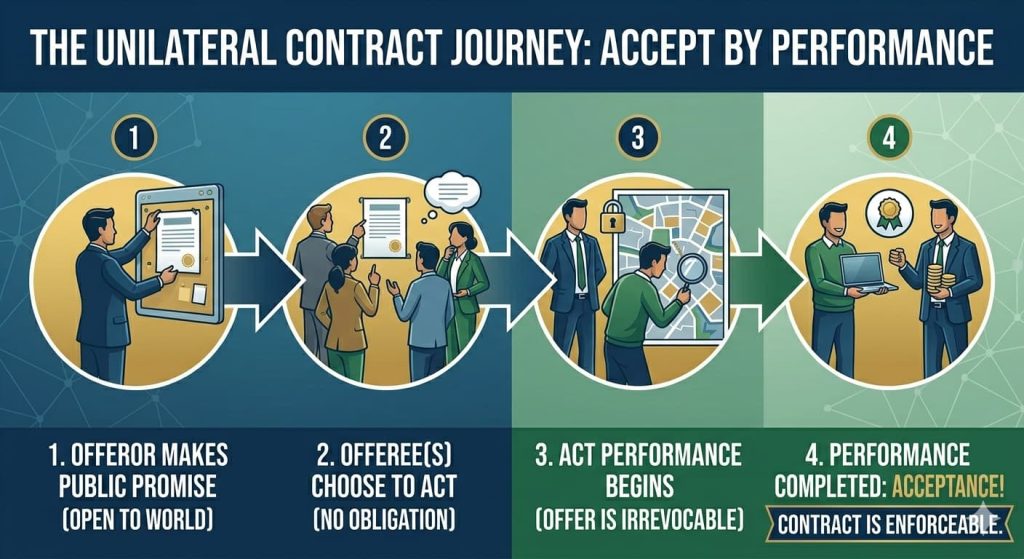
Understanding the formation process helps clarify when a unilateral contract comes into existence and when obligations arise.
Step 1: The offeror makes a public or directed promise
The offeror communicates a clear offer, specifying the act required and the reward or benefit they will provide upon completion. This offer may be made publicly, to a defined group, or to a specific individual.
Step 2: The offeree decides whether to act
The offeree is under no obligation to respond. They consider whether performing the act is worth the effort and whether the promised reward is sufficient motivation. There is no requirement to accept formally or notify the offeror.
Step 3: The offeree begins performance
Once the offeree starts performing the requested act, the offeror’s ability to revoke the offer is typically limited. This protects offerees from having the offer withdrawn mid-performance.
Step 4: The act is completed
When the offeree completes the performance in full, the contract is formed. At this point, the offeror becomes legally obligated to deliver the promised reward, payment, or benefit.
Step 5: The offeror fulfils the promise
The offeror is legally bound to honour the promise made in the offer. Failure to do so constitutes a breach of contract, and the offeree may pursue legal remedies.
Unilateral Contract Examples
Unilateral contracts appear in a wide range of personal and business contexts. The following examples illustrate how this structure operates in practice.
1. Reward Offers
A reward offer is perhaps the most classic unilateral contract example. A person posts a notice stating: “I will pay Rs. 5,000 to anyone who finds and returns my lost laptop.”
No one is required to search for the laptop. But if someone does find and return it, the person who posted the offer is legally obligated to pay the stated amount. The act of returning the laptop constitutes both acceptance and consideration.
2. Insurance Policies
Insurance policies are a widely cited unilateral agreement example. The insurance company makes a promise to pay a certain amount if a specified event occurs, such as an accident, illness, or fire. The policyholder is not obligated to file a claim, but if they do and the conditions are satisfied, the insurer is bound to pay.
The policyholder’s payment of premiums keeps the policy active, but the core obligation to pay the benefit rests solely with the insurer, making it a unilateral structure.
3. Employee Performance Bonus Programmes
An employer announces: “Any sales team member who achieves Rs. 50 lakh in revenue this quarter will receive a bonus of Rs. 1 lakh.”
Employees are not obligated to meet this target. However, any employee who does meet it has accepted the offer through performance, and the employer is legally bound to pay the bonus. This is a common unilateral contract example in employment and HR contexts.
4. Open Listing Agreements in Real Estate
In open listing agreements, a property owner offers a commission to any real estate agent who successfully closes a sale. Multiple agents can work on finding a buyer, but only the one who actually completes the sale is entitled to the commission. The property owner is under no obligation to pay until performance is delivered.
5. Promotional Contests and Public Challenges
A company announces: “The first customer to submit a design that meets our brand guidelines will receive a Rs. 25,000 prize.”
This is a unilateral contract. The company is obligated to pay the prize only to the qualifying performer. No participant is obligated to submit a design.
6. Freelance and Task-Based Work Arrangements
In certain freelance arrangements, work is commissioned on the basis of delivery rather than a mutual agreement to work. A platform may offer: “Complete this task according to these specifications and receive Rs. 3,000 on verified submission.” The freelancer is not obligated to accept, but if they complete and submit the work as specified, the offeror is bound to pay.
7. Credit Card Reward Programmes
Many credit card reward programmes operate as unilateral agreements. The card issuer promises cashback, points, or rewards if the cardholder spends a specified amount within a defined period. The cardholder is not obligated to spend, but if they meet the condition, the issuer must deliver the promised benefit.
Unilateral Contract vs Bilateral Contract

Understanding the difference between unilateral and bilateral contracts is fundamental for anyone working with agreements professionally.
| Feature | Unilateral Contract | Bilateral Contract |
| Number of promises | One party makes a promise | Both parties make promises |
| How acceptance happens | Through performance of an act | Through a verbal, written, or implied counter-promise |
| Obligation on the offeree | None, until performance is complete | Present from the time of acceptance |
| When the contract is formed | When the offeree completes the act | When both parties exchange promises |
| Common examples | Reward offers, insurance policies, bonus schemes | Employment contracts, sale agreements, service contracts |
Most everyday business contracts are bilateral. Both parties commit to specific obligations from the point of signing. Unilateral contracts are more situational, used where the offeror wants to incentivise action without requiring a commitment from the other side in advance.
Unilateral Contracts Under the Indian Contract Act, 1872
In India, the legal framework governing contracts is the Indian Contract Act, 1872. While the Act does not use the specific term “unilateral contract,” the legal principles it lays down accommodate and recognise this contract structure.
Under Section 2(h) of the Act, a contract is defined as “an agreement enforceable by law.” For any agreement to qualify as an enforceable contract, it must include the elements set out in Section 10: a lawful offer, acceptance, free consent, lawful consideration, competent parties, and a lawful object.
Unilateral contracts satisfy these requirements in the following way:
- The offeror’s promise constitutes the offer
- The offeree’s performance constitutes both acceptance and consideration
- Section 8 of the Act specifically recognises that acceptance can occur through performance of a condition, without prior communication to the offeror
Section 8 is particularly significant. It states: “Performance of the conditions of a proposal, or the acceptance of any consideration for a reciprocal promise which may be offered with a proposal, is an acceptance of the proposal.” This provision establishes the legal basis for unilateral contracts under Indian law.
The landmark case of Carlill v. Carbolic Smoke Ball Company (1893), though decided under English contract law, is widely cited in Indian legal education as authority for the enforceability of unilateral contracts. The court in that case held that a public advertisement offering a reward constituted a valid unilateral offer, and that the claimant’s performance of the stated conditions amounted to valid acceptance.
Under Indian law, unilateral contracts are enforceable once the requested performance has been completed, provided all other elements of a valid contract are satisfied.
Advantages and Limitations of Unilateral Contracts
Advantages
1. Encourages specific action without prior commitment
Unilateral contracts are useful when an organisation wants to motivate performance without requiring the other party to make any upfront promise. This makes them practical for reward programmes, incentive schemes, and public challenges.
2. Reduces administrative complexity
There is no requirement for negotiation, counter-signatures, or mutual agreement before the offer is accepted. This simplifies the process in contexts where the offeror wants to cast a wide net and reward successful performance.
3. Limits offeror exposure until performance is complete
The offeror incurs no legal obligation unless and until the offeree actually completes the act. This provides a degree of financial and legal protection compared to bilateral agreements, where obligations arise at signing.
4. Flexibility for the offeree
The offeree retains complete freedom to decide whether to act. There is no pressure, no commitment, and no penalty for choosing not to perform.
Limitations
1. Lack of certainty for the offeror
Since no one is obligated to act, the offeror cannot be certain that the performance will be completed. In time-sensitive situations, this unpredictability can be a drawback.
2. Risk of revocation disputes
If the offeror attempts to withdraw the offer after an offeree has already begun performing, it can lead to legal disputes. Courts in many jurisdictions, including India, will scrutinise such revocations carefully.
3. Potential for vague terms
If the terms of the offer are not clearly defined, disputes can arise about whether the offeree’s performance met the conditions. Ambiguity in a unilateral offer can make enforcement difficult.
4. Limited scope for negotiation
Unlike bilateral contracts, unilateral contracts are generally presented as fixed offers with no room for the offeree to negotiate terms. This can be a limitation in contexts where both parties would benefit from a negotiated arrangement.
Legal Considerations and Enforceability
There are several legal points that lawyers and business professionals should keep in mind when dealing with unilateral contracts.
1. Clarity of the offer
The more specific the terms of the offer, the more enforceable the contract. Vague language about what constitutes acceptable performance, what the reward entails, and what deadlines apply creates risk for both parties.
2. Revocation before performance
The offeror may withdraw the offer at any time before the offeree begins performance. However, once performance has commenced, the offer is generally treated as irrevocable for a reasonable period to allow the offeree to complete the act.
3. Proof of performance
Since the contract is formed through action rather than a signed document, it is important for offerees to maintain evidence of their performance. Photographs, timestamps, delivery records, and witness confirmations can all serve as evidence that performance was completed.
4. Third-party beneficiaries
In some cases, a third party may benefit from the performance of a unilateral contract. Whether that third party can enforce the contract depends on the specific terms of the offer and the applicable legal principles.
5. Jurisdiction-specific rules
The rules governing unilateral contract revocation, partial performance, and enforcement can vary between jurisdictions. Legal advice should always be sought when drafting or enforcing a unilateral contract, particularly in cross-border transactions.
How Organisations Manage Unilateral Contracts
While unilateral contracts may appear simpler than bilateral agreements, they still require careful documentation and management, particularly in organisational settings where multiple such agreements may be active at any given time.
1. Maintaining a record of all active offers
Organisations that run employee bonus programmes, vendor performance incentives, or promotional contests should maintain clear records of each offer made, the conditions attached, and the deadlines applicable.
2. Tracking performance and fulfilment claims
When an offeree performs and claims their reward or payment, the organisation needs a documented process for verifying compliance with the stated conditions before fulfilling its promise.
3. Ensuring offers are clearly communicated
Internal communications, public notices, or platform announcements used to make unilateral offers should use precise language. Vague or poorly worded offers create disputes and reputational risk.
4. Integrating with contract management systems
In larger organisations, unilateral agreements such as incentive structures, open listing commissions, and reward programmes can be tracked within a contract management platform. This provides visibility, ensures timely fulfilment, and reduces the risk of missed obligations.
Platforms like Legistify, which support contract lifecycle management for in-house legal teams, can help organisations store, track, and monitor the status of contractual obligations including those arising from unilateral arrangements, reducing reliance on manual tracking and disconnected records.
Conclusion
A unilateral contract is a one-sided promise that becomes a legally binding agreement only when the other party completes a specific action. Unlike bilateral contracts, it does not require mutual promises or advance agreement. It is formed entirely through performance.
The unilateral contract structure is common across many areas of business and everyday life: insurance policies, reward programmes, employee incentives, real estate open listings, and promotional contests all rely on this framework. Each is built on the same principle: the offeror promises a benefit, and anyone who meets the conditions earns that benefit.
For lawyers and legal teams, understanding what a unilateral contract is and how it operates is essential for drafting offers that are clear, enforceable, and fair. For business professionals, recognising the structure helps avoid disputes and ensures that both the offer and the resulting obligations are properly managed.
Whether the agreement is a simple public reward or a structured employee incentive scheme, the fundamentals of a valid unilateral contract remain the same: clear terms, a lawful object, performance as acceptance, and an offeror who is ready to fulfil the promise once earned.
Frequently Asked Questions (FAQs)
What is a unilateral contract in simple terms?
A unilateral contract is a legal agreement where only one party makes a promise. That promise becomes enforceable when the other party completes a specific action. The person making the offer is bound to fulfil their promise once the act is done, but the other party has no obligation to act at all.
What is a common unilateral contract example in everyday life?
A reward offer is the most common unilateral contract example. For instance, if someone posts: “I will pay Rs. 5,000 to anyone who finds and returns my stolen bicycle,” that is a unilateral contract. Anyone who finds and returns the bicycle is entitled to the payment. No one is required to participate, but those who do and meet the conditions must be paid.
Is a unilateral contract legally enforceable in India?
Yes. Unilateral contracts are legally enforceable in India under the Indian Contract Act, 1872. Section 8 of the Act specifically provides that acceptance of an offer can occur through the performance of a condition, without prior communication. Once the offeree completes the requested act, the offeror is legally bound to fulfil their promise.
What is the difference between a unilateral contract and a bilateral contract?
In a unilateral contract, only one party makes a promise, and the contract is formed when the other party completes an act. In a bilateral contract, both parties make promises to each other, and the contract is formed when those promises are exchanged. Most standard business agreements, including employment contracts and sale agreements, are bilateral contracts.
Can a unilateral contract be revoked after someone has started performing?
Generally, no. While an offeror can withdraw a unilateral offer at any point before the offeree begins performance, most courts and legal systems hold that once performance has commenced, the offeror cannot revoke the offer. The offeree must be given a reasonable opportunity to complete the act. Attempting to revoke after performance has started can expose the offeror to a breach of contract claim.