Agentic AI for Legal Teams: From Contract Copilots to Autonomous Legal Agents
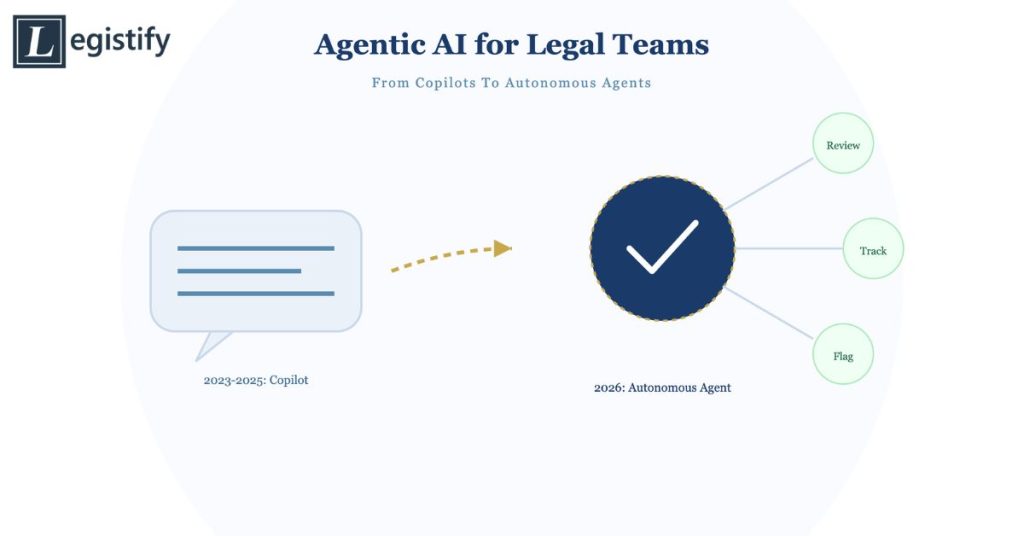
A commercial lawyer bills for judgment, not for reading the same indemnity clause for the four-hundredth time. Yet most in-house teams still spend the bulk of their week on exactly that: NDAs, vendor agreements, renewal notices, the steady drip of low-stakes paper that has to be checked but rarely surprises anyone. Legal AI moved from copilot to agent in 2026, and understanding what that shift actually means, rather than treating “agentic AI” as another marketing buzzword layered onto existing tools, is now a genuinely practical question for any legal team evaluating its technology stack. This guide covers what makes an AI agent structurally different from a copilot, the specific use cases where agentic AI for legal teams is already delivering real value, and how to pilot this capability without handing over more autonomy than the underlying risk justifies. Copilot to Agent: What Agentic AI for Legal Teams Actually Means Legal technology has followed the same broad curve as software development, roughly one cycle behind. In 2023, legal AI meant simple prompts and basic document question-answering. By 2025, it meant more advanced multi-step workflows, still largely directed step by step by a human user. In 2026, it means agents completing complex, end-to-end legal work autonomously, in context, with human oversight built into specific checkpoints rather than required at every single step. The underlying pattern that describes this shift is a four-stage sequence: Read (ingest unstructured information), Think (apply domain knowledge), Write (produce structured output), and Verify (check the output against defined standards). This sequence describes a junior associate working through a contract review just as accurately as it describes any other structured knowledge task. What has changed is not the underlying logic of legal work, which has always fit this model, but that the technology can now execute this full sequence at a high level of quality and reliability without requiring a human to manually direct each individual step. A useful, concrete way to see the distinction: a well-scoped legal agent does not decide whether to sign a contract. It decides whether clause 9.2 matches your pre-agreed fallback position on liability caps, and says so with a citation to the exact clause it is quoting. Serious contract agents ground every claim in the actual document text, so a lawyer can verify the finding in one click instead of simply trusting a summary, the same retrieval-grounded pattern that underlies reliable AI systems more broadly: the model reasons over your real content, not a generic pattern from its training data. Why This Matters Enough to Act On Now In a 2026 survey of in-house counsel, 52% of teams were already using or actively evaluating AI for contract review specifically, and the reason is straightforward: a large share of routine legal volume, NDAs, vendor agreements, renewal paperwork, is exactly the kind of steady, low-surprise work that an agent grounded in an organisation’s own playbook can now handle with defined, auditable checkpoints, freeing lawyer time for the genuinely judgment-intensive work that actually requires it. The vendor landscape has moved decisively in this direction through 2026. Thomson Reuters announced the next generation of CoCounsel Legal in February 2026, promising more autonomous agents requiring less human supervision, alongside expanding the platform to the UK market. Harvey’s Agent Builder, launched in early 2026, lets legal teams create custom AI agents for multi-step tasks, with more than 25,000 custom agents now reportedly operating across M&A, due diligence, contract drafting, and document review. Major international law firms, including collaborations between A&O Shearman and Harvey, have moved agentic AI into production deployment for complex legal workflows such as reviewing loan documents in leveraged finance transactions, not just pilot testing. The Practical Use Cases Already Working for Legal Teams Autonomous contract review against a playbook. With attorney oversight, agents can be trained to classify agreements, extract relevant provisions, compare terms against predefined standards, and flag contracts containing unusual or potentially significant language. This is consistently identified as one of the highest-value near-term use cases precisely because the outputs are inherently reviewable: an attorney can inspect exactly which provisions were flagged, check the underlying contract text directly, and make the final judgment call, rather than being asked to trust an opaque conclusion. Autonomous contract lifecycle management. A CLM agent integrated with an organisation’s contract repository, email, and ERP systems can handle intake, obligation tracking, and renewal alerts across the full contract portfolio autonomously, reclaiming attorney time from administrative tracking and giving legal operations genuine, proactive control over contractual risk rather than reactive, after-the-fact discovery of missed deadlines. Negotiation copilot during redlining. During active negotiation, agents can assemble first drafts by drawing on pre-approved clause libraries and rule-driven playbooks, leading to shorter cycle times and less manual editing. As redlines come back from a counterparty, agents can flag risky or non-standard language, recommend pre-approved alternative clauses, and surface bottlenecks, escalating specifically to the relevant account executive or legal lead with context on exactly what is holding a deal up, rather than leaving that escalation to happen only once someone notices the delay manually. Litigation document synthesis and case knowledge development. An early, emerging pattern uses agentic AI as a copilot for document-heavy litigation work and structured discovery workflows, not as a fully autonomous legal operator making strategic decisions. Keeping a human genuinely in the loop for anything touching case strategy remains essential in this specific use case. Regulatory and compliance monitoring. Autonomous agents can continuously track regulatory changes relevant to an organisation’s specific operations and flag when existing contracts, policies, or processes may need updating in response, converting a task that traditionally depended on someone remembering to check for updates into a continuously running background process. Why Legal Teams Are Not Handing Over Full Autonomy Because of the privacy, security, and broader risk considerations associated with agentic AI, legal professionals are consistently thinking of agents as capable legal assistants rather than as attorneys or independent decision-makers. Teams are not looking to hand end-to-end legal judgment to fully autonomous systems; instead, they are using
Agentic AI for Legal Teams: From Contract Copilots to Autonomous Legal Agents Read More »