
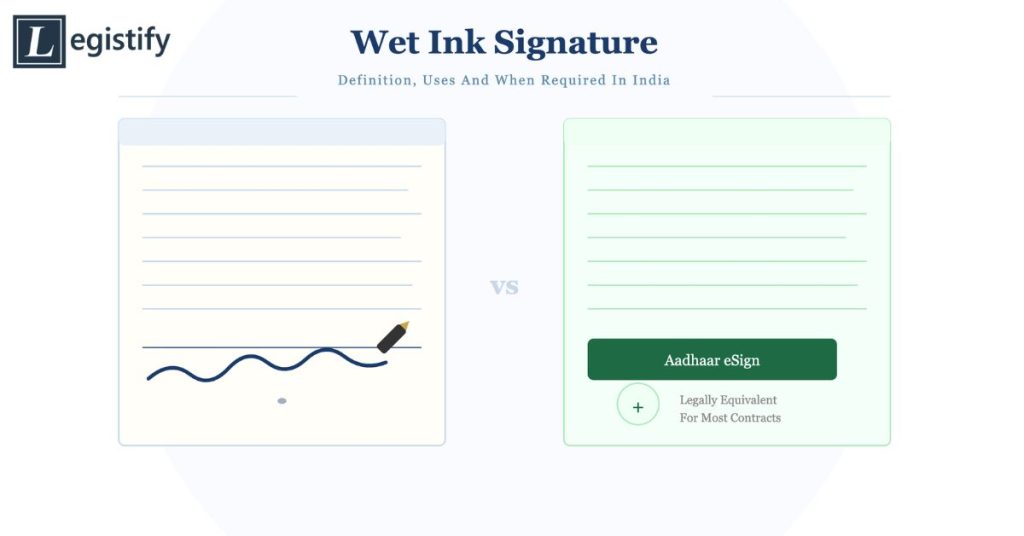
A wet ink signature is a handwritten signature applied directly to a physical document using a pen. The term comes from the literal ink that is wet immediately after signing. It distinguishes a traditional handwritten signature from digital or electronic signatures applied to documents in electronic form.
In India’s increasingly digital contracting environment, the wet ink signature remains legally required for certain categories of documents, is preferred in specific commercial and regulatory contexts, and continues to be used alongside electronic signature methods in hybrid execution workflows. Understanding when a wet ink signature is required, when an electronic alternative is acceptable, and how the two types of signature compare under Indian law is practically important for enterprise legal teams managing contract execution.
What a Wet Ink Signature Is
A wet ink signature is the physical act of signing a document in one’s own hand with ink. The signature produces a visible mark on the physical document that represents the signatory’s identity and, when applied in the context of a contract, their consent to be bound by the document’s terms.
The term “wet ink” is used to distinguish physical signatures from electronic signatures and digital signatures, which produce no physical mark on a document but instead create a digital record of the signing event.
A wet ink signature does not have a defined legal standard for what the signature must look like. A signatory’s signature may be their full name written in cursive, an abbreviation, a stylised mark, or any other consistent written representation. What matters legally is not the form of the mark but whether it was made by the signatory with the intention of authenticating the document.
Legal Framework for Wet Ink Signatures in India
In India, the general legal framework for contracts is the Indian Contract Act, 1872. The Act does not require that contracts be in writing or that they bear handwritten signatures to be valid. Most contracts in India can be oral or in writing and can be signed in any agreed manner.
However, several categories of documents are required by specific statutes to be in writing and signed, and in many cases these requirements have historically implied or required a wet ink signature. The relevant statutory frameworks include:
The Transfer of Property Act, 1882. Transfers of immovable property such as sales, gifts and mortgages must be made by a signed written instrument, and in the case of sales above the prescribed value, by a registered instrument. Gift deeds and mortgage deeds must also be attested by at least two witnesses. In practice, these instruments are signed by wet ink on the physical document.
The Registration Act, 1908. Documents required to be registered under the Registration Act are presented for registration at the Sub-Registrar’s office, where the parties appear in person and the registering officer verifies their identity and the execution of the document. Because the instrument is a physical document, this has historically meant wet ink signatures.
The Companies Act, 2013. Company filings with the Ministry of Corporate Affairs are made electronically with a digital signature, while some company records and physical documents continue to be signed in wet ink as the company’s practice or the applicable rules require. Check the specific requirement for each company document before choosing the signing method.
Negotiable instruments. Cheques, promissory notes, and bills of exchange under the Negotiable Instruments Act, 1881 require the drawer’s signature. While the Act does not specify that the signature must be a wet ink signature, the practical execution of negotiable instruments has traditionally been by physical signature on the physical instrument.
Court documents. Pleadings, affidavits, and court filings that are executed in physical form require wet ink signatures. Courts have progressively expanded the acceptance of electronic filings, but specific documents and contexts continue to require physical signature.
Documents Excluded From the IT Act: The First Schedule
The most important reason wet ink signatures remain in use in India is Section 1(4) of the Information Technology Act, 2000. It provides that the Act does not apply to the documents and transactions listed in the First Schedule. The following cannot be executed by electronic signature under the IT Act:
- Negotiable instruments other than a cheque, such as promissory notes and bills of exchange
- Powers of attorney
- Trusts
- Wills and other testamentary dispositions
- Contracts for the sale or conveyance of immovable property or any interest in such property
The Central Government may amend the First Schedule by notification, so confirm the current list before relying on it. For the rest of a company’s contracts, see whether e-signatures are legally binding in India.
Wet Ink Signature vs Electronic Signature vs Digital Signature
Understanding the types of signature is necessary for applying the correct execution method to each document type.
Wet ink signature. A physical, handwritten mark applied to a physical document. Legally valid for all documents in India unless a specific statute or court rule requires a different form of execution. Cannot be applied to an electronic document.
Electronic signature. Under Section 2(1)(ta) of the Information Technology Act, 2000, an electronic signature means authentication of an electronic record by the electronic technique specified in the Second Schedule, and it includes a digital signature. Section 5 gives legal recognition to such signatures: where a law requires a document to be signed, authentication by electronic signature satisfies the requirement. Section 10A adds that a contract is not unenforceable solely because it was formed by electronic means.
Digital signature. A specific type of electronic signature that uses public key cryptography to authenticate the signatory’s identity and to ensure that the document has not been altered after signing. Digital signatures in India use a Digital Signature Certificate (DSC) issued by a licensed Certifying Authority. A digital signature under the IT Act is the most legally robust form of electronic signature in India and is required for specific filings including company registrations with the MCA, income tax returns, and customs filings.
Aadhaar eSign. A specific electronic signature method using Aadhaar-based authentication. The signatory authenticates through their Aadhaar number and biometric or OTP verification, and the signature is applied by a licensed Certifying Authority. Aadhaar eSign is recognised as an electronic signature technique in the Second Schedule of the IT Act and is widely used in consumer-facing financial services, insurance, and digital lending contexts.
Basic electronic signature. A typed name, a scanned signature image or a click-to-accept confirmation. A contract signed this way is not unenforceable merely because it is electronic, but such a signature does not by itself satisfy the reliability requirements of Section 3A and has weaker evidential standing than a digital signature or Aadhaar eSign.
| Type | What it is | Legal basis in India | Typical use |
|---|---|---|---|
| Wet ink signature | Handwritten mark on a physical document | General law, and the specific statutes for registered and excluded documents | Registered deeds, wills, powers of attorney, physical instruments |
| Digital signature (DSC) | Cryptographic signature using a DSC from a licensed Certifying Authority | IT Act, Sections 3 and 5 | MCA filings, income tax returns, customs filings |
| Aadhaar eSign | Electronic signature using Aadhaar-based authentication | IT Act, Section 3A and the Second Schedule | Lending, insurance, consumer agreements |
| Basic electronic signature | Typed name, scanned image or click-to-accept | Contract formation by electronic means, Section 10A | Lower-risk commercial agreements |
When Wet Ink Signatures Are Still Required in India
Several document categories continue to require or practically necessitate wet ink signatures in India.
Registered documents involving immovable property. Documents that require registration under the Registration Act, such as sale deeds, gift deeds, lease deeds for periods above one year, and mortgage deeds, are executed in physical form and presented for registration before the Sub-Registrar. These documents require wet ink signatures from all parties, and the parties appear before the registering officer for the registration.
Stamp paper execution. Documents executed on physical stamp paper are physically stamped and physically signed. While e-stamping has been introduced in most states, some document types and some states continue to use physical stamp papers that require wet ink execution.
Bank account opening and financial instruments. Banks traditionally require wet ink signature specimen cards for account operations, and physical signature verification remains part of banking KYC and account operation processes, particularly for institutional accounts and high-value transactions.
Wills and testamentary documents. A will in India must be attested by at least two witnesses, each of whom must have seen the testator sign the will or affix their mark. Wills are listed in the First Schedule to the IT Act, which means they cannot be executed by electronic signature and require wet ink signatures.
Powers of attorney. A power of attorney is listed in the First Schedule to the IT Act, so it is executed in physical form. Powers of attorney authorising the holder to execute documents for the transfer of immovable property also require notarisation and registration in many contexts.
Negotiable instruments in physical form. Cheques drawn on physical cheque leaves require wet ink signatures matching the bank’s specimen signature on file. Negotiable instruments other than cheques, such as promissory notes and bills of exchange, are in the First Schedule and cannot be executed electronically under the IT Act.
Court documents not yet accepted in electronic form. Despite the progressive expansion of electronic filing in Indian courts, specific courts and specific document types continue to require physical signature on physical documents.
Wet Ink Signatures in Hybrid Execution Workflows
Many enterprise contracts are executed through hybrid workflows: the contract is agreed and circulated in electronic form, but ultimately executed as a physical document with wet ink signatures from both parties, often by counterpart originals.
Execution by counterparts is a common mechanism where each party signs a separate physical copy of the same agreement, and the two signed originals together constitute the fully executed contract. This approach allows parties in different locations to sign without the physical document travelling between them.
For Indian enterprise legal teams, hybrid execution workflows arise in:
M&A and investment transactions. Share purchase agreements, investment agreements, and shareholder agreements often require physical wet ink signatures, particularly where there is a preference for maximum enforceability and where stamp duty is payable on a physical instrument.
High-value vendor agreements. Some counterparties, particularly public sector enterprises and regulated institutions, require physical signature on commercial agreements as a matter of internal policy.
Government contracts and procurement. Government contracts in India typically require physical execution with wet ink signatures, often with stamp papers and notarisation requirements that necessitate a physical document.
International contracts. Where a party in a foreign jurisdiction is required by its local law to physically sign a document, the contract may be executed in hybrid form with the Indian party using wet ink and the foreign party using their locally required execution method.
Stamp Duty and Wet Ink Signatures
Stamp duty in India is payable on instruments, not on transactions. The stamp duty rules in most Indian states contemplate physical stamped paper instruments, and stamp duty is classically paid by affixing or using a physical stamp on the physical document.
E-stamping, which allows stamp duty to be paid electronically and generates a certificate rather than a physical stamp, has been introduced in most Indian states. However, the rules governing which instruments must use physical stamp paper versus e-stamp certificates vary by state and instrument type.
Where a wet ink signed document is used alongside e-stamping, the physical document is printed on plain paper, the e-stamp certificate is attached, and the parties sign with wet ink on the physical document. Where a physical stamp paper is required, the document is typed or printed on the stamped paper and signed with wet ink.
An instrument that has not been duly stamped under the applicable stamp law is inadmissible in evidence in Indian courts until the stamp duty and any penalty have been paid. The stamp duty assessment should therefore be completed as part of the execution process, whichever signature method is used.
Practical Considerations for Enterprise Legal Teams
Maintain a clear list of document types that require wet ink execution. Not every contract type requires physical signature. Having a clear internal policy on which documents require wet ink, which accept electronic signatures, and which accept Aadhaar eSign reduces the risk of executing documents in the wrong form.
Manage originals carefully. Wet ink signed originals are primary evidence in disputes. Original executed documents should be stored securely, with copies maintained electronically. For high-value agreements, maintaining multiple signed originals (one for each party) is good practice.
Record execution details. For documents executed by wet ink, the execution record should note the date of signing, the signatories, the location of signing, and the location of the original document. This record supports the Section 63 BSA 2023 certification process if an electronic copy of the document needs to be produced as evidence.
Consider authentication requirements. Some wet ink signed documents require additional authentication: notarisation, apostille for international use, or registration. The execution workflow should account for these requirements to avoid producing a signed document that does not meet its intended purpose.
How Legistify Helps Legal Teams Manage Wet Ink and Electronic Execution
Most enterprises run a mix of wet ink and electronic execution, and the risk lies in executing a document in the wrong form or losing track of an original. Legistify is an AI-native legal operations platform for enterprises, and its contract lifecycle management tools help legal teams handle both routes.
- E-signing where the law allows: The e-signature module supports Aadhaar integration and keeps a secure audit trail of signature activity, so documents outside the First Schedule are signed and recorded digitally.
- Tracking hybrid execution: Workflows assign tasks and track progress, and a dashboard shows each contract at every stage, so the steps of a physical signing, such as printing, stamping, signing and scanning, are tracked against the contract.
- One record for every agreement: Executed contracts, including scanned copies of wet ink originals, sit in a central repository with AI-powered search, so the execution record and the scanned copy stay with the contract.
- Drafting for the right route: Legistify AI CLM works as a Microsoft Word add-in with a clause library and playbooks, so execution clauses such as counterparts follow the same standard across agreements.
Explore Legistify’s e-signature and contract workflow features, or compare tools in the guide to the best e-signature software.
Frequently Asked Questions
What is a wet ink signature?
A wet ink signature is a handwritten signature applied to a physical document using ink. The term distinguishes a traditional physical signature from electronic or digital signatures applied to electronic documents. The signature represents the signatory’s identity and their consent to be bound by the document’s contents.
When is a wet ink signature required in India?
Wet ink signatures are required for documents that must be registered under the Registration Act, 1908, including sale deeds, mortgage deeds, and lease deeds for periods above one year. Wills, powers of attorney, trusts, negotiable instruments other than cheques and contracts for the sale or conveyance of immovable property are listed in the First Schedule to the IT Act and cannot be executed by electronic signature. Physical cheques, court documents not yet accepted in electronic form, and many government contracts also continue to require physical wet ink execution.
Which documents cannot be signed electronically in India?
Under Section 1(4) and the First Schedule of the Information Technology Act, 2000, the IT Act does not apply to negotiable instruments other than cheques, powers of attorney, trusts, wills and other testamentary dispositions, and contracts for the sale or conveyance of immovable property. These documents are executed by wet ink signature. The Central Government may amend the list by notification.
What is the difference between a wet ink signature and a digital signature?
A wet ink signature is a physical handwritten mark on a physical document. A digital signature is an electronic signature using public key cryptography that authenticates the signatory’s identity and verifies that the document has not been altered after signing. A digital signature in India uses a Digital Signature Certificate issued by a licensed Certifying Authority under the IT Act, 2000. Both are legally valid for their respective document types, but they serve different contexts and have different legal weight for different document categories.
Is a wet ink signature legally more valid than an electronic signature in India?
Not universally. For most commercial contracts, a digital signature or Aadhaar eSign is as legally valid as a wet ink signature under the IT Act, 2000. For documents listed in the First Schedule or required to be registered under the Registration Act, such as sale deeds, a wet ink signature on the physical document is required. The appropriate signature method depends on the document type, the statutory requirements that apply to it, and the evidentiary standard the parties want to meet.
Is a scanned signature or typed name a valid signature in India?
A contract is not unenforceable solely because it was formed by electronic means (Section 10A of the IT Act). However, a typed name, a scanned signature image or a click-to-accept confirmation does not by itself satisfy the reliability requirements of Section 3A, and it has weaker evidential standing than a digital signature or Aadhaar eSign. It is not accepted for the documents listed in the First Schedule.
How does stamp duty interact with wet ink signature requirements?
Stamp duty in India is payable on instruments. Physical instruments are traditionally stamped using physical stamp paper or e-stamp certificates. An instrument that has not been duly stamped under the applicable stamp law is inadmissible in evidence until the duty and any penalty are paid. The stamp duty assessment should be completed as part of the execution process, and the physical or e-stamp should be applied to the instrument.


Pingback: E-Stamping Services in India: Process, Portals, Rules