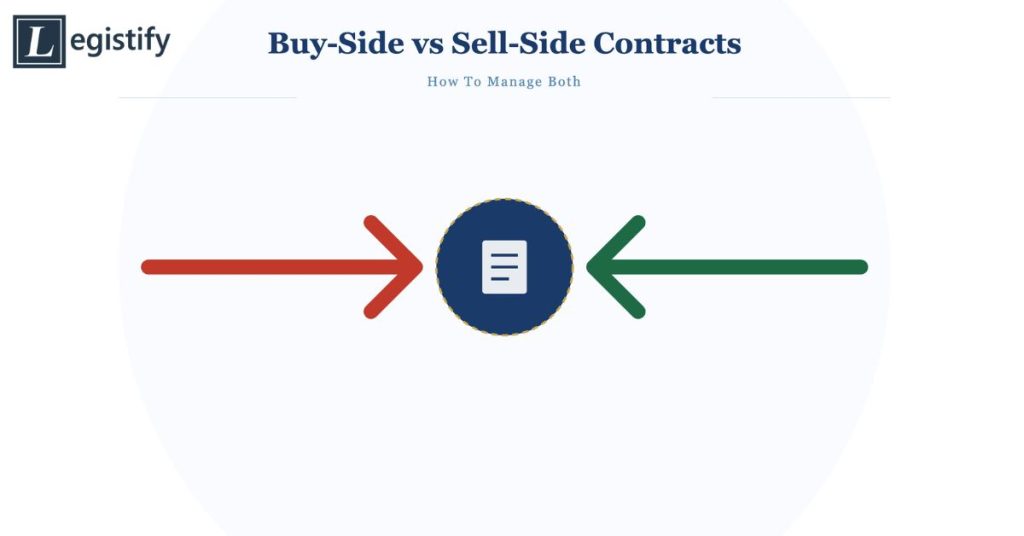
Every organisation that transacts with the outside world manages two distinct categories of contracts: buy-side contracts, where the organisation is procuring goods or services, and sell-side contracts, where the organisation is providing goods or services to customers. The distinction sounds simple, but the two categories carry different objectives, different stakeholders, and different risk profiles, and most organisations manage them through separate teams and separate systems, which creates silos and missed opportunities for alignment.
What Buy-Side Contracts Are
A buy-side contract, also called a procurement contract, is an agreement where an organisation purchases goods, services, or assets from another party, typically a supplier or vendor. Common examples include vendor agreements, supplier SLAs, raw material supply contracts, and technology licensing agreements where the organisation is the licensee.
Buy-side contracts are typically managed by procurement teams, whose primary objective is to reduce costs while securing the resources needed for business operations. Procurement negotiates favourable pricing, delivery schedules, quality standards, and compliance terms, and then monitors supplier performance against these commitments throughout the contract term.
Key performance indicators for buy-side contracts typically include cost savings against budget or benchmark, quality adherence, on-time delivery rates, and supplier compliance rates. These are monitored and iteratively optimised by procurement teams as part of ongoing vendor management.
Risks specific to buy-side contracts include delivery delays, quality issues, unexpected cost escalations during the contract term, and supplier non-compliance with regulatory or contractual standards. These risks are typically managed through carefully drafted SLA and remedy clauses, and through active supplier relationship management.
What Sell-Side Contracts Are
A sell-side contract governs the sale and delivery of an organisation’s own goods, services, or securities to a customer. Common examples include sales agreements, licensing agreements where the organisation is the licensor, customer Master Services Agreements (MSAs), and subscription agreements.
Sell-side contracts are managed by sales teams, whose primary objective is to maximise revenue and accelerate the sales cycle. Sales focuses on closing deals efficiently, structuring pricing and commitments that win the business, and building long-term customer relationships that support renewal and expansion revenue.
Key performance indicators for sell-side contracts typically include sales targets achieved, customer retention rates, and revenue growth from existing accounts. These metrics are owned and monitored by sales teams and account managers as part of ongoing relationship and revenue management.
Risks specific to sell-side contracts include service level breaches (failing to meet the commitments made to the customer), delayed delivery, and disputes arising from customer dissatisfaction with the product or service delivered. These risks are managed through realistic commitment-setting during the sales process and through active account management post-signature.
The Core Difference: Cost Control vs Revenue Generation
At the highest level, the distinction between buy-side and sell-side contracts comes down to a single dimension: buy-side contracts focus on cost reduction and risk mitigation in acquiring what the organisation needs, while sell-side contracts focus on revenue generation and customer relationship management in what the organisation provides. Buy-side contracts influence profitability by controlling costs, supplier performance, and spend efficiency. Sell-side contracts drive revenue through pricing structure, deal terms, and customer commitments.
True organisational profitability depends on how well both sides are managed together. Strong supplier terms without efficient revenue realisation on the sell side, or vice versa, can still erode overall margins even if one side of the business is performing exceptionally well in isolation.
What Buy-Side and Sell-Side Contracts Have in Common
Despite their different objectives and stakeholders, buy-side and sell-side contracts share a substantial amount of structural similarity, which is the basis for managing both through a unified system rather than entirely separate processes.
The contract lifecycle stages are the same. Both types of contracts move through request, drafting or template selection, negotiation, approval, execution, and post-signature obligation management. The specific content differs, but the process flow is largely identical.
Both require risk avoidance and compliance management. Buy-side contracts need to manage supplier compliance risk; sell-side contracts need to manage customer commitment and delivery risk. Both require the same underlying discipline of tracking obligations and escalating issues before they become disputes.
Both use the same core contract metadata. Party names, addresses, signature details, effective dates, renewal terms, and governing law provisions are structurally identical fields regardless of which side of the transaction the contract represents.
Both benefit from the same software capabilities. Template-based drafting, approval workflows, e-signature integration, and obligation tracking apply equally to a vendor agreement and a customer sales contract, even though the specific templates and playbook positions differ.
Why Organisations Manage Buy-Side and Sell-Side Contracts Separately (and Why This Creates Problems)
Historically, contract management software vendors developed solutions focused on one side or the other. Some platforms specialised in operations and procurement contract management (buy-side), while others specialised in sales contract management (sell-side). This history has left many organisations managing the two contract categories through entirely separate systems, owned by separate teams, with no shared visibility.
This separation creates specific, recurring problems.
Duplicated infrastructure and effort. Procurement and sales teams often build parallel processes, templates, and tracking mechanisms for what is structurally the same underlying workflow, wasting effort that could be consolidated.
Missed alignment opportunities. When buy-side and sell-side data live in separate systems, the organisation cannot easily see how supplier costs connect to customer pricing. A sale that triggers a corresponding procurement need (for materials or subcontracted services to fulfil the order) requires manual coordination between the two functions rather than an automated linkage.
Inconsistent governance. Different systems mean different approval workflows, different data retention practices, and different audit trails, making it harder to apply consistent governance and compliance standards across the organisation’s full contract portfolio.
Fragmented risk visibility. Leadership cannot get a single view of total contractual risk and exposure across the organisation, because buy-side risk (supplier concentration, delivery dependency) and sell-side risk (customer concentration, commitment exposure) sit in different systems that do not talk to each other.
How to Manage Both Buy-Side and Sell-Side Contracts in One System
A unified contract lifecycle management (CLM) platform that handles both contract categories through shared infrastructure addresses these problems directly, while still respecting the different needs of procurement and sales teams.
One repository, one source of contract data. Rather than separate document stores, all contracts (vendor and customer) live in a single, searchable repository with consistent metadata extraction and tagging across both categories.
Shared workflows with role-appropriate templates. The underlying approval and execution workflow is the same engine for both buy-side and sell-side contracts, but the templates, playbook positions, and approval thresholds are configured separately to reflect the different content and risk profile of each contract type.
Cross-functional visibility without merging team ownership. Procurement continues to own and manage buy-side contracts; sales continues to own sell-side contracts. But both teams, along with legal and finance, gain visibility into the full contract portfolio through role-based dashboard views built on the same underlying data.
Connected data for operational alignment. When a sales contract commits to a delivery timeline that depends on a specific supplier agreement, a unified system can surface this dependency directly, rather than requiring manual cross-referencing between procurement and sales teams.
Consistent governance and audit trail. A single platform applies the same data security, retention, and audit standards across all contracts, simplifying compliance reporting and regulatory response regardless of which side of the business a specific contract belongs to.
Practical Guidance for Getting Started
Many organisations prioritise one side of the CLM implementation first, often sales, since sales teams can demonstrate value quickly through faster deal cycles and reduced bottlenecks in getting customer contracts signed. Starting with the side that has the clearest, most visible pain point, and then extending to the other side once the platform has proven its value, is a common and reasonable implementation sequence, provided the platform selected genuinely supports both contract categories from the outset rather than requiring a different tool for the second phase.
Legistify’s contract management platform supports both buy-side (vendor, procurement) and sell-side (sales, customer) contracts within a single system, with role-based workflows and dashboards for legal, procurement, sales, and finance teams built on a shared underlying data model.
Conclusion
Buy-side and sell-side contracts serve different organisational objectives, cost control on one side and revenue generation on the other, and are typically owned by different teams with different priorities. But they share enough structural similarity in their lifecycle, their metadata, and their software requirements that managing them through a single, unified system produces meaningfully better outcomes than the fragmented, siloed approach most organisations still use: consistent governance, better cross-functional visibility, and a genuine single source of truth for the organisation’s total contractual risk and commitment.
Frequently Asked Questions
What is the difference between buy-side and sell-side contracts?
Buy-side contracts are agreements where an organisation purchases goods or services from suppliers, focused on cost control, supplier performance, and risk mitigation, and typically managed by procurement teams. Sell-side contracts are agreements where an organisation sells its own goods or services to customers, focused on revenue generation and customer relationship management, and typically managed by sales teams.
What are examples of buy-side and sell-side contracts?
Buy-side contract examples include vendor agreements, supplier SLAs, raw material supply contracts, and technology licences where the organisation is the licensee. Sell-side contract examples include sales agreements, customer Master Services Agreements (MSAs), subscription agreements, and licensing agreements where the organisation is the licensor.
Why should buy-side and sell-side contracts be managed in the same system?
While the two contract categories have different objectives and stakeholders, they share the same underlying lifecycle stages, metadata structure, and software requirements. Managing both in a single system eliminates duplicated infrastructure, improves cross-functional visibility (such as connecting a sale to the procurement it triggers), ensures consistent governance and audit trails, and gives leadership a unified view of total contractual risk across the organisation.
What are the key risks associated with buy-side contracts?
Buy-side contract risks include delivery delays, quality issues, unexpected cost escalations during the contract term, and supplier non-compliance with regulatory or contractual standards. These are typically managed through carefully negotiated SLA and remedy provisions and through active supplier performance monitoring.
What are the key risks associated with sell-side contracts?
Sell-side contract risks include service level breaches (failing to meet commitments made to the customer), delayed delivery of the product or service, and disputes arising from customer dissatisfaction. These risks are typically managed by setting realistic commitments during the sales process and maintaining active account management after the contract is signed.