
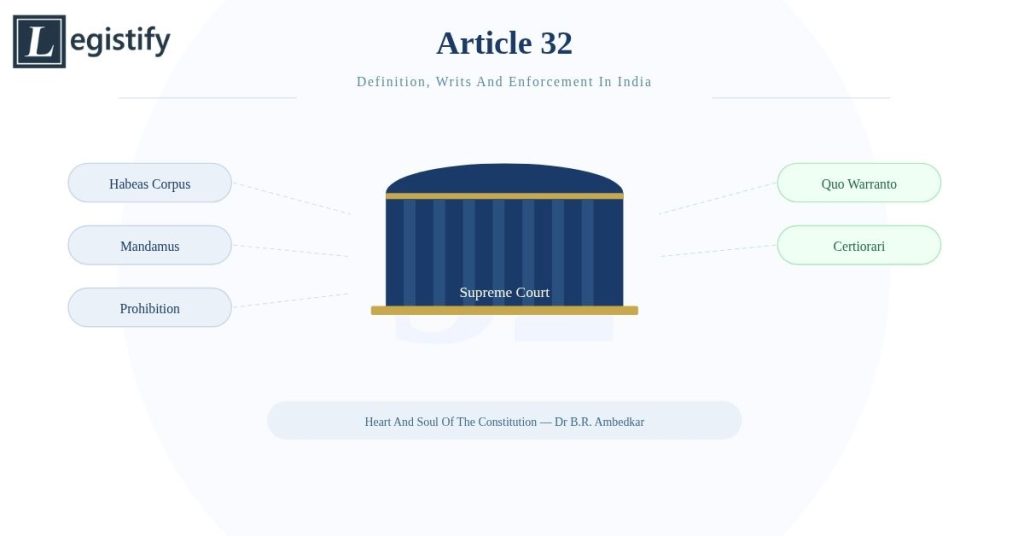
Article 32 of the Indian Constitution (also written as Art. 32) is the constitutional provision that gives every person the right to approach the Supreme Court of India directly for the enforcement of fundamental rights. It is one of the most significant provisions of the Constitution. Dr B.R. Ambedkar described it in the Constituent Assembly on 9 December 1948 as “the very soul of the Constitution and the very heart of it.”
Without Article 32, fundamental rights would exist as constitutional declarations without a guaranteed enforcement mechanism. Article 32 transforms fundamental rights from aspirational provisions into legally enforceable entitlements by giving citizens a direct right to approach the apex court when those rights are violated.
What Article 32 Provides
Article 32 of the Indian Constitution contains four clauses.
Article 32(1) guarantees the right to move the Supreme Court by appropriate proceedings for the enforcement of the fundamental rights conferred by Part III of the Constitution.
Article 32(2) gives the Supreme Court the power to issue directions, orders, or writs, including writs in the nature of habeas corpus, mandamus, prohibition, quo warranto, and certiorari, whichever may be appropriate, for the enforcement of any of the rights conferred by Part III.
Article 32(3) allows Parliament to empower any other court to exercise within a local jurisdiction all or any of the powers exercisable by the Supreme Court under Article 32(2).
Article 32(4) states that the right guaranteed by Article 32 shall not be suspended except as otherwise provided for by the Constitution. The relevant provision is Article 359, which permits the President to suspend the right to move the courts for the enforcement of fundamental rights during a Proclamation of Emergency, except the rights under Articles 20 and 21.
The right guaranteed by Article 32 is itself a fundamental right. This means that the right to approach the Supreme Court for the enforcement of fundamental rights is protected in the same way as the substantive rights it enforces. A law that purports to take away the right guaranteed by Article 32 would itself be unconstitutional.
The Five Writs Under Article 32
The Supreme Court exercises its jurisdiction under Article 32 primarily through the issuance of writs. The five writs available under Article 32 are derived from the English common law system and have been adapted to the Indian constitutional context.
| Writ | Meaning | What it does |
|---|---|---|
| Habeas corpus | “You shall have the body” | Secures the release of a person who is unlawfully detained |
| Mandamus | “We command” | Directs a public authority to perform a legal duty |
| Prohibition | “To forbid” | Stops an inferior court or tribunal from exceeding its jurisdiction |
| Quo warranto | “By what authority” | Challenges a person’s right to hold a public office |
| Certiorari | “To certify” | Quashes an order of a lower court or tribunal for an error of jurisdiction or law |
1. Habeas Corpus
Habeas corpus, meaning “you shall have the body,” is the writ issued to secure the release of a person who is unlawfully detained or imprisoned. When a court issues a writ of habeas corpus, it directs the authority holding a person in custody to produce that person before the court and to justify the legality of the detention. If the court finds that the detention is unlawful, it orders the immediate release of the detained person.
The writ of habeas corpus is the primary constitutional remedy against unlawful deprivation of personal liberty. It can be filed by the detained person themselves or by any person on their behalf, including a relative, friend, or public interest litigant. Courts have held that the writ of habeas corpus cannot be refused on procedural grounds when personal liberty is at stake.
The scope of habeas corpus in India extends to both state detention and private detention. A person unlawfully confined by a private party can apply for the writ, not just a person detained by state authorities.
2. Mandamus
Mandamus, meaning “we command,” is the writ issued by a court to direct a public authority, government body, or public official to perform a specific legal duty that they have failed or refused to perform. It is used to enforce a legal right when a public authority has a duty to act and has unjustifiably failed to do so.
Mandamus is generally not available against private persons or bodies unless they perform a public duty. It is also not issued against the President and Governors of States for the exercise of the powers and duties of their office, because Article 361 gives them immunity from the courts. It cannot be issued to require a public authority to exercise its discretion in a particular way, but can be used to require an authority that has erroneously refused to exercise its discretion to do so.
The writ of mandamus is frequently used to enforce statutory rights, to compel the performance of statutory duties, and to require public authorities to act on pending applications or representations.
3. Prohibition
Prohibition is the writ issued by a superior court to prevent an inferior court or tribunal from exceeding its jurisdiction. Where a lower court is proceeding in a matter beyond its jurisdictional limits or is acting in violation of the principles of natural justice, a writ of prohibition can be issued to stop those proceedings.
Unlike certiorari, which quashes a decision already made, prohibition is preventive rather than curative: it stops the inferior court from continuing proceedings that are improper. Where both the process and the outcome are challenged, prohibition and certiorari can be sought together.
4. Quo Warranto
Quo warranto, meaning “by what authority,” is the writ through which the court challenges a person’s authority to hold a public office. Where a person is holding or claiming a public office without legal entitlement, the writ of quo warranto requires that person to demonstrate the legal basis for holding the office. If they cannot, the court can declare the office vacant.
The writ of quo warranto applies only to public offices of a substantive nature, not to ministerial positions or offices that are purely private in character. It is used to prevent usurpation of public office by persons who have no valid authority to hold it.
5. Certiorari
Certiorari, meaning “to certify,” is the writ issued by a superior court to examine and quash the record of proceedings in an inferior court, tribunal, or quasi-judicial body where there has been an error of jurisdiction or an error of law apparent on the face of the record. It is used to correct jurisdictional errors and errors of law by lower authorities.
The writ of certiorari does not substitute the superior court’s judgment for that of the lower court: it quashes the impugned order and returns the matter to the lower authority for decision in accordance with law. Courts have extended certiorari to cover errors of law appearing on the face of the record, errors of natural justice, and exercises of jurisdiction based on no evidence.
Who Can Apply Under Article 32?
Any person whose fundamental rights have been violated can approach the Supreme Court under Article 32. The petitioner does not need to be the person directly affected by the violation in all circumstances. The Supreme Court has developed the doctrine of public interest litigation (PIL), under which any person acting in the public interest may file a petition under Article 32 on behalf of persons who are unable to approach the court themselves due to poverty, illiteracy, or other circumstances.
The expansion of the locus standi through PIL has significantly widened access to the Supreme Court’s Article 32 jurisdiction. Many of the most significant constitutional decisions in India over the past four decades have been rendered in PIL petitions filed by lawyers, academics, journalists, and civil society organisations on behalf of communities whose rights were at stake.
Difference Between Article 32 and Article 226
Article 226 of the Indian Constitution similarly empowers High Courts to issue writs for the enforcement of fundamental rights and for other purposes. The key differences between Article 32 and Article 226 are as follows.
| Basis | Article 32 | Article 226 |
|---|---|---|
| Court | Supreme Court of India | High Courts |
| Purpose of the writ | Enforcement of fundamental rights only | Enforcement of fundamental rights and any other purpose |
| Nature | Itself a fundamental right | A power of the High Courts, not a fundamental right |
| Territorial jurisdiction | Throughout India | Within the High Court’s own state or Union Territory |
Court of jurisdiction. Article 32 applies to the Supreme Court of India. Article 226 applies to each High Court within its territorial jurisdiction.
Scope of writ jurisdiction. Article 32 is available only for the enforcement of fundamental rights. Article 226 is broader: it applies to the enforcement of fundamental rights and for any other purpose, which includes enforcement of statutory rights and constitutional provisions beyond Part III.
Right versus power. The right to move the Supreme Court under Article 32 is itself a fundamental right, which means it is subject to the same constitutional protection as the fundamental rights it enforces. The power of High Courts under Article 226 is similarly important but does not have the status of a fundamental right.
Alternative remedy. The Supreme Court has discouraged direct petitions under Article 32 where a High Court is an adequate forum. This is a rule of judicial restraint, not a constitutional condition, and the right itself cannot be abridged.
Territorial jurisdiction. The Supreme Court has jurisdiction throughout India. High Courts have territorial jurisdiction limited to their respective states and Union Territories.
Suspension of Article 32 Rights
Article 32(4) provides that the right guaranteed by Article 32 shall not be suspended except as otherwise provided for by the Constitution. The relevant provision is Article 359, which allows the President to suspend the right to move any court for the enforcement of fundamental rights during a Proclamation of Emergency, except for rights under Articles 20 and 21.
The 44th Constitutional Amendment, 1978 specifically protected Articles 20 and 21 from suspension even during an Emergency. The right to life and personal liberty under Article 21 and the protection against double jeopardy and self-incrimination under Article 20 cannot be suspended during an Emergency.
Article 32 as a Basic Structure
The Supreme Court has held that Article 32 is part of the basic structure of the Indian Constitution and cannot be abrogated or substantially curtailed even by a constitutional amendment. In L. Chandra Kumar v. Union of India (1997), the Supreme Court held that the power of judicial review of legislative and executive action, including as exercised through Article 32, is a basic feature of the Constitution.
This means that Parliament cannot pass a constitutional amendment that eliminates or meaningfully restricts the right guaranteed by Article 32.
Conclusion
Article 32 is the constitutional provision that gives fundamental rights their practical force. Without the right to approach the Supreme Court directly, the rights guaranteed by Part III of the Constitution would lack their most important enforcement mechanism. By making the right to move the Supreme Court itself a fundamental right, the Constitution ensures that the enforcement mechanism is as protected as the rights it serves.
Frequently Asked Questions
What is Article 32 of the Indian Constitution?
Article 32 guarantees the right of every person to approach the Supreme Court of India directly for the enforcement of fundamental rights. It empowers the Supreme Court to issue writs, directions, and orders for this purpose. The right guaranteed by Article 32 is itself a fundamental right and cannot be suspended except in the limited circumstances provided by Article 359 during a Proclamation of Emergency.
Is Article 32 a fundamental right?
Yes. Article 32 is itself a fundamental right, placed in Part III of the Constitution as the Right to Constitutional Remedies. It gives every person a guaranteed remedy before the Supreme Court when another fundamental right is violated, and Parliament cannot take it away by ordinary law.
Why did Dr B.R. Ambedkar call Article 32 the soul of the Constitution?
Dr B.R. Ambedkar told the Constituent Assembly on 9 December 1948 that Article 32 was the article without which the Constitution would be a nullity, and called it the soul and heart of the Constitution. The article makes fundamental rights enforceable by giving every person a guaranteed remedy before the Supreme Court.
What are the five writs under Article 32?
The five writs available under Article 32 are habeas corpus, mandamus, prohibition, quo warranto, and certiorari. Habeas corpus secures release from unlawful detention. Mandamus directs a public authority to perform a legal duty. Prohibition prevents an inferior court from exceeding its jurisdiction. Quo warranto challenges a person’s authority to hold a public office. Certiorari quashes the proceedings of a lower court or tribunal for errors of jurisdiction or law.
What is the difference between Article 32 and Article 226?
Article 32 gives the right to approach the Supreme Court for the enforcement of fundamental rights only. Article 226 empowers High Courts to issue writs for the enforcement of fundamental rights and for any other purpose, including enforcement of statutory rights. The right under Article 32 is itself a fundamental right. Article 226 is a power of the High Courts. The scope of Article 226 is broader than Article 32 in terms of the purposes for which writs can be sought.
Who can file a petition under Article 32?
Any person whose fundamental rights have been violated can file a petition under Article 32. The Supreme Court has also developed the doctrine of public interest litigation, under which any person acting in the public interest may file a petition on behalf of persons who cannot approach the court themselves. This has significantly expanded access to the Supreme Court’s Article 32 jurisdiction.
Is the right under Article 32 ever suspended?
Only during a Proclamation of Emergency. Under Article 359, the President suspends the right to move the courts for the enforcement of fundamental rights by order, except for the rights under Articles 20 and 21, which the 44th Constitutional Amendment, 1978 protected from suspension.
Is Article 32 part of the basic structure of the Constitution?
Yes. The Supreme Court has held in L. Chandra Kumar v. Union of India (1997) that the power of judicial review, including the right guaranteed by Article 32, is part of the basic structure of the Indian Constitution. This means it cannot be abrogated or substantially curtailed by any constitutional amendment.