
Contract amendments are a routine part of enterprise contract management. Business conditions change. Commercial terms need adjustment. Scope modifications arise from project developments. Regulatory requirements create new obligations that need to be incorporated into existing agreements. For a large enterprise managing hundreds of active contracts, amendments are a continuous workflow, not an occasional event.
The challenge is not executing amendments. The challenge is managing them without creating gaps in the contract record that undermine the organisation’s understanding of what is currently agreed, and without losing the audit history that shows what was changed, when, and why.
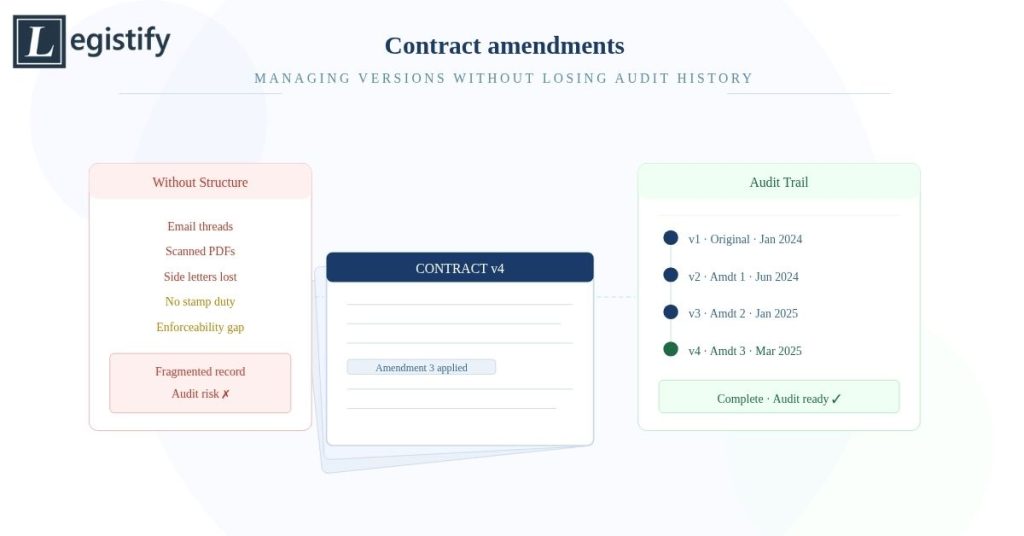
When contract amendments are managed informally, through email exchanges, scanned attachments, and handwritten additions to printed documents, the result is a fragmented record. The original contract says one thing. An email thread from six months later says something slightly different. A second addendum adds a new clause without referencing the first. Nobody is entirely sure which version is controlling. When a dispute arises, or an audit requires production of the contract record, reconstructing what was actually agreed across all amendments takes considerable effort and produces incomplete results.
This article covers what contract amendments are, the main types, the risks of inadequate amendment management, and the practices that enterprise legal teams use to manage amendments systematically while maintaining audit-ready records.
What Contract Amendments Are
A contract amendment is any change to the terms of an executed agreement, made after the original contract has come into force. Amendments can range from minor corrections to fundamental changes in the commercial relationship.
The terms used for different types of post-execution modifications vary, but the most common are:
Amendment or addendum: A formal modification to specific terms of the original agreement. An amendment changes what the contract says. An addendum may add new terms without changing existing ones. In practice, the two terms are often used interchangeably.
Variation: A change to the scope, deliverables, or timeline of an agreement, commonly used in project and services contracts. Variation procedures are typically defined in the contract itself, specifying how variations are initiated, assessed, priced, and approved.
Novation: A formal substitution of one party with another, or of one obligation with a different obligation, with the agreement of all parties. Novation is more significant than an amendment because it extinguishes the original obligation and replaces it with a new one.
Side letter: An agreement between parties that operates alongside the main contract and modifies or supplements its terms. Side letters are sometimes used to document commercial arrangements that the parties do not want to incorporate formally into the main agreement. They carry the same legal weight as a formal amendment but are more prone to being lost or overlooked in contract records.
Waiver: A party’s agreement to forgo a contractual right on a specific occasion. A waiver is not a permanent amendment to the contract, but if waivers are repeated or documented in writing without reservation of rights, they can affect the enforceability of the original term.
Why Contract Amendments Create Audit Trail Risk
Every amendment to an executed contract creates a version management challenge. The original contract, the first amendment, the second amendment, and any side letters or waivers collectively define what the parties have agreed. If any of these documents is missing from the record, or if the relationship between them is unclear, the contract record is incomplete.
This creates three specific risks.
Enforceability risk. A party relying on a contractual right needs to be able to produce the full contract record, including all amendments, in a form that demonstrates the current state of the agreement. If the amendment that created the right in question is missing, or if its relationship to the original contract is unclear, the enforceability of the right is weakened. In a dispute, the other party will exploit any gap in the contract record.
Audit risk. Regulatory inspections and internal audits may require production of the complete contract record for specific agreements. For regulated sectors in India, this is not a hypothetical. RBI inspections, IRDAI reviews, and SEBI audits all involve examination of contractual arrangements. A fragmented amendment record, where some changes are in formal amendment documents and others are in email threads or informal side letters, does not meet the documentation standard that regulators expect.
Operational risk. When the current state of a contract is unclear because amendments are scattered across multiple documents in different formats, the team managing the relationship operates with an incomplete picture. Obligations from the original contract that were modified by a later amendment may be tracked and performed as originally agreed rather than as amended. Pricing that was adjusted in an amendment may not be reflected in actual invoicing. Rights that were waived temporarily may be treated as permanently waived. These operational failures create disputes and financial leakage.
The Amendment Process: What It Should Cover
A structured amendment process covers five elements.
Initiation and documentation of the change request
Every amendment starts with a change request: a party identifying that a modification to the existing agreement is needed. For project and services contracts with formal variation procedures, this typically follows a defined process in the contract. For other contract types, the change request may originate from a business team, a counterparty communication, or a regulatory requirement.
The change request should be documented from the outset: who is requesting the change, what change is being requested, the business or legal justification, and the impact assessment on the existing agreement. This documentation becomes part of the amendment’s audit history.
Legal review of the proposed change
Every amendment should go through a legal review that assesses: whether the proposed change is consistent with the organisation’s standard positions, whether it creates new risk that requires escalation, and whether the change is properly captured in contract language that is precise and unambiguous.
For amendments involving regulatory obligations, the review should assess whether the change satisfies the relevant regulatory requirements or creates compliance risk. An amendment to a data processing agreement needs to be assessed against DPDPA obligations. An amendment to an RBI-regulated lending agreement needs to be assessed against the Digital Lending Directions.
Approval routing appropriate to the nature of the change
Not every amendment requires the same level of approval. A minor correction to a party’s address requires less scrutiny than an amendment that changes the liability cap or the governing law. The approval workflow should be calibrated to the significance of the change, with higher-risk amendments requiring senior legal review or executive approval.
The approval workflow should be documented so that there is a clear record of who approved the amendment, on what basis, and at what stage.
Formal execution of the amendment document
An amendment is a contract modification and needs to be executed with the same formality as the original agreement. This means appropriate signatures or electronic execution, stamp duty assessment where required, and satisfaction of any form requirements in the original contract or applicable law.
Many contracts include an amendment clause that defines how the contract can be modified: typically requiring a written instrument signed by authorised representatives of both parties. Any amendment that does not satisfy the contractual amendment procedure risks being unenforceable. If the original contract required written amendments signed by named officers, an email exchange agreeing to modified terms may not satisfy this requirement.
For Indian enterprises, stamp duty on amended agreements is a specific consideration. Where an amendment materially changes the nature or value of the underlying agreement, stamp duty may be payable on the amendment instrument itself, at rates that depend on the applicable state law and instrument classification.
Integration with the contract record
Once executed, the amendment needs to be integrated into the contract record in a way that makes the relationship between the original agreement and all amendments clear. This means storing the amendment alongside the original in the contract repository, updating the contract’s metadata to reflect the amended terms, and maintaining a version history that shows what the contract said before and after each amendment.
For key commercial terms that are tracked for business purposes, such as contract value, payment terms, and expiry dates, the amendment needs to trigger an update to these tracked fields so that the organisation’s operational systems reflect the current state of the agreement.
Common Amendment Management Failures
Email as an amendment mechanism
The most common amendment management failure is treating email exchanges as amendments. A procurement manager sends an email agreeing to extend a delivery deadline. The counterparty responds confirming the extension. Both parties treat this as binding. The email is not stored in the contract record. A year later, when a dispute arises about the delivery timeline, neither party can produce the email easily, and there is no formal amendment in the contract file.
Email exchanges may or may not constitute binding modifications depending on the contract’s amendment clause and applicable law. But even where they are binding, they are difficult to find, easy to lose, and do not integrate with the contract record in a way that supports systematic management or audit.
Side letters not integrated into the main contract record
Side letters are sometimes used to document commercial arrangements that one or both parties want to keep separate from the main agreement: a confidential pricing arrangement, a grace period not reflected in the main contract terms, or an agreed exception to a standard clause. Where side letters are not stored alongside the main contract in the repository, they are systematically overlooked. The team managing the relationship operates under the main contract terms without knowing that a side letter has modified them.
Amendments that create inconsistency with remaining terms
A poorly drafted amendment may change one provision without accounting for the effect on related provisions elsewhere in the contract. An amendment to a payment clause that changes the payment trigger without updating the related penalty clause. An amendment to the scope of services without updating the associated SLA obligations. These inconsistencies create interpretation disputes when the relationship deteriorates.
Inadequate version control in the contract repository
Where amendments are stored as separate documents without a clear link to the original contract and to each other, the contract repository becomes a collection of documents without a coherent record of the current state of any agreement. Finding the current version of a contract requires locating the original, identifying all amendments, and reading them in sequence. This is manageable for one contract. It is not manageable across a portfolio of hundreds or thousands.
Best Practices for Amendment Management in Indian Enterprises
Treat every amendment as a new contract for execution purposes
Every amendment needs to go through the same rigour as the original agreement: legal review, approval routing appropriate to the risk level, formal execution with appropriate signature authority, and stamp duty assessment where required. This discipline prevents the accumulation of informal modifications that are difficult to enforce and create audit trail gaps.
Maintain a single consolidated contract record
For every agreement, the contract record should be a single, consolidated view of the current state of the agreement, incorporating all amendments. This can be achieved either by maintaining a consolidated restated version that incorporates all amendments, or by maintaining a clear index of the original and all amendments in order, with version notes for each.
The consolidated record should be updated every time an amendment is executed, so that the operational teams managing the relationship always have access to the current state of the agreement.
Require formal amendment clauses in all contracts
Every contract should include an amendment clause that defines how modifications are made: typically requiring a written instrument executed by authorised representatives of both parties. This clause prevents informal modifications from creating enforceability uncertainty, and creates a clear standard that both parties know they need to meet to make a binding change.
For contracts involving regulatory compliance obligations, the amendment clause should also require that amendments comply with any regulatory notification or approval requirements that apply to changes in material contract terms.
Track amendment history as part of contract metadata
The contract management system should record the amendment history as part of the contract’s metadata: date of each amendment, nature of the change, who approved it, and what specific terms were modified. This history is part of the audit trail and should be immediately accessible without having to read through the amendment documents themselves.
For tracked fields such as contract value, expiry date, and key commercial terms, amendments should automatically trigger updates to these fields so that the operational view of the contract always reflects the current state.
Apply stamp duty to amendments where required
Under Indian stamp duty law, amendments to contracts may attract stamp duty depending on the nature of the change and the applicable state law. An amendment that increases the contract value, changes the nature of the instrument, or modifies terms in a way that creates a new taxable event needs to be assessed for stamp duty liability. Executing an amendment without the required stamp duty creates the same inadmissibility risk as executing an unstamped original contract.
For enterprises executing amendments across multiple states, the stamp duty assessment needs to account for the variation in applicable state laws, as the stamp duty implications of the same type of amendment may differ between states.
Contract Amendments in Regulated Sectors
For Indian enterprises in regulated sectors, amendment management has additional requirements beyond standard contract governance.
RBI-regulated agreements. Amendments to agreements between banks or NBFCs and their LSPs need to be assessed against the requirements of the RBI’s Digital Lending Directions. Material changes to the scope of services, the liability allocation, or the data handling arrangements may trigger obligations under the Directions that need to be addressed in the amendment.
IRDAI distribution channel agreements. Amendments to distribution channel agreements for insurers need to be assessed against the IRDAI’s Fraud Monitoring Framework Guidelines and the obligations they impose on the RE-distribution channel relationship. Material changes may require the insurer to assess whether the amended arrangement continues to satisfy the regulatory requirements.
SEBI material contracts for listed entities. For listed companies, material contracts and amendments to them may trigger disclosure obligations under SEBI’s listing regulations. The amendment management process needs to include an assessment of whether any amendment to a material contract triggers a disclosure requirement.
DPDPA data processing amendments. Amendments to data processing agreements need to be assessed against DPDPA obligations. Changes to the scope of processing, the categories of personal data involved, the data retention period, or the sub-processor arrangements may create new obligations under the Act that need to be addressed in the amendment and in the compliance programme.
Legistify’s contract management platform supports structured amendment management, with version control, amendment history tracking, approval workflows for contract modifications, and stamp duty assessment integrated into the amendment execution process.
Conclusion
Contract amendments are not an exception to contract management best practice. They are part of it. Every amendment to an executed agreement creates a version management challenge that, if handled informally, produces exactly the kind of fragmented, incomplete contract record that creates enforceability risk, audit risk, and operational risk.
The practices that address this challenge are not complex: treat every amendment with the same rigour as the original contract, maintain a single consolidated record, track amendment history as part of contract metadata, and apply stamp duty where required. These practices, applied consistently across the contract portfolio, ensure that the organisation always knows what it has agreed to, and can demonstrate this to regulators, auditors, and courts when it matters.
Frequently Asked Questions
What is a contract amendment?
A contract amendment is a formal modification to the terms of an executed agreement, made after the contract has come into force. Amendments can range from minor corrections to fundamental changes in commercial terms. Common forms include formal amendments or addenda, variation orders in project contracts, novations, side letters, and waivers. Each type of modification needs to be documented, executed appropriately, and integrated into the contract record.
What is the difference between an amendment, an addendum, and a novation?
An amendment changes specific terms of an existing contract while leaving the rest of the contract in force. An addendum adds new terms without changing existing ones, though the distinction from an amendment is often blurred in practice. A novation substitutes one party with another, or replaces one obligation with a different one, with the agreement of all parties. Unlike an amendment, a novation extinguishes the original obligation and creates a new one.
What is the risk of managing contract amendments through email?
Email exchanges may or may not constitute binding modifications depending on the contract’s amendment clause and applicable law. Even where they are binding, they are difficult to find, easy to lose, and do not integrate with the contract record in a way that supports systematic management or audit. When disputes arise or regulatory inspections occur, an amendment record consisting of email threads is difficult to produce and creates gaps in the audit trail that undermine the organisation’s position.
Does stamp duty apply to contract amendments in India?
Stamp duty may apply to amendments under Indian law depending on the nature of the change, the applicable state law, and the instrument classification. An amendment that increases the contract value, changes the nature of the instrument, or creates a new taxable event needs to be assessed for stamp duty liability. Executing an amendment without the required stamp duty creates inadmissibility risk, as an unstamped instrument may not be admitted as evidence in Indian courts.
How should regulated enterprises handle amendments to RBI or IRDAI-regulated agreements?
Amendments to RBI-regulated agreements between banks or NBFCs and their LSPs need to be assessed against the requirements of the RBI’s Digital Lending Directions. Amendments to IRDAI distribution channel agreements need to be assessed against IRDAI’s Fraud Monitoring Framework Guidelines. Material changes may trigger regulatory obligations or notification requirements. For listed companies, amendments to material contracts may trigger SEBI disclosure obligations. The amendment management process in regulated sectors needs to include a regulatory assessment step alongside the standard legal review.


Pingback: Difference Between Addendum and Amendment