

Every contract that is validly formed must eventually come to an end. The obligations it creates — to pay, to deliver, to perform a service, to refrain from an act — cannot continue indefinitely. At some point, the legal relationship established by the contract is extinguished, and the parties are released from their duties under it.
This process is called the discharge of contract.
Understanding discharge of contract is important not just for lawyers and law students. For in-house legal teams, procurement professionals, and business leaders who manage multiple agreements at any given time, knowing how contracts end — and why — is directly relevant to how they handle renewals, disputes, early terminations, and failed deliveries.
This blog explains the discharge of contract meaning, covers all recognised modes of discharge of contract under Indian law, and includes practical examples to illustrate how each mode operates in real situations.
What is Discharge of Contract?
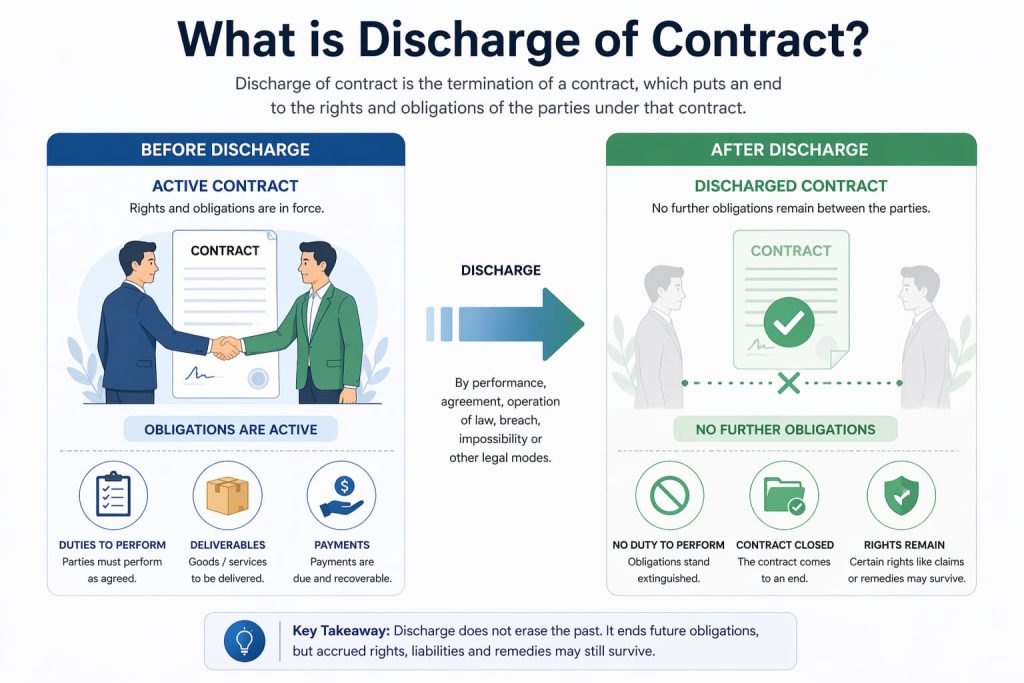
Discharge of contract refers to the termination of the legal obligations and rights created by a contract. When a contract is discharged, it ceases to be operative. The parties are no longer bound to perform their respective promises, and the contract can no longer be enforced by law.
To put it plainly: once a contract is discharged, both parties are free from the commitments they made to each other under that agreement.
The most straightforward and desirable way for a contract to be discharged is through performance. Both parties fulfil their obligations as agreed, and the contract naturally comes to an end. However, contracts can also be discharged through mutual agreement, operation of law, impossibility of performance, lapse of time, or breach, depending on the circumstances.
Understanding what is discharge of contract is particularly relevant when things do not go as planned. When a vendor fails to deliver, when a project becomes legally impossible to complete, or when both parties decide to walk away from an agreement, the question of how the contract has been discharged, and what the legal consequences are, becomes central.
Discharge of Contract Meaning: Key Points
The discharge of contract meaning can be summarised through the following core principles:
- Discharge brings the contract to an end and extinguishes the obligations of all parties
- Once discharged, no party can demand further performance under the original contract
- Discharge does not always mean the contract has been performed successfully. It can occur through breach, agreement, or operation of law as well
- The mode of discharge determines the legal consequences that follow. Performance results in a clean end with no liability. Breach, on the other hand, results in discharge but also exposes the defaulting party to legal claims
- Discharge is distinct from termination in the strict legal sense. Discharge refers to the natural or legal extinguishment of obligations, while termination usually refers to one party bringing the contract to an end following a breach or pursuant to a contractual right
Discharge of Contract Sections Under the Indian Contract Act, 1872
In India, the discharge of contract is governed primarily by the Indian Contract Act, 1872. The following are the key discharge of contract sections under the Act:
| Section | Provision |
| Section 37 | Parties must perform their promises or offer to perform them |
| Section 38 | Effect of refusal to accept offer of performance (tender) |
| Section 39 | Effect of refusal of party to perform promise wholly |
| Section 56 | Agreement to do impossible act is void; supervening impossibility (Doctrine of Frustration) |
| Section 62 | Effect of novation, rescission, and alteration of contract |
| Section 63 | Promisee may dispense with or remit performance (remission and waiver) |
| Section 67 | Effect of neglect of promisee to afford promisor reasonable facilities for performance |
| Limitation Act, 1963 | Discharge by lapse of time where the remedy becomes time-barred |
These sections collectively form the statutory framework for understanding how and when contractual obligations come to an end under Indian law.
Modes of Discharge of Contract
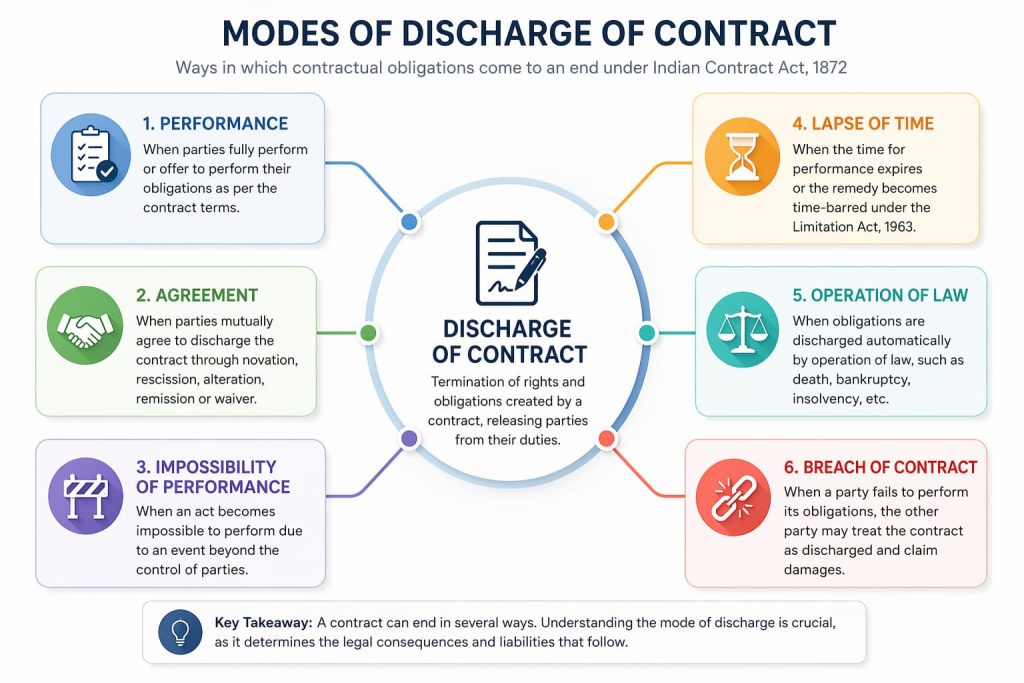
The law recognises several distinct modes of discharge of contract. Each mode operates differently, arises from different circumstances, and produces different legal consequences. The following covers all primary modes in detail.
1. Discharge by Performance
Discharge by performance is the most common and the most straightforward mode. It occurs when the parties to a contract fulfil their respective obligations in accordance with the terms of the agreement.
Under Section 37 of the Indian Contract Act, parties to a contract are obligated to perform, or to offer to perform, their promises. When they do so fully and correctly, the contract is discharged.
Discharge by performance has two forms:
Actual Performance
This is where both parties have completely and correctly performed all their obligations. The contract ends without dispute. There are no remaining rights or duties on either side.
Example: A construction company agrees to renovate an office space for Rs. 20 lakh by a specified date. The company completes the renovation as agreed, and the client pays the full amount. Both parties have performed, and the contract is discharged by actual performance.
Attempted Performance (Tender)
Tender refers to a situation where one party offers to perform their obligation, but the other party refuses to accept the performance. Under Section 38 of the Indian Contract Act, a valid tender of performance has the same legal effect as actual performance. The party making the offer is discharged from their obligation, and the refusing party becomes liable for any resulting loss.
Example: A supplier attempts to deliver goods on the agreed date, but the buyer refuses to accept the delivery without any valid reason. The supplier has tendered performance, and the contract is discharged on their part. The buyer bears liability for the consequences of the refusal.
For a tender to be valid, it must be unconditional, made at the proper time and place, and for the full quantity and quality as agreed.
2. Discharge by Agreement or Consent
Just as a contract is created by the agreement of parties, it can also be brought to an end by agreement. Section 62 and Section 63 of the Indian Contract Act govern discharge by agreement, which can take several forms.
Novation
Novation involves the substitution of an existing contract with a new one. The new contract may involve the same parties or new parties, and may contain different terms. Once novation is agreed upon, the original contract is discharged and there is no obligation to perform it.
Novation must occur before the breach or expiry of the original contract. Both parties must consent to it, and the new contract must itself be valid and supported by consideration.
Example: A owes Rs. 5 lakh to B. By mutual agreement, they agree that C will assume A’s debt and pay B instead. The original contract between A and B is discharged through novation. A new obligation arises between C and B.
Example (corporate context): A law firm is retained by Company X under a service agreement. Company X is later acquired by Company Y. With the consent of all parties, the retainer is novated such that Company Y steps into the position of Company X. The original contract is discharged.
Rescission
Rescission is the mutual cancellation of a contract. Both parties agree to abandon the contract entirely. When a contract is rescinded, all obligations under it are extinguished, and the parties are restored, as far as possible, to their pre-contractual positions.
Unlike novation, rescission does not result in a new contract. The original contract is simply cancelled.
Example: A buyer places an order for custom machinery. Before manufacturing begins, both the buyer and the seller agree that the order will not proceed and cancel the contract. The contract is discharged by rescission.
Alteration
Alteration refers to a change in one or more terms of a contract, made with the mutual consent of all parties. When terms are altered, the original contract with its original terms is discharged, and the parties are bound by the altered terms going forward.
Note: Alteration changes the terms but does not change the parties. Novation may change either the terms or the parties.
Example: A software vendor and a client agreed to deliver a platform in six months at Rs. 10 lakh. Due to increased scope, both agree to extend the timeline to nine months and revise the price to Rs. 14 lakh. The original contract is discharged, and the amended terms govern the relationship going forward.
Remission
Remission, under Section 63, refers to a situation where the promisee agrees to accept lesser performance than what was originally contracted for. No consideration is needed for remission to be valid. The promisee can dispense with or reduce the performance obligation voluntarily.
Example: X owes Y Rs. 50,000. Y agrees to accept Rs. 35,000 in full settlement of the debt. The contract is discharged through remission, and X is no longer liable for the remaining Rs. 15,000.
Waiver
Waiver occurs when one party voluntarily gives up their right to demand performance from the other party. By waiving the right, the party releases the other from the obligation.
Example: A client who was entitled to receive a detailed monthly report under a service contract tells the vendor that reports are no longer needed. The vendor is discharged from that specific obligation.
Accord and Satisfaction
An accord is a new agreement to accept a different form of performance in substitution of the original obligation. Satisfaction is the actual carrying out of that new arrangement. When satisfaction is complete, the original contract is discharged.
Example: A contractor owes a penalty of Rs. 2 lakh for delay. The client agrees that instead of paying the penalty, the contractor will provide additional services worth Rs. 2 lakh. Once those services are provided, the original penalty obligation is discharged.
3. Discharge by Impossibility of Performance
When it becomes impossible to perform the obligations of a contract — either at the time of formation or due to subsequent events — the contract may be discharged. This is governed by Section 56 of the Indian Contract Act.
Initial Impossibility
If an agreement requires the performance of an act that is impossible from the outset, the agreement is void from the beginning. There is no valid contract to discharge.
Example: An agreement to bring a deceased person back to life is void from the start. It cannot be enforced.
Subsequent Impossibility (Doctrine of Frustration)
When a contract was capable of being performed at the time it was entered into, but subsequently becomes impossible or unlawful due to circumstances beyond the control of the parties, the contract is discharged under the doctrine of frustration.
The Supreme Court of India, in Satyabrata Ghose v. Mugneeram Bangur and Co. (AIR 1954 SC 44), clarified that the word “impossible” in Section 56 does not refer only to physical or literal impossibility. It also includes situations where, though physical performance may still be possible, the purpose of the contract has been destroyed by supervening circumstances.
Common grounds for frustration include:
- Destruction of subject matter: If the specific subject matter of the contract is destroyed, the contract is discharged. Example: A hall booked for a corporate event burns down before the event date. The contract for the hire of the hall is discharged.
- Change in law or government policy: If a new law or policy makes performance of the contract illegal, the contract is discharged. Example: A company contracts to export a specific product. A government notification banning the export of that product is issued before delivery. The contract is discharged.
- Death or incapacity: In contracts involving personal skill or service, the death or permanent incapacitation of the party obligated to perform discharges the contract.
- Non-occurrence of a contemplated event: If the contract was entered into on the basis of a specific event taking place, and that event does not occur, the contract may be discharged.
Important: What Does NOT Constitute Frustration
The following situations do not discharge a contract on grounds of impossibility:
- Difficulty in performance or increase in cost does not frustrate a contract
- Strikes, lockouts, or civil disturbances, unless expressly provided for in the contract, do not discharge it
- Default by a third party upon whom the promisor was depending does not discharge the promisor
- Self-induced impossibility, where the promisor causes the impossibility through their own conduct, does not discharge the contract
4. Discharge by Lapse of Time
Every contractual right has a limitation period within which it must be exercised. Under the Limitation Act, 1963, if a party does not enforce their contractual rights within the prescribed time period, the contract becomes time-barred and unenforceable.
Once the limitation period has passed, the contract is effectively discharged. The party who was entitled to performance can no longer pursue a legal remedy.
The general limitation period for a contract is three years from the date the right to sue accrues, though this varies depending on the nature of the contract.
Example: A creditor lends money to a borrower and the amount is not repaid. If the creditor does not file a suit within three years of the repayment due date, the claim becomes time-barred, and the borrower’s obligation is discharged by lapse of time.
This is why proactive contract management — particularly tracking deadlines and performance obligations — is an important function for legal and procurement teams.
5. Discharge by Operation of Law
In certain situations, a contract is automatically discharged by the effect of law, independently of the parties’ actions or intentions. The principal circumstances include:
Death
In contracts that involve the personal skill, knowledge, or presence of a specific individual, the death of that person discharges the contract. This is because the specific performance the contract called for can no longer be delivered.
Example: A musician is contracted to perform at a corporate event. The musician passes away before the event. The contract is discharged. In contrast, for contracts that do not depend on personal performance, the legal representatives of the deceased may be required to perform.
Insolvency
When a party is declared insolvent by a court, the Insolvency and Bankruptcy Code, 2016 (and the earlier Presidency Towns Insolvency Act) provides for certain contractual obligations of the insolvent party to be discharged. The Insolvency Resolution Professional or the court takes over management of the obligations.
Merger
When a party holds both a right and an obligation under overlapping contracts, a merger may occur. The inferior right merges into the superior right, and the original contract is discharged.
Example: A tenant who has a lease agreement with a landlord later purchases the same property from the landlord. The tenant and landlord are now the same person in terms of property ownership. The original lease contract merges into the ownership and is discharged.
Material Alteration by One Party
If one party makes an unauthorised, material change to a written contract without the consent of the other party, the contract is discharged as against the party who suffered the alteration. The other party may treat the contract as void.
6. Discharge by Breach
Breach of contract occurs when one party fails or refuses to perform their obligations under the contract without any lawful justification. When a breach occurs, the contract is discharged, and the non-breaching party acquires the right to claim remedies including damages, specific performance, or rescission.
Breach is the least desirable mode of discharge. It ends the contract, but it also creates legal liability for the defaulting party.
There are two forms of breach:
Actual Breach
Actual breach occurs when a party fails to perform their obligation on the due date of performance, or performs in a manner that does not conform to the terms of the contract.
Example: A logistics company agrees to deliver goods on 15 March. On 15 March, they fail to deliver. The non-performing party has committed an actual breach. The contract is discharged, and the client can claim damages.
Example: A law firm is engaged to submit a legal opinion by a specified deadline. The firm submits an opinion that does not address the questions raised in the brief. This constitutes an actual breach of the terms of engagement.
Anticipatory Breach
Anticipatory breach occurs when a party, before the date on which performance is due, declares either expressly or through conduct that they will not perform their obligations.
The landmark case of Hochster v. De La Tour (1853) established that the innocent party does not need to wait until the performance date to bring a claim. They can treat the contract as discharged immediately and sue for damages.
Example: A vendor agrees to supply raw materials on 1 June. On 10 May, they inform the buyer that they will not be able to deliver. This is an anticipatory breach. The buyer can immediately treat the contract as discharged and seek a replacement supplier or claim damages.
Example (Indian context): In a construction contract, the contractor informs the developer in writing, three months before the completion date, that due to financial difficulties they will not be completing the project. The developer can treat this as an anticipatory breach, terminate the contract, and engage another contractor, claiming the cost difference as damages.
What Does NOT Discharge a Contract
To avoid confusion, it is equally important to understand circumstances that do not discharge a contract:
- Commercial hardship or increased cost does not discharge a contract. A party cannot walk away simply because performance has become more expensive or less profitable than anticipated
- Strikes, lockouts, or civil disturbances do not discharge a contract unless explicitly provided for in the force majeure or frustration clause of the agreement
- Third-party default does not excuse the promisor from performance. If a party relies on a supplier who fails them, that does not discharge their own obligation under their customer contract
- Partial performance does not discharge a contract unless the promisee agrees to accept the partial performance in full satisfaction
- Mere inconvenience or change in business circumstances does not amount to frustration under Section 56
Legal Effects of Discharge of Contract
Once a contract is discharged, regardless of the mode, the following legal consequences follow:
- All future obligations under the contract come to an end
- Neither party can demand further performance from the other under the discharged contract
- Any rights that had already accrued before discharge remain enforceable. Discharge does not extinguish rights that arose from a breach that occurred before the contract was discharged
- In the case of discharge by breach, the non-defaulting party retains the right to claim damages for the loss suffered
- In the case of frustration, neither party is liable to the other for the failure to perform, as the impossibility arose from circumstances beyond both parties’ control
- In the case of novation, the parties are bound by the new contract and no longer by the original one
Discharge of Contract in Business and Legal Practice
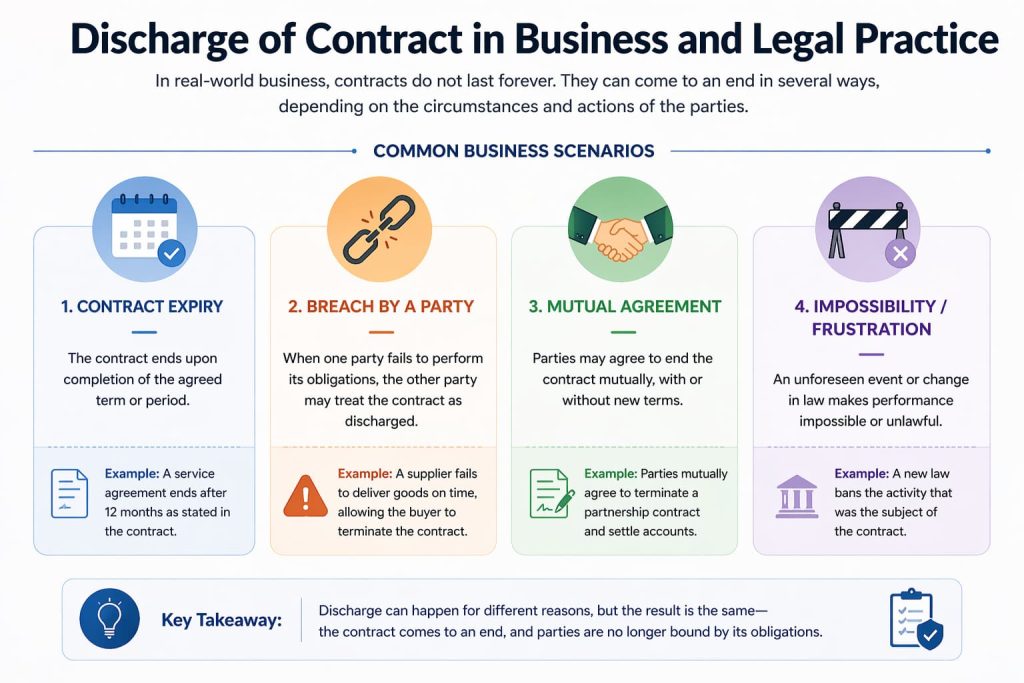
For organisations that manage a significant number of vendor, supplier, client, and employment contracts, understanding when and how discharge occurs has direct operational implications.
Contract Renewal and Expiry
A contract that expires at the end of its term is discharged by performance or by lapse of time. Many organisations lose track of expiry dates, which can lead to contracts auto-renewing on terms that are no longer appropriate, or to service gaps where no valid contract is in place after the original has expired. Tracking discharge dates is as important as tracking execution dates.
Termination Clauses and Breach
Most commercial contracts include a termination for cause clause, which allows a party to end the contract if the other commits a material breach. This contractual right of termination is the mechanism through which discharge by breach is formalised in practice. Legal teams should ensure these clauses are clearly drafted, specifying what constitutes a material breach, what notice is required, and what remedies follow.
Force Majeure and Frustration
The COVID-19 pandemic brought discharge by frustration into sharp focus. Many businesses sought to invoke force majeure clauses or the doctrine of frustration under Section 56 to excuse non-performance. Understanding the distinction between frustration (where the purpose of the contract has been destroyed) and mere difficulty (which does not discharge) is essential for both drafting and advising on contracts.
Novation in Corporate Transactions
Novation frequently arises in mergers, acquisitions, and restructurings. When a company is acquired or a business is transferred, contracts with vendors, clients, and service providers may need to be novated to the acquiring entity. This requires the consent of all parties and needs to be documented formally to ensure the original contracts are properly discharged and the new obligations are clearly established.
Remission and Settlement of Disputes
When parties are in a commercial dispute over payment or performance, remission and accord and satisfaction are practical tools for resolution. A creditor accepting a lower sum in full settlement, or a client accepting alternative performance, can discharge the disputed obligation without litigation. Legal teams frequently facilitate these arrangements as part of commercial dispute resolution.
Platforms like Legistify support in-house legal teams in tracking contract lifecycles — including expiry dates, renewal obligations, performance milestones, and termination notices — helping organisations stay on top of the obligations that determine when and how their contracts are discharged.
Conclusion
Discharge of contract marks the point at which the legal obligations created by a contract come to an end. Whether that happens through the smooth fulfilment of agreed obligations, a mutual decision to walk away, the intervention of law, or the failure of one party to perform, each mode of discharge carries its own legal consequences.
The modes of discharge of contract recognised under Indian law — performance, agreement, impossibility, lapse of time, operation of law, and breach — cover the full range of circumstances in which a contract can end. Knowing which mode applies in a given situation helps parties understand their rights, manage their exposures, and respond appropriately when things do not go as planned.
For legal and procurement teams, this knowledge is not academic. It directly shapes how contracts are drafted, how disputes are handled, and how contractual transitions are managed across the lifecycle of an organisation’s agreements.
Frequently Asked Questions (FAQs)
What is discharge of contract in simple terms?
Discharge of contract means the end of the legal obligations created by a contract. Once a contract is discharged, neither party is required to perform any further obligation under it, and the contract can no longer be enforced. Discharge can happen in several ways, including when both parties perform their obligations, when they mutually agree to cancel or modify the contract, when performance becomes legally impossible, or when one party breaches the agreement.
What are the main modes of discharge of contract under Indian law?
Under the Indian Contract Act, 1872, the main modes of discharge of contract are: discharge by performance (actual or tendered), discharge by agreement (through novation, rescission, alteration, remission, or waiver), discharge by impossibility of performance or frustration under Section 56, discharge by lapse of time under the Limitation Act, 1963, discharge by operation of law (including death, insolvency, and merger), and discharge by breach (actual or anticipatory).
Which sections of the Indian Contract Act, 1872 deal with discharge of contract?
The key discharge of contract sections under the Indian Contract Act, 1872 are Section 37 (duty to perform), Section 38 (tender of performance), Section 39 (anticipatory refusal), Section 56 (impossibility and frustration), Section 62 (novation, rescission, and alteration), and Section 63 (remission and waiver). The Limitation Act, 1963 governs discharge by lapse of time.
What is the difference between discharge by frustration and discharge by breach?
When a contract is discharged by frustration, the performance has become impossible or the purpose of the contract has been destroyed due to circumstances beyond both parties’ control. Neither party is at fault, and neither party owes damages to the other for the non-performance. Discharge by breach, on the other hand, occurs because one party has failed or refused to perform through their own default. The defaulting party is liable to the non-breaching party for damages.
Does commercial difficulty or increased cost discharge a contract?
No. Under Indian law, and generally under contract law principles, a contract is not discharged merely because performance has become more difficult, more expensive, or less commercially viable. The doctrine of frustration applies only where performance has become genuinely impossible or where the fundamental purpose of the contract has been completely destroyed. A change in market conditions, rising costs, or a reduction in profitability does not amount to frustration and does not discharge the contract.