

Consideration in contract law is something of value that each party gives, or promises to give, in exchange for the other party’s promise. This is the legal meaning of consideration: the act, abstinence or promise given at the desire of the promisor, as defined in Section 2(d) of the Indian Contract Act, 1872. Without lawful consideration, an agreement is generally not an enforceable contract.
A promise made without anything in return is generally just a promise. It creates a moral obligation at most, and the law does not usually treat it as a contract.
Consideration is one of the most fundamental concepts in contract law. It is present in every binding commercial agreement, from a simple sale of goods to a complex multi-party service contract. Yet it is also one of the most frequently misunderstood elements, particularly when questions arise about what counts as valid consideration and what does not.
This blog explains consideration in contract law clearly and in full, covering its definition, essential elements, types, real-world examples, governing rules, and the specific circumstances in which valid consideration is not required under Indian law.
What is Consideration in Contract Law?
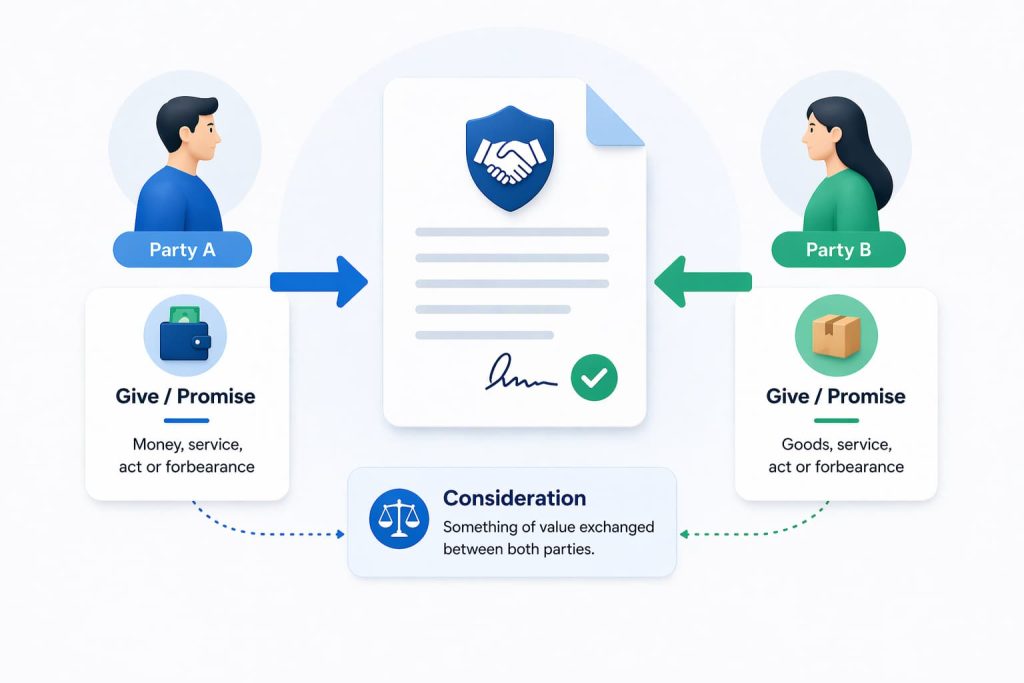
Consideration in contract law refers to something of value that each party to a contract gives, or promises to give, in exchange for the promise or performance of the other party. It is the element that transforms a bare promise into a legally binding obligation.
In simple terms, consideration is the “price” one party pays for the other party’s promise. It does not have to be money. It can be an act, a promise to act, or a promise to refrain from doing something. What matters is that both parties are giving and receiving something of legal value.
Consider a straightforward example. A company agrees to pay a vendor Rs. 5 lakh for software development services. The company’s promise to pay is its consideration. The vendor’s promise to deliver the software is the vendor’s consideration. Both sides are giving something, and both sides are receiving something. This mutual exchange is what makes the agreement a legally enforceable contract.
Without consideration, an agreement is not a contract (see contract vs agreement for the distinction). It is a gratuitous promise, which courts in most jurisdictions, including India, will not enforce.
Consideration Meaning in Law: The Statutory Definition Under Section 2(d)
Under the Indian Contract Act, 1872, consideration is formally defined under Section 2(d):
“When, at the desire of the promisor, the promisee or any other person has done or abstained from doing, or does or abstains from doing, or promises to do or to abstain from doing, something, such act or abstinence or promise is called a consideration for the promise.”
Breaking this definition down:
- Consideration can be an act (doing something), an abstinence (refraining from doing something), or a promise (committing to do or not do something in the future)
- It must be done or given at the desire of the promisor, meaning the promisor must have requested it, directly or impliedly
- It can come from the promisee or any other person. Under Indian law, unlike English law, consideration need not move from the promisee alone, and it is valid when a third party furnishes it
The phrase “quid pro quo” is often used in connection with consideration. It is a Latin term meaning “something for something,” and it captures the essence of what consideration requires: a reciprocal exchange, not a one-sided favour.
Section 10 of the Indian Contract Act reinforces this by providing that an agreement becomes a valid contract only when it is supported by lawful consideration. Section 25 further states that an agreement made without consideration is void, subject to specific exceptions.
Essential Elements of Valid Consideration
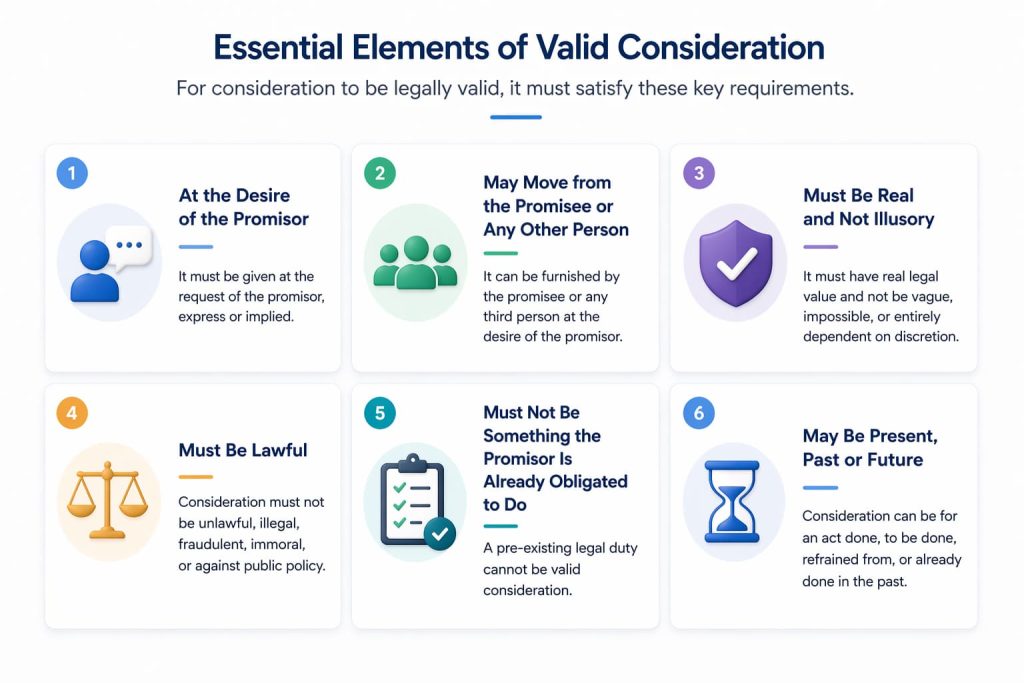
Not every exchange of value qualifies as valid consideration in the eyes of the law. For consideration to be legally sufficient, it must satisfy the following requirements:
1. It Must Move at the Desire of the Promisor
Consideration is only valid if it is given in response to a request, express or implied, from the promisor. An act done voluntarily, without any request from the promisor, does not constitute consideration.
Example: If A saves B’s goods from a fire without being asked, A cannot claim compensation from B on the basis of consideration. B never requested the act, so A’s action does not qualify as consideration for any promise by B.
2. It May Move from the Promisee or Any Other Person
Under the Indian Contract Act, consideration need not come from the promisee alone. It can be furnished by a third party, as long as it is done at the desire of the promisor. This distinguishes Indian contract law from English contract law, where consideration must move from the promisee.
Example: A owes money to B. C, a relative of A, pays B the amount on A’s behalf at A’s request. This constitutes valid consideration, even though it did not come from A (the promisee).
3. It Must Be Real and Not Illusory
Consideration must have real legal value. A promise that is vague, impossible to perform, or entirely dependent on the promisor’s own discretion is considered illusory and does not constitute valid consideration.
Example: “I will pay you if I feel like it” is not valid consideration because the obligation to pay is entirely within the promisor’s control and creates no real commitment.
4. It Must Be Lawful
Under Section 23 of the Indian Contract Act, consideration is unlawful if it:
- Is forbidden by law
- Would, if permitted, defeat the provisions of any law
- Is fraudulent
- Involves injury to any person or property
- Is opposed to public policy
- Is immoral
An agreement supported by unlawful consideration is void.
Example: A promise to pay someone to withhold evidence in a court proceeding is supported by unlawful consideration. The agreement is void and unenforceable.
5. It Must Be Something the Promisor Is Not Already Legally Obligated to Do
A party cannot offer something they are already legally required to do as consideration. Performing an existing legal duty is not consideration because the other party gains no new benefit and the promisor gives up nothing additional.
Example: A police officer cannot claim a reward for arresting a criminal, because making that arrest is already part of their legal duty.
6. Consideration Need Not Be Adequate, But Must Be Sufficient
Indian law does not require consideration to be equal in value to what the other party receives. The law allows parties to make their own bargains. As long as some consideration of legal value exists, its adequacy is generally not for the courts to assess.
However, while adequacy is not required, sufficiency is. The consideration must have some legal value. If it has none, the contract fails.
Example: A agrees to sell a car worth Rs. 10 lakh for Rs. 1 lakh. This is valid as long as A’s consent was freely given. The inadequacy of consideration may be relevant in assessing whether consent was free, but it does not by itself void the agreement.
Types of Consideration in Contract Law
Consideration can be classified based on the timing of its performance relative to the promise it supports.
| Type | When it is given | Position under Indian law |
|---|---|---|
| Past consideration | Before the promise is made | Valid if given at the desire of the promisor (generally not valid under English law) |
| Present (executed) consideration | At the same time as the promise | Valid |
| Future (executory) consideration | A promise to perform later | Valid, and the most common form in commercial contracts |
Past Consideration
Past consideration refers to an act or benefit that was already provided before the promise was made. In other words, the consideration had already been fully performed before the parties entered into the agreement.
Under English contract law, past consideration is generally not valid. However, under Indian contract law, past consideration is recognised as valid, provided it was given at the desire of the promisor.
Example: A renders services to B at B’s request. A month later, B promises to pay A for those services. Under Indian law, this is enforceable. The consideration (A’s services) was past, but it was done at B’s desire, making it valid.
Present Consideration (Executed Consideration)
Present consideration, also called executed consideration, is given simultaneously with the promise. The act constituting consideration and the promise are exchanged at the same time.
Example: A pays Rs. 500 to B at the time B hands over a book. The consideration (payment) and the performance (delivery of the book) happen concurrently.
Future Consideration (Executory Consideration)
Future or executory consideration is a promise to perform an act in the future. Both parties make promises to each other, with performance expected at a later date. Most commercial contracts are built on executory consideration.
Example: A company signs a contract with a vendor on 1 January. The vendor promises to deliver goods on 1 March, and the company promises to pay on delivery. Both promises are future commitments. This is executory consideration, and it is the most common form found in business agreements.
Consideration in Contract: Real-World Examples
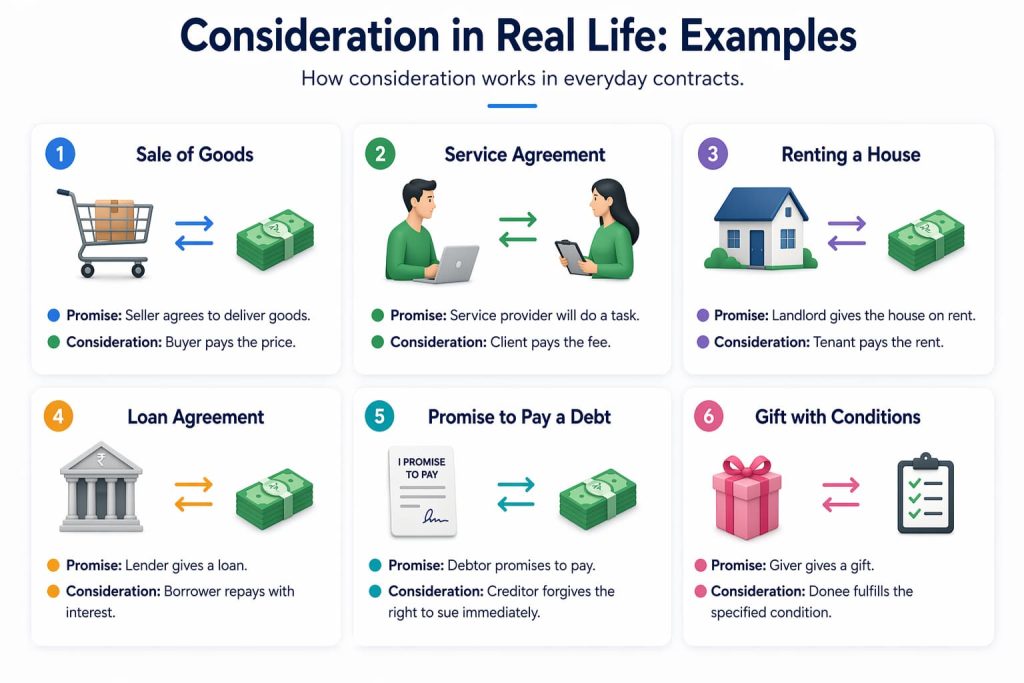
Understanding how consideration operates in practice across different contract types helps clarify when it is present, when it may be questioned, and what constitutes a valid exchange.
1. Sale and Purchase Agreement
A buyer agrees to pay Rs. 2 crore to purchase a commercial property from a seller. The seller’s consideration is the transfer of the property. The buyer’s consideration is the payment of Rs. 2 crore. Both sides exchange something of value. The agreement is supported by valid consideration.
2. Employment Contract
An employee agrees to provide their skills and time in exchange for a monthly salary and other benefits. The employee’s consideration is their service. The employer’s consideration is the salary and benefits. The contract is valid.
3. Non-Disclosure Agreement (NDA)
Company A shares confidential information with Company B. In exchange, Company B promises not to disclose that information to third parties. Company A’s consideration is the disclosure of valuable confidential information. Company B’s consideration is the promise of confidentiality, which constitutes a forbearance, meaning an agreement to refrain from doing something.
This is a common example of consideration taking the form of abstinence rather than a payment or act.
4. Legal Retainer Agreement
A company retains a law firm to handle its commercial disputes. The company agrees to pay a monthly retainer fee. The law firm agrees to provide legal services on demand during the retainer period. Both parties exchange value: money on one side and professional services on the other. This is valid consideration.
5. Settlement Agreement
A vendor and a client are in a payment dispute. The client agrees to pay Rs. 8 lakh (less than the Rs. 10 lakh claimed) in full and final settlement. The vendor agrees to accept this reduced amount and release all claims. The vendor’s consideration is the release of the remaining claim. The client’s consideration is the Rs. 8 lakh payment. This is a valid compromise agreement supported by mutual consideration.
6. Loan Agreement
A bank agrees to lend Rs. 50 lakh to a borrower at an agreed interest rate. The bank’s consideration is the disbursement of the loan amount. The borrower’s consideration is the promise to repay the principal with interest over the agreed term. Both sides provide consideration, making the agreement enforceable.
7. Contractor Agreement
A property developer contracts a construction company to build a residential complex. The developer promises to pay a fixed sum in instalments tied to project milestones. The contractor promises to complete the construction according to approved drawings and specifications. This is executory consideration on both sides, with performance obligations extending into the future.
Rules Governing Consideration in Contract Law
Several established legal rules govern what qualifies as valid consideration under Indian and general contract law principles. These rules help courts assess whether consideration in a given contract is legally sufficient.
Rule 1: Consideration must move at the desire of the promisor Voluntary acts performed without any request from the promisor do not constitute consideration. The act must be done in response to the promisor’s request, whether stated explicitly or reasonably implied.
Rule 2: Past consideration is valid under Indian law (with conditions) Unlike English law, Indian contract law recognises past consideration, provided the act was performed at the promisor’s desire. A promise made after the act has been completed can still be enforceable if the original act was done at the promisor’s request.
Rule 3: Consideration need not be adequate The law does not require the two sides of an exchange to be equal in monetary value. A party that makes a poor bargain is still bound by it, as long as their consent was freely given. Inadequacy of consideration may, however, be considered by courts when assessing whether consent was truly free.
Rule 4: Consideration must be real and possible Illusory promises, vague commitments, and promises to perform acts that are physically or legally impossible do not constitute valid consideration.
Rule 5: Consideration must not be for something the promisor is already legally obligated to do An existing legal duty cannot form the basis of new consideration. However, doing something beyond what the existing duty requires can constitute fresh consideration.
Rule 6: Consideration must be lawful Consideration that involves an illegal act, fraud, injury to another, or anything contrary to public policy renders the entire contract void.
Rule 7: Consideration may move from any person (unique to Indian law) In India, it is not necessary for consideration to come from the promisee. A third party may provide the consideration, and the contract will still be valid.
What Does Not Constitute Valid Consideration?
This is a question that frequently arises in contract disputes. The following are common situations where something offered as consideration will not be treated as legally valid:
1. A Promise to Give a Gift
A pure gift is not a contract. If A promises to give B Rs. 50,000 as a gift without receiving anything in return, there is no consideration and no contract. B cannot enforce this promise in court.
This principle holds unless the gift falls within the exceptions under Section 25 of the Indian Contract Act, such as a gift made in writing and registered between close relatives out of natural love and affection.
2. Performance of an Existing Legal Duty
A person who is already legally obligated to perform a certain act cannot use that performance as consideration for a new promise. The other party gains no benefit from what was already required.
Example: A government officer promises to complete a task that is already their legal obligation in exchange for a payment. The payment cannot be enforced as a contract because the officer provided no fresh consideration.
3. Past Consideration Under English Law (Note for Cross-Border Contracts)
While Indian law accepts past consideration in certain circumstances, English law and many other common law systems do not. In contracts governed by English law or the laws of jurisdictions that follow English common law principles, a benefit that had already been conferred before the promise was made will not support an enforceable agreement.
This distinction is important for organisations entering into cross-border contracts or agreements governed by foreign law.
4. An Illusory Promise
A promise that appears to commit to something but gives the promisor the unilateral right to decide whether or not to perform is illusory and does not constitute consideration. Courts will not enforce agreements where one party’s commitment is entirely discretionary.
Example: “I will buy your goods if I choose to” is not valid consideration because the buyer retains full discretion over whether to buy. No real commitment has been made.
5. A Promise to Do Something That Is Impossible
A promise to do something that is physically or legally impossible cannot constitute consideration. There is nothing real being exchanged.
6. A Moral Obligation Alone
A promise based purely on moral obligation, without any legal duty or mutual exchange, generally does not constitute valid consideration. Good intentions do not create enforceable contracts.
Example: A promises to pay B for saving A’s life in an emergency, out of gratitude. Under general contract law principles, this moral obligation alone is not valid consideration. However, under Section 25(2) of the Indian Contract Act, a promise to compensate someone who has voluntarily done something for the promisor may be enforceable under a specific exception.
Exceptions: When a Contract Is Valid Without Consideration
Section 25 of the Indian Contract Act, 1872 begins with the clear statement that an agreement without consideration is void. However, the same section then identifies specific situations where an agreement remains valid and enforceable even without consideration.
Exception 1: Natural Love and Affection (Section 25(1))
An agreement made between parties in a close personal relationship, such as family members, is enforceable without consideration, provided the agreement is:
- In writing
- Registered under the applicable law for registration of documents
- Made out of natural love and affection
Example: A father, out of love for his daughter, promises in a written and registered document to give her a fixed sum of money. Even though the daughter provides no consideration, the agreement is valid and enforceable under Section 25(1).
Courts have interpreted this exception narrowly. In Rajlukhy Dabee v. Bhootnath Mookerjee (1900), the court held that a husband’s promise to pay his wife maintenance was not enforceable under this exception because there was no genuine love and affection between the parties given the disputes that existed between them.
Exception 2: Compensation for Past Voluntary Services (Section 25(2))
A promise to compensate someone who has already voluntarily done something for the promisor is enforceable even without fresh consideration, provided the act was done voluntarily and for the promisor.
Example: B voluntarily supports A’s elderly parent during a period of illness. Later, A promises to pay B Rs. 20,000 for the care provided. This promise is enforceable under Section 25(2), even though B’s act was done before any promise was made.
Exception 3: Promise to Pay a Time-Barred Debt (Section 25(3))
A written promise, signed by the debtor or their authorised agent, to pay a debt that has become unenforceable due to the expiry of the limitation period is valid even without fresh consideration.
Example: A owes B Rs. 1 lakh under a loan that has become time-barred under the Limitation Act, 1963. A makes a fresh written promise to pay the amount. This promise is enforceable under Section 25(3).
Other Situations Where Consideration Is Not Required
- Contract of Agency (Section 185): An agency relationship can be created without consideration. A principal can appoint an agent to act on their behalf without any payment or promise of payment.
- Completed Gifts (Explanation 1 to Section 25): The “no consideration, no contract” rule does not apply to gifts that have already been made and accepted. Once a gift is complete, it cannot be revoked on the ground that there was no consideration.
- Remission of Performance (Section 63): A promisee may dispense with or remit the performance of a promise, or accept a lesser sum in satisfaction, without fresh consideration.
- Gratuitous Bailment: A bailment made without payment, such as a gratuitous loan of goods, is recognised under the Act (see Sections 159 and 162).
Consideration vs. Condition: Understanding the Difference
A common source of confusion in contract law is the distinction between consideration and a condition attached to a gift or promise.
Consideration involves a mutual exchange where one party’s promise is given in return for something from the other party. Both sides are providing and receiving value.
A condition is a requirement attached to a gift or gratuitous promise that must be satisfied before the gift or promise becomes operative. The person satisfying the condition is not providing value to the other party. They are simply meeting a prerequisite.
Example: If A says to B, “I will give you Rs. 1 lakh if you travel to Mumbai,” this depends on the context. If A wants B in Mumbai for A’s own purposes (such as to meet a client on A’s behalf), then B’s travel may constitute consideration. But if A simply attaches travel to Mumbai as a condition of a gift, with no benefit to A from B being there, then B’s travel is a condition, not consideration. The promise remains gratuitous.
This distinction matters because it determines whether the agreement is an enforceable contract or an unenforceable gratuitous promise.
Why Consideration Matters in Business and Legal Practice
For legal teams, procurement professionals, and business leaders, the concept of consideration in contract has direct practical relevance.
Drafting Enforceable Agreements Every commercial agreement must be supported by valid consideration on both sides. When contracts are drafted without clearly identifying what each party is giving and receiving, they risk being challenged as lacking consideration. Legal teams should ensure that the consideration is clearly stated in the agreement, particularly in settlement agreements, modifications to existing contracts, and one-sided commitments.
Contract Modifications and Variations When parties agree to modify an existing contract, for example by changing the price, timeline, or scope of work, the change should be documented as a written amendment signed by both parties. Under Section 62 of the Indian Contract Act, parties to a contract may substitute a new contract for it or rescind or alter it, and the original contract then need not be performed. Under Section 63, a promisee may also remit performance or accept a lesser sum without fresh consideration. See contract novation and discharge of contract for how these provisions work.
Example: If a vendor agrees to accept a lower price mid-contract, Section 63 allows the vendor to remit part of the performance without fresh consideration. A written amendment signed by both parties still avoids a later dispute about what was agreed.
Settlement of Disputes Consideration is central to settlement agreements. When a party agrees to accept a lesser amount in settlement of a larger claim, the release of the remaining claim constitutes the consideration from the creditor’s side. Without this, the settlement may not be enforceable.
Non-Disclosure and Restrictive Agreements NDAs, non-compete agreements, and exclusivity agreements must all be supported by consideration. In employment contexts, where a non-compete is introduced after employment has already begun, care should be taken to ensure that fresh consideration, such as a bonus, a promotion, or access to confidential information, is provided at the time the new obligation is introduced. In India, post-employment non-compete clauses are generally void under Section 27 of the Act, so fresh consideration matters mainly for confidentiality obligations and for restrictions that apply during employment.
Identifying Invalid Agreements When a dispute arises over an agreement, one of the first questions a legal team will assess is whether valid consideration existed. If an agreement was reached based on a pre-existing obligation, an illusory promise, or past consideration in a jurisdiction that does not recognise it, the agreement may be unenforceable. Early identification of these issues can prevent costly litigation.
How Legistify Helps Legal Teams Document Consideration and Manage Contract Changes
Legistify is an AI-native legal operations platform for enterprises, and its contract lifecycle management tools help in-house legal teams put the principles in this guide into practice. Consideration problems usually come from agreements that are drafted loosely, changed informally, or hard to find when a dispute arises. Legistify supports each stage of that process.
- Clear drafting and review: Legistify AI CLM works as a Microsoft Word add-in with a clause library and playbooks. A legal team sets playbook rules, for example that every agreement states what each party gives and receives, and the add-in reviews a contract against those rules and suggests redlines.
- Controlled negotiation and amendments: Track changes and version control make it easy to compare versions, so every amendment, such as a revised price or scope, is recorded before both parties sign it.
- Approval workflows: Contracts are routed to the right approver and their progress is tracked, so payment terms and other commercial terms are reviewed before signing.
- E-signing with an audit trail: The e-signature module supports Aadhaar integration and keeps a secure audit trail of signature activity for each executed agreement.
- Central repository and search: Executed agreements are stored in one repository with AI-powered search, so the signed terms are quick to find when a question of enforceability arises.
Explore Legistify’s contract workflow, collaboration and negotiation, and e-signature features to see how they fit your team’s contracts.
Conclusion
Consideration in contract law is the element that gives a promise its legal force. It is the exchange at the heart of every enforceable agreement, the “something for something” that distinguishes a binding contract from a bare promise.
Whether consideration takes the form of a payment, a service, a promise to act, or a promise to refrain, it must be real, lawful, and given at the desire of the promisor. An agreement lacking valid consideration is, in most cases, void and unenforceable.
Understanding what does and does not constitute valid consideration is essential for anyone involved in drafting, reviewing, or advising on contracts. It determines whether an agreement will hold up when tested, and it shapes how contract modifications, settlements, and new obligations should be structured to remain enforceable.
For legal teams and business professionals, getting consideration right is not a formality. It is the foundation on which contractual relationships rest.
Frequently Asked Questions (FAQs)
What is consideration in contract law in simple terms?
Consideration in contract law is the value that each party gives to the other as part of an agreement. It is the “something in return” that makes a promise legally binding. It can be money, a service, a promise to act, or a promise to refrain from doing something. Without consideration, an agreement is generally not enforceable as a contract.
How do you define consideration in law under the Indian Contract Act?
Section 2(d) of the Indian Contract Act, 1872 defines consideration as: when, at the desire of the promisor, the promisee or any other person has done or abstained from doing, or does or abstains from doing, or promises to do or abstain from doing something, such act or abstinence or promise is called consideration for the promise. In short, it is any act, abstinence, or promise given at the promisor’s request in exchange for the promisor’s promise.
What does sale consideration or consideration amount mean?
In a sale deed or an agreement of sale, the consideration amount, also called sale consideration, is the price the buyer pays for the property or goods. It is the buyer’s consideration in the contract of sale, and the seller’s consideration is the transfer of the property or goods.
What does not constitute valid consideration?
The following do not constitute valid consideration: a promise to give a pure gift without receiving anything in return, performance of an act the promisor is already legally obligated to do, an illusory promise where the promisor retains full discretion over whether to perform, a promise based on moral obligation alone (with no legal duty or exchange), and a promise to do something that is physically or legally impossible. Under English law, past consideration also does not qualify, though Indian law takes a different position under certain conditions.
Does consideration have to be adequate to be valid?
No. Indian contract law does not require consideration to be adequate or equal in value to what the other party receives. Parties are free to make their own bargains, even if the exchange appears commercially unequal. However, consideration must be sufficient, meaning it must have some legal value. A grossly inadequate consideration may be considered by courts when assessing whether consent was freely given, but it does not by itself void the agreement.
Can a contract be valid without consideration in India?
Yes, in specific situations. Section 25 of the Indian Contract Act, 1872 provides exceptions where an agreement is enforceable even without consideration. These include: agreements made in writing and registered between close relatives out of natural love and affection, promises to compensate someone for a past voluntary service done for the promisor, and written promises to repay a debt that has become time-barred under the Limitation Act, 1963. Additionally, contracts of agency under Section 185 and completed gifts are valid without consideration.


Pingback: Contract vs Agreement: Key Differences With Examples (2026)
Pingback: What Is a Contingent Contract? Meaning, Types and Examples
Pingback: Contract Novation: Meaning, Process and Examples (2026)
Pingback: What Is a Contract? Meaning, Elements and Types in India