

Contracts are at the center of almost all business and personal transactions. Whether it is an employment contract, a vendor agreement, an online purchase, or a lease, contracts establish the rights and remedies of the parties involved.
Contract law regulates the formation, interpretation, enforcement, and termination of contracts. It provides that promises made within a legally recognised framework are binding and that remedies are available for breach of those promises. These foundations form the contract law basics that every business and individual should understand.
In India, the Indian Contract Act, 1872, is the main legislation that regulates contract law. The knowledge of its principles can help businesses minimise risks and avoid costly disputes.
What is Contract Law?

Contract law refers to the law that governs the binding agreement of two or more parties. A contract is formed when an agreement becomes legally binding.
Not all agreements are contracts. For an agreement to be legally binding, it must contain the following essential elements:
- Offer
- Acceptance
- Consideration
- Intention to create legal relations
- Capacity to contract
- Free consent
- Lawful object
If any of the above elements are absent, the agreement can be void, voidable, or unenforceable. These elements reflect the general principle of law of contract recognised across legal systems.
Agreement vs Contract: What is the Difference?
The terms agreement and contract are often used interchangeably, but under Indian law they are not the same thing.
An agreement is simply a promise or a set of promises exchanged between two or more parties. It can be as informal as agreeing to meet a friend for dinner. An agreement does not, on its own, carry any legal obligation.
A contract is an agreement that is enforceable by law. Under Section 2(h) of the Indian Contract Act, 1872, an agreement becomes a contract only when it satisfies the essential elements listed above, offer, acceptance, consideration, capacity, free consent, and lawful object.
In short, every contract is an agreement, but not every agreement is a contract. The distinction matters because only a contract can be enforced in a court of law. An agreement that does not meet these requirements, such as a casual social arrangement, creates no legal obligation and offers no legal remedy if it is not honoured.
Scope of the Law of Contract
The law of contract does not just define what a contract is — it governs the entire lifecycle of a contractual relationship. The scope of contract law covers five broad areas:
Formation of contracts
Contract law sets out the rules for how a valid contract comes into existence — what constitutes a valid offer, how acceptance must be communicated, what counts as consideration, and what conditions must be met for an agreement to be legally binding.
Performance of contracts
Once a contract is formed, contract law governs how it must be performed. This includes the standard of performance expected, the time and manner of performance, and what happens when performance is partial or delayed.
Breach of contracts
Contract law defines what constitutes a breach — whether it is a minor breach, a material breach, or an anticipatory breach — and determines what rights arise for the non-breaching party.
Remedies for breach
When a contract is breached, contract law provides the remedies available to the affected party. These include damages, specific performance, rescission, and injunctions, depending on the nature and extent of the breach.
Discharge of contracts
Contract law also governs how contracts come to an end. A contract may be discharged by performance, by agreement, by frustration, by breach, or by operation of law.
Objectives of Contract Law
Contract law exists for a specific set of purposes that benefit both individual parties and the broader commercial ecosystem:
Enforcing promises
The primary objective of contract law is to ensure that legally made promises are kept. When a party fails to honour a contractual commitment, the law provides mechanisms to compel performance or compensate the affected party.
Protecting legal rights
Contract law protects the rights of each party by defining their obligations clearly and providing recourse when those obligations are not met. It ensures that neither party can unilaterally change or escape their commitments without legal consequence.
Facilitating commercial transactions
Commerce depends on the ability to make reliable, enforceable commitments. Contract law creates the framework within which businesses can transact with confidence — knowing that agreements will be honoured or that legal remedies exist if they are not.
Reducing disputes
By establishing clear rules for what constitutes a valid contract, how it must be performed, and what happens when it is breached, contract law reduces the likelihood of disputes and provides a structured process for resolving them when they do arise.
Creating certainty in business relationships
Contract law gives parties certainty about their rights and obligations. This certainty is particularly important in long-term commercial relationships, where both parties need to plan and invest based on commitments made at the outset.
Fundamental Principles of Contract Law
Several core principles underpin the law of contract across legal systems, including under the Indian Contract Act, 1872:
Freedom of contract
Parties are generally free to agree on whatever terms they choose, provided those terms are lawful. The law does not dictate the content of a contract — it only sets the boundaries within which parties can operate. This principle respects the autonomy of contracting parties.
Consensus ad idem (meeting of minds)
For a valid contract to exist, both parties must have the same understanding of what they are agreeing to. If the parties are operating under fundamentally different assumptions about the subject matter, there is no true agreement and no enforceable contract.
Intention to create legal relations
Not every agreement is a contract. The parties must intend for their agreement to create legal obligations. Business and commercial agreements are presumed to carry this intention. Social and domestic arrangements are generally presumed not to.
Privity of contract
Only the parties to a contract can enforce it or be bound by it. A third party who is not a party to the contract generally has no rights under it, even if the contract was made for their benefit.
Legal enforceability
A contract is only as valuable as the legal system’s willingness to enforce it. Contract law ensures that agreements meeting all legal requirements are enforceable in court — giving parties confidence that their contractual rights will be protected.
The Indian Contract Act, 1872
In India, contract law is primarily governed by the Indian Contract Act, 1872. This legislation remains the foundation of commercial and personal contracting in India and has been in operation for over 150 years.
Purpose of the Act
The Indian Contract Act was enacted to codify the law relating to contracts in India. Before its enactment, contract disputes were governed by personal law and judicial precedent, which led to inconsistency. The Act brought uniformity and clarity to contractual obligations across India.
Applicability
The Act applies to all contracts entered into within India, regardless of the parties’ nationality or the nature of the transaction. It governs commercial agreements, employment contracts, vendor agreements, financial arrangements, and any other contract formed under Indian law.
Key provisions
The Act defines what constitutes a valid contract (Section 10), sets out the essential elements of a contract, governs offer and acceptance, consideration, free consent, capacity, and lawful object. It also addresses void agreements, contingent contracts, performance and discharge, breach, and remedies.
Why it remains the foundation
Despite significant changes in the commercial landscape — including digital contracting, international trade, and complex financial instruments — the Indian Contract Act, 1872 continues to provide the legal backbone for all contractual relationships in India. Courts consistently apply its principles when resolving contract disputes, making it essential knowledge for any business or legal professional operating in India.
Essential Principles of Contract Law
The principles of contract law ensure that agreements are fair, voluntary, and legally enforceable.
1. Offer and Acceptance
A contract is formed after an offer is made by one party (offeror) and accepted by another party (offeree).
What is an Offer?
An offer is a definite proposal to do or refrain from doing something, made with the intention of being accepted.
What is Acceptance?
Acceptance must:
- Be unconditional
- Match the offer exactly
- Be properly communicated
If acceptance alters the original offer, it becomes a counter-offer and not acceptance.
Example:
If a seller makes an offer to sell an article for ₹10,000 and the buyer accepts the offer to buy the article at that price, an agreement is formed.
2. Consideration
Consideration is the value given in return for something. It can be:
- Money
- Goods
- Services
- A promise to act or refrain from acting
Consideration is also referred to as the “price” of a promise. An agreement without consideration is not enforceable (except in statutory exceptions).
Example:
A agrees to paint B’s house for ₹20,000. The money is consideration for the service.
3. Intention to Create Legal Relations
The parties must intend that the agreement be legally binding.
- A business agreement usually implies legal intention.
- A social or domestic arrangement does not.
This prevents courts from enforcing a casual promise made without legal seriousness.
4. Capacity to Contract
To be able to enter into a valid contract, one must:
- Be of legal age (usually 18 years or above in India)
- Be of sound mind
- Not be disqualified by law
Contracts entered into by minors are void under Indian law. Contracts entered into by persons of unsound mind are not enforceable.
5. Free Consent
Consent must be given voluntarily. A contract is valid only if the consent is free from the following:
- Coercion
- Undue influence
- Fraud
- Misrepresentation
- Mistake
Issues such as mistakes in contract law can affect the validity of agreements. If the consent is given improperly, the contract may become voidable at the option of the affected party.
Example:
If a party is compelled to sign a contract under threat, the contract is not based on free consent.
6. Legality of Object
The object of the contract must be legal and not opposed to public policy.
An agreement that is based on illegal activity, fraud, or immoral purpose is void from the outset.
Example:
A contract for smuggling goods is void and unenforceable.
Types of Contracts
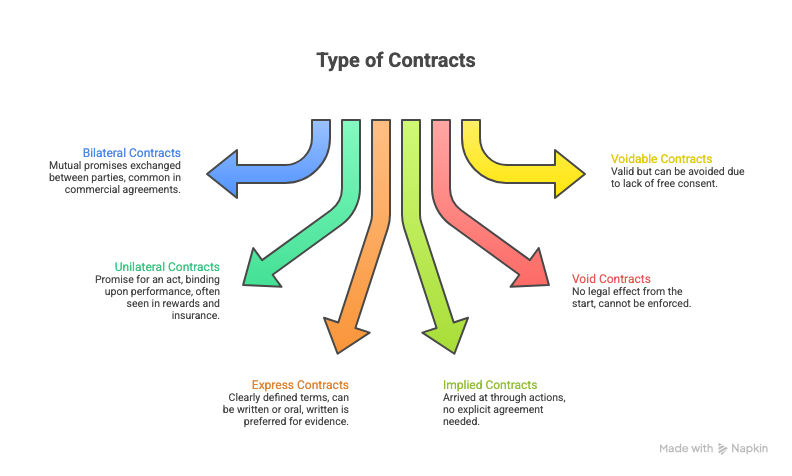
Contracts can be categorised according to formation, performance, and enforceability. These classifications explain the various types of contract law recognised in practice.
1. Bilateral Contracts
In bilateral contracts, mutual promises are given by both parties.
Example:
A sales contract in which:
- Seller agrees to deliver the goods
- Buyer agrees to pay the agreed price
This type of contract is the most common form of commercial contracts.
2. Unilateral Contracts
In a unilateral contract, a party makes a promise in return for the act of another party.
The contract is binding only when the act is performed.
Example:
Offering a reward of ₹5,000 for finding a lost pet. The promise will be binding only when the pet is found.
Insurance contracts are often cited as examples of unilateral contracts.
3. Express Contracts
In an express contract, the terms are clearly defined.
They can be:
- Written (employment contracts, lease agreements)
- Oral (service contracts)
Written contracts are always better as they offer concrete evidence of the terms of the contract.
4. Implied Contracts
An implied contract is arrived at through the actions of the parties.
Even if nothing has been said or written, the actions of the parties reveal the understanding.
Example:
Placing an order for food at a restaurant is an implied contract to pay for the food.
5. Void and Voidable Contracts
Void Contracts
A void contract has no legal effect from the start. It cannot be enforced by either party.
Example:
An agreement with an illegal object.
Voidable Contracts
A voidable contract is valid but can be avoided by one party because of the absence of free consent.
Example:
A contract signed due to misrepresentation.
Many important contract law cases have clarified the distinction between void and voidable agreements.
Breach of Contract and Legal Remedies
A breach of contract occurs when a party refuses to fulfill their obligations as agreed in the contract.
Remedies available to the affected party include:
1. Damages
Compensation for the losses incurred as a result of the breach of contract. Courts award damages in contract law to restore the injured party to the position they would have been in had the contract been performed.
2. Specific Performance
An order from the court requiring the party that breached the contract to perform their obligations under the contract. This remedy is often used in property transactions.
3. Injunction
An order from the court requiring a party to refrain from performing a particular act that constitutes a breach of contract.
Importance of Contract Law in Business
A good grasp of contract law is not just useful for lawyers — it is essential for anyone involved in running or managing a business. Here is how contract law applies across key business functions:
Employment contracts
Every employment relationship is governed by a contract. Contract law determines what terms are enforceable, how disputes about salary, notice periods, or non-compete clauses are resolved, and what remedies are available when an employer or employee breaches their obligations.
Service agreements
Businesses that engage service providers — from IT vendors to marketing agencies — rely on service agreements to define scope, timelines, payment terms, and liability. Contract law ensures these agreements are enforceable and provides remedies when a service provider fails to deliver.
Vendor contracts
Procurement teams negotiate vendor contracts covering price, delivery, quality standards, and termination rights. Understanding contract law helps procurement and legal teams identify risk, negotiate protective clauses, and enforce agreements when vendors do not perform.
Commercial transactions
From sale of goods to distribution agreements, commercial transactions depend on contracts. Contract law governs the passage of risk, implied warranties, remedies for defective goods, and the rights of buyers and sellers when transactions go wrong.
Business partnerships
Partnership agreements, joint venture contracts, and shareholder agreements are all governed by contract law. Disputes about profit sharing, decision-making authority, exit rights, and confidentiality are resolved through the principles of contract law.
In the current digital and business age, contracts range from cloud-based SaaS agreements to cross-border transactions. A working knowledge of contract law helps businesses draft better contracts, avoid costly disputes, and protect their interests at every stage of a commercial relationship.
Conclusion
Contract law is the legal system that converts an agreement into an enforceable contract. This is achieved by ensuring that the necessary elements of an agreement — offer, acceptance, consideration, capacity, free consent, and lawful intent — are present. Understanding the scope, objectives, and principles of contract law, along with the provisions of the Indian Contract Act, 1872, helps businesses and individuals make better decisions, draft stronger contracts, and resolve disputes efficiently. Platforms like Legistify help enterprises put these principles into practice by automating contract creation, tracking obligations, and maintaining a compliant contract repository.
FAQs
What are the principles of contract law?
The core principles of contract law are offer and acceptance, consideration, intention to create legal relations, capacity to contract, free consent, and legality of object. Together, these principles ensure that contracts are entered into voluntarily, for a lawful purpose, by parties who are legally capable of contracting — and that the resulting obligations are enforceable by law.
What is contract law and its types?
Contract law is the body of law that governs the formation, performance, enforcement, and termination of legally binding agreements. Contracts are classified by formation (bilateral or unilateral), by expression (express or implied), and by enforceability (void or voidable). In India, contract law is primarily governed by the Indian Contract Act, 1872.
What happens if a contract is breached?
When a contract is breached, the non-breaching party has several legal remedies available. Damages are the most common remedy — the court awards financial compensation to restore the injured party to the position they would have been in had the contract been performed. Other remedies include specific performance, where the court orders the breaching party to fulfil their contractual obligations, and injunctions, which prevent a party from taking an action that would constitute a breach.
Are oral contracts legally valid?
Yes. Oral contracts are legally valid in India provided they satisfy all the essential elements of a valid contract — offer, acceptance, consideration, free consent, capacity, and a lawful object. However, oral contracts are significantly harder to enforce in the event of a dispute, as proving what was agreed can be difficult without written evidence. Written contracts are always recommended for commercial and high-value transactions.
What is the difference between an agreement and a contract?
An agreement is simply a promise or set of promises exchanged between parties, with no legal obligation attached. A contract is an agreement that meets the essential requirements under Section 2(h) of the Indian Contract Act, 1872, offer, acceptance, consideration, capacity, free consent, and lawful object, and is therefore enforceable by law. Every contract is an agreement, but not every agreement is a contract.