Contracts are the backbone of every business relationship, whether it is a vendor contract, a sales contract, an employment contract, or an NDA. However, the way many organisations review contracts has not evolved in decades. This raises an important question for many businesses: what is contract analysis, and how should it evolve in the modern era?
Manual contract review is:
- Time-consuming
- Resource-intensive
- Susceptible to human error
- Difficult to scale
Legal teams in many organisations spend countless hours reviewing similar clauses, comparing versions, checking compliance, and flagging risks as part of routine contract analysis. As contract volumes grow, the review process slows down, leading to slower deal closures and greater operational risk.
This is where AI contract analysis is changing the process significantly.
What Is AI Contract Analysis?
AI contract analysis is the application of artificial intelligence technology, such as Natural Language Processing (NLP) and machine learning, to automatically analyse, interpret, and extract key information from contracts. In simple terms, it uses AI to modernise traditional review processes.
Rather than reading through each clause manually, AI technology can:
- Analyse and categorise clauses
- Extract key information (renewal terms, payment terms, liability limits)
- Highlight potentially problematic or non-standard language
- Create summaries
- Offer structured insights into large contract portfolios
In short:
AI takes complex legal contracts and converts them into searchable, structured, and actionable data.
It is worth noting the difference between a contract repository and AI contract analysis. A contract repository is simply a storage system for contracts. An AI contract analysis system interprets and analyses those contracts using advanced software capabilities.
How AI Contract Analysis Works (Step-by-Step)
1. Document Ingestion
Contracts are uploaded into the system, whether they are Word documents, PDFs, or scanned copies. Optical Character Recognition (OCR) converts scanned copies into text.
2. Clause & Data Extraction
The AI uses NLP to pick out the following from contracts:
- Termination clauses
- Indemnity clauses
- Confidentiality clauses
- Payment obligations
- Renewal dates
- Governing law
- Limitation of liability
The system organises this data automatically, often following a predefined contract analysis template for structured classification.
3. Risk & Deviation Detection
AI technology matches contract language against playbooks or templates. If a contract contains language that is not approved, the deviation is flagged.
For instance:
- Unlimited liability rather than limited liability
- Auto-renewal clauses without termination rights
- Lack of data protection clauses
4. Insights & Reporting
Finally, the data becomes available through dashboards, summaries, and risk scores inside a centralised contract analysis tool. This lets teams quickly:
- Search contracts
- View obligations
- View upcoming renewals
- View trends for vendors or customers
What previously required hours of manual effort can now be done in minutes.
Key Features of AI Contract Analysis Software
The following are the main characteristics of most AI contract analysis software:
Automated Clause Identification
Automatically identifies and groups clauses across thousands of contracts.
Risk Scoring & Compliance Checks
Highlights risky clauses and checks compliance against company policies or regulations.
AI-Powered Summaries
Creates a summary of important contract obligations and risks.
Version Comparison & Redlining
Highlights differences between contract versions instantly.
Obligation Tracking
Pulls deliverables, deadlines, and milestones to help avoid missed obligations.
Searchable Contract Repository
Enables searching contracts using keywords or natural language search.
Conversational AI Search
Some advanced software lets users ask questions such as:
“Show me all contracts with unlimited liability.”
Benefits of AI Contract Analysis
Faster Contract Reviews
AI analysis cuts review time considerably. What took hours now takes minutes, shortening deal cycles.
Improved Accuracy & Consistency
AI does not suffer from fatigue and reviews every contract with the same level of scrutiny.
Proactive Risk Identification
AI identifies contracts with high-risk clauses before they are executed, reducing legal risk.
Better Business Insights
By analysing contracts in a structured format, businesses can see:
- Revenue risk
- Vendor risk
- Contract renewal cycles
- Performance requirements
Contracts become a source of business intelligence, not just legal documents.
Reduced Legal Costs
Automation reduces the need for manual contract review, freeing lawyers to focus on higher-level strategy.
Faster Deal Closures
Shorter contract review cycles translate into faster sales cycles and revenue growth.
Use Cases Across Departments
AI contract analysis is no longer limited to legal teams.
Legal Teams
- Accelerate review processes
- Ensure policy compliance
- Reduce contract backlogs
Sales Teams
- Speed up negotiations
- Get quicker approvals
- Identify bottlenecks
Procurement
- Assess vendor risk
- Monitor obligations
- Ensure pricing compliance
Finance
- Track revenue commitments
- Analyse payment terms
- Forecast contract value
HR
- Review employment contracts
- Ensure policy alignment
- Monitor non-compete and confidentiality terms
AI gives organisations cross-functional visibility into contractual risk and opportunity.
AI Contract Analysis vs Manual Review
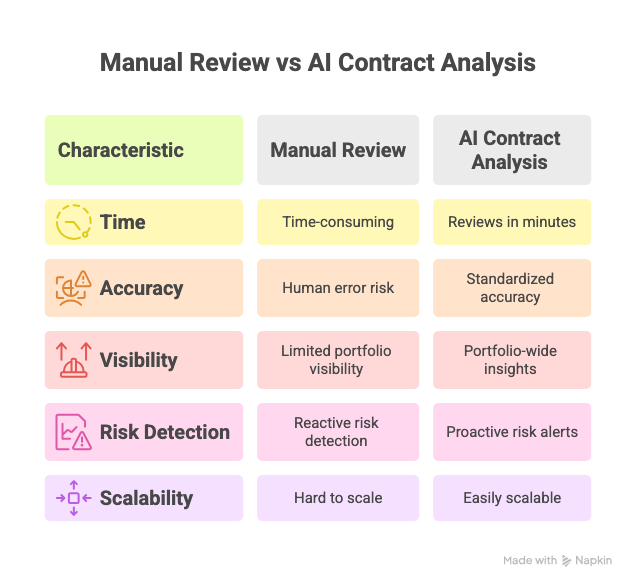
| Manual Review | AI Contract Analysis |
| Time-consuming | Reviews in minutes |
| Human error risk | Standardised accuracy |
| Limited portfolio visibility | Portfolio-wide insights |
| Reactive risk detection | Proactive risk alerts |
| Hard to scale | Easily scalable |
The difference becomes especially clear when dealing with high contract volumes or enterprise-scale operations.
Common Challenges & Limitations
AI contract analysis has real capability, but it is not perfect.
AI Cannot Replace Legal Judgment
AI is a helper, not a substitute for lawyers. Complex legal judgment is still best left to human expertise.
Requires Training & Configuration
These systems need to be trained with contract data and playbooks.
Data Quality Matters
Inconsistent contract formatting can affect accuracy.
Implementation Costs
There may be costs associated with implementation.
The best approach is a hybrid one, combining AI efficiency with human oversight.
How to Choose the Right AI Contract Analysis Software
When assessing solutions, consider the following:
- Accuracy of clause identification
- Customisable playbooks
- Integration with CRM or CLM systems
- Data security standards
- Scalability to meet increasing contract volumes
- User-friendly dashboards
Selecting the right platform provides long-term value, rather than short-term automation.
The Future of AI in Contract Analysis
AI in the legal tech industry is developing quickly.
Some of the new use cases emerging include:
- Generative AI for automated drafting
- Predictive risk modelling
- Intelligent negotiation suggestions
- Real-time compliance monitoring
- Cross-contract trend analytics
As AI develops, contracts will move from being static documents to dynamic data assets.
Conclusion
AI contract analysis is changing how organisations manage legal risk and business relationships. It is not about replacing lawyers, but about giving them better tools to work with. By automating repetitive tasks, identifying risks early, and turning contracts into structured intelligence, AI helps organisations move faster, reduce risk, and make more informed decisions.
FAQs
What is contract analysis?
Contract analysis is the process of reviewing a contract to understand its key terms, obligations, and risks before it is signed or acted upon. It covers identifying clauses such as payment terms, liability limits, termination rights, and renewal conditions, and assessing whether they align with an organisation’s standard positions and risk tolerance.
How does AI improve contract analysis?
AI improves contract analysis by automatically extracting and categorising clauses, flagging deviations from approved playbooks, and generating summaries of key obligations and risks. This turns a process that would take a lawyer hours of manual reading into one that takes minutes, while also applying the same level of scrutiny to every contract regardless of volume.
Can AI replace lawyers in contract review?
No. AI handles the repetitive, high-volume parts of contract review, such as clause extraction and deviation flagging, but it cannot replace the judgment needed for complex negotiations, novel contract structures, or nuanced legal risk assessment. The most effective approach uses AI to surface what needs attention, while lawyers make the final call on how to act on it.
What should businesses look for in contract analysis software?
Businesses should evaluate accuracy of clause identification on their own contract types, flexibility to customise playbooks to internal policies, integration with existing CRM or CLM systems, strong data security and access controls, and the ability to scale as contract volumes grow. For Indian enterprises specifically, support for India-specific clause types and regulatory language is also worth checking, since generic tools trained on Western contracts often perform less accurately on Indian agreements.