Contracts are the backbone of contemporary business relationships, covering sales, procurement, partnerships, employment, and compliance. However, many organisations are still struggling with disorganised contracts, manual approval processes, and missed contract obligations. Understanding contract management well is essential for growing organisations that want to get this right. By embracing a systematic way of managing contracts from inception to completion, organisations can minimise risks, maximise efficiency, and tap into the full potential of every contract.
What is Contract Management?

Contract Management, also known as Contract Lifecycle Management (CLM), is the end-to-end process of contract creation, negotiation, execution, and management of legally binding contracts. The main purpose of contract management is to ensure that contracts are compliant, obligations are fulfilled, risks are mitigated, and financial performance is optimised.
Instead of considering contracts as static documents, contract management considers contracts as living documents that need to be constantly watched over throughout their lifecycle. Modern contract management is highly dependent on standardised processes, contract lifecycle management tools, and technology.
Why Contract Management Is Important
Contract management affects the legal and financial health of an organisation. Ineffective contract management can lead to risks such as non-compliance, loss of revenue, and delays. Key reasons contract management matters include:
- Risk reduction: Clear tracking of obligations and liabilities helps prevent disputes and penalties.
- Operational efficiency: Streamlined workflows reduce turnaround times and manual effort.
- Cost control: Visibility into pricing, renewals, and terms prevents overspending and missed savings.
- Stronger relationships: Well-managed contracts promote transparency and trust between parties.
The Contract Management Process (Lifecycle)
A well-managed contract involves a systematic, multi-step contract process that follows a lifecycle:
1. Request / Initiation
The contract management lifecycle starts with the recognition of a business requirement. Essential details like contract type, parties, scope, timelines, and commercial terms are collected to establish the need for the contract.
2. Drafting & Authoring
The contract is authored using standardised templates and approved clauses, often starting from a predefined contract template. This helps maintain consistency, minimise legal risks, and speed up the contract development process, particularly for commonly used contracts.
3. Negotiation
The contract draft is reviewed and marked up by both parties using redlining and version control. Negotiation is centred on harmonising commercial terms, obligations, and risk-sharing until a mutually agreeable contract is reached.
4. Review & Approval
The completed draft is sent for approval. The legal, financial, and business teams examine the agreement to ensure it complies with company policies and regulations.
5. Execution
The agreement is signed, and the contract becomes enforceable. Most companies have adopted electronic signatures to speed up the process and provide a secure audit trail.
6. Obligation Management & Monitoring
After signing, the agreement is monitored for performance. Critical obligations, milestones, service levels, and expiration dates are closely tracked, often through a centralised contract management dashboard, to ensure mutual obligations are met during the life of the contract.
7. Renewal or Closure
When the agreement is about to expire, it is either renewed, modified, or terminated depending on performance and business requirements. Completed agreements are stored for future use and audit purposes.
Common Challenges in Contract Management
Despite its importance, organisations may still experience the following challenges:
- Contracts maintained in different systems or locations
- Delays in approvals through manual processes
- Obligations and renewals that are missed
- Lack of visibility into risks and performance
These issues highlight the need for structured processes and centralised systems supported by modern contract management tools.
Best Practices for Effective Contract Management
1. Use a Centralised Contract Repository
Maintaining all contracts in a secure and searchable digital repository ensures a single source of truth and facilitates easy accessibility.
2. Automate Contract Workflows
Automated approval, notification, and reminder systems minimise human errors, shorten turnaround times, and ensure that no critical deadline is overlooked.
3. Standardise Templates and Clauses
Pre-approved templates and clause libraries facilitate quick contract drafting with minimal legal and compliance risks.
4. Ensure Cross-Functional Collaboration
Contract management works best as a collaboration between legal, sales, procurement, and finance teams, so responsibilities do not fall into silos.
5. Conduct Regular Audits and Reporting
Regular audits help identify areas of compliance, performance, and cost savings.
6. Adopt AI and Analytics
AI-powered contract management tools can extract key information, detect high-risk clauses, and offer insights that support more informed decision-making.
Key Benefits of Contract Management
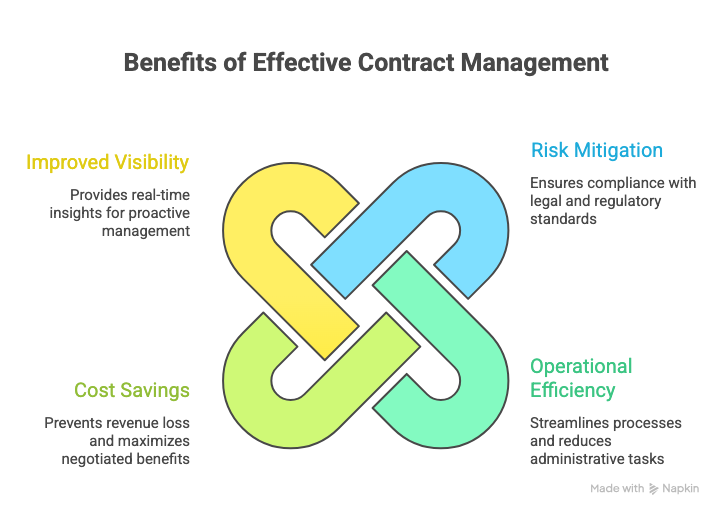
When done correctly, contract management offers tangible benefits:
- Risk Mitigation: Compliance with legal and regulatory norms
- Operational Efficiency: Shorter cycle times and reduced administrative burden
- Cost Savings: Avoidance of revenue leakage and realisation of negotiated benefits
- Improved Visibility: Proactive management with real-time visibility
Role of Contract Management Software
Contract Management Software (CLM) is a centralised system that enables contract management throughout the entire contract life cycle, from drafting and negotiation to execution, monitoring, and renewal. CLM automates contract-related workflows, monitors contract obligations, and supports collaboration between different functions, making contract management a more organised and proactive process. This becomes particularly important as organisations grow and adopt more advanced contract lifecycle management tools.
How We Enable Contract Management at Legistify
At Legistify, we help organisations manage the complete contract lifecycle on a single platform. We centralise contracts, simplify drafting and approvals, and use AI-driven tools to scan for risks and extract key information. With automated alerts, digital execution, and real-time visibility into obligations and renewals, we help teams stay compliant, reduce manual effort, and get the most value out of every contract.
Conclusion
Contract management is no longer a mere administrative function but has become a strategic business function. By following a structured lifecycle, best practices, and the use of technology, contract management can be used as a powerful tool for risk management and efficiency.
FAQs
What is contract management?
Contract management is the process of managing contracts from creation to completion to ensure compliance and maximise business value.
What are the key stages of the contract management process?
The key stages of the contract management process are request/initiation, drafting, negotiation, review and approval, execution, obligation monitoring, and renewal/termination.
Why is contract lifecycle management (CLM) important for businesses?
Contract lifecycle management is important for businesses as it helps them increase efficiency, ensure compliance, avoid revenue leakage, and provide visibility into all contracts.
How does contract management software help organisations?
Contract management software helps organisations manage contracts centrally, automates contract-related tasks, tracks obligations and renewals, and offers insights that help organisations manage contracts more effectively.