
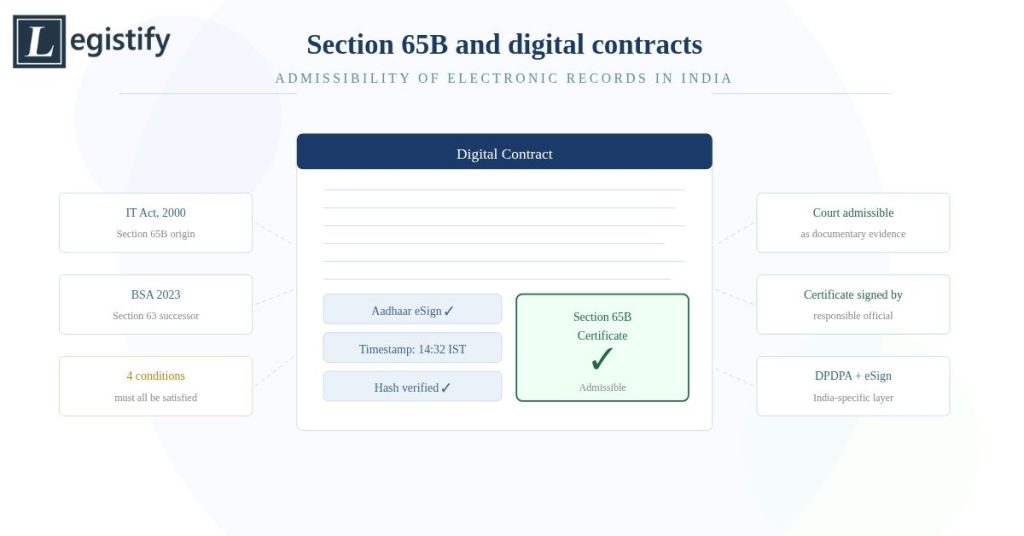
Section 65B of the Indian Evidence Act, 1872, governs how electronic records, including digital contracts, are admitted as evidence in Indian courts. For enterprise legal teams managing large volumes of electronically executed agreements, understanding Section 65B is not an academic exercise. It is the difference between a digital contract that is enforceable in a dispute and one that cannot be admitted in evidence because the certification requirements were not met.
With over 85% of businesses now using electronic contracts, the volume of digitally executed agreements that need to meet Section 65B requirements has grown substantially. A digital contract that is admissible as evidence in a Section 65B compliance framework is a legally effective document. One that is not certified correctly is vulnerable to challenge at the point when its enforceability matters most.
This article covers what Section 65B requires, how the Bharatiya Sakshya Adhiniyam 2023 has updated the framework, what the key Supreme Court interpretations establish, and what enterprise legal teams need to do to ensure their digital contracts meet the admissibility standard.
What Section 65B Is
Section 65B was introduced into the Indian Evidence Act by the Information Technology Act, 2000. It provides the mechanism by which electronic records, which by their nature do not exist as physical documents, can be admitted as documentary evidence in Indian courts.
The section provides that any information contained in an electronic record, printed on paper, stored, recorded, or copied in optical or magnetic media, produced by a computer, shall be deemed to be a document and admissible as evidence without further proof or production of the original, if the conditions specified in the section are satisfied.
The practical effect is that electronic records, including digitally executed contracts, can be produced and relied upon as evidence in court proceedings without having to produce the original device or system that created them. This is the mechanism that makes digital contracts legally useful: not just valid as agreements (which Section 10A of the IT Act addresses) but admissible as evidence when their terms need to be proved in a dispute.
The Bharatiya Sakshya Adhiniyam, 2023
A critical update for legal teams: the Indian Evidence Act, 1872 was replaced by the Bharatiya Sakshya Adhiniyam, 2023 (BSA 2023), which came into force on July 1, 2024. The BSA 2023 is the current governing legislation for evidence in Indian courts.
Section 65B of the Indian Evidence Act is substantially replicated in Section 63 of the BSA 2023. The admissibility framework for electronic records, the conditions for admissibility, and the certificate requirement are all carried forward. Legal teams that have developed compliance frameworks around Section 65B should review those frameworks against Section 63 of the BSA 2023 to ensure they remain current.
References to “Section 65B” continue to be used in legal practice and in the existing body of case law, and this article addresses both the established Section 65B framework and its continuation in the BSA 2023.
The Four Conditions for Admissibility
Section 65B (and its successor Section 63 of the BSA 2023) specifies four conditions that must be satisfied for an electronic record to be admissible as a document in court.
Condition 1: The computer output must have been produced by the computer in regular use. The electronic record must have been produced by a computer that was, at the time of production, in regular use for storing or processing information for the activities of the organisation.
This condition ensures that the electronic record comes from a reliable, functioning system that was in active use, not from a system specifically set up to produce evidence after the fact.
Condition 2: The computer must have been in regular use throughout the relevant period. The computer must have been in regular use during the period over which the electronic record was created or stored. If the computer was used only intermittently, or if there was a period when it was not in use during the relevant time, the admissibility of records from that period may be affected.
Condition 3: The computer was operating properly. The computer must have been operating properly throughout the relevant period, or any malfunctions that occurred must not have affected the electronic record or the accuracy of its contents. A record produced by a malfunctioning system, or where system errors may have affected the record’s contents, does not satisfy this condition.
Condition 4: The information in the electronic record was fed into the computer in the ordinary course of activities. The information recorded in the electronic record must have been fed into the computer (or derived from information fed into the computer) in the ordinary course of the activities to which the record relates.
This condition prevents the production of records that were created specifically for litigation rather than in the normal course of business. A contract that was executed and stored in the ordinary course of the organisation’s commercial activities satisfies this condition. A record created or modified for the purpose of a specific proceeding does not.
The Certificate Requirement
In addition to the four conditions, Section 65B(4) requires that the electronic record be accompanied by a certificate identifying the record, describing the manner in which it was produced, and giving particulars of the device involved in its production.
The certificate must be signed by a person occupying a responsible official position in relation to the operation of the relevant device or the management of the relevant activities.
What the certificate must contain
The courts have clarified what the Section 65B certificate needs to address. The certificate should include:
- Identification of the electronic record, specifying the file name, date, or other identifying information
- Description of the device from which the record was produced, including make, model, or system information where available
- Explanation of the process by which the record was generated, stored, or retrieved
- Statement that the record was produced by a computer that was in regular use and operating properly during the relevant period
- Statement that the information in the record was fed into the computer in the ordinary course of the relevant activities
- Identification of the certifying person and their position in relation to the operation of the device or management of the relevant activities
The certificate is to be given based on the best of the person’s knowledge and belief. Courts have also clarified that if the person responsible for issuing the certificate refuses to do so, a court can direct or summon its production.
Primary versus secondary electronic evidence
A distinction that enterprise legal teams need to understand is the difference between primary and secondary electronic evidence in the context of Section 65B.
When an electronic record is itself the original and is being produced as primary evidence, Section 65B and its certificate requirement may not apply in the same way as when a copy or printout of an electronic record is being produced as secondary evidence. The Supreme Court’s jurisprudence on this distinction has evolved, and the current position under Arjun Panditrao Khotkar v. Kailash Kushanrao Gorantyal (2020) and the framework under the BSA 2023 should be reviewed for the specific type of electronic record and mode of production involved.
For most practical purposes in commercial disputes involving digital contracts, the certificate requirement will apply and compliance is the safe approach.
Key Supreme Court Interpretations
Anvar v. P.K. Basheer (2014)
The Constitution Bench judgment in Anvar P.V. v. P.K. Basheer established the foundational interpretation of Section 65B. The Court held that Sections 65A and 65B form a complete code when it comes to the admissibility of electronic records. An electronic record produced as secondary evidence must satisfy the requirements of Section 65B, including the written certificate under Section 65B(4). The Court overruled the earlier position in Navjot Sandhu that allowed secondary electronic evidence to be admitted under Sections 63 and 65 of the Evidence Act without complying with Section 65B.
Arjun Panditrao Khotkar v. Kailash Kushanrao Gorantyal (2020)
The three-judge bench in Arjun Panditrao substantially clarified the Anvar judgment. The Court confirmed that the Section 65B certificate is mandatory when electronic records are relied upon as secondary evidence. The Court also addressed the timing of the certificate: it can be submitted at the time the electronic evidence is sought to be produced and need not be produced at the time of filing the suit or complaint. If the person responsible for the certificate refuses to issue it, a court can direct or summon its production.
The Arjun Panditrao judgment is the leading authority on Section 65B procedure and should be reviewed by legal teams designing their electronic evidence compliance frameworks.
What This Means for Digital Contracts
Digital contracts must be executed and stored in a way that supports Section 65B compliance
For a digital contract to be admissible as evidence under Section 65B, it needs to satisfy the four conditions described above. This means:
The contract must be stored in a computer system that is in regular use for the organisation’s commercial activities. Ad hoc storage on personal devices or external drives that are not part of the organisation’s regular systems creates admissibility risk.
The system must be functioning properly. If the organisation’s document management system has experienced technical issues that may have affected the integrity of stored records, this needs to be addressed in the compliance framework.
The contract must have been created and stored in the ordinary course of business. Contracts created through standard commercial workflows, stored in the organisation’s standard contract repository, satisfy this condition. Contracts created or modified after a dispute has arisen may face challenge.
The certification process must be planned in advance
The certificate requirement under Section 65B(4) requires a person in a responsible official position to certify that the conditions are satisfied. For enterprise legal teams, this means:
There must be a designated person or role with responsibility for issuing Section 65B certificates when electronic records from the organisation’s systems are required for proceedings.
That person must have the knowledge and access to the relevant systems to be able to certify the conditions. A senior IT officer or the person responsible for the organisation’s document management systems is typically appropriate.
The process for obtaining a certificate when it is needed must be defined in advance. If the organisation is served with a discovery request or a court order requiring production of electronic records, a last-minute search for the right person to sign a certificate creates delay and risk.
E-signature workflows must produce records that meet the conditions
For digitally executed contracts, the e-signature workflow needs to produce records that satisfy the Section 65B conditions. This means:
The e-signature platform must be part of the organisation’s regular systems, not an external tool used on an ad hoc basis.
The execution record, including the timestamp, the identity verification method, the document hash, and the delivery confirmation, must be stored as part of the contract record in a tamper-evident format.
For Aadhaar eSign workflows, the audit trail produced by the licensed Certifying Authority, which includes the identity verification record and the time of signing, is part of the documentation that supports Section 65B compliance.
For DSC-based signing, the digital signature itself includes a timestamp and identity verification that supports the admissibility framework.
WhatsApp and informal digital communications as contract evidence
A specific issue that arises frequently in commercial disputes is the admissibility of communications over WhatsApp, email, and other digital channels as evidence of contractual terms or modifications. These communications are electronic records for Section 65B purposes.
For enterprise legal teams, the practical implication is that informal communications that may evidence contractual terms, modifications, or waivers need to be preserved and certified in the same way as formal contract documents if they are to be relied upon in proceedings. A WhatsApp message agreeing to a contract modification is an electronic record that requires a Section 65B certificate to be admitted as secondary evidence.
This is one of the reasons why formal contract amendment processes, with written instruments executed through the organisation’s standard workflows, are preferable to email or messaging-based modifications. Formal amendments are easier to certify and produce in evidence than informal communications.
The BSA 2023 Update
The Bharatiya Sakshya Adhiniyam, 2023 introduced a notable expansion of the electronic records framework. Section 2(1)(t) of the BSA 2023 defines electronic records to include records stored in a semiconductor memory or any communication device. The definition of “computer” under the BSA 2023 includes computer networks, computer resources, communication devices, and data stored in portable electronic devices.
This expanded definition means that the electronic records framework now explicitly covers records from mobile devices, cloud storage, and communication platforms, which were sometimes subject to interpretive uncertainty under the 1872 Act framework.
The certificate requirement is retained in Section 63 of the BSA 2023, with the same conditions and the same requirement for a certificate from a person in a responsible official position.
Practical Steps for Enterprise Legal Teams
Review the contract repository and storage systems
Assess whether the contract repository satisfies the Section 65B conditions. The repository should be part of the organisation’s regular systems, should be properly maintained, and should have a defined data integrity and backup process. Contracts stored in personal drives, ad hoc cloud storage, or shared mailboxes may not satisfy the conditions as clearly as contracts stored in a purpose-built contract management system.
Establish the certification process
Designate the person or role responsible for issuing Section 65B certificates. Define the process for certificate issuance when electronic records are required for proceedings. Document the system description information that the certifying person will need to include in the certificate.
Ensure e-signature workflows produce compliant records
Review the e-signature platform and workflow against the Section 65B conditions. The execution record should be stored as part of the contract record, in the organisation’s standard systems, with a tamper-evident audit trail that the certifying person can describe in a certificate.
Preserve digital communications that may evidence contractual terms
Establish a policy for preserving digital communications that may evidence contract modifications, waivers, or oral agreements. While formal written amendments are preferable, where informal communications have been used to modify contract terms, a preservation policy ensures that the evidence is available and certifiable if needed.
Review the framework against BSA 2023
If the organisation’s Section 65B compliance framework was developed under the 1872 Act, review it against Section 63 of the BSA 2023 to ensure it reflects the updated framework. The substantive requirements are largely the same, but the expanded definitions under the BSA 2023 may affect how the framework applies to specific types of records.
Legistify’s contract management platform maintains all contract records in a structured, tamper-evident repository that supports Section 65B and Section 63 BSA 2023 compliance, with complete audit trails for contract creation, execution, amendment, and storage.
Conclusion
Section 65B, and its successor in the Bharatiya Sakshya Adhiniyam 2023, is the gateway through which digital contracts reach Indian courts as admissible evidence. A digital contract that is not stored and certified in compliance with the framework may be valid as an agreement but difficult to enforce in proceedings.
For enterprise legal teams managing large volumes of digitally executed contracts, the compliance framework needs to be built into the contract management process from the start: the right storage systems, the right e-signature workflows, the defined certification process, and the preservation policies that ensure electronic records can be produced when they are needed.
Frequently Asked Questions
What is Section 65B of the Indian Evidence Act?
Section 65B was introduced into the Indian Evidence Act, 1872 by the Information Technology Act, 2000. It provides the mechanism by which electronic records, including digitally executed contracts, can be admitted as evidence in Indian courts. It specifies four conditions for admissibility and requires a certificate from a person in a responsible official position certifying that those conditions are satisfied.
Has Section 65B been replaced by the Bharatiya Sakshya Adhiniyam 2023?
Yes. The Indian Evidence Act, 1872 was replaced by the Bharatiya Sakshya Adhiniyam, 2023, which came into force on July 1, 2024. Section 65B’s provisions are substantially replicated in Section 63 of the BSA 2023. The admissibility conditions, the certificate requirement, and the framework for electronic records are carried forward. Legal teams should review their compliance frameworks against Section 63 of the BSA 2023.
What are the four conditions for admissibility under Section 65B?
The four conditions are: (1) the electronic record must have been produced by a computer in regular use for the organisation’s activities; (2) the computer must have been in regular use throughout the relevant period; (3) the computer must have been operating properly; and (4) the information in the record must have been fed into the computer in the ordinary course of the relevant activities. All four conditions must be satisfied for the electronic record to be admissible.
Is a Section 65B certificate always required?
The certificate is required when an electronic record is produced as secondary evidence. The Supreme Court in Arjun Panditrao Khotkar v. Kailash Kushanrao Gorantyal (2020) confirmed that the certificate is mandatory for secondary electronic evidence and clarified that it can be submitted at the time the evidence is sought to be produced. If the responsible person refuses to issue the certificate, the court can direct or summon its production.
What are the implications of Section 65B for digitally executed contracts?
For a digitally executed contract to be admissible as evidence under Section 65B, it must be stored in a computer system that is in regular use for the organisation’s commercial activities, the system must have been functioning properly at the relevant time, and the contract must have been created and stored in the ordinary course of business. The e-signature workflow must produce an execution record that can be certified under the Section 65B framework. Enterprise legal teams should ensure their contract storage and e-signature processes satisfy these requirements.