Contracts are the backbone of every business relationship, spanning vendors, customers, employees, and partners. As businesses scale, the number of contracts increases, and so does the complexity of staying compliant. Handling this manually is no longer feasible.
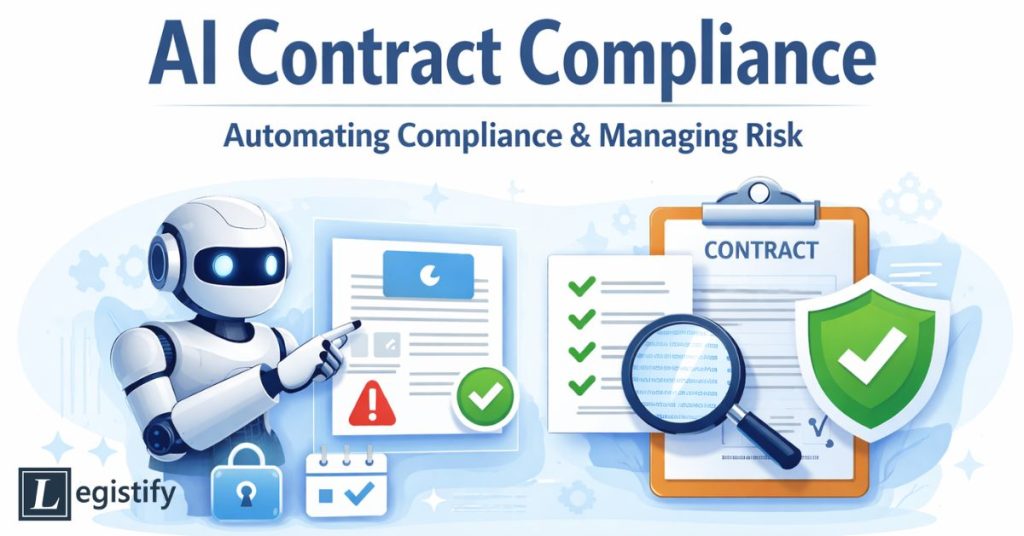
AI contract compliance uses artificial intelligence and natural language processing (NLP) to automate the review, monitoring, and governance of contracts. Rather than relying on periodic audits and spreadsheets, businesses can move towards continuous, intelligent compliance throughout the contract lifecycle.
What is AI Contract Compliance?
AI contract compliance is the use of artificial intelligence technology, especially machine learning and natural language processing, to examine, monitor, and control contractual agreements in a systematic and automated manner.
Contracts have traditionally been maintained as static files. AI turns them into structured data assets that can be searched, categorised, and analysed in real time.
Fundamentally, AI contract compliance allows companies to:
- Automatically identify important contract clauses and obligations
- Identify potentially risky or non-standard language
- Monitor performance metrics and deadlines
- Comply with internal playbooks and regulatory requirements
- Trigger alerts and compliance reports
Rather than responding to contract compliance problems after they happen, companies can now prevent them from happening in the first place through intelligent, AI-driven compliance monitoring.
Why Traditional Contract Compliance Falls Short
Contract compliance before AI was a manual-intensive process. Lawyers and procurement teams reviewed contracts line by line, used spreadsheets to track obligations, and performed periodic audits to assess risk, often relying on a basic compliance checklist.
This approach has several drawbacks:
1. Manual Overload
As the number of contracts grows, the ability to review them does not scale. This leads to a backlog of reviews and gaps in oversight.
2. Human Error
Even the most skilled professionals can miss nuanced details or high-risk language, especially in large document sets.
3. Fragmented Systems
Contracts are frequently maintained in separate departments, with no overall visibility. This makes cross-departmental compliance difficult and weakens structured contracting practices.
4. Reactive Oversight
Traditional contract compliance relies on scheduled reviews rather than real-time monitoring. Often, by the time a risk is identified, financial or legal harm has already occurred.
5. Revenue Leakage
Unnoticed renewal deadlines, untracked price escalations, and unmonitored performance terms can have a direct effect on revenue.
In a regulatory environment that is growing more complex by the day, manual contract compliance struggles to keep up compared to modern, AI-powered compliance software.
How AI Contract Compliance Works
AI contract compliance follows a systematic, multi-step approach to translate unstructured legal language into actionable intelligence.
1. Contract Ingestion and Structuring
Contracts are loaded into a single platform. AI uses text recognition and NLP to translate unstructured language into structured, searchable, machine-readable data.
2. Automated Clause Extraction
AI algorithms identify and classify contractual clauses such as:
- Indemnity
- Limitation of liability
- Termination rights
- Payment terms
- Confidentiality agreements
- Governing law
These clauses are extracted and compared against predetermined company standards or approved templates, with any variance automatically highlighted, cutting the initial review period down considerably.
3. Risk Detection and Language Analysis
AI examines language patterns to detect:
- Ambiguities in terms
- Unconventional language
- Omitted protective clauses
- Inconsistencies with regulatory requirements
- Unusual liability risks
More sophisticated systems can also suggest safer alternative language consistent with company policy, shifting risk management from reactive to proactive.
4. Obligation and KPI Tracking
One of the most effective uses of AI in contract compliance is its ability to track obligations automatically. AI identifies the most important obligations in a contract, such as:
- Payment terms
- Delivery terms
- Service level agreements
- Reporting obligations
- Renewal terms
- Termination notice periods
These obligations are tied to reminders and tracking systems, so important deadlines are far less likely to slip through unnoticed.
5. Continuous Monitoring
While traditional contract compliance is done on a quarterly basis, AI allows for continuous monitoring. This means:
- Real-time notifications can be sent
- Renewals can be tracked
- Compliance status can be checked
- Performance can be tracked
Continuous monitoring makes contract compliance part of everyday business, rather than a quarterly exercise.
AI Capabilities Used in Contract Compliance
Understanding what AI actually does in contract compliance helps organisations move beyond viewing it as a generic automation tool. Here are the core AI capabilities that power modern contract compliance:
Clause extraction
AI uses natural language processing to scan contracts and identify specific clause types, including indemnity, termination, payment terms, liability caps, confidentiality, and governing law, and maps them against standard templates or approved playbooks. This removes the need for manual clause-by-clause review.
Obligation extraction
Beyond identifying clauses, AI extracts the specific obligations each party must fulfil under a contract, including payment schedules, delivery commitments, reporting requirements, and service level targets. Each obligation is logged, assigned an owner, and tracked against deadlines.
Risk detection
AI analyses language patterns to identify contractual risk, including ambiguous terms, missing protective clauses, unusual liability language, and deviations from regulatory requirements. Risk is scored and flagged for legal review, helping teams prioritise the contracts that need attention most.
Compliance monitoring
AI continuously monitors active contracts against internal policies, regulatory requirements, and contractual obligations. Any deviation, such as a missed payment, an expired certificate, or a service level breach, is automatically detected and escalated.
Automated alerts
Rather than waiting for a scheduled audit to surface a compliance issue, AI sends real-time alerts as key dates, milestones, or thresholds approach or are missed, including renewal notices, termination deadlines, and performance review triggers.
Compliance reporting
AI generates structured compliance reports across the entire contract portfolio, showing compliance rates, obligation fulfilment, risk exposure, and upcoming deadlines. These reports can be produced on demand or on a scheduled basis for legal, procurement, and senior leadership.
Obligation Management with AI
One of the strongest use cases for AI in contract compliance is its ability to identify, extract, and track contractual obligations automatically. Manual obligation tracking is one of the most error-prone aspects of contract management, since obligations are often buried in dense legal text, spread across multiple clauses, and easy to overlook as contract volumes grow.
AI makes obligation management structured, visible, and automated.
Payment obligations
AI extracts payment terms, amounts, due dates, and escalation clauses from contracts and tracks them against actual payment records. Late payments and missed invoices are flagged before they result in penalties or disputes.
Service level obligations
SLA terms, including response times, uptime commitments, and delivery windows, are extracted and monitored continuously. Any breach is surfaced immediately, allowing account managers and legal teams to respond before the counterparty raises a formal complaint.
Renewal obligations
Contracts with auto-renewal clauses or fixed renewal windows are tracked against their notice periods. AI sends alerts in advance of renewal deadlines, giving organisations time to review, renegotiate, or terminate rather than being locked into unwanted renewals.
Reporting obligations
Many commercial contracts require periodic reporting, such as financial statements, compliance certificates, or performance reports. AI tracks these deadlines and sends reminders to the responsible teams, so nothing gets missed.
Notice period tracking
Termination notice periods are extracted and monitored. If a contract requires 60 days’ notice before termination, AI ensures the relevant stakeholders are alerted well in advance of the window closing.
Real-Time Compliance Monitoring
Traditional contract compliance relied on periodic audits, quarterly or annual reviews that checked whether contracts were being followed. By the time a compliance issue was identified through a scheduled audit, financial or legal damage had often already occurred.
AI enables a fundamentally different approach: continuous, real-time compliance monitoring.
Continuous monitoring
AI monitors every active contract in the repository on an ongoing basis, tracking obligation fulfilment, deadline proximity, and regulatory alignment around the clock rather than on a fixed schedule.
Real-time alerts
When a compliance issue arises, such as a missed payment, a clause deviation, an expired certification, or an SLA breach, the system sends an immediate alert to the relevant stakeholders, so teams can respond in hours rather than discovering the problem weeks later during a quarterly review.
Compliance dashboards
Legal and procurement teams have access to live dashboards showing the compliance status of every active contract, surfacing contracts that are fully compliant, those approaching key deadlines, and those already in breach, giving teams a single, accurate view of the portfolio at any point in time.
Exception detection
AI is particularly effective at identifying exceptions, such as contracts that deviate from standard language, counterparties that consistently miss SLAs, or patterns of non-compliance across a vendor relationship. These exceptions are surfaced automatically, without requiring a human to review every contract individually.
Early risk identification
Because AI monitors contracts continuously, compliance risks are identified early, before they escalate into disputes, regulatory penalties, or revenue losses. This shifts the legal team’s role from reactive firefighting to proactive risk management.
Key Benefits of AI Contract Compliance
1. Speed and Scalability
AI processes thousands of contracts in minutes, whereas it would take human teams weeks or even months.
2. Accuracy
AI applies the same logic to every contract. It does not suffer from fatigue or miss important details, resulting in fewer errors.
3. Cost Savings
Enterprises save on:
- Legal contract review costs
- In-house administrative overheads
- Fines for non-compliance
- Loss of revenue
Across a large enough contract portfolio, these savings add up considerably.
4. Better Risk Management
Identifying risks during the drafting and negotiation phase helps enterprises avoid contract disputes and non-compliance issues before they arise.
5. Better Visibility and Governance
Contract management dashboards enable enterprises to track:
- Compliance status
- Obligation fulfilment
- Risk exposure
- Renewal pipelines
This visibility supports better strategic decision-making.
6. Business Agility
AI-powered contract review and automated compliance enable enterprises to move quickly on:
- Vendor onboarding
- Procurement cycles
- Sales contracting
- Contract modifications
Enterprises can respond quickly to changing market conditions without losing control.
AI Contract Compliance vs Traditional Compliance
| Traditional Compliance | AI Contract Compliance |
| Manual clause review | Automated clause extraction |
| Spreadsheet tracking | Integrated dashboards |
| Periodic audits | Continuous monitoring |
| Reactive risk management | Proactive risk detection |
| Limited scalability | Enterprise-wide scalability |
AI does not just speed up existing processes; it changes how compliance is managed from the ground up.
Common Contract Compliance Risks AI Can Identify
Rather than discussing risk management in general terms, it is useful to understand the specific compliance risks that AI is equipped to detect:
Missed renewal dates
Auto-renewal clauses and fixed renewal windows are among the most commonly missed obligations in large contract portfolios. AI tracks every renewal date and sends advance alerts, preventing accidental renewals or missed exit windows.
Non-standard clauses
When a counterparty introduces language that deviates from the organisation’s approved clause library, such as a modified liability cap, a non-standard indemnity, or an unusual governing law, AI flags the deviation for legal review before the contract is executed.
Regulatory deviations
Contracts in regulated industries must comply with sector-specific requirements, including data protection obligations under the DPDP Act, financial services regulations, or healthcare compliance standards. AI checks contract language against these requirements and flags any provisions that may create regulatory exposure.
Missed contractual obligations
Payment deadlines, delivery commitments, reporting requirements, and certification renewals are tracked against actual fulfilment. When an obligation is approaching or has been missed, AI surfaces it immediately.
Unapproved contract language
Some organisations maintain approved playbooks that define acceptable language for key contract types. AI compares executed contracts against these playbooks and identifies any provisions that were not reviewed or approved through the standard workflow.
Expired certifications and insurance
Many vendor contracts require counterparties to maintain valid insurance certificates or compliance certifications. AI tracks expiry dates and alerts procurement teams before a counterparty falls out of compliance.
Real-World Applications
AI contract compliance is especially useful in contract-heavy industries.
Financial Services
Tracking regulatory clauses, risk, and vendor compliance.
Healthcare
Verifying contracts comply with data privacy and patient protection regulations.
Manufacturing and Supply Chain
Tracking supplier contracts, delivery terms, and penalty clauses.
Technology and SaaS
Managing subscription contracts, renewals, and service level agreements.
Government and Public Sector
Maintaining strict audit trails and regulatory compliance.
In each of these industries, the volume and complexity of contracts makes automation a practical necessity.
AI Within the Contract Lifecycle
AI contract compliance can be integrated throughout the entire contract lifecycle:
- Drafting – Standardised clause usage
- Negotiation – Risky deviations identified
- Approval – Data-driven insights
- Execution – Structured agreements stored
- Post-Signature – Obligations and compliance tracked
Organisations can build a closed-loop system for contract compliance by integrating AI across the entire lifecycle.
Implementation Considerations
For a successful implementation of AI contract compliance, organisations need to plan carefully across several dimensions:
Contract repository readiness
AI contract compliance tools work best when all contracts are centralised in a single, searchable repository. Contracts scattered across email, shared drives, and departmental folders need to be consolidated before AI can provide meaningful coverage. A fragmented repository will result in incomplete compliance monitoring.
Standardised clause libraries
AI compares contract language against approved standards. If no standard clause library exists, the AI has nothing to compare against. Building and maintaining an approved clause library, covering key contract types such as vendor agreements, NDAs, employment contracts, and customer agreements, is a prerequisite for effective AI-driven compliance.
Compliance playbooks
Playbooks define the rules that AI enforces: which clauses are required, which are acceptable with modification, and which should never appear in a contract. Compliance playbooks should be developed in collaboration with legal, procurement, and risk teams before AI monitoring is activated.
Integration with CLM systems
AI contract compliance tools deliver the most value when integrated with the broader contract lifecycle management system. Integration ensures that contracts flow automatically from drafting and execution into the compliance monitoring layer, without manual uploads or data re-entry.
Data quality considerations
AI is only as good as the data it processes. Contracts that are poorly scanned, inconsistently named, or missing key metadata will produce incomplete or inaccurate compliance outputs. A data quality review before implementation helps ensure AI has clean, complete inputs to work with.
Training on workflow integration
Legal and procurement teams need to understand how AI-generated alerts, risk flags, and compliance reports fit into their existing workflows. Implementation should include training on how to interpret AI outputs, when to escalate, and how to use compliance dashboards for decision-making.
The Future of AI Contract Compliance
As artificial intelligence continues to develop, contract compliance is set to become more predictive and autonomous.
The future may bring capabilities such as:
- Predictive risk scoring
- Automated negotiation insights
- Regulatory update integration
- Smart compliance agents that automatically trigger workflow actions
Contracts are moving from being simple agreements to becoming intelligent systems embedded in enterprise infrastructure.
Conclusion
AI contract compliance moves organisations from manual contract monitoring to intelligent, continuous monitoring. Organisations that adopt it benefit from faster processing, higher accuracy, lower costs, better control over compliance, and increased business agility.
In a business and regulatory environment that is only getting more complex, manual contract monitoring is no longer an effective option. AI contract compliance helps organisations turn contracts from static documents into dynamic risk management tools.
FAQs
What does AI compliance mean?
AI compliance is the use of artificial intelligence to ensure that processes, systems, or contracts comply with the law, regulations, and organisational policies.
How is AI used in contracts?
AI is applied in contracts to automatically analyse clauses, identify risks, extract obligations, and ensure compliance with the contract throughout its lifecycle.
What is the meaning of contract compliance?
Contract compliance is the process of ensuring that all parties involved meet their obligations under the contract and that the contract itself complies with the law and organisational policies.