
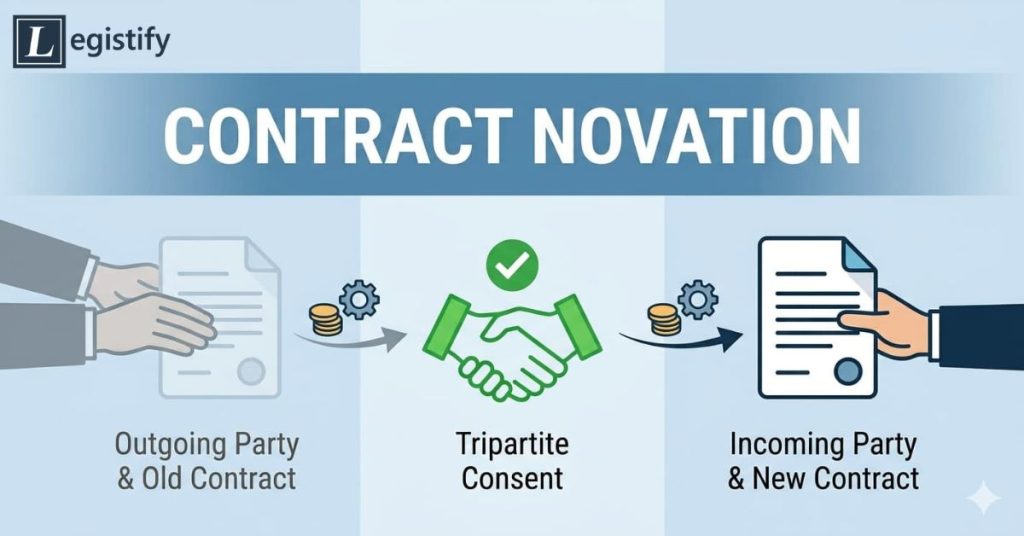
When a business changes hands, a key vendor exits a project, or a company restructures its debt, one common legal question arises: what happens to the existing contracts?
In many of these situations, the answer is contract novation. For lawyers, in-house legal teams, and law firm professionals, understanding how novation works – and when to use it – is essential to managing contract transitions cleanly and with legal certainty.
This guide explains what contract novation is, how it differs from assignment, walks through the step-by-step process, and provides practical examples across common business scenarios.
What Is Contract Novation?
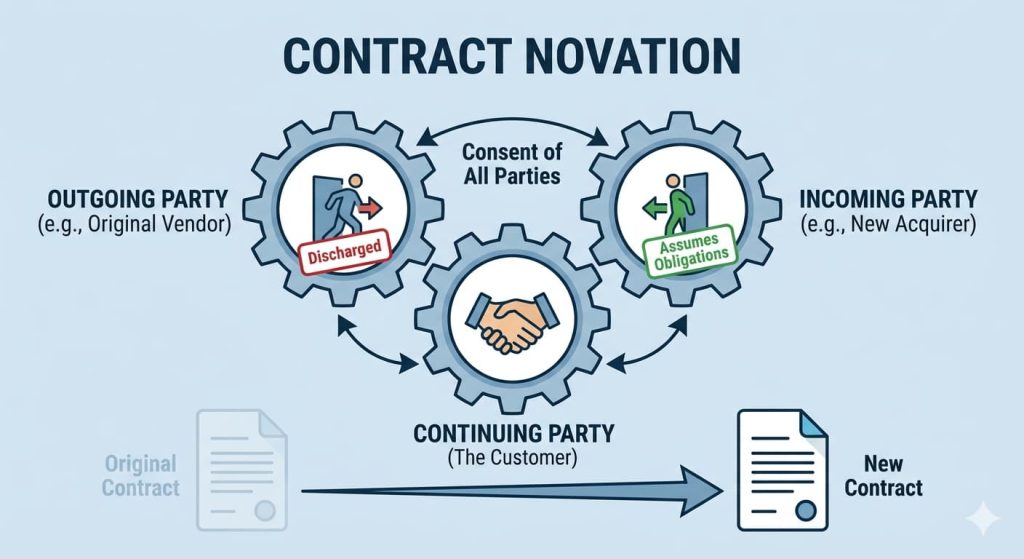
To define novation in simple terms: contract novation is a legal process where an existing contract is replaced by a new one. In this new contract, a third party takes over the rights and obligations of one of the original parties, who is then fully released from the agreement.
Unlike a contract amendment (which modifies existing terms) or an assignment (which transfers only benefits), novation creates an entirely new contractual relationship. The original contract is discharged, and the incoming party assumes full responsibility going forward.
What is a novation agreement, then? It is the formal written document that records this three-party arrangement – identifying the outgoing party, the incoming party, and the continuing party, and clearly stating that the original contract is extinguished.
A key principle: novation requires the consent of all three parties. Without that tripartite agreement, a valid novation cannot occur.
Novation Agreement Meaning: Key Elements
For a novation contract to be legally valid, four core elements must be present:
- A prior valid contract – Novation cannot happen in a vacuum. There must be an existing, enforceable agreement between the original parties.
- Consent of all parties – The outgoing party, the incoming party, and the continuing party must all agree to the novation. This is non-negotiable.
- Discharge of the original contract – The novation must explicitly release the outgoing party from its obligations. The old contract ceases to exist.
- A new, enforceable contract – The incoming party steps into the shoes of the outgoing party, assuming both rights and obligations under the new agreement.
The consideration required for the new contract is typically the discharge of the former contract itself – meaning no separate payment is usually needed to make the novation binding.
Types of Novation
Novation takes different forms depending on what is being substituted:
1. Substitution of a New Party The most common type. One party exits the contract and is replaced by a new party who takes on all rights and obligations. This is frequently used in business acquisitions and outsourcing transitions.
2. Substitution of a New Obligation The parties remain the same, but the original obligation is replaced with a new one. For example, an existing debt may be restructured and replaced with a new repayment obligation under different terms.
3. Substitution in Financial Markets In derivatives markets, novation refers to the transfer of securities to a central clearinghouse, which then assumes the position of the counterparty. The clearinghouse steps in to manage counterparty risk, making this a standard mechanism in structured finance.
Novation vs. Assignment: What Is the Difference?
Legal teams frequently encounter both novation and assignment as mechanisms for transferring contractual interests. While they may appear similar on the surface, they are fundamentally different in scope and legal effect.
| Feature | Novation | Assignment |
| What is transferred | Rights and obligations | Rights only |
| Consent required | All three parties | Usually only notice to the other party |
| Original contract | Extinguished and replaced | Remains in force |
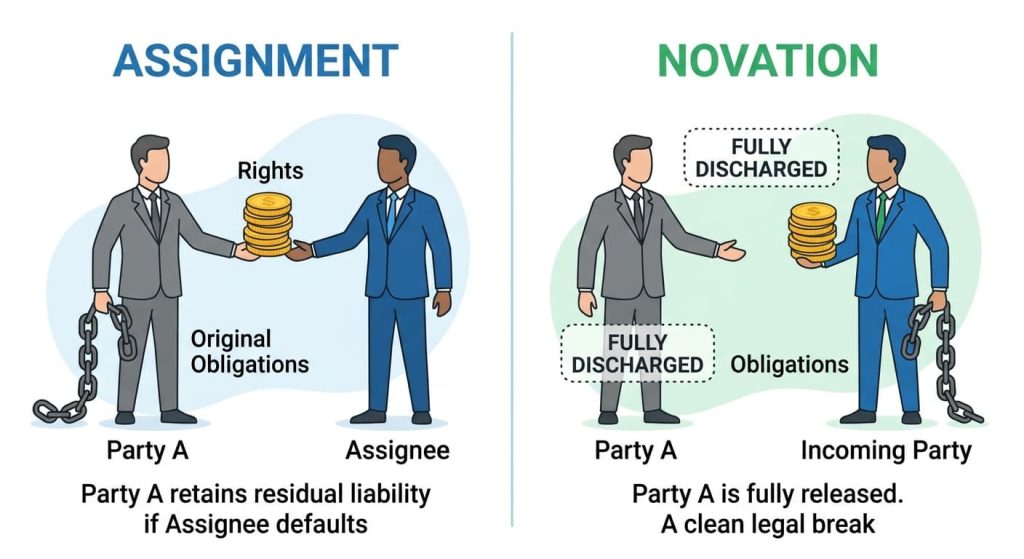
| Liability of outgoing party | Fully discharged | May remain liable if assignee defaults |
| New contract created | Yes | No |
The critical distinction for legal teams: in an assignment, the original party can still be held liable if the new party fails to perform. In a novation, the outgoing party is fully released. This makes novation the preferred route when complete legal separation is the goal.
For example, if a supplier assigns a contract to a new vendor without novation and the new vendor defaults, the original supplier may still face claims from the counterparty. A novation would have prevented this exposure entirely.
The Novation Process: Step-by-Step
What is contract novation in practice? It follows a structured process. Here is how legal teams typically manage a novation from start to finish.
Step 1: Identify the Need for Novation
Novation becomes relevant when a party to an existing contract is unable or unwilling to continue performing, and a suitable replacement has been identified. Common triggers include:
- A business sale or acquisition
- Corporate restructuring
- A service provider transferring its client base to another firm
- A contractor being replaced mid-project
The first step is confirming that novation – rather than assignment, termination, or amendment – is the right mechanism for the situation.
Step 2: Obtain Consent from All Parties
This is the most critical step. All three parties – the outgoing party, the incoming party, and the continuing (remaining) party – must agree to the novation. Legal teams should ensure that consent is explicit and documented.
Where the original contract contains a novation clause (discussed below), the process may be more straightforward. Where it does not, negotiation may be required before the novation agreement can be drafted.
Step 3: Draft the Novation Agreement
The novation agreement is the core legal document. It should clearly:
- Identify all three parties by name and role
- Reference the original contract (date, parties, subject matter)
- State that the original contract is discharged as of a specified effective date
- Confirm that the incoming party assumes all rights and obligations going forward
- Include any representations or warranties by the incoming party
- Address any outstanding obligations, liabilities, or disputes under the original contract
Legal teams often use templates for standard scenarios but should tailor the agreement to the specific transaction.
Step 4: Execute the Agreement
All three parties must sign the novation agreement. Depending on the jurisdiction and the nature of the original contract, the novation may need to be executed as a deed rather than a simple contract – particularly where consideration is limited.
Step 5: Notify Relevant Third Parties
Once executed, parties should notify any third parties affected by the change – such as subcontractors, lenders, regulators, or insurers – to ensure continuity of obligations and avoid gaps in coverage.
Step 6: Discharge of the Original Contract
From the effective date of the novation, the original contract is extinguished. The outgoing party has no further rights or obligations under it, and the incoming party steps in with full responsibility.
Novation Agreement Example: Common Scenarios
To understand how novation works in practice, it helps to look at specific situations where legal teams are likely to encounter it.
1. Business Sale or Acquisition
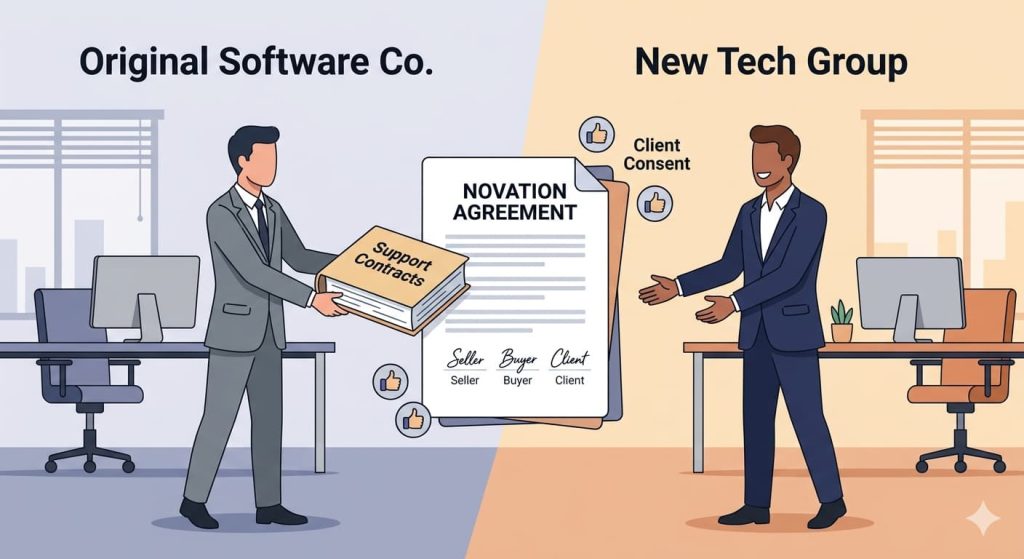
A software company sells its business to a larger technology group. The seller has ongoing support contracts with 30 enterprise clients. Rather than terminating and renegotiating each contract, the parties use novation to transfer all existing contracts to the acquirer. Each client (the continuing party) must consent to the novation. Once executed, the acquirer assumes all obligations, and the seller is fully released.
This is one of the most common novation agreement examples in commercial practice.
2. Outsourcing Transitions
A company decides to outsource its HR operations to a third-party provider. The existing employment service contracts are novated from the company to the outsourcing provider. The provider takes on all obligations, and the company exits the contractual relationship. Employees and vendors dealing with those contracts are notified of the change.
3. Debt Restructuring
A borrower is unable to service a loan under its current terms. The lender and borrower agree to replace the original loan agreement with a new one on revised terms – different repayment schedule, adjusted interest rate, or changed security structure. This substitution of obligation (rather than substitution of a party) is another form of novation, extinguishing the old debt and creating a new enforceable obligation in its place.
4. Construction Projects
In design-and-build construction projects, novation is a standard mechanism. A client commissions an architect to prepare an initial design. When a main contractor is appointed, the design contract is novated from the client to the contractor. The contractor then takes on the architect’s obligations and manages the design through to completion. This is widely used in the UK construction industry and recognised in English case law.
5. Partnership Changes
When a partner exits a professional services firm, client engagement contracts may need to be novated to reflect the firm’s new structure. The departing partner’s obligations transfer to the firm or to a new partner, with client consent. This is particularly relevant for law firms, accountancy practices, and consulting firms.
6. Government Contracts
Under frameworks like the US Federal Acquisition Regulation (FAR 42.1204), novation of government contracts requires the explicit approval of the relevant government agency. The agency must agree to recognise the new contractor, making the process more procedurally intensive than commercial novations.
Key Clauses in a Novation Agreement
When drafting or reviewing a novation agreement, legal teams should pay close attention to the following provisions:
1. Definitions and Parties Clearly identify all three parties – often referred to as the Outgoing Party, the Incoming Party, and the Continuing Party – and define the Original Contract being novated.
2. Effective Date Specify the exact date from which the novation takes effect. Obligations before this date remain with the outgoing party; obligations after belong to the incoming party.
3. Transfer of Rights and Obligations Confirm that all rights, title, and interests of the outgoing party under the original contract are transferred to the incoming party as of the effective date.
4. Release and Discharge State explicitly that the continuing party releases and discharges the outgoing party from all future obligations under the original contract.
5. Assumption of Liabilities The incoming party should assume all obligations, duties, and liabilities arising from the effective date. Legal teams should negotiate carefully whether pre-novation liabilities are also assumed.
6. Warranties and Representations The incoming party typically warrants that it has the legal capacity, authority, and resources to perform the obligations it is assuming.
7. Governing Law and Dispute Resolution Specify which jurisdiction’s law governs the novation agreement and how disputes will be resolved – especially important where the original contract and the novation agreement involve parties across different jurisdictions.
8. Indemnity Provisions Include clauses addressing how the parties will indemnify each other for losses arising from pre-novation or post-novation conduct, particularly where liabilities are split at the effective date.
Risks and Challenges for Legal Teams
While novation is a well-established legal mechanism, it is not without complexity. Legal teams should be aware of the following risks:
Obtaining Consent Can Be Difficult Unlike assignment, novation requires the agreement of all parties. If the continuing party is reluctant – perhaps because it preferred the outgoing party – the process can stall. Legal teams may need to negotiate additional protections for the continuing party to secure consent.
Liability Allocation at the Effective Date Determining which party bears responsibility for obligations that arose before the novation date but are not yet settled can be a significant source of dispute. The agreement must be precise about the cut-off.
Implied Novation Courts have, in some cases, found that a novation has occurred by conduct – even without a formal written agreement. In Enterprise Managed Services Limited v Tony McFadden Utilities (2009), the payment of large sums was taken as evidence of an implied novation. Legal teams should be alert to situations where informal arrangements may have already created a novation by implication.
Jurisdiction-Specific Requirements In some jurisdictions, novation agreements must be executed as deeds, notarised, or filed with regulatory bodies to be effective. Government contract novations, in particular, are subject to specific procedural requirements.
Volume and Tracking in Complex Transactions In M&A transactions or large outsourcing projects, the number of contracts requiring novation can be significant. Tracking consent, execution status, and effective dates across dozens or hundreds of contracts requires careful process management.
Incomplete Documentation A novation agreement that fails to clearly discharge the original contract or properly identify what is being transferred can create ambiguity – leaving the outgoing party exposed to claims it believed it had exited.
Platforms like Legistify’s contract management system can assist legal teams in tracking novation workflows, maintaining a central repository of agreements, and ensuring no contract falls through the cracks during a complex business transaction.
Why Contract Novation Matters
For legal teams, contract novation is more than a technical mechanism – it is a practical tool for managing commercial risk during periods of change.
It matters for the following reasons:
- Legal certainty – Novation provides a clear, documented transition of obligations, reducing the risk of disputes about who is liable after the change.
- Risk protection for the outgoing party – Full discharge from the original contract means no residual liability if the incoming party defaults.
- Business continuity – For the continuing party, novation ensures that services, obligations, and contractual protections continue without interruption.
- Compliance – In regulated industries, proper novation ensures that contractual arrangements meet legal and regulatory requirements, particularly where government contracts or licensed activities are involved.
Understanding when to use a novation contract – and how to structure it correctly – is a core competency for any legal professional involved in transactions, restructurings, or contract lifecycle management.
Conclusion
Contract novation is a structured, consent-based legal mechanism that allows one party to exit a contract and be fully replaced by a new party. It differs fundamentally from assignment: where assignment transfers benefits, novation transfers both benefits and obligations – and completely discharges the outgoing party.
For lawyers and in-house legal teams, the novation process demands careful attention to consent, precise drafting of the novation agreement, and clear allocation of liabilities at the effective date. The mechanism is broadly applicable – from business sales and outsourcing to debt restructuring and construction projects – and its correct use is critical to managing legal risk during periods of transition.
When approached with the right process and documentation, novation provides all parties with a clean, legally sound outcome.
Frequently Asked Questions
What is the difference between novation and assignment?
Novation replaces both the rights and obligations of an outgoing party with a new party, fully discharging the outgoing party from the original contract. Assignment transfers only the benefits (rights) of a contract, leaving the original party still responsible for obligations. Novation also requires the consent of all parties, whereas assignment generally requires only notice to the other party.
Can a novation happen without a written agreement?
In principle, yes – courts have recognised novation by conduct in certain circumstances. However, relying on implied novation is legally risky. A properly drafted and executed novation agreement is always the recommended approach to ensure legal certainty and avoid disputes.
Does the new party need to provide separate consideration in a novation?
Not typically. The discharge of the original contract is generally considered sufficient consideration to support the new contract. However, the novation agreement should clearly reflect the arrangement, and in some jurisdictions, execution as a deed may be required where consideration is limited.
What happens to pre-novation liabilities after a novation agreement is signed?
This depends on how the novation agreement is drafted. Typically, the outgoing party remains responsible for liabilities that arose before the effective date of novation, while the incoming party assumes responsibility for obligations from the effective date onwards. Legal teams must ensure the agreement explicitly addresses this allocation.
Is consent from all parties always required for a novation?
Yes. Consent from the outgoing party, the incoming party, and the continuing party is a fundamental requirement for a valid novation. This distinguishes novation from assignment. Where an original contract includes a novation clause, the process for obtaining consent may be pre-agreed – but the consent itself cannot be waived.