
An executory contract is a legally binding agreement in which one or both parties still have obligations left to perform. The contract is “in motion”: performance has either not begun or is ongoing, and neither side has fully discharged its duties. Most commercial contracts are executory by nature. Whether it’s a software subscription, a long-term supply agreement, a commercial lease, or an employment contract, the obligations of both parties are still outstanding at the time of signing.
For legal professionals and in-house counsel, understanding what an executory contract is is not only a matter of academic interest. It has direct implications for how contracts are drafted, monitored, enforced, and terminated, especially in high-stakes situations like corporate insolvency or M&A transactions.
This guide breaks down the definition of an executory contract, how it works, how Indian law treats it, what clauses matter most, and how termination works across different scenarios.
What Is an Executory Contract?

An executory contract is a legally binding agreement in which one or both parties still have material obligations left to perform. In simple terms, an executory contract is defined by ongoing or pending obligations.
The most widely cited legal definition comes from United States bankruptcy jurisprudence, where a contract is considered executory when:
“The obligations of both parties are so far unperformed that the failure of either to complete performance would constitute a material breach excusing the performance of the other.”
This is known as the Countryman test, named after Professor Vern Countryman, and it remains the dominant standard applied in U.S. courts. Under this test, the key is mutuality of obligation, meaning both parties must still have substantial duties remaining. The Countryman test is a US bankruptcy concept. Indian law has no equivalent test, and in India the term is used more widely for any contract in which performance is still pending on one side or both.
Executory vs. Executed Contracts
The distinction is straightforward:
- An executed contract is one where all parties have fully performed. A one-time cash purchase is a good example: money changes hands, goods are delivered, and the contract is complete.
- An executory contract is one where performance is ongoing or yet to happen. A three-year software licensing agreement, for instance, remains executory for its entire duration as long as both parties continue to owe obligations.
This distinction between executed and executory contracts is critical for legal teams managing ongoing obligations. See contractual agreement for the other types of contracts based on performance.
Under Indian Law
The Indian Contract Act, 1872 does not define an executory contract. Executed and executory contracts are a classification of contracts based on performance, and the Act’s rules on performance, breach, discharge and remedies apply to them. The provisions that matter most are:
- Reciprocal promises (Sections 51 to 54): where promises are to be performed together, neither party need perform unless the other is ready and willing to perform (Section 51). If one party prevents the other from performing, the contract is voidable at the option of the party prevented (Section 53).
- Time of performance (Section 55): if a party fails to perform at the agreed time and time was of the essence, the contract becomes voidable at the option of the other party.
- Anticipatory breach (Section 39): if a party refuses to perform its promise in its entirety, or disables itself from performing, the other party is entitled to put an end to the contract.
- Impossibility (Section 56): a contract to do an act that becomes impossible or unlawful after the contract is made becomes void when the act becomes impossible or unlawful. This is the Indian rule of frustration and it matters most for long executory contracts.
- Changes to the contract (Section 62): parties are able to substitute a new contract, rescind or alter the existing one by agreement. See contract novation.
- Compensation (Section 73): a party who suffers from a breach is entitled to compensation for loss caused by it.
How Executory Contracts Work
At their core, executory contracts operate on a framework of reciprocal obligations. Party A agrees to provide something of value (a service, a payment, a deliverable), and Party B agrees to provide something in return, often on a continuous or periodic basis.
Here is a simplified flow of how they work in practice:
1. Formation: Both parties agree to terms and sign. Obligations are clearly defined, including performance standards, timelines, and payment schedules.
2. Ongoing performance: Both parties fulfil their respective duties over the contract’s duration. This is the phase where the contract remains “executory”: active, not yet complete.
3. Monitoring and compliance: Legal teams track adherence to milestones, deliverables, and payments. Any deviation is documented.
4. Trigger events: Certain events, such as a breach, a change in law, insolvency, or expiry of a term, may activate specific contract provisions.
5. Discharge or termination: The contract ends either through full performance, mutual agreement, expiry of term, or one of the termination mechanisms built into the agreement.
Where Are Executory Contracts Commonly Used?
Executory contracts appear across virtually every sector. Some common examples include:
- Commercial leases: Landlord and tenant both have ongoing obligations (property maintenance vs. rent payment) for the full lease term.
- Software and SaaS licensing: The vendor provides continuous access and support, and the licensee pays periodic fees.
- Employment contracts: The employer pays salary, the employee performs services, and both obligations continue throughout the engagement.
- Supply and procurement agreements: Ongoing delivery of goods in exchange for periodic payment.
- Franchise agreements: The franchisor provides brand access, training, and support, and the franchisee pays royalties and meets operational standards. See franchise agreements.
- Construction contracts: The contractor delivers work in phases, and the client pays in instalments.
- Loan agreements: The lender has disbursed funds, and the borrower has ongoing repayment obligations. This is executory in the wider sense used in India, although it does not meet the US Countryman test because the lender has already performed.
- Intellectual property licences: Royalties and rights of use continue over the licence term.
In each of these cases, neither party has finished performing, which is precisely what makes them executory.
Key Clauses in Executory Contracts
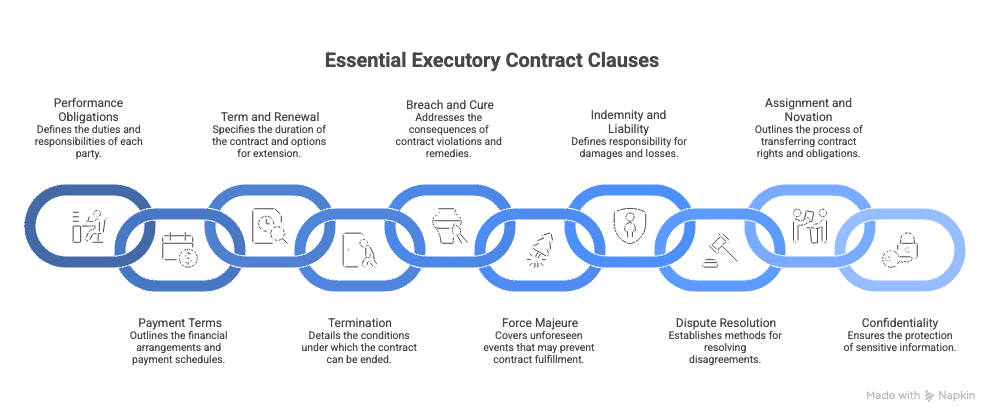
Drafting and reviewing executory contracts requires close attention to the clauses that govern ongoing performance and contingency scenarios. The following are the most critical:
1. Performance Obligations Clause
This clause defines exactly what each party is expected to do, when they must do it, and to what standard. A well-drafted performance obligations clause should:
- Clearly identify each party’s duties with specificity
- Set measurable timelines and milestones
- Define quality standards or service levels (especially in service agreements)
- Address what happens when partial performance occurs
Vague performance obligations are among the leading causes of contract disputes. Precision here is not optional.
2. Payment Terms Clause
Executory contracts typically involve periodic payment, whether monthly, quarterly, or milestone-based. This clause should specify:
- Payment amounts and schedule
- Acceptable payment methods
- Consequences of delayed or missed payments
- Provisions for price escalation or adjustment
3. Term and Renewal Clause
This defines the duration of the contract and the conditions under which it is renewed. Key considerations include:
- Fixed term vs. evergreen (auto-renewing) arrangements
- Notice periods required for non-renewal
- Conditions that must be met before renewal
- Whether renewal terms differ from original terms
Auto-renewal clauses, in particular, catch organisations off guard if not actively tracked. See contract renewal.
4. Termination Clause
One of the most important provisions in any executory contract, a termination clause sets out the circumstances under which either party may end the agreement. Common grounds for termination include:
- Termination for cause, triggered by a material breach or non-performance
- Termination for convenience, which allows either party to exit without a specific reason, usually with advance notice
- Termination for insolvency, activated when one party files for bankruptcy or becomes insolvent
- Termination by mutual agreement, where both parties consent to end the contract
Each scenario carries different legal and financial implications, covered in detail below.
5. Breach and Cure Provisions
A breach provision defines what constitutes a violation of the contract and what remedies are available. A well-constructed breach clause should include:
- A clear definition of “material breach” versus minor non-compliance
- A cure period, a defined window (commonly 15 to 30 days) in which the defaulting party remedies the breach before termination rights arise
- Consequences of uncured breach, including the right to terminate, claim damages, or seek specific performance
6. Force Majeure Clause
This clause excuses performance when extraordinary events, such as floods, pandemics, war, or government actions, make it impossible or impractical to perform. In executory contracts with long durations, force majeure provisions are particularly important. They should:
- Clearly enumerate qualifying events (or adopt a broad standard)
- Specify whether the contract is suspended or terminated
- Define notice obligations when a force majeure event is invoked
In India, a force majeure clause works alongside Section 56 of the Indian Contract Act. Where the contract has an express clause, the clause governs, and Section 56 applies where the clause does not cover the event.
7. Indemnity and Liability Clauses
These clauses allocate risk between parties. In executory contracts, they address potential losses arising from non-performance, third-party claims, or other events during the contract’s life. Caps on liability, mutual indemnities, and exclusion of consequential damages are commonly negotiated here. See indemnity agreements.
8. Dispute Resolution Clause
Given the long-term nature of many executory contracts, disputes are a realistic possibility. This clause should specify:
- Whether disputes go to arbitration, mediation, or litigation
- The governing law and jurisdiction
- Timelines for raising and resolving disputes
9. Assignment and Novation Clause
This addresses whether either party can transfer their rights or obligations to a third party. Assignment without consent is a substantial issue in executory contracts, particularly in corporate transactions. The clause should make clear:
- Whether assignment is permitted, and under what conditions
- Whether the other party’s consent is required
- How novation (the substitution of a new party) works
10. Confidentiality and Post-Termination Obligations
Many executory contracts, especially in services and technology, include confidentiality obligations that survive termination. Other post-termination provisions might cover data return, non-solicitation, transition assistance, or wind-down procedures.
How Termination Works
Termination of an executory contract discharges both parties from further performance, but the circumstances under which it happens matter a great deal for legal and financial outcomes.
1. Termination for Breach
When one party fails to perform a material obligation, the other party typically gains the right to terminate. The process generally follows these steps:
- The non-breaching party identifies the breach and provides written notice.
- The defaulting party is given a cure period (if the contract provides for one).
- If the breach is not remedied within the cure period, the non-breaching party terminates and pursues remedies, including damages.
Example: A technology vendor stops providing contracted support services mid-term. The client issues a breach notice, grants a 21-day cure period, and after no remediation, terminates the contract and claims damages for the cost of finding an alternative provider.
2. Termination for Convenience
Many commercial contracts allow one party to terminate without cause, by giving advance written notice (commonly 30, 60, or 90 days). This is called termination for convenience. It is common in government contracts, outsourcing agreements, and long-term service contracts.
This mechanism provides flexibility, but it creates financial exposure. Contracts often specify that the terminating party must pay a breakage fee, cover sunk costs, or compensate for work already performed.
3. Termination by Mutual Agreement
Parties agree at any time to end an executory contract. This is the cleanest form of termination. It typically involves a signed termination agreement that confirms the end date, settles outstanding obligations, and releases both parties from further claims.
Mutual termination is particularly common when circumstances have changed materially, the relationship has run its course, or a restructuring requires unwinding existing contracts.
4. Termination Due to Insolvency or Bankruptcy
This is perhaps the most complex scenario. Most contracts contain an ipso facto clause, a provision that purports to automatically terminate or allow termination upon a party’s insolvency or bankruptcy filing.
United States. In many jurisdictions, including the United States, ipso facto clauses in executory contracts are generally unenforceable once a bankruptcy case is filed. Under Section 365 of the U.S. Bankruptcy Code:
- The bankruptcy trustee or debtor-in-possession has the right to assume (keep) or reject (abandon) an executory contract.
- If the contract is assumed, both parties’ obligations are preserved.
- If the contract is rejected, it is treated as a breach occurring immediately before the bankruptcy filing, and the non-debtor party becomes an unsecured creditor for resulting damages.
- Ipso facto clauses that automatically terminate contracts upon insolvency are specifically rendered unenforceable by Section 365(e)(1).
India. India has no provision equivalent to Section 365, and the Insolvency and Bankruptcy Code, 2016 (IBC) does not expressly invalidate ipso facto clauses. Several rules still limit a counterparty’s ability to terminate:
- Moratorium (Section 14): during the moratorium, proceedings against the corporate debtor and recovery actions are restricted. Section 14(2) also bars the termination of supplies of essential goods and services, such as electricity, water, telecommunication and information technology services, to the corporate debtor.
- Critical supplies (Section 14(2A)): the supply of goods or services that the resolution professional considers critical to preserve the value of the corporate debtor and keep it a going concern cannot be terminated, suspended or interrupted during the moratorium.
- Gujarat Urja Vikas Nigam Ltd v. Amit Gupta (2021): the Supreme Court held that the NCLT is able to use its residuary jurisdiction under Section 60(5)(c) to restrain the termination of a contract that is terminated solely on the ground of the corporate debtor’s insolvency, where the contract is central to the success of the resolution process. In that case it was a power purchase agreement that was the debtor’s sole contract.
- Termination on unrelated grounds: the moratorium is not a blanket shield. The Supreme Court has held that where a contract is terminated for reasons unrelated to insolvency, such as an earlier breach, the NCLT’s jurisdiction under Section 60(5)(c) cannot be invoked (Tata Consultancy Services Ltd v. Vishal Ghisulal Jain).
Practical note for legal teams: Even if your contract contains a termination-on-insolvency clause, do not assume it is enforceable once insolvency proceedings begin. Always seek legal advice before exercising such rights.
5. Expiry of Term
Some executory contracts run their course. When the term expires and neither party exercises a renewal option, the contract terminates automatically. In this case, parties should ensure that all outstanding obligations (delivery, payment, data return, etc.) are addressed before the expiry date.
Why Executory Contracts Matter for Legal Teams
Understanding executory contracts is not only a drafting concern. It has real operational and strategic implications:
Risk management: Ongoing obligations mean ongoing exposure. Legal teams must assess what happens if the other party fails to perform financially, operationally, and reputationally.
Corporate transactions: In M&A, due diligence requires a thorough review of the target’s executory contracts. Key contracts may have change-of-control clauses that trigger termination or require consent upon acquisition, which materially affects deal value.
Insolvency and restructuring: When a counterparty enters insolvency, knowing your rights under the applicable law is critical. Proactive contract review ahead of a counterparty’s financial distress is good legal practice.
Regulatory compliance: In sectors like financial services, healthcare, and technology, executory contracts often carry compliance obligations (data processing agreements, regulatory reporting, audit rights) that must be actively monitored.
Cash flow and financial planning: Finance teams rely on legal teams to provide visibility into future payment obligations and receivables locked in executory contracts. Tracking these accurately is part of effective contract lifecycle management.
Common Challenges in Managing Executory Contracts
Despite their ubiquity, executory contracts present real management challenges for legal and compliance teams:
Volume and visibility: Large organisations may have hundreds or thousands of active contracts at any time. Without a centralised contract management system, tracking obligations, renewal dates, and performance milestones is difficult.
Missed renewal and expiry deadlines: Auto-renewal clauses lock organisations into unwanted commitments. Termination deadlines are frequently missed without proper calendar tracking.
Ambiguous performance standards: Poorly drafted performance obligations lead to disputes about whether a breach has actually occurred. This is especially common in service agreements where quality is subjective.
Counterparty monitoring: Legal teams are not always notified promptly when a counterparty experiences financial difficulties. By the time insolvency is declared, it may be too late to take protective action.
Cross-border complexity: Executory contracts spanning multiple jurisdictions involve different governing laws, enforcement regimes, and insolvency frameworks. What is enforceable in one country may not be in another.
Post-termination compliance: Even after an executory contract ends, obligations around confidentiality, data handling, IP ownership, and non-solicitation often survive. Failing to track these exposes organisations to liability.
Best Practices for Drafting and Managing Executory Contracts
For legal professionals working with executory contracts, these practices reduce risk and improve enforceability:
- Define obligations with precision. Ambiguity in performance obligations is the root cause of most disputes. Use measurable standards wherever possible.
- Include a well-defined breach and cure mechanism. Specify what counts as a material breach, set a realistic cure period, and make clear what remedies arise if the breach is not cured.
- Review termination-on-insolvency clauses carefully. Understand whether these clauses are enforceable under the applicable law, and draft them with realistic triggers rather than only a bankruptcy filing.
- Track key dates proactively. Renewal dates, termination notice deadlines, and performance milestones should all be tracked in a contract management system and not only in a shared spreadsheet.
- Conduct periodic contract reviews. Long-term executory contracts should be reviewed at regular intervals to assess whether the terms still reflect commercial reality and whether any obligations are at risk.
- Coordinate with finance. Legal teams should ensure that finance functions have visibility into payment obligations and receivables arising from executory contracts.
How Legistify Helps Legal Teams Manage Executory Contracts
Because executory contracts stay live for years, the risk is in what nobody tracks. Legistify is an AI-native legal operations platform for enterprises, and its contract lifecycle management tools help legal teams keep ongoing contracts under control.
- Every live contract in one place: Contracts are stored in a central repository with AI-powered clause extraction and search, so a team finds every contract with a given termination, renewal or insolvency clause.
- Key dates and status: A dashboard shows each contract at every stage, and the platform monitors key milestones and deadlines, such as renewal and notice dates.
- Consistent clauses: Legistify AI CLM works as a Microsoft Word add-in with a clause library and playbooks that check a contract against internal rules, such as your standard termination and breach clauses, and suggest redlines.
- Controlled changes: Approval workflows route amendments and terminations to the right approver, and track changes and version control keep a record of every change.
- Signing and reporting: The e-signature module supports Aadhaar integration and keeps a secure audit trail of signature activity, and analytics and reporting give visibility across the portfolio.
Explore Legistify’s contract management software, contract workflow and e-signature features to see how they fit your team’s contracts.
Conclusion
Executory contracts are the backbone of modern commercial activity. From software licences to supply agreements, employment contracts to commercial leases, the vast majority of business relationships involve ongoing obligations, which means they fall within the scope of executory contract frameworks.
For lawyers and in-house legal teams, the key takeaway is this: understanding what an executory contract is and how it operates in practice is essential for managing risk, ensuring compliance, and maintaining control over long-term contractual relationships.
Understanding the key clauses that govern performance, termination, and breach, and knowing how courts and insolvency frameworks treat these contracts, is essential for anyone advising on or managing commercial contracts. Combined with the right processes and tools, this knowledge enables legal teams to move from reactive firefighting to proactive contract governance.
Frequently Asked Questions (FAQs)
What is an executory contract?
An executory contract is a legally binding agreement in which one or both parties still have obligations left to perform. Examples include leases, software subscriptions, supply agreements and employment contracts.
What is the difference between an executory contract and an executed contract?
An executed contract is one where all parties have fully performed their obligations and the agreement is complete. An executory contract is one where one or both parties still have significant obligations to fulfil. Most ongoing commercial agreements, such as leases, subscriptions, and employment contracts, are executory throughout their term.
Can an executory contract be terminated at any time?
It depends on the contract’s terms. Many contracts include a “termination for convenience” clause that allows exit with advance notice. Otherwise, termination generally requires a valid legal ground such as material breach, mutual agreement, or a specific trigger event defined in the contract.
Which sections of the Indian Contract Act apply to executory contracts?
The Act does not define executory contracts, but its rules on performance and breach apply to them: Sections 51 to 54 on reciprocal promises, Section 55 on time of performance, Section 39 on refusal to perform, Section 56 on impossibility, Section 62 on novation, rescission and alteration, and Section 73 on compensation for breach.
What happens to an executory contract when one party goes bankrupt?
It depends on the applicable law. Under the U.S. Bankruptcy Code (Section 365), the trustee may assume or reject the contract, and if rejected it is treated as a pre-bankruptcy breach. In India, there is no equivalent provision. During the moratorium under Section 14 of the IBC, the termination of essential and critical supplies to the corporate debtor is barred, and in Gujarat Urja Vikas Nigam Ltd v. Amit Gupta (2021) the Supreme Court allowed the NCLT to restrain termination of a contract made solely on the ground of insolvency, where the contract is central to the resolution.
Are termination-on-insolvency clauses enforceable?
It depends on the jurisdiction. In the United States, such clauses, known as ipso facto clauses, are generally unenforceable once a bankruptcy case is filed. In India, the IBC does not expressly invalidate them, but the moratorium and the Supreme Court’s decision in Gujarat Urja Vikas Nigam Ltd v. Amit Gupta limit their use where the contract is central to the debtor’s resolution. Legal advice should always be sought before relying on such a clause.
How can legal teams better manage executory contracts?
The most effective approach combines good drafting (clear obligations, defined remedies, realistic termination triggers) with a contract lifecycle management system. Centralising contracts, monitoring key dates and deadlines, and keeping visibility into counterparty performance are the foundations of sound executory contract management. Legistify’s platform brings these capabilities together, with a central repository, a dashboard that monitors milestones and deadlines, and approval workflows.