
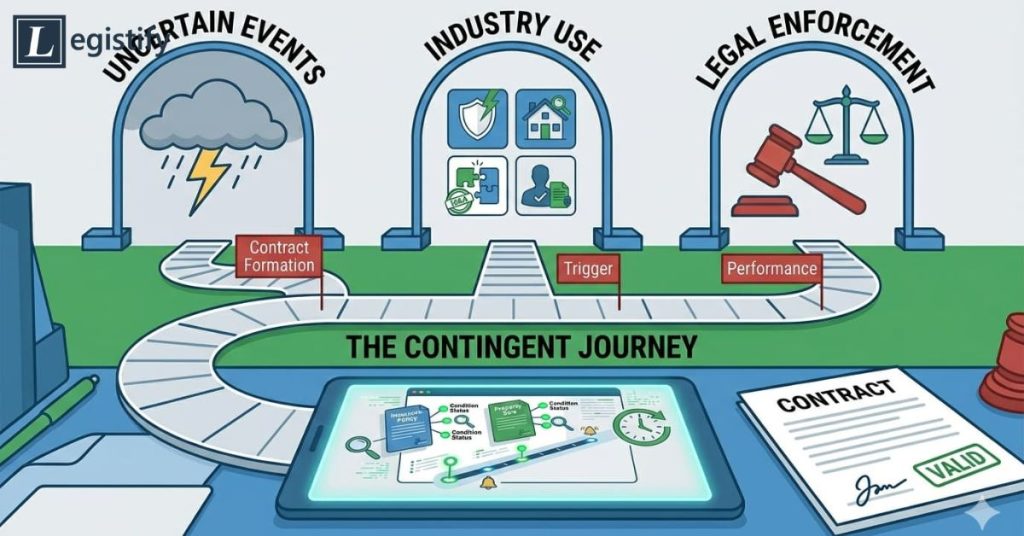
Businesses and legal professionals regularly deal with situations where performance cannot be guaranteed until a future event takes place. In such cases, parties often turn to a specific type of agreement that links obligations to conditions rather than immediate action.
This type of agreement is called a contingent contract. It is a foundational concept in contract law, used across industries ranging from real estate and insurance to mergers, employment, and project-based services.
This blog explains the contingent contract meaning, its legal basis, the different types of contingent contract, how enforcement works, and where these agreements are most commonly used.
What is a Contingent Contract?
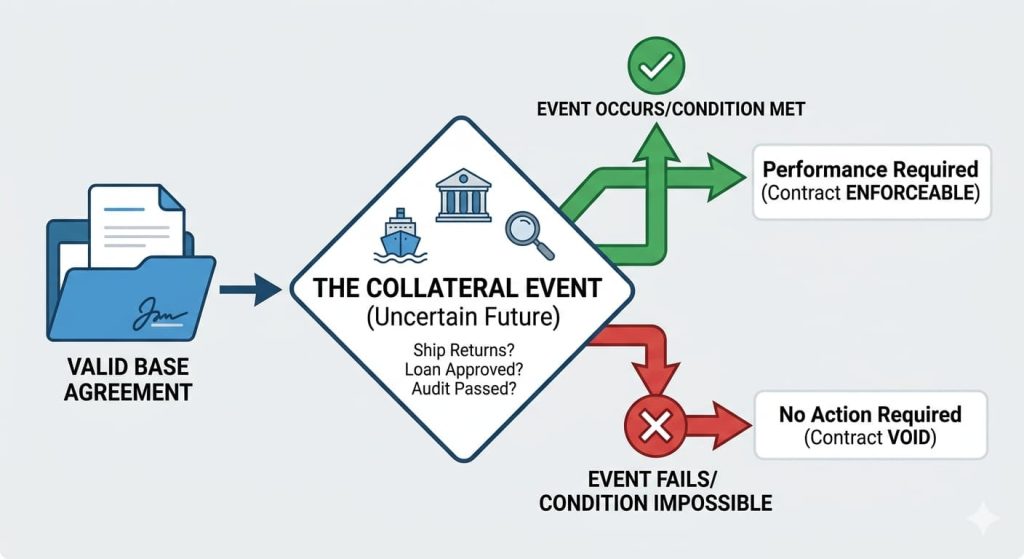
A contingent contract is an agreement in which the performance of one or both parties depends on the occurrence or non-occurrence of a specified future event that is uncertain at the time the contract is formed.
In simple terms, neither party is required to act unless a particular condition is met. The contract does not become enforceable until the triggering event either happens or definitively cannot happen.
Contingent Contract Definition under the Indian Contract Act, 1872
Section 31 of the Indian Contract Act, 1872, defines a contingent contract as:
“A contract to do or not to do something, if some event, collateral to such contract, does or does not happen.”
The phrase “collateral to such contract” is important. It means the event triggering the contract must be separate from the main obligations in the agreement itself. The event should be an external, uncertain circumstance that neither party can control directly.
Contingent Meaning in Law
Understanding contingent meaning in law requires distinguishing between two closely related ideas: a condition and a contingency.
In legal terms, a condition is a requirement that must be satisfied for an obligation to arise. A contingency, more specifically, refers to a future, uncertain event outside the direct control of the parties.
When lawyers use the term “contingent” in a contract, they mean that performance is not certain or automatic. It is conditional on something happening or not happening. This could be a regulatory approval, a market event, a third party’s action, or any other external occurrence.
The contingent meaning in law, therefore, implies conditionality, uncertainty, and dependence on future events.
Key Elements of a Contingent Contract
For a contract to qualify as a contingent contract, it must satisfy certain essential elements.
1. A Valid Base Agreement
There must be an underlying contract with offer, acceptance, consideration, and the capacity of the parties to contract. The contingency does not replace the contract; it modifies when performance is required.
2. Dependency on a Collateral Event
The performance of the contract must depend on the occurrence or non-occurrence of an event that is collateral (external) to the contract itself.
3. The Event Must Be Uncertain
The triggering event must be one that may or may not occur. If the event is certain to happen, the agreement is not contingent; it is an absolute contract with a delayed obligation.
4. The Event Must Be Possible
A contingent contract based on an impossible event is void from the beginning. The triggering condition must be something that can realistically occur in the present circumstances.
5. The Event Must Not Be Within the Sole Control of One Party
If one party can unilaterally determine whether the condition is met, the agreement may lack fairness and could be challenged legally.
How a Contingent Contract Works
A contingent contract functions through a trigger mechanism. The parties agree in advance what obligations each will have if a specified event occurs or does not occur. Until the trigger event plays out, neither party is obligated to perform.
Here is how the process typically unfolds:
- Contract Formation: Both parties agree to the terms, including the conditions and the obligations linked to those conditions.
- Waiting Period: The parties wait for the specified event to either happen or not happen.
- Trigger: If the event occurs (or fails to occur, depending on the contract), the obligations activate.
- Performance: The party or parties perform their respective duties as outlined in the contract.
- Void Outcome: If the event becomes impossible or expires without occurring, the contract becomes void and no performance is required.
The key characteristic is that the contract is alive and binding from the start, but performance is suspended until the condition is resolved.
Types of Contingent Contract
There are several types of contingent contract based on the nature of the triggering condition. Understanding these types helps legal professionals draft agreements that accurately reflect the parties’ intent.
1. Contract Contingent on the Happening of an Event
This is the most common type. The promisor is required to perform only if a specified future event occurs.
Example: A agrees to pay B a sum of money if B’s ship returns safely within 30 days.
2. Contract Contingent on the Non-Happening of an Event
Here, performance is triggered if the specified event does not occur.
Example: A agrees to pay B if a certain arbitration award is not issued against A within a fixed period.
3. Contract Contingent on the Happening of an Event Within a Fixed Time
The contract must be performed only if the event happens within a specific timeframe. If the time expires without the event occurring, the contract becomes void.
Example: A agrees to sell goods to B if a particular trade approval is granted within 60 days.
4. Contract Contingent on the Non-Happening of an Event Within a Fixed Time
Performance is triggered only if the event does not occur within the agreed time.
Example: A promises to pay B if a specific regulation does not come into force within six months.
5. Contract Contingent on the Future Conduct of a Living Person
Some contingent contracts are based on how a specific person will behave in the future. If that person takes an action that makes the condition permanently impossible, the contract is treated as void.
Example: A agrees to pay B if B enters into a partnership with C. If C enters into a competing agreement that permanently prevents the partnership, the contract becomes void.
6. Contract Contingent on an Impossible Event
A contract based on an event that is already impossible when the agreement is formed is void from the outset, regardless of whether the parties were aware of the impossibility.
Contingent Contract Examples
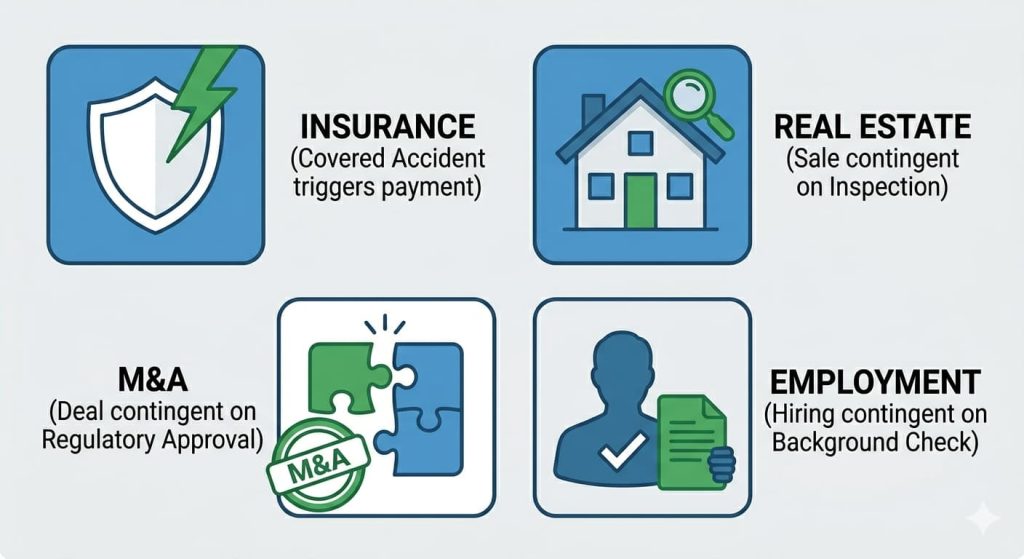
Real-world contingent contract examples span a wide range of industries and transactions. Here are some of the most commonly encountered ones.
Insurance Contracts
Insurance is one of the clearest contingent contract examples. The insurer agrees to pay a specified amount only if a covered event occurs, such as an accident, fire, flood, or medical emergency. If the event does not occur, the insurer has no payment obligation during the policy period.
Real Estate Transactions
Property sale agreements frequently contain contingency clauses. A buyer may agree to purchase a property only if the home inspection reveals no structural issues, or only if the buyer secures a mortgage loan within a set period. The seller is not obligated to transfer title until these conditions are satisfied.
Mergers and Acquisitions
In M&A transactions, parties often make obligations contingent on regulatory approvals, antitrust clearances, or due diligence outcomes. A company may agree to acquire another business only if no material adverse change occurs before the closing date.
Employment Agreements
An employer may offer a position to a candidate contingent on the candidate passing a background verification check or clearing a medical assessment. The employment agreement is not enforceable until the specified condition is met.
Business Investment Agreements
An investor may agree to provide additional funding to a startup only if the startup meets specific performance milestones, such as acquiring a certain number of customers or reaching a revenue target within a defined period.
Software and Technology Contracts
A software deployment agreement may be contingent on the vendor passing a security audit. The client’s payment obligation arises only after the audit produces a satisfactory result.
These examples show how contingent contracts allow parties to enter agreements while managing uncertainty effectively.
Enforcement Rules for Contingent Contracts
The enforcement of contingent contracts in India is primarily governed by Sections 32 to 36 of the Indian Contract Act, 1872. These sections set out the rules for when a contingent contract can be enforced and when it becomes void.
Section 32: Contracts Contingent on the Happening of an Event
A contingent contract to do or not to do something, if an uncertain future event happens, cannot be enforced by law unless and until the event has actually happened. If the event becomes impossible, the contract becomes void.
Section 33: Contracts Contingent on the Non-Happening of an Event
A contingent contract based on the non-happening of an uncertain event can be enforced when the happening of that event becomes impossible.
Section 34: When Future Conduct of a Person Renders the Condition Impossible
If a contract is contingent on how a person will act in the future, the event is considered impossible if that person does anything that makes it permanently impossible for them to act in the required manner.
Section 35: Contracts Contingent on an Event Within a Fixed Time
If a specified event does not happen within the time fixed, or becomes impossible before the time expires, the contingent contract becomes void. If the contract is based on an event not happening within a fixed time, it may be enforced when the time expires without the event occurring.
Section 36: Agreements Contingent on Impossible Events are Void
Any agreement contingent on an impossible event is void from the beginning, even if the parties did not know the event was impossible at the time of contracting.
Key Enforcement Principles
- The specified event must have actually occurred (or become impossible) before a court will enforce the contract.
- Courts look at whether the condition was clearly defined and measurable.
- Vague or subjective conditions create enforcement difficulties and are often a source of disputes.
- Time-bound contingencies must be assessed at the expiry of the fixed period.
In jurisdictions outside India, the general principles of contract law apply. Courts in the United Kingdom and the United States similarly require that the triggering condition be clearly stated, possible to occur, and not entirely within the control of one party.
Contingent Contract vs Absolute Contract
The distinction between a contingent contract and an absolute contract is one of the first things legal professionals need to understand when drafting or reviewing agreements.
| Basis | Contingent Contract | Absolute Contract |
| Performance | Depends on a future uncertain event | Unconditional, must be performed as agreed |
| Enforceability | Only when the triggering event occurs | Immediately enforceable upon formation |
| Risk | Shared between parties based on the condition | Falls squarely on the party that fails to perform |
| Flexibility | Allows for uncertainty and conditions | Requires certainty of obligation |
An absolute contract is a straightforward promise to perform a specific act. A contingent contract, by contrast, links that promise to a condition. If the condition is not met, performance is not required and the contract may become void.
Contingent Contract vs Wagering Agreement
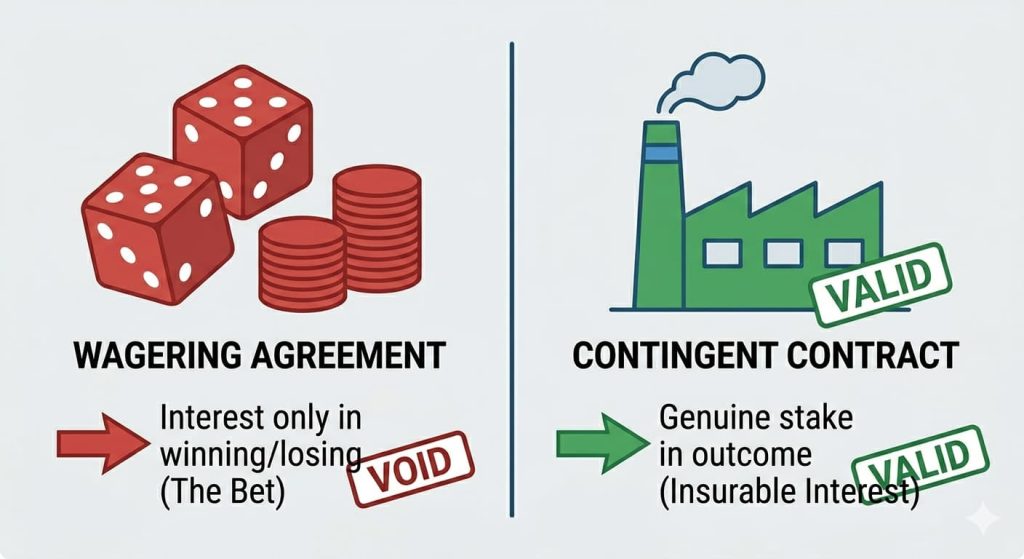
Another comparison that frequently comes up is between a contingent contract and a wagering agreement. While they may appear similar on the surface, they are legally distinct.
Contingent Contract
- Parties have a genuine interest in the outcome of the event.
- The event is collateral to the main purpose of the contract.
- Valid and enforceable under law.
- Example: An insurance policy where the insured has a genuine interest in avoiding loss.
Wagering Agreement
- Parties have no genuine interest in the event beyond winning or losing.
- The uncertain event is the sole subject matter of the agreement.
- Void and unenforceable under Section 30 of the Indian Contract Act, 1872.
- Example: A bet on which team wins a cricket match.
The key distinction lies in the genuine interest of the parties. In a contingent contract, the event serves the broader purpose of the agreement. In a wagering agreement, winning or losing is the only purpose.
All wagering agreements are contingent contracts in structure, but not all contingent contracts are wagering agreements.
Importance of Contingent Contracts
Contingent contracts serve several practical purposes in business and legal practice.
Risk Allocation
By linking obligations to specific conditions, parties can distribute risk in a way that reflects the actual uncertainty of a situation. Neither party bears an obligation until the risk crystallises.
Facilitating Agreement Under Uncertainty
When parties disagree about how the future will unfold, a contingent contract allows them to proceed without having to resolve every uncertainty upfront. Each party accepts the terms knowing their obligations will only arise in specific circumstances.
Reducing Disputes
Because the triggering conditions are agreed upon in advance, there is less room for interpretation disputes about what should happen when circumstances change.
Enabling Complex Transactions
Many multi-party transactions, such as joint ventures, staged investments, and regulatory-dependent deals, would not be possible without contingent structures. These agreements allow parties to commit in principle while waiting for external conditions to be resolved.
Self-Enforcing Mechanism
When conditions are clearly defined, contingent contracts become partially self-enforcing. The parties themselves can determine whether the condition has been met, reducing the need for court intervention.
Common Challenges in Contingent Contracts
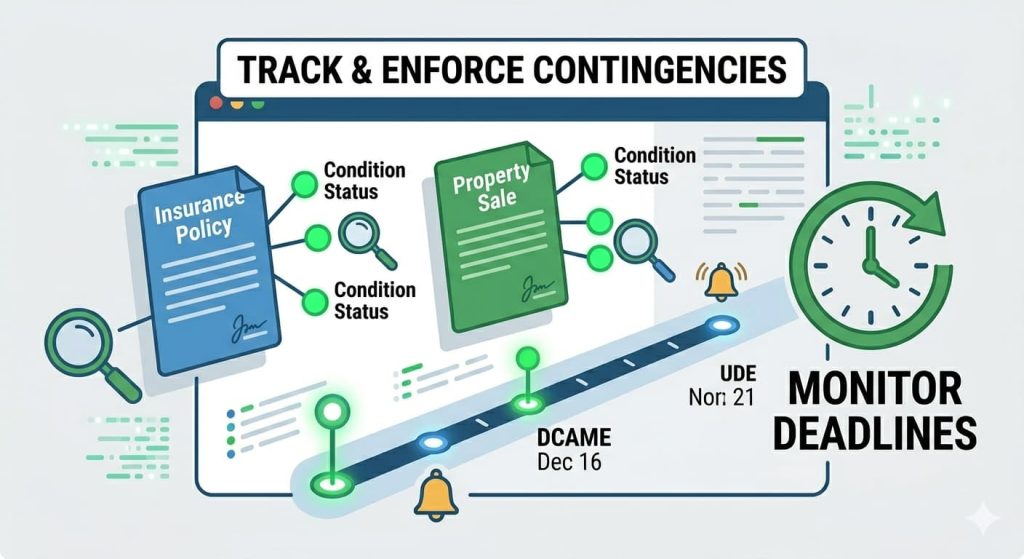
Despite their advantages, contingent contracts come with practical challenges that legal teams should anticipate.
Vague Condition Language
One of the most common issues is poorly drafted conditions. Terms like “adequate financing,” “satisfactory performance,” or “reasonable approval” are subjective and open to dispute. Conditions must be specific, measurable, and verifiable by objective standards.
Tracking and Monitoring
In contracts with multiple contingencies or long waiting periods, tracking the status of conditions can become administratively burdensome. Missing a deadline or failing to notice that a condition has been met can create legal complications.
Disputes Over Whether a Condition Was Met
Parties frequently disagree on whether a condition was actually satisfied. Without clear measurement criteria, these disputes often end up in litigation or arbitration.
Impossible or Contradictory Conditions
Drafting errors can result in conditions that are impossible to meet, or that contradict each other. A contract with an impossible condition is void from inception, which means neither party gets the benefit of the agreement.
Uncertainty Over Timelines
Contingent contracts without clear deadlines can remain open-ended, creating uncertainty for both parties about when their obligations will be triggered.
How Contract Management Tools Help
Managing contingent contracts manually is prone to errors, particularly in organisations that handle a large volume of agreements. Tracking multiple conditions, deadlines, and triggering events across hundreds of contracts requires a structured system.
Contract management platforms like Legistify help legal teams centralise their contract repositories, extract key clause information, and set automated reminders for condition-related deadlines. For teams handling contracts with performance conditions, regulatory approvals, or staged payment terms, having visibility into the status of each contingency reduces the risk of missed triggers and non-compliance.
Structured contract data also makes it easier for in-house legal teams to report on obligations and provide accurate updates to business stakeholders when contingency conditions are approaching resolution.
Conclusion
Contingent contracts are a core part of modern commercial and legal practice. They allow parties to enter into binding agreements while managing uncertainty by tying obligations to specific future events.
Understanding the contingent contract definition, the different types of contingent contract, and the enforcement rules that apply is essential for lawyers, in-house legal professionals, and anyone involved in drafting, reviewing, or negotiating agreements.
The key takeaways are straightforward. The triggering condition must be clearly defined, genuinely uncertain, legally possible, and external to the contract. Enforcement follows once the condition is met or definitively cannot be met. Poorly drafted conditions are the leading source of disputes in contingent agreements, making precision in language critical.
For legal teams managing contracts at scale, combining strong drafting practices with effective contract management processes reduces risk and ensures that obligations are tracked accurately from formation to performance.
Frequently Asked Questions
What is the contingent contract meaning in simple terms?
A contingent contract is an agreement where one or both parties are required to perform only if a specific future event occurs or does not occur. Until the triggering event is resolved, neither party is obligated to act. It is essentially a conditional promise tied to an uncertain external event.
What are the main types of contingent contract?
The main types of contingent contract include contracts contingent on the happening of an event, contracts contingent on the non-happening of an event, contracts contingent on events within a fixed time, contracts contingent on events not happening within a fixed time, contracts based on the future conduct of a person, and contracts contingent on impossible events (which are void).
Can a contingent contract be enforced in court?
Yes, a contingent contract can be enforced in court, but only after the triggering condition has been satisfied. If the event on which the contract is based has occurred (or has become impossible, depending on the structure), the contract becomes enforceable and a court can compel performance.
What is the difference between a contingent contract and a wagering agreement?
A contingent contract is valid and enforceable. The parties have a genuine interest in the outcome of the event, and the event is collateral to the main purpose of the contract. A wagering agreement is void because the only purpose of the agreement is to win or lose based on an uncertain event, with no genuine interest in the subject matter beyond the bet itself.
What makes a contingent contract void?
A contingent contract becomes void in the following situations: if the event on which it is based becomes impossible; if the contract is based on an event that was already impossible at the time of formation; or if a time-bound event does not occur within the fixed period and the contract is conditioned on that event happening. In all these cases, neither party is required to perform.