Contracts are the backbone of every business relationship – from vendors, customers, employees, to partners. However, as businesses scale, the number of contracts increases, and so do the complexities of compliance. Handling this complexity manually is no longer feasible.
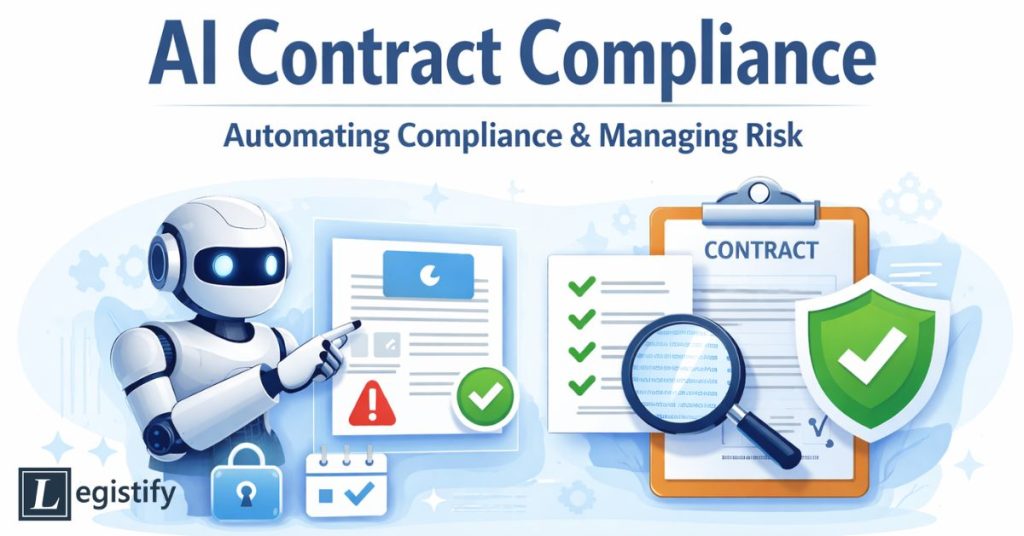
AI Contract Compliance is a solution that leverages the power of artificial intelligence and natural language processing (NLP) to automate the review, monitoring, and governance of contracts. Rather than relying on periodic audits and spreadsheets, businesses can now move towards continuous intelligent compliance throughout the contract lifecycle.
Many organizations exploring what is contract compliance and the broader contract compliance meaning are now turning to advanced contract compliance software to modernize their processes.
What is AI Contract Compliance?
What is AI Contract Compliance?
AI contract compliance is the use of artificial intelligence technology, especially machine learning and natural language processing, to examine, monitor, and control contractual agreements in a systematic and automated manner.
In the past, contracts have been maintained as static files. AI turns them into structured data assets that can be searched, categorized, and analyzed in real-time.
Fundamentally, AI contract compliance allows companies to:
- Automatically identify important contract clauses and obligations
- Identify potentially risky or non-standard language
- Monitor performance metrics and deadlines
- Comply with internal playbooks and regulatory requirements
- Trigger alerts and compliance reports
Rather than responding to contract compliance problems after they happen, companies can now prevent them from happening in the first place through intelligent contract compliance monitoring powered by AI-driven contract compliance tools.
Why Traditional Contract Compliance Falls Short
Contract compliance before AI was a manual-intensive process. Lawyers and procurement teams reviewed contracts line by line, used spreadsheets to track contract obligations, and performed periodic audits to assess risks, often relying on a basic contract compliance audit checklist.
This process has several drawbacks:
1. Manual Overload
As the number of contracts grows, the ability to review them does not scale. This leads to a backlog of reviews and gaps in oversight.
2. Human Error
Even the most skilled professionals can miss nuanced details or high-risk language, especially in large document sets.
3. Fragmented Systems
Contracts are frequently maintained in separate departments, with no overall visibility. This makes interdepartmental contract compliance challenging and weakens structured compliance contracting practices.
4. Reactive Oversight
Traditional contract compliance involves scheduled reviews, not real-time monitoring. Often, by the time a risk is identified, financial or legal harm has already occurred.
5. Revenue Leakage
Unnoticed renewal deadlines, untracked price escalations, and unmonitored performance terms can have a direct effect on revenue.
In a regulatory environment that is growing more complex by the day, manual contract compliance cannot keep up, especially when compared to modern contract compliance management software solutions.
How AI Contract Compliance Works
AI contract compliance follows a systematic, multi-step approach to translate unstructured legal language into actionable intelligence.
1. Contract Ingestion and Structuring
Contracts are loaded into a single platform. AI technology employs text recognition software and NLP to translate unstructured language into structured data. This enables searching and machine-readability.
In a regulatory environment that is growing more complex by the day, manual contract compliance cannot keep up, especially when compared to modern contract compliance management software solutions.
2. Automated Clause Extraction
AI algorithms identify and classify contractual clauses such as:
- Indemnity
- Limitation of liability
- Termination rights
- Payment terms
- Confidentiality agreements
- Governing law
These clauses are extracted and compared to predetermined company standards or approved templates. Any variance is automatically highlighted.
This significantly shortens the initial review period.
3. Risk Detection and Language Analysis
AI technology examines language patterns to detect:
- Ambiguities in terms
- Unconventional language
- Omitted protective clauses
- Inconsistencies in regulations
- Unusual liability risks
More sophisticated systems can also suggest more secure alternative language consistent with company policies.
This enables a shift from reactive to proactive risk management.
4. Obligation and KPI Tracking
One of the most effective uses of AI in contract compliance is its ability to track obligations automatically.
AI identifies the most important obligations in a contract, such as:
- Payment terms
- Delivery terms
- Service level agreements
- Reporting obligations
- Renewal terms
- Termination notice periods
These obligations are then tied to reminders and tracking systems, making it impossible to forget important obligations.
Late payments and poor performance become a thing of the past.
5. Continuous Monitoring
While traditional contract compliance is done on a quarterly basis, AI allows for continuous monitoring. This means that:
- Real-time notifications can be sent
- Renewals can be tracked
- Compliance status can be checked
- Performance can be tracked
Continuous monitoring ensures that contract compliance becomes a part of everyday business, rather than something that needs to be done on a quarterly basis.
Key Benefits of AI Contract Compliance
1. Speed and Scalability
AI processes thousands of contracts in minutes, whereas it would take human teams weeks or even months.
2. Accuracy
AI applies the same logic to contracts. It does not suffer from fatigue or miss important details, resulting in fewer errors.
3. Cost Savings
Enterprises save money on:
- Legal contract review costs
- In-house administrative overheads
- Fines for non-compliance
- Loss of revenue
The total savings can be significant.
4. Better Risk Management
Identifying risks during the contract drafting and negotiation phase helps enterprises avoid contract disputes and non-compliance issues before they arise.
5. Better Visibility and Governance
Contract management dashboards enable enterprises to track:
- Compliance status
- Obligation fulfillment
- Risk exposure
- Renewal pipelines
This visibility supports better strategic decision-making.
6. Business Agility
AI-powered contract review and automated compliance enable enterprises to move quickly on:
- Vendor onboarding
- Procurement cycles
- Sales contracting
- Contract modifications
Enterprises can respond quickly to changing market conditions without losing control.
AI Contract Compliance vs Traditional Compliance
| Traditional Compliance | AI Contract Compliance |
| Manual clause review | Automated clause extraction |
| Spreadsheet tracking | Integrated dashboards |
| Periodic audits | Continuous monitoring |
| Reactive risk management | Proactive risk detection |
| Limited scalability | Enterprise-wide scalability |
AI does not just improve existing processes; it completely transforms them.
Real-World Applications
AI contract compliance is especially useful in contract-heavy industries.
Financial Services
Tracking regulatory clauses, risk, and vendor compliance.
Healthcare
Verifying contracts are in compliance with data privacy and patient protection regulations.
Manufacturing and Supply Chain
Tracking supplier contracts, delivery terms, and penalty clauses.
Technology and SaaS
Managing subscription contracts, renewals, and service level agreements.
Government and Public Sector
Strictly maintaining audit trails and regulatory compliance.
In each of these industries, the sheer volume and complexity of contracts necessitates automation.
AI Within the Contract Lifecycle
AI contract compliance is fully integrated throughout the entire contract life cycle:
- Drafting – Standardized clause usage
- Negotiation – Risky deviations identified
- Approval – Data-driven insights
- Execution – Structured agreements stored
- Post-Signature – Obligations and compliance tracked
Organizations can develop a closed-loop system for contract compliance by integrating AI throughout the entire life cycle.
Implementation Considerations
For a successful implementation of AI contract compliance, organizations should concentrate on the following:
- Standardized clause libraries
- Compliance playbooks
- Contract repositories
- Integration of AI tools with ERP and CRM systems
- Training on workflow integration
A planned implementation will help in maximizing the return on investment.
The Future of AI Contract Compliance
As artificial intelligence continues to develop, the process of contract compliance will become more predictive and autonomous.
The future may bring the following capabilities:
- Predictive risk scoring
- Automated negotiation insights
- Regulatory update integration
- Smart compliance agents that automatically trigger workflow actions
Contracts will no longer be simply agreements, but rather intelligent systems integrated into enterprise infrastructure.
Conclusion: A Strategic Imperative
AI contract compliance is a paradigm shift from manual contract monitoring to intelligent contract monitoring.
Organizations can benefit from AI contract compliance in the following ways:
- Faster processing
- Higher accuracy
- Lower costs
- Better control over compliance
- Increased business agility
In the current scenario, where the business and regulatory environment is highly complex, manual contract monitoring is not an effective option. AI contract compliance helps organizations turn contracts from static documents to dynamic risk management tools.
FAQs
What does AI compliance mean?
AI compliance is the use of artificial intelligence to ensure that processes, systems, or contracts are in compliance with the law, regulations, and organizational policies.
How is AI used in contracts?
AI is applied in contracts to automatically analyze clauses, identify risks, extract obligations, and ensure compliance with the contract throughout its life cycle.
What is the meaning of contract compliance?
Contract compliance is the process of ensuring that all parties involved are in compliance with their obligations in the contract and that the contract is in compliance with the law and organizational policies.