
An arbitration clause is a provision in a contract that requires the parties to resolve disputes arising from the contract through arbitration rather than through court litigation. It is one of the most commercially significant provisions in any commercial contract and one of the most frequently negotiated.
The arbitration clause takes effect at the point of dispute. When a disagreement arises between the contracting parties and one or both want to pursue a formal legal remedy, the arbitration clause determines the forum, the rules, the seat, and the procedure for that process.
In India, the arbitration clause derives its legal force from the Arbitration and Conciliation Act, 1996. A valid arbitration clause gives an arbitral tribunal the authority to hear the dispute in place of a court, and its award, once made, is generally enforceable as a decree of the court.
What an Arbitration Clause Is
An arbitration clause is an agreement to arbitrate future disputes. It is contained within a larger commercial contract and becomes operative when a dispute arises under that contract.
The distinction between an arbitration clause and an arbitration agreement is technical but important. An arbitration clause is embedded in the main contract as one of its provisions. A separate arbitration agreement is a standalone document that governs the arbitration of disputes under a specified relationship or existing dispute. Both are valid under the Arbitration and Conciliation Act, 1996, and both are referred to in the Act as “arbitration agreements”.
The arbitration clause has a legal character that is separate from the main contract. Under the doctrine of separability, recognised under Section 16 of the Arbitration and Conciliation Act, the arbitration clause survives even if the main contract is found to be void, voidable, or unenforceable. This means that even a dispute about whether the main contract is valid can be referred to arbitration.
Why Arbitration Clauses Are Used
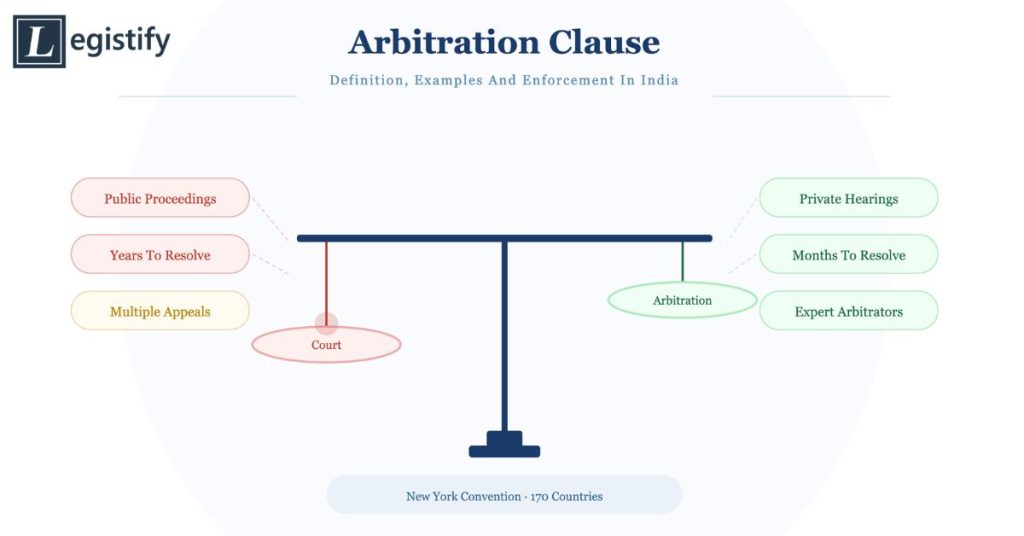
Confidentiality. Court proceedings in India are public. Arbitration proceedings are private. For commercial disputes involving sensitive business information, trade secrets, or reputational considerations, arbitration allows the dispute to be resolved without public disclosure.
Expertise of the decision-maker. Courts of general jurisdiction handle all types of disputes. Arbitrators in commercial arbitration can be chosen for their specific expertise in the relevant field: construction disputes decided by engineers or construction lawyers, IP disputes decided by IP specialists, financial disputes decided by finance professionals. This expertise can produce more commercially informed awards.
Speed. Indian court litigation is notoriously time-consuming. Commercial courts and the commercial divisions of High Courts have reduced timelines for commercial disputes, but the case backlog remains significant. Arbitration, particularly institutional arbitration with defined timelines, can produce a final award significantly faster than court litigation.
Finality. Arbitration awards are generally final with limited grounds for challenge. The Arbitration and Conciliation Act restricts the grounds on which an arbitral award can be set aside to specific categories: incapacity of the parties, invalidity of the arbitration agreement, improper notice, excess of jurisdiction, improper tribunal composition, non-arbitrability, and public policy. This limited right of challenge can reduce the total time to resolution compared to court litigation, where multiple levels of appeal are available.
Enforceability internationally. India is a signatory to the New York Convention on the Recognition and Enforcement of Foreign Arbitral Awards. A foreign arbitral award from a New York Convention country can be enforced in India, and an Indian arbitral award can be enforced in the courts of other New York Convention countries. This makes arbitration particularly appropriate for contracts with international parties where cross-border enforcement may be needed.
Key Elements of an Arbitration Clause
A well-drafted arbitration clause covers five essential elements.
1. Scope of disputes
The arbitration clause defines which disputes are referred to arbitration. The scope can be broad, covering “any dispute arising out of or in connection with this agreement”, or narrower, covering only specific categories of dispute.
A broad scope clause is generally preferred. Disputes about whether the main contract is valid, disputes about the interpretation of the arbitration clause itself, and disputes arising from events connected with the contract are all within the scope of a well-drafted broad clause. A narrow scope clause may leave disputes outside the arbitration framework and expose the parties to court litigation for matters they intended to arbitrate.
2. Number of arbitrators
Indian commercial arbitration typically uses either a sole arbitrator or a tribunal of three arbitrators. The choice depends on the contract value, the expected complexity of disputes, and the cost preferences of the parties.
For lower-value contracts and straightforward dispute types, a sole arbitrator is typically more cost-effective and faster. For high-value contracts or complex disputes, a three-member tribunal provides additional expertise and the comfort of a majority decision rather than a single arbitrator’s judgment.
Under the Arbitration and Conciliation Act, the parties are free to specify the number of arbitrators. If the clause is silent on the number, the Act provides that the tribunal shall consist of a sole arbitrator.
3. Appointment mechanism
The arbitration clause typically specifies how the arbitrator or arbitrators are appointed. Common approaches:
Party appointment. Each party appoints one arbitrator, and the two party-appointed arbitrators agree on the presiding arbitrator. If they cannot agree, the presiding arbitrator is appointed by an institution or court. This is the traditional mechanism for three-member tribunals.
Institutional appointment. The parties refer the appointment to an arbitral institution, such as the Indian Council of Arbitration (ICA), ICADR, MCIA, or an international institution such as SIAC or ICC. The institution appoints the arbitrator or arbitrators from its panel.
Sole arbitrator by agreement. The parties agree on a named sole arbitrator or on a selection process for a sole arbitrator.
Institutional arbitration, where the appointment mechanism is handled by the institution, avoids the delays that can arise from party appointment disputes. Under the Arbitration and Conciliation Act (as amended in 2019), where parties have agreed on a procedure but one party refuses to cooperate, the other party can approach the Supreme Court or the High Court for appointment, but this adds time and cost.
4. Seat and venue of arbitration
The seat of arbitration is the legal home of the arbitration. It determines which country’s law governs the arbitration procedure, which courts have supervisory jurisdiction over the arbitration, and where the award is considered to be made. The seat is a legal concept, not necessarily a physical location.
The venue of arbitration is where the arbitration proceedings physically take place. Hearings can be held at a venue different from the seat, including in a different country.
For Indian domestic contracts, the seat is typically specified as a city in India: Mumbai, Delhi, Bangalore, or another commercial centre. This ensures that Indian courts have supervisory jurisdiction and that Indian procedural law applies.
For international contracts, the choice of seat is a significant negotiation point. Indian counterparties often prefer Mumbai or Singapore as the seat. International counterparties may prefer Singapore, London, or Paris. Each seat has implications for procedural law, court supervision, and enforceability.
5. Governing law of arbitration
The arbitration clause should specify the law governing the arbitration agreement itself. This may be the same as the governing law of the main contract or different from it. For Indian domestic contracts, Indian law typically governs both the main contract and the arbitration agreement. For international contracts, the parties need to confirm whether the governing law of the arbitration agreement is the same as the seat’s law.
Example Arbitration Clauses
Simple domestic arbitration clause
“Any dispute, controversy, or claim arising out of or relating to this agreement, or the breach, termination, or invalidity thereof, shall be settled by arbitration in accordance with the Arbitration and Conciliation Act, 1996. The seat of arbitration shall be Mumbai, India. The arbitration shall be conducted by a sole arbitrator appointed by mutual agreement of the parties. If the parties cannot agree on the appointment of a sole arbitrator within 30 days of the dispute being raised, the arbitrator shall be appointed by the High Court of Bombay on the application of either party. The language of the arbitration shall be English. The award of the arbitrator shall be final and binding on the parties.”
Institutional arbitration clause (MCIA)
“All disputes arising out of or in connection with this agreement, including any question regarding its existence, validity or termination, shall be referred to and finally resolved by arbitration under the MCIA Rules, which Rules are deemed to be incorporated by reference into this clause. The seat of arbitration shall be Mumbai, India. The language to be used in the arbitral proceedings shall be English. The number of arbitrators shall be three.”
Escalation clause (negotiation before arbitration)
“The parties shall first attempt to resolve any dispute arising out of or in connection with this agreement through good faith negotiations between senior representatives of each party. If the dispute is not resolved within 30 days of written notice of the dispute being given (or such longer period as the parties may agree in writing), either party may refer the dispute to arbitration in accordance with [arbitration provisions].”
Common Drafting Issues in Arbitration Clauses
Pathological clauses. An arbitration clause that is so vague or contradictory that it cannot be given effect is called a pathological clause. Examples include clauses that refer to a non-existent arbitral institution, clauses that specify inconsistent procedural rules, and clauses that leave the appointment mechanism so unclear that it cannot be implemented. Pathological clauses may result in court litigation despite the parties’ intention to arbitrate.
Opting out of institutional rules. Parties sometimes include institutional rules by name but then impose conditions that conflict with those rules. The interaction between the parties’ contractual terms and the institutional rules needs to be carefully considered.
Failure to specify the seat. A clause that specifies a venue for hearings without specifying the seat creates uncertainty about which courts have supervisory jurisdiction and which law governs the arbitration procedure. The seat and the venue should be expressly distinguished where they differ.
Unlimited escalation periods. Escalation clauses that require negotiation before arbitration but do not fix the maximum escalation period can be used to delay arbitration indefinitely. The escalation period should be defined and short.
The Arbitration and Conciliation Act, 1996 and Recent Amendments
The Arbitration and Conciliation Act, 1996 is the governing statute for both domestic and international arbitration in India. Key provisions include:
Section 7: Defines the arbitration agreement and its requirements. An arbitration agreement must be in writing, contained in a document signed by the parties, an exchange of letters or other communications, or a statement of claim and defence.
Section 8: Requires a court to refer parties to arbitration when one party raises a valid arbitration agreement, unless the court finds the agreement null and void, inoperative, or incapable of being performed.
Section 11: Governs the appointment of arbitrators by the Supreme Court or High Court where the parties cannot agree.
Section 16: Confirms the kompetenz-kompetenz principle and the separability of the arbitration clause: the tribunal can rule on its own jurisdiction, and the arbitration clause survives the invalidity of the main contract.
Section 34: Specifies the limited grounds on which an arbitral award can be set aside by a court.
Section 36: An arbitral award is enforceable as a decree of the court, making the enforcement process straightforward once the setting-aside period has passed.
The 2015 and 2019 amendments to the Act significantly strengthened the arbitration framework: introducing timelines for completing arbitration proceedings, expanding the grounds for challenging arbitrators, creating a dedicated institutional arbitration framework under the Arbitration Council of India, and restricting the court’s ability to grant stays of arbitral proceedings.
Arbitration vs Litigation in India: A Practical Comparison
| Dimension | Arbitration | Court Litigation |
| Confidentiality | Private proceedings | Public proceedings |
| Timeline | Defined in rules or statute | Uncertain, often lengthy |
| Expertise of decision-maker | Chosen by parties | General jurisdiction judge |
| Cost | High upfront, lower overall | Lower upfront, higher overall |
| Appeal | Very limited | Multiple levels available |
| International enforcement | New York Convention | Bilateral treaty or case-by-case |
| Interim relief | Available from tribunal and courts | Available from courts |
For high-value commercial disputes between sophisticated parties, arbitration is generally preferred in India. For lower-value disputes, court litigation may be more cost-effective. For disputes involving public sector parties, arbitration is increasingly used pursuant to standard government contract clauses.
Conclusion
The arbitration clause is one of the most consequential provisions in a commercial contract. Its drafting determines where and how disputes are resolved, which courts have supervisory jurisdiction, and how awards are enforced. A well-drafted arbitration clause provides a clear, efficient, and confidential pathway to dispute resolution. A poorly drafted one produces the uncertainty, delay, and cost that the clause was supposed to avoid.
For Indian enterprise legal teams, the arbitration clause in every significant commercial agreement should be reviewed against the key elements: scope, number of arbitrators, appointment mechanism, seat, and governing law. The standard institutional clauses provided by MCIA, ICA, and other recognised institutions provide a reliable starting point for most domestic commercial contracts.
Frequently Asked Questions
What is an arbitration clause?
An arbitration clause is a provision in a contract that requires the parties to resolve disputes arising from the contract through arbitration rather than court litigation. It specifies the rules, procedure, seat, and appointment mechanism for the arbitration. Under the Arbitration and Conciliation Act, 1996, a valid arbitration clause gives the arbitral tribunal authority to hear the dispute, and the resulting award is enforceable as a decree of court.
What makes an arbitration clause valid under Indian law?
Under Section 7 of the Arbitration and Conciliation Act, 1996, an arbitration agreement must be in writing. It can be contained in a document signed by the parties, in an exchange of correspondence, or in a statement of claim and defence in which one party asserts the existence of the arbitration agreement and the other does not deny it. The clause must refer to a defined dispute resolution process. A clause that is so vague as to be incapable of being given effect is invalid.
What is the difference between the seat and venue in arbitration?
The seat of arbitration is the legal home of the arbitration. It determines which courts have supervisory jurisdiction, which country’s arbitration law governs the procedure, and where the award is considered to be made. The venue is where the physical hearings take place. Hearings can be held in a different city or country from the seat. The seat must be expressly specified in the arbitration clause; if it is not, there may be uncertainty about which courts have supervisory jurisdiction.
Can a court in India refuse to enforce an arbitration clause?
A court in India must refer parties to arbitration when a valid arbitration agreement exists and one party raises the agreement before submitting their first statement on the merits of the dispute (Section 8). The court can refuse to refer if the arbitration agreement is null and void, inoperative, or incapable of being performed. Courts have interpreted these exceptions narrowly, consistent with India’s pro-arbitration policy.
What are the grounds for setting aside an arbitral award in India?
Under Section 34 of the Arbitration and Conciliation Act, 1996, an arbitral award can be set aside on the following grounds: a party was under some incapacity; the arbitration agreement is invalid; a party was not given proper notice or was unable to present their case; the award deals with matters outside the scope of the arbitration; the composition of the tribunal or the arbitral procedure was not in accordance with the parties’ agreement; the subject matter of the dispute is not capable of settlement by arbitration; or the award conflicts with the public policy of India. These grounds are narrowly interpreted and most arbitral awards in India are not successfully challenged.