
Contracts are the foundation of almost every business relationship. They set out what each party is expected to do, when they must do it, and what happens if they do not. When one party fails to meet those expectations, it gives rise to a breach of contract.
Understanding breach of contract is essential for lawyers, in-house legal teams, and law firm professionals. A clear understanding of what constitutes a breach, what types exist, and what remedies are available helps legal teams respond effectively, manage risk proactively, and advise clients with confidence.
This blog covers the breach of contract meaning, the key types, real-world examples, available legal remedies under Indian law, and the challenges legal teams commonly face when handling these disputes.
What Is Breach of Contract?
A breach of contract occurs when one party to a legally binding agreement fails to fulfill its obligations under that agreement, without a lawful excuse. This failure can take many forms: non-payment, non-delivery, incomplete performance, or a refusal to perform altogether.
Under Indian law, Section 37 of the Indian Contract Act, 1872, establishes the general rule that parties to a contract must perform, or offer to perform, their respective promises, unless performance has been dispensed with or excused under the Act or any other law. Section 39 goes further, addressing what happens when a party refuses to perform its promise in its entirety, or disables itself from performing it: in such cases, the other party is entitled to treat the contract as ended, unless they have signified, by words or conduct, that they still intend to continue with it.
For a breach of contract claim to succeed, there must first be a valid and enforceable contract in place. That contract must clearly establish the obligations of each party. The non-breaching party must then demonstrate that those obligations were not met and that they suffered a loss as a result.
In simple terms, the breach of contract meaning can be summarised as: one party made a promise, and did not keep it.
Why Breach of Contract Matters for Legal Teams
Breach of contract disputes are among the most common legal issues that businesses face. For in-house legal teams, they arise across commercial agreements, vendor contracts, employment arrangements, and service agreements. For law firms, they represent a significant share of commercial litigation.
The financial and reputational consequences of a breach can be substantial. A party that suffers a breach may lose revenue, incur additional costs, or face disruption to its business operations. Understanding the legal position early is important for deciding whether to negotiate, pursue formal remedies, or take preventive action.
For legal professionals, knowing how to identify and classify a breach quickly is the starting point for every other decision in the dispute.
Elements Required to Establish a Breach of Contract
Before a legal team pursues any remedy, it is important to confirm that the essential elements of a breach of contract claim are present. Courts generally look for the following:
- A valid contract: There must be an offer, acceptance, consideration, and an intention to create legal relations.
- Clear contractual obligations: The specific duties of each party must be identifiable from the terms of the agreement, consistent with the obligation to perform set out under Section 37 of the Indian Contract Act, 1872.
- Non-performance: The accused party must have failed to meet one or more of those obligations.
- Causation and loss: The non-breaching party must have suffered a loss that was caused by the failure to perform, in line with the compensation principles under Section 73 of the Act.
If any of these elements is missing or difficult to establish, the viability of the claim may be affected. This is why precise contract drafting matters so much at the outset.
Types of Breach of Contract
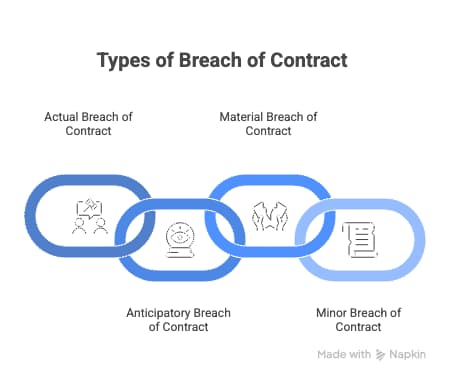
Not all breaches are the same. The nature of the breach determines how serious the legal consequences are and which remedies become available. There are four main types of breach of contract that legal professionals should understand.
1. Actual Breach of Contract
An actual breach of contract is the most straightforward type. It occurs when a party has failed to perform its contractual obligations by the agreed date or has performed them incompletely or defectively.
An actual breach of contract can be either material or minor, depending on the severity of the failure. A contractor who completes a building project but installs the wrong fixtures has committed an actual breach. A supplier who fails to deliver goods entirely has also committed an actual breach, though the consequences in each case may differ significantly.
2. Anticipatory Breach of Contract
An anticipatory breach occurs when one party clearly indicates, before the performance date, that it will not be fulfilling its obligations. This can be communicated through a direct statement or through conduct that makes it obvious that performance will not take place. Under Indian law, this is directly addressed by Section 39 of the Indian Contract Act, 1872, which entitles the non-breaching party to treat the contract as ended once the other party has refused to perform or disabled itself from performing.
The significance of an anticipatory breach is that the non-breaching party does not need to wait until the deadline passes to take action. They can treat the contract as terminated immediately and begin pursuing remedies, including finding an alternative supplier or service provider to minimise their losses.
3. Material Breach of Contract
A material breach is a significant failure that goes to the heart of the contract. It deprives the non-breaching party of substantially what they were entitled to expect from the agreement.
A material breach entitles the non-breaching party to treat the contract as discharged and to claim damages. For example, a software company that delivers a product entirely different from what was specified has committed a material breach. The client is not required to accept partial or inadequate performance.
4. Minor Breach of Contract
A minor breach, sometimes called a partial breach, occurs when a party performs most of its obligations but fails on a specific, less critical aspect. The overall purpose of the contract is still achieved, but there is a deviation from the agreed terms.
A vendor who delivers goods one day late but otherwise meets all specifications may have committed a minor breach. In such cases, the non-breaching party may still be entitled to damages for any loss caused by the deviation, but they cannot treat the contract as discharged.
Breach of Contract Examples
Real-world breach of contract examples help illustrate how these principles apply in practice. The following scenarios are common across different sectors.
Non-Payment of Invoices
A manufacturing company agrees to pay a raw material supplier within 30 days of delivery. The goods are delivered on time, but payment is withheld without explanation. This is an actual breach of contract. The supplier may claim the outstanding amount plus any interest or consequential losses arising from the non-payment.
Failure to Deliver Services
A digital marketing agency enters into a 12-month retainer agreement with a retail company. After three months, the agency stops delivering reports and ceases all work without providing notice or returning any fees. This is a material breach of contract. The client may terminate the agreement and claim damages for the cost of engaging an alternative agency and for any business losses during the period of non-performance.
Anticipatory Refusal to Perform
A construction firm is contracted to complete a commercial fitout by a specific date. Two months before the deadline, the firm’s director writes to the client stating that the company is unable to proceed due to financial difficulties. This constitutes an anticipatory breach. The client can immediately treat the contract as terminated and seek a replacement contractor, without waiting for the deadline to pass.
Defective Performance
A software development company delivers a product to a financial services client. The software fails to meet the security standards specified in the contract, and significant rework is required. This is an actual breach of contract, likely material depending on the extent of the failure. The client may claim the cost of rectification or seek a substitute performance.
Late Delivery Under a Supply Agreement
A logistics provider misses a delivery window specified in a supply contract. The buyer receives the goods two weeks late, causing production delays. Depending on the terms of the contract, this may constitute a minor or material breach. If the contract contains a liquidated damages clause for late delivery, the buyer may rely on that provision, and on Section 74 of the Indian Contract Act, 1872, to calculate compensation.
Remedies for Breach of Contract Under Indian Law
When a breach of contract has occurred, the non-breaching party has a range of legal remedies available. In India, these remedies are primarily set out in Sections 73 to 75 of the Indian Contract Act, 1872, alongside the Specific Relief Act, 1963. The appropriate remedy depends on the type of breach, the loss suffered, and the terms of the contract itself.
1. Compensatory Damages
Compensatory damages are the most common remedy for breach of contract. Section 73 of the Indian Contract Act, 1872, provides that the party who suffers from a breach is entitled to compensation for any loss or damage caused to them which naturally arose in the usual course of things from the breach, or which the parties knew, at the time they made the contract, was likely to result from it. Remote or indirect loss is not recoverable under this section. These damages aim to put the non-breaching party in the financial position they would have been in had the breach not occurred, not to punish the party at fault.
There are two main categories of compensatory damages:
- Expectation damages: These cover the loss of the benefit the party expected to receive under the contract, such as lost profit.
- Consequential damages: These cover losses that flow indirectly from the breach but were foreseeable at the time the contract was formed, such as lost business opportunities caused by a supply failure.
The foreseeability principle underlying Section 73 draws on the same reasoning as the English case Hadley v Baxendale (1854), which Indian courts have consistently applied when interpreting what losses “naturally arise” from a breach or were reasonably within the contemplation of the parties.
2. Liquidated Damages
Liquidated damages are a pre-agreed amount specified in the contract that will be payable in the event of a breach. Under Section 74 of the Indian Contract Act, 1872, where a contract names a sum payable in case of breach, or stipulates a penalty, the aggrieved party is entitled to reasonable compensation not exceeding the amount named, regardless of whether actual loss or damage is proved. They are commonly used in construction, logistics, and technology contracts, where delays or failures can cause quantifiable losses.
Indian courts retain discretion to determine what constitutes “reasonable compensation” under Section 74, and will not automatically award the full stipulated amount simply because it was written into the contract. If the amount is considered a penalty designed to punish rather than genuinely pre-estimate the likely loss, the court may reduce it.
3. Specific Performance
Specific performance is an equitable remedy that requires the breaching party to fulfill its obligations under the contract, governed in India under the Specific Relief Act, 1963. It is typically awarded when monetary compensation is insufficient to remedy the harm, and where the subject matter of the contract is unique or irreplaceable.
This remedy is most commonly seen in contracts for the sale of land or unique assets. Courts will not generally order specific performance for contracts involving personal services or where performance is no longer feasible.
4. Rescission
Rescission allows the non-breaching party to cancel the contract entirely and be restored to their pre-contractual position. Section 75 of the Indian Contract Act, 1872, specifically provides that a party who rightfully rescinds a contract is entitled to compensation for any damage sustained through the non-fulfilment of the contract. Rescission is typically available where the breach is material or where the contract was entered into based on misrepresentation, mistake, duress, or fraud.
Rescission effectively unwinds the agreement, and both parties are relieved of their remaining obligations. Any payments already made may need to be returned.
5. Injunction
An injunction is a court order that requires a party to do something or refrain from doing something. In the context of breach of contract, an injunction may be used to prevent a party from continuing to breach a negative obligation, such as a non-compete clause or a confidentiality agreement. In India, injunctions in contract disputes are typically granted under the Specific Relief Act, 1963.
Injunctions can be temporary (pending the outcome of proceedings) or permanent. They are awarded at the discretion of the court and are generally only granted where damages alone would be an inadequate remedy.
6. Nominal Damages
Nominal damages are a small, token award made by the court when a breach has been established but no significant financial loss can be proven. They serve to confirm that the non-breaching party’s legal rights were violated, even if the practical harm was minimal.
While a nominal damages award may seem like a limited victory, it can be significant in some cases, particularly where a contract includes an attorney fee clause that is triggered by any damages award.
Notable Breach of Contract Cases
Examining established breach of contract cases, both English precedent that continues to inform Indian judicial reasoning and the underlying statutory framework, helps legal professionals understand how courts approach these disputes.
1. Hadley v Baxendale (1854)
This foundational English case established the principle that damages for breach of contract should be limited to losses that were within the reasonable contemplation of both parties at the time the contract was formed. Indian courts have repeatedly applied this same foreseeability reasoning when interpreting Section 73 of the Indian Contract Act, 1872, which similarly limits recoverable damages to losses that naturally arose from the breach or were known to the parties as a likely consequence at the time of contracting.
2. Hochster v De La Tour (1853)
This case established the doctrine of anticipatory breach in English law. The court held that when one party repudiates a contract before performance is due, the other party may treat the contract as immediately terminated and bring a claim without waiting for the performance date. In India, this same outcome is achieved through Section 39 of the Indian Contract Act, 1872, which entitles the aggrieved party to treat the contract as ended once the other party refuses to perform or disables itself from performing.
3. Photo Production Ltd v Securicor Transport Ltd (1980)
This case addressed the enforceability of exclusion clauses in commercial contracts. The House of Lords confirmed that a clearly drafted exclusion clause could limit liability even in the event of a material breach, reinforcing the importance of precise contract drafting. Indian courts take a broadly similar approach, generally upholding clearly worded exclusion and limitation of liability clauses provided they do not offend public policy or the requirements of free consent under the Indian Contract Act, 1872.
These cases illustrate that the courts take a structured approach to breach of contract disputes, and that the specific terms of the agreement, along with the nature of the breach, will significantly influence the outcome.
Challenges in Breach of Contract Disputes
Breach of contract disputes are not always straightforward. Legal teams regularly encounter a range of challenges when assessing and pursuing these claims.
1. Proving the Breach
Establishing that a breach occurred requires clear evidence of what the contract required and how the other party fell short. Ambiguous contract language, missing documentation, or incomplete performance records can all make this difficult.
2. Quantifying Loss
Even where a breach is clear, calculating the actual financial loss is often complex. Legal teams must gather evidence of lost profits, additional costs, and consequential losses, while anticipating arguments about the foreseeability and mitigation of those losses.
3. The Duty to Mitigate
In most legal systems, the non-breaching party has a duty to take reasonable steps to mitigate its losses after a breach occurs. Failure to do so can reduce the damages recoverable. Legal teams should advise clients to document mitigation efforts carefully from the moment a breach becomes known.
4. Contractual Defences
A party accused of breach may raise a range of defences, including impossibility of performance, frustration of contract, force majeure, or the argument that the other party itself committed a prior breach. Each of these requires careful analysis of the contract terms and the surrounding circumstances.
5. Limitation Periods
Breach of contract claims must be brought within a specified limitation period, which varies by jurisdiction. Missing this deadline can extinguish the claim entirely, regardless of its merit. Legal teams should identify the applicable limitation period at the outset of any dispute.
How Legal Teams Can Reduce Breach Risk
Prevention is always preferable to litigation. Legal teams can take several practical steps to reduce the likelihood of breach and to protect the organisation’s position if a breach does occur.
1. Draft contracts with precision.
Clearly defined obligations, timelines, payment terms, and performance standards leave less room for disputes about what was required. Vague language is one of the most common contributors to contract disputes.
2. Include dispute resolution and notice clauses.
Contracts should specify the steps parties must take if a breach is suspected, including notice requirements and escalation procedures. This can help resolve disputes early and avoid unnecessary litigation.
3. Use liquidated damages clauses where appropriate.
In high-value or time-sensitive contracts, pre-agreed damages clauses under Section 74 of the Indian Contract Act, 1872, provide certainty and remove the need to prove actual loss in the event of specific types of breach.
4. Monitor contractual obligations actively.
Keeping track of deadlines, deliverables, payment schedules, and renewal dates is essential. Many breaches occur not through deliberate intent but through poor contract management. Platforms like Legistify help legal teams centralise contract data, set automated reminders, and monitor obligations across the entire contract portfolio, making it easier to identify and address potential issues before they escalate.
5. Document everything.
If a dispute does arise, contemporaneous records of communications, deliverables, and performance will be critical. Legal teams should establish documentation practices from the moment a contract is signed.
Conclusion
Breach of contract is one of the most common legal issues in commercial practice, and the consequences can range from minor financial adjustments to significant litigation and reputational damage. Understanding what constitutes a breach, how to categorise it, and what remedies are available under the Indian Contract Act, 1872, is fundamental knowledge for any legal professional.
The types of breach of contract, from actual breach of contract to anticipatory breach, each carry different legal implications. The remedies available, including compensatory damages under Section 73, liquidated damages under Section 74, rescission under Section 75, specific performance, and injunctions under the Specific Relief Act, 1963, serve different purposes and apply in different circumstances. Real-world breach of contract examples and established breach of contract cases provide important context for applying these principles in practice.
For legal teams, the most effective approach is a combination of clear contract drafting, active contract management, and a thorough understanding of the legal options available when things go wrong.
Frequently Asked Questions
What is breach of contract in simple terms?
A breach of contract occurs when one party to a legally binding agreement fails to fulfill their obligations under that agreement without a valid legal excuse. This could involve non-payment, failure to deliver goods or services, defective performance, or a refusal to perform.
What are the main types of breach of contract?
The main types of breach of contract are actual breach (where a party has already failed to perform), anticipatory breach (where a party indicates in advance that they will not perform), material breach (a serious failure that undermines the core purpose of the contract), and minor breach (a partial failure that does not deprive the other party of the main benefit of the agreement).
What is the difference between actual breach and anticipatory breach?
An actual breach of contract occurs after the performance deadline has passed and the obligation has not been met. An anticipatory breach occurs before the deadline, when one party makes it clear through words or conduct that they will not be performing their obligations. In the case of anticipatory breach, the non-breaching party can act immediately without waiting for the breach to materialise.
What remedies are available for breach of contract?
Under the Indian Contract Act, 1872, the main remedies for breach of contract include compensatory damages under Section 73 (financial compensation for losses suffered), liquidated damages under Section 74 (pre-agreed sums specified in the contract), specific performance and injunctions under the Specific Relief Act, 1963, and rescission under Section 75 (cancellation of the contract with compensation for damage sustained).
Can a breach of contract be resolved without going to court?
Yes. Many breach of contract disputes are resolved through direct negotiation, mediation, or arbitration without the need for court proceedings. Most contracts include dispute resolution clauses that require parties to attempt informal resolution before commencing litigation. Resolving disputes at an early stage is generally faster, less costly, and helps preserve the business relationship where possible.