

An addendum is a separate document that adds new information or terms to an existing contract without changing its original wording, while an amendment changes, deletes or replaces existing terms. The word addendum comes from Latin and means something to be added, and its plural is addenda. Both become binding once all parties sign them.
Contracts are rarely static. As business relationships develop, certain terms need clarification, expansion, or modification, and businesses usually turn to an addendum or an amendment. The two terms are often used interchangeably, but they have distinct purposes, and using the wrong one can create confusion over which terms apply to the contract.
This guide explains the difference between addendum and amendment, when to use each, how both work under Indian law, and gives examples so you apply them correctly.
What Is an Addendum? Meaning and Definition

An addendum is a separate document that contains new information or terms to an existing contract without modifying the original language of the agreement. For clarity, the addendum definition refers to a supplemental document that becomes part of the original contract once executed.
It is like an attachment or supplement. Once signed by all parties, it becomes part of the contract and formally operates as an addendum to agreement documents already in place.
Key Characteristics of an Addendum
- Adds new clauses or information
- Does not modify or delete existing terms
- Typically attached as an exhibit or appendix
- Requires signatures from all parties
Common Use Cases
An addendum is used in the following situations:
- A new Statement of Work (SOW) is added to a master services agreement
- Additional services are introduced
- New disclosures are required
- Extra policies (such as a pet policy in a lease agreement) are added
An addendum is like adding more pages to the contract without rewriting the existing ones. The plural, addenda, simply refers to more than one addendum attached to a contract.
What Is an Amendment?

An amendment is a document that changes the original contract by modifying, deleting, or replacing some of the original contract terms. In legal practice, this is often referred to as a contract amendment. For a fuller guide, see contract amendments.
An amendment does not add new information that stands alone, but rather changes the wording or the requirements of the original contract.
Key Characteristics of an Amendment
- Changes particular clauses
- May replace clauses completely
- Must refer to the original contract
- Needs the signature of all parties
Common Use Cases
An amendment is used in the following situations:
- The price changes
- The deadline for the contract is extended
- The payment terms change
- The scope changes
- The contract needs renewal or the time needs to be shortened
Addendum and Amendment: Side-by-Side Comparison
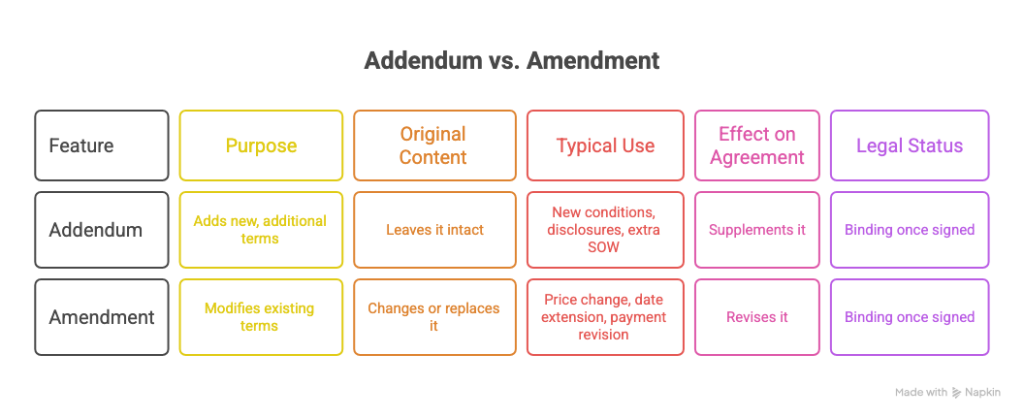
| Feature | Addendum | Amendment |
| Purpose | Adds new, additional terms | Modifies existing terms |
| Original Content | Leaves it intact | Changes or replaces it |
| Typical Use | New conditions, disclosures, extra SOW | Price change, date extension, payment revision |
| Effect on Agreement | Supplements it | Revises it |
| Legal Status | Binding once signed | Binding once signed |
| Legal basis in India | Parties’ agreement to alter the contract (Section 62) | Parties’ agreement to alter the contract (Section 62) |
Both documents are legally enforceable once properly executed. The difference lies in whether you are adding to or changing the agreement.
Timing: Before or After Signing?
An addendum is used in the following ways:
- Before the contract is signed (in order to incorporate missing information), or
- After the contract is signed (in order to incorporate new clauses)
An amendment, on the contrary, is mostly used when the contract has already been executed and the parties are agreeing to alter the original conditions.
Why the Distinction Matters
The incorrect document type may not seem a major consideration, but it leads to significant problems:
- Ambiguity about what terms apply
- Inconsistent language in the document
- Disputes about what the terms mean
- Increased legal risk
For example, a change in payment terms may be intended, but the document sent out is labelled as an addendum and does not say that it replaces the original payment clause. The contract then holds two payment terms that conflict, which leads to confusion. Courts generally look at what a document actually says rather than its title, so the document should state clearly whether it adds to or replaces an existing clause.
Accurate documentation leads to:
- Transparency between the parties
- Version control
- Improved contract management
- Lower legal risk
Addendum and Amendment Under Indian Law
The Indian Contract Act, 1872 does not define the terms addendum or amendment. Both rest on the parties’ agreement to alter a contract, which Section 62 recognises: if the parties to a contract agree to substitute a new contract for it, or to rescind or alter it, the original contract need not be performed.
- Mutual consent is required. All parties to the original contract must agree and sign. A change made by one party without the consent of the others is unlikely to be enforceable.
- It alters the same contract. An addendum or an amendment changes or adds to the existing contract. If the change replaces a party or the whole contract, it is a novation instead.
- Check the formalities. Stamp duty and registration requirements depend on the applicable law and on the nature of the original contract, such as certain leases, so check them before signing.
How to Properly Draft an Addendum
If you are preparing an addendum, you should:
- Clearly indicate the addendum by using the title “Addendum.”
- Make a reference to the contract.
- Clearly indicate that it is a supplement.
- State that all other terms remain the same.
- Ensure all the parties sign it.
This is to ensure that the addendum is fully integrated into the existing contract without any changes to the clauses that were previously established.
How to Properly Draft an Amendment
When writing an amendment, it should be:
- Clear in its title, which should read “Amendment.”
- Specifically indicate the original agreement.
- State which section is being changed.
- Include quotes, if necessary, and the new version.
- Include a statement that all other terms remain valid.
- Include signatures from all parties.
Precision is key when writing an amendment. The document should be clear and specific, indicating what is being changed, otherwise, it might be misinterpreted.
Practical Examples
Now, let’s consider two examples of simple situations:
Scenario 1: Adding a New Service
A master service agreement is executed between a company and a service provider. Later, the company wants to add a new service, which was not included in the original master service agreement.
Solution: Adding a new SOW through an addendum.
Scenario 2: Modifying the Contract Period
Two parties agree to extend their contract period by six months.
Solution: Modifying the term clause through an amendment.
Best Practices for Contract Updates
Whether by addendum or amendment:
- Obtain mutual consent
- Control versioning
- Store documents with the original contract
- Systematically control changes
- State which document prevails if it conflicts with the original contract
- Check the stamp duty and registration requirements before signing
- Eliminate the practice of relying on emails to reach an agreement
A well-managed process for contract amendments reduces risks and improves operational ease.
How Legistify Helps Legal Teams Manage Addenda and Amendments
Every addendum and amendment adds a document that has to be linked to the original contract, reviewed, signed and found again later. Legistify is an AI-native legal operations platform for enterprises, and its contract lifecycle management tools help legal teams handle each of those steps.
- Consistent drafting: Legistify AI CLM works as a Microsoft Word add-in with a clause library and playbooks, so addendum and amendment clauses follow the same standard across contracts.
- Version control and review: Contracts are shared in real time, and track changes and version control make it easy to compare versions before a change is signed.
- Approvals: Approval workflows route changes to the right approver, so a revised price or scope is reviewed before it is executed.
- Signing: The e-signature module supports Aadhaar integration and keeps a secure audit trail of signature activity.
- One record: Executed documents are stored in a central repository with AI-powered search, which makes it easy to keep each addendum and amendment with its original contract.
Explore Legistify’s collaboration and negotiation, contract workflow, and e-signature features to see how they fit your team’s contracts.
Conclusion
An addendum is an addition of new information into the contract without affecting the current conditions.
An amendment, on the other hand, involves changing, deleting, or replacing the current conditions in the contract.
Both documents are legally binding if signed correctly. However, the appropriate document is vital for effective contract management.
The difference between the two is not just technical. It is vital for effective and dispute-free relationships.
FAQs
What is the meaning of addendum in law?
An addendum is a separate document that adds new information or terms to an existing contract without changing its original wording. The word comes from Latin and means something to be added, and its plural is addenda. Once all parties sign it, an addendum becomes part of the original contract.
What is an example of an addendum?
An example of an addendum is the addition of a new Statement of Work (SOW) into an already established master services agreement without any alteration to the original contract.
How does an addendum differ from an amendment?
An addendum adds new contract terms and leaves the original wording untouched, while an amendment changes, deletes or replaces existing terms. Both are binding once signed by all parties.
What is an amendment?
An amendment is the alteration of an original contract by modifying, deleting, or replacing original contract terms.
Is an addendum legally binding?
Yes. An addendum is legally binding once it is signed by all parties to the original contract, and it becomes part of that contract. Under the Indian Contract Act, 1872, it rests on the parties’ agreement to alter the contract, which is recognised in Section 62.