Contract Management

Check all the Contract Management articles here.

A Complete Guide to Contract Management for Modern Businesses

Contracts are the backbone of contemporary business relationships, covering sales, procurement, partnerships, employment, and compliance. However, many organisations are still struggling with disorganised contracts, manual approval processes, and missed contract obligations. This is where what is contract management becomes a critical question for growing organisations. By embracing a systematic way of managing contracts from inception to completion, organisations can minimise risks, maximise efficiency, and tap into the full potential of every contract. What is Contract Management? Contract Management, also known as Contract Lifecycle Management (CLM), is the end-to-end process of contract creation, negotiation, execution, and management of legally binding contracts. The main purpose of contract management is to ensure that contracts are compliant, obligations are fulfilled, risks are mitigated, and financial performance is optimised. Instead of considering contracts as static documents, contract management considers contracts as living documents that need to be constantly watched over throughout their lifecycle. Modern contract management is highly dependent on standardised processes, contract lifecycle management tools, and technology. Why Contract Management Is Important Contract management affects the legal and financial health of an organisation. Ineffective contract management can lead to risks such as non-compliance, loss of revenue, and delays. The most important reasons why contract management is important include: Key reasons contract management matters include: The Contract Management Process (Lifecycle) A well-managed contract involves a systematic, multi-step contract process that follows a lifecycle: 1. Request / Initiation The contract management lifecycle starts with the recognition of a business requirement. Essential details like contract type, parties, scope, timelines, and commercial terms are collected to establish the need for the contract. 2. Drafting & Authoring The contract is authored by using standardised templates and approved clauses, often starting from a predefined contract template. This helps in maintaining consistency, minimising legal risks, and speeding up the contract development process, particularly for commonly used contracts. 3. Negotiation The contract draft is reviewed and marked up by both parties using redlining and version control. Negotiation is centered on harmonising commercial terms, obligations, and risk-sharing until a mutually agreeable contract is arrived at. 4. Review & Approval The completed draft is sent for approval. The legal, financial, and business teams examine the agreement to ensure it complies with company policies and regulations. 5. Execution The agreement is signed, and the contract becomes enforceable. Most companies have adopted electronic signatures to expedite the process and provide a secure audit trail. 6. Obligation Management & Monitoring After signing, the agreement is monitored for performance. Critical obligations, milestones, service levels, and expiration dates are closely tracked often through a centralised contract management dashboard to ensure mutual obligations are met during the life of the contract. 7. Renewal or Closure When the agreement is about to expire, it is either renewed, modified, or terminated depending on performance and business requirements. Completed agreements are stored for future use and audit purposes. Common Challenges in Contract Management However, due to its significance, organisations may still experience the following challenges: These issues highlight the need for structured processes and centralised systems supported by modern contract management tools. Best Practices for Effective Contract Management 1. Use a Centralised Contract Repository Maintaining all contracts in a secure and searchable digital repository ensures a single source of truth and facilitates easy accessibility. 2. Automate Contract Workflows Automated approval, notification, and reminder systems minimise human errors, shorten turnaround times, and ensure that no critical deadline is overlooked. 3. Standardise Templates and Clauses Pre-approved templates and clause libraries facilitate quick contract drafting with minimal legal and compliance risks. 4. Ensure Cross-Functional Collaboration Contract management should be done by the collaboration of legal, sales, procurement, and finance departments to avoid silos and alignment. 5. Conduct Regular Audits and Reporting Regular audits help to identify areas of compliance, performance, and cost savings. 6. Adopt AI and Analytics The use of AI contract management solutions can help to extract key information, detect high-risk clauses, and offer insights to make informed decisions. Key Benefits of Contract Management When done correctly, contract management offers tangible benefits: Role of Contract Management Software Contract Management Software (CLM) is a centralised system that enables contract management throughout the entire contract life cycle, from contract drafting and negotiation to contract execution, monitoring, and renewal. CLM enables the automation of contract-related workflows, monitoring of contract obligations, and collaboration between different functions, making contract management a more organised and proactive process. This is particularly important as organisations expand and adopt advanced contract lifecycle management tools. How We Enable Contract Management at Legistify At Legistify, we help organisations manage the complete contract lifecycle on a single platform. We centralise contracts, streamline drafting and approvals, and use AI-driven tools to identify risks and extract key data. With automated alerts, digital execution, and real-time visibility into obligations and renewals, we enable teams to stay compliant, reduce manual effort, and maximise the value of every contract. Legistify assists organisations in handling the entire contract life cycle from a single interface. It organises contracts, simplifies contract drafting and approval, and uses AI-powered technology to scan contracts for risks and extract essential information. With automated notifications, electronic signing, and constant monitoring of contracts and renewals, Legistify empower organisations to remain compliant and make the most out of contracts. Conclusion Contract management is no longer a mere administrative function but has become a strategic business function. By following a structured lifecycle, best practices, and the use of technology, contract management can be used as a powerful tool for risk management and efficiency. FAQs

A Complete Guide to Contract Management for Modern Businesses Read More »

What Is a Contractual Agreement?

What Is a Contractual Agreement? Definition, Types, and Legal Remedies

In the world of business and personal transactions, contractual agreements are the basis of trust, accountability, and legal certainty. Whether it is the hiring of an employee, a vendor, a lease agreement for property, or the purchase of goods, contractual agreements establish the rights and responsibilities of the parties involved, especially in the context of a contractual agreement in business. It is important to have an understanding of what a contractual agreement is, the different types of contracts, and their legal implications to avoid any kind of disputes and ensure that the contract is enforceable. This article will discuss the definition of contractual agreements, the legal aspects of contractual agreements in Indian law, the different types of contracts, and their legal implications. What Is a Contractual Agreement? A contract agreement is a binding promise between two or more parties that establishes enforceable rights and duties, commonly referred to as a contractual agreement between two parties. In simpler words, it is an agreement that is recognised and enforced by the law, which explains the contractual agreement meaning in practical terms. Although the words “agreement” and “contract” are often used interchangeably, they are not the same. An agreement can only be considered a contract if it meets certain legal requirements. If not, the agreement may be valid in theory but not enforceable in a court of law. Legal Definition Under Indian Law According to Section 2(h) of the Indian Contract Act, 1872, a contract is defined as “an agreement enforceable by law.” This definition of a contract emphasizes the following two aspects: An agreement becomes a contract only if it fulfills the requirements set by law, and thus becomes enforceable by law. Essential Elements of a Valid Contract For a contractual agreement to be valid and enforceable, the following elements must be present in the agreement: 1. Offer An offer is a specific and definite proposal made by one party to another, showing willingness to enter into a contract on certain terms. 2. Acceptance Acceptance is the act of the other party agreeing to the offer without any conditions or alterations. Acceptance must match exactly with the terms of the offer. 3. Lawful Consideration Consideration is something of value given in exchange between the two parties, such as money, goods, services, or a promise to do or refrain from doing something. Consideration must be lawful. 4. Capacity to Contract The parties to a contract must possess legal capacity. This requires that they be of legal age, of sound mind, and not disqualified by law. 5. Free Consent The consent must be free and not affected by coercion, undue influence, fraud, misrepresentation, or mistake. 6. Intention to Create Legal Relations The parties must intend that the agreement be legally binding. Social or domestic agreement lack this intention and are therefore not enforceable. 7. Lawful Object The object of the contract must be legal. Agreements with illegal objects are void and therefore unenforceable. Types of Contractual Agreements Contracts can be categorized in various ways depending on the formation, performance, and validity of the contract. 1. Types of Contracts Based on Formation Express Contracts Express contracts are made through the use of explicit language, either written or verbal. This is the most common type of contract. Implied Contracts Implied contracts are created through the actions or behavior of the parties involved. The contract is not created through written or verbal language. The intention to create a contract is inferred from the circumstances. Quasi-Contracts Quasi-contracts are not created by agreement but are created by law to avoid unjust enrichment. They are used to ensure fairness where one party is enriched at the expense of another. 2. Types of Contracts Based on Performance Executed Contracts In an executed contract, both parties have completely performed their obligations. Executory Contracts An executory contract is one where the obligations of one or both parties are yet to be performed. Unilateral Contracts In unilateral contracts, one party gives a promise in return for an act. The contract arises only after the act is performed. Bilateral Contracts Bilateral contracts involve mutual promises where both parties are bound to perform their respective promises. 3. Types of Contracts Based on Validity Valid Contracts Valid contracts are those that satisfy all the legal requirements and are fully enforceable by law. Void Contracts A void contract is an unenforceable contract from the start, which is either illegal or impossible. Voidable Contracts Voidable contracts are valid contracts that can be cancelled at the discretion of one of the parties, which is often due to the absence of free consent. Contingent Contracts Contingent contracts are dependent on the occurrence or absence of an uncertain future event. Common Examples of Contractual Agreements Contractual agreements are used across various personal and commercial contexts, serving as practical contractual agreement examples, including: Legal Implications of a Contractual Agreement Breach of Contract Breach of contract takes place when one of the parties involved in the contractual agreement fails to fulfill their obligations. There are two types of breaches of contract: Remedies for Breach of Contract In case of a breach of contract, the affected party can file a lawsuit against the other party for the following remedies: When Is a Contract Not Enforceable? Certain agreements are not enforceable under law, including: Importance of Contractual Agreements in Business Contractual agreements play a crucial role in business operations and regulatory alignment, including adherence to a contractual compliance agreement, by: Conclusion A contract is more than just a piece of paper; it is a legal binding document that regulates the relationship between the parties involved. The definition, types, and legal aspects of contracts are important to ensure that one protects his or her interests. A contract can only be effective if it is drafted in a clear manner and meets the legal requirements. FAQs

What Is a Contractual Agreement? Definition, Types, and Legal Remedies Read More »

what is an electronic contract

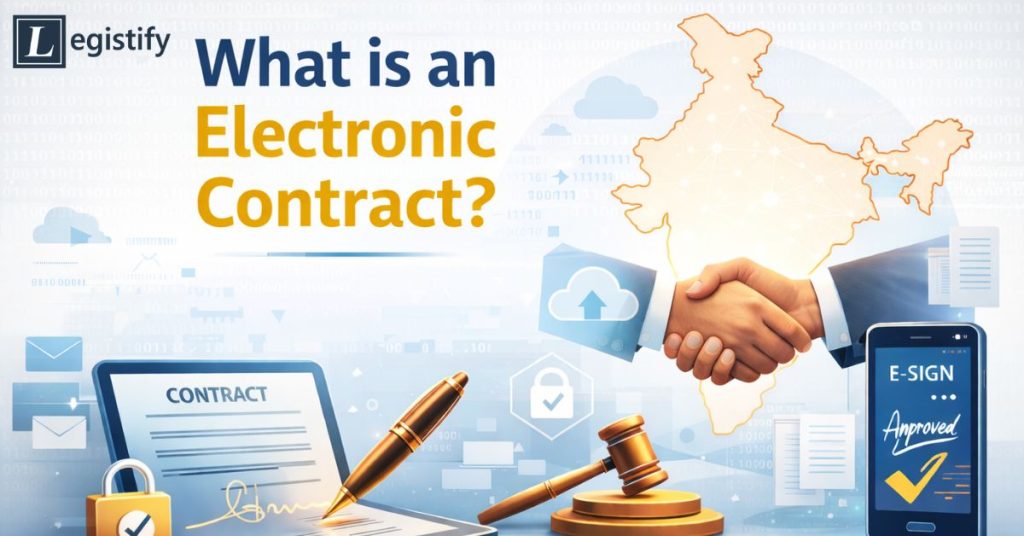
What Is an Electronic Contract? Types, Validity & Benefits in India

In the modern digital-first business world, contracts are no longer confined to mere pen-written agreements around a table. Today, businesses negotiate and conclude agreements through emails, hire employees remotely, and engage in business through digital platforms such as the internet. The center on which this modern business practice revolves is electronic contracts, also referred to as E-contracts. Electronic contracts are an important facet of modern business transactions. This ranges from clicking on ‘I Agree’ on a website to electronic contract signing in a business agreement. One must note that these are not informal agreements; rather, these are legally binding agreements that are valid under Indian law once the legal conditions are fulfilled. Through this blog, we aim to give an overall idea of what is e contract, their process of execution, types of electronic contracts, their validity from a legal perspective in India, their benefits, and their challenges. What Is an Electronic Contract? The e-contract is a type of contract that is created, negotiated, and executed with the use of electronic media, while physical paper and handwritten signatures are avoided. It involves digitally creating an agreement using emails, websites, mobile applications, online forms, or electronic signature platforms, often supported by an electronic contract management system. So, essentially, an electronic contract is no different from a conventional contract. There is a difference only with regard to the media of communication and execution of the contract. Definition of Electronic Contracts An electronic contract can be defined as: A contract that is created through electronic communication methods, with the parties expressing their consent through digital means without any physical interaction or written documentation. Key Features of an Electronic Contract 1. Electronic Formation The contract is created and communicated through the use of electronic devices like computers, smartphones, or tablets. 2. Originator and Addressee 3. Digital Consent There are several electronic forms that consent may take, including: 4. No Physical Presence Required There is no requirement to physically see each other in order for the contract to be valid. How Do Electronic Contracts Work? The electronic contract formation process is exactly the same as the traditional contract formation process, but technology is involved. 1. Offer One party initiates the offer electronically using email, the internet, or an online platform. 2. Acceptance The other party agrees to the offer digitally. The acceptance needs to be clear and unambiguous, e.g., clicking an “accept” button or sending an affirmative response by email. 3. Consideration There must be something of value exchanged between the two parties, such as money, services, or goods. 4. Execution and Storage In most cases, the contract, once accepted, would then be executed electronically and stored as a digital record, very often with audit trails and timestamps. Types of Electronic Contracts Electronic contracts may be grouped into categories based on the method used to obtain consent. 1. Click-Wrap Agreements “Click-wrap agreements” require accepting the terms by clicking the “I Agree” or “Accept” box. Examples: Legal strength: The most enforcing form of an e-contract is click-wrap agreements due to the consent involved. 2. Browse-Wrap Agreements In a browse wrap agreement, the terms and conditions of the contract are presented on a website with a hyperlink, and the user is assumed to have agreed to the terms by continuing to use the website. Examples: Legal strength: They are enforceable licenses, but this is only true if users are given due notice. Lack of clarity may impair enforceability. 3. Email Contracts Contracts can be created through email as well, as long as there is: Examples: Email contracts are one of the most common these days in business transactions and are also legally valid if contractual intent is available. Legal Validity of Electronic Contracts in India Electronic contracts are legally binding and enforceable under Indian law, subject to the validity of contracts formed through electronic means as prescribed under existing contract and technology laws. Governing Laws Indian Contract Act, 1872 Electronic contracts have to fulfill all the essential elements of a valid contract, which are applicable as in any other contract. Information Technology Act, 2000 Section 10A of the IT Act specifically states that: The contract shall not be deemed unenforceable merely because it was formed electronically. This provision accords electronic contracts the same legal standing as paper-based contracts, confirming the validity of electronic contracts in India. Essential Elements of a Valid Electronic Contract To be legally binding, an electronic contract requires: 1. Offer and Acceptance There must be a lawful offer, as well as an acceptance through electronic media. 2. Lawful Consideration The contract should be one in which there is an exchange of something of value. 3. Free Consent Consent must not be obtained by coercion, fraud, misrepresentation, or undue influence. 4. Capacity of Parties The parties to the agreement must be competent to sign the contract.  5. Lawful Object The intention of the contract should not be illegal or prohibited by law. Admissibility of Electronic Contracts as Evidence In Indian Courts, electronic contracts are admissible as evidence. According to Sections 65A and 65B of the Indian Evidence Act, electronic records can be considered valid evidence if the conditions set forth in reference to them have been satisfied. This means: can all be used in legal proceedings. Benefits of Electronic Contracts Electronic contracting has major advantages over the traditional paper-based agreement. 1. Speed and Efficiency Contracts can be instantly created, shared, and signed without the lengthy process brought about by printing, scanning, or courier services. This speeds up the closing of deals and business operations. 2. Cost Savings E-contracts reduce costs related to: To organizations executing high volumes of contracts, the savings can be considerable. 3. Convenience and Accessibility Parties can enter a contract at any time and from any place without the need to arrange a physical meeting. This is advantageous for both remote teams and international transactions. 4. Security and Traceability The modern digital contracting platforms offer: These characteristics improve transparency and lower the chances of dispute related to the content. 5. Environmental

What Is an Electronic Contract? Types, Validity & Benefits in India Read More »

What Is an Electronic Signature

What Is an Electronic Signature? Meaning, Validity, and Benefits

Paperwork no longer has to mean piles of paper. With electronic signatures, you can sign documents online in just a few clicks. No printing, no scanning, no hassle. Whether it’s a business contract or a government form, e-signatures are fast, safe, and legal. You can sign documents anytime, anywhere, using your phone or laptop using an electronic signature online platform. What Is an Electronic Signature? An electronic signature, or e-signature, is a digital way to demonstrate a person’s consent or approval of an electronic document—in simple terms, this answers the question: what is an electronic signature. It can range from a simple “I agree” click to a complex cryptographically verified digital signature, which provides advanced security features. Essentially, an e-signature assists in proving three important aspects: These three aspects combine to make electronic signatures a trustworthy and accepted means of digitally signing documents and clearly explain the difference between digital signature and electronic signature in terms of security level and use cases. Types of Electronic Signatures 1. Simple Electronic Signature (SES) This is the most basic method of signing a document online. It includes: The SES method is best suited for low-risk documents, internal approvals, or when a high level of legal proof is not necessary. 2. Advanced Electronic Signature (AES) This type of signature is more secure and reliable. It involves additional security measures such as verification of identity and encryption to ensure the security of the signing process. It assists in ensuring that: AES is widely used in business contracts and documents related to compliance 3. Qualified Electronic Signature (QES) This is the most secure and legally strong type of electronic signature. It usually includes: QES is best for important, high-value, or legally regulated documents where strict compliance is required. Are Electronic Signatures Legally Valid? Yes, they are. Electronic signatures are recognized as legal in many countries across the globe, provided a few simple requirements are met. What does this mean in simple terms? Once these requirements are met, the electronic signature is considered the same as a handwritten signature and can be enforced under the law.  Legality of Electronic Signatures in India Yes electronic signatures are completely legal in India They are recognized under the Information Technology Act, 2000, which states that electronic documents and signatures will be given the same status as paper documents and handwritten signatures, provided the necessary formalities are complied with. Commonly Accepted Forms in India The most commonly used and accepted forms of e-signatures in India are: These ensure the identity of the signing individual and also secure the document. Where Electronic Signatures Are Used Electronic signatures are widely used for: Due to this legal recognition, e-signatures have become an integral part of India’s digital governance system and have made document processing faster, easier, and paperless. Documents Where E-Signatures May Not Apply Although e-signatures are sufficient for most types of paperwork, there are some documents that require a physical (handwritten) signature due to legal requirements. These typically consist of: In these cases, a physical signature is still necessary to ensure the document is valid. In summary: most paperwork can be signed online but a few important documents still require pen and paper. How Electronic Signatures Work Using an electronic signature is quite easy and simple. Here’s how it is done, including how to electronic signature PDF documents securely: 1. Upload the document The document that is to be signed is uploaded to an e-signature platform. 2. Verify the signer’s identity The system checks who the signer is. This can be done through email verification, OTP, Aadhaar-based verification, or a digital certificate. 3. Sign the document online The person signing the document adds their e-signature by clicking a button, typing their name, drawing their signature, or using a secure digital signature. This explains how to make an electronic signature. 4. Create an audit trail The system automatically records information such as date and time of signing, IP address, and activity logs. All these steps combined make the process secure, transparent, and valid, which is why electronic signatures are trusted for signing documents online. Common Uses of Electronic Signatures 1. Business & Corporate Electronic signatures simplify business operations. They are used for: 2. Financial Services In banking and financial institutions, e-signatures simplify approval and customer onboarding processes. They are used for: 3. Real Estate In real estate, e-signatures are commonly employed for: 4. Government & Compliance Government agencies and regulated sectors employ e-signatures for: In general, e-signatures help cut down on time and paperwork for approvals in various sectors Benefits of Using Electronic Signatures 1. Faster & More Efficient Documents can be signed in just a few minutes instead of taking days. This speeds up approvals and saves a lot of time. 2. More Secure E-signatures come with security features like audit trails and tamper alerts, which help prove the document is genuine and prevent misuse. 3. Saves Money No need to print, scan, courier, or store paper documents. This cuts down on extra costs and paperwork. 4. Easy & Convenient You can sign documents from anywhere, using your phone, laptop, or tablet making the whole process simple and stress-free. Electronic Signature vs Handwritten Signature  Aspect Electronic Signature Handwritten Signature Speed Signed and completed instantly Takes more time to print, sign, and send Security Secure with audit trails and encryption Easier to copy, forge, or alter Cost Very low cost—no paper or courier needed Extra costs for printing, courier, and storage Convenience Can be signed anytime, from anywhere Needs physical presence and paperwork Conclusion By using electronic signatures, organisations can work faster, cut down costs, and finish approvals much quicker without losing legal validity or security. As more work goes digital, e-signatures are no longer just a nice extra. They’ve become a must-have for modern businesses. FAQs

What Is an Electronic Signature? Meaning, Validity, and Benefits Read More »

Understanding the Essential Elements of a Contract

Understanding the Essential Elements of a Contract

Most people believe that a contract exists only when you sign some long legal document. That is not quite right, though. Even ordinary, casual actions, such as buying a cup of coffee, can be the beginning of a contract. So what exactly makes an agreement turn into a legally valid one? In this blog, we describe what constitutes the basic elements of a contract in straightforward, simple language and with relatable examples so that anyone can understand how contracts work in real life. What Is a Contract? A contract isn’t just a piece of written work, it’s worth it in that the law will back it up. If two or more parties want the same thing and satisfy some basic conditions, the agreement will be considered contractual. These principles are in place to make sure that both parties understand what’s being agreed to, and that both willingly and intentionally are entering into this contractual agreement and that the purpose is legal and fair. 7 Essential Elements of a Contract For an agreement to be legal and enforceable, a few key elements are required. These elements ensure that the agreement is clear, fair, as well as legal. 1. Offer and Acceptance (Agreement) A contract can be said to start when an individual makes an offer, and the other person accepts the offer. The acceptance made should be similar to the offer made, without changing a word. Both parties must have the same understanding. Example: “I’ll sell you my car for $5,000” (offer).“Yes, I agree” (acceptance). 2. Consideration That means, a contract is created when there is something of value going to or coming from each side. An example may be money, a product, a service, or perhaps a promise to do or not do something. If not, it is likely a promise, but not a contract. Example: One person gives the car, and the other pays $5,000. 3. Capacity to Contract All of the parties need to have the legal capacity to enter into a contract. Typically, this means being of adult age and capable of understanding their agreement. Example: A minor usually cannot enter into a binding business contract. 4. Free Consent The parties should willingly agree. The agreement will have no legal effect if one party is under compulsion, threat, fraud, or misrepresentation. Example: A contract signed because of pressure or threats does not involve free consent. 5. Lawful Object (Legal Purpose) The contract should be for something legal. If it is illegal, or if the purpose is opposed to law, then the contract is invalid. Example: An agreement to sell illegal drugs has no legal value. 6. Intention to Create Legal Relations The people involved must intend for the agreement to have legal consequences. Casual promises between friends or family usually don’t count, but business agreements usually do. The parties must intend for their agreement to have legal effect. A casual promise between friends, or between family members, isn’t likely to be counted, but an agreement between business associates probably is counted. Example: A business deal creates legal duties, while a friendly promise usually doesn’t. 7. Clear Terms and Possible Performance The terms of the contract need to be specific so that all parties know what has to be done. Also, one has to ensure that what can be promised can actually be done. Example: “Selling 100 items at ₹100 each” is clear.“Selling some items at a fair price” is too vague to enforce. Examples of Contracts Simple Contract: Everyday Transactions Lots of what we do on a daily basis is, in fact, the execution of a contract, without our thinking of it in this manner. Grocery shopping is a super simple example of this. Offer: An item is being offered for sale if it is placed on a store shelf along with the price tag. Acceptance: You accept the offer when you take the goods to the cashier to pay for them. Consideration: You pay money, and in turn, the store provides you with the commodities. Legality: Since it is legal to buy as well as to sell the items, it means that all the conditions are valid, hence an enforceable contract. Why Are the Elements of a Contract Important? The key elements in any contract are important since they ensure that the contract is valid, fair, and capable of being enforced. Every element plays its own role in ensuring that all parties in the contract are protected and that there is clarity in the future. 1. Clear understanding between both sides These elements ensure that all parties are clear about what they are contractually agreeing to, thus preventing misunderstandings in the future. 2. A real exchange of value They support that in order to have a binding contract, both sides have to be giving or receiving some sort of valuable item, which is what distinguishes a simple promise from a binding contract itself. 3. Free and willing consent They ensure that no one is compelled, deceived, or coaxed into this agreement, and that this is done through mutual and voluntary consent. 4. A legal purpose An agreement should be about something legal and should not disobey the law or public interest. 5. Can be enforced by law When all the elements are there, the agreement can be enforced in court in case one of the parties fails to honor the promise.  6. Legal clarity and protection These aspects work together to give all parties clarity, certainty, and protection. If any of these essential elements are missing, the agreement may not be legally valid and could be cancelled or not protected by law at all. Complex Contract: Software License Agreement A software license agreement is a kind of detailed contract that is very often used in these modern times. Even if you agree to its terms online, a software license agreement is governed by similar rules and regulations applicable to a legal contract. Offer: The software company is offering you a license to use its software,

Understanding the Essential Elements of a Contract Read More »

Franchise Agreements Explained: Definition, Clauses, and Examples

Considering investing in a franchise or expanding your business through franchising? Before even opening your store or installing your signboard, one paper governs all there is—the franchise agreement. In simple terms, a franchise agreement is a kind of contract or agreement between the person who owns the franchise and the person who operates the business. It has all the details about what each person will do, what each person will pay, and even how the business will be operated. It includes things like in the agreement are fees, where you may operate, and what may happen if you want to leave. This guide breaks down what a franchise agreement is all about, the key terms to understand, and how the entire process works, without legal jargon or complicated language. What Is a Franchise Agreement? A franchise agreement is a legal contract between the owner of the brand, referred to as the franchisor, and the owner of the outlet, referred to as the franchisee. Simply put, a franchise agreement defines how a particular franchise business operates, outlines responsibilities, as well as the guidelines that govern them. Essentially, the contract primarily establishes the terms of the working relationship between the parties. The franchise is giving the franchisee the use of the brand name, trademark, and the effective manner of operation. In return, the franchisee agrees to follow the brand’s rules, keep quality consistent, and pay the agreed fees. One way to think about a franchise agreement is to consider it a rule book that governs the franchise. This includes everything from how the business operates every day, from staff training to the way the business is marketed. Even in case a party wishes to dissolve the business relationship, the franchise agreement deals with all that. In this agreement, the franchisee receives an already existing business model, business systems, brand, and support. In return, the franchisee has to pay an inception fee, as well as charges on a regular basis. This business relationship helps brands grow quicker while providing business owners with a much safer approach to opening any business with an existing brand name. Why Franchise Agreements Are Important Having a franchise agreement is valuable as it maintains everything clear and organized between the owner of the brand and the owner of the franchise. In the case of the franchisor, or the owner of the brand, the franchise agreement works to protect the brand. A franchise agreement defines how the business must be operated, including operations, quality, marketing, and customer service. This ensures that each franchise operates in the same manner, irrespective of their locations. The agreement helps the franchisee (business owner) in that it works like a clear guideline or blueprint that spells out what they should be doing, what they should be getting from the brand, and what still needs to be accomplished on their part since everything is spelled out on paper. As the contract explicitly states fees, geographical areas, duties, and the process of withdrawal, there are fewer possibilities of confusion and disputes. Both parties are aware of the parameters right from the beginning. Key Terms in a Franchise Agreement Common Clauses You’ll Find in a Franchise Agreement Even though no two franchises will be alike, there will be several common terms that will be involved in most franchises that define this relationship from opening the business through an exit strategy. 1. Term and Renewal This clause will give you an indication of how long the franchise has been agreed for, as well as any rights you may have to further extend the agreement, as well as any costs that may be incurred for the renewal of the franchise. 2. Training and Support In this case, the contract states what assistance the franchisor will provide you with. This typically covers things like startup support, assistance with running the operation, and so on.  3. Marketing and Advertising Contributions In this section, the topic being discussed is marketing costs. In this section, you are being informed about whether you must contribute to national or regional advertising, or undertake local marketing, and how you are able to use the brand for marketing. 4. Compliance and Audits This clause ensures the franchisee complies with the branding standards. In addition, this clause enables the franchisor to inspect the business records or the franchise outlet to ensure everything runs according to plan. 5. Termination and Exit Conditions This section describes when and how the agreement can come to an end and related consequences, including non-payment, default, underperformance, and consequences after termination, like abandoning the brand and the brand logo. 6. Dispute Resolution In the event that there is a dispute, it goes on to provide how the dispute would be resolved. This could be by discussion, mediation, arbitration, or taking it to court, and typically states under what law this would be conducted. Together, these provide a clear understanding and avoid misunderstandings for both parties throughout the whole franchising process. Examples of Franchise Agreements Across Industries Franchise agreements are to be found in many industries. Even though the basic structure remains the same, what the agreement focuses on depends upon the type of business. 1. Food & Restaurants In food and restaurant franchises, the focus is mainly on taste, quality, and customer experience. Well-known brands such as McDonald’s, Subway, and KFC apply very detailed franchise agreements. These agreements clearly govern things like menu items, quality of food, sourcing of ingredients, cleanliness, training of staff, and service standards. This ensures that customers get the same food and experience at every outlet, no matter where it is located. 2. Retail Business franchises center on the marketing of goods with the assistance of the recognized brand name. 7-Eleven franchises and automobile franchises are good examples which contain contracts with rules and regulations regarding the store and merchandise design, and price structure. It is to ensure that all the stores look and feel the same and help the brand spread quickly across locations. 3. Services Service-based franchises

Franchise Agreements Explained: Definition, Clauses, and Examples Read More »

Cross Offer in Contract Management

Cross offer: Not Binding Contract

A Contract is an agreement between two or more parties that is enforceable by law as a binding legal agreement. The Indian Contract Act, 1872 came in to effect on September 1, 1872 and is applicable in the whole country. It governs entering into a contract, execution of the contract, and the effects of breach of contract. So for a valid contract, there should be an agreement which should also be enforceable by law. Also, the agreement must create a legal obligation or duty. Essentials of a Valid Contract All contracts are agreements but all agreements are not contracts. In order to become a contract, an agreement must satisfy following essential requirements: 1. Offer and Acceptance: For any contract, there must be at least two parties, one of them making the offer and the other one accepting it. The acceptance must be unconditional and absolute. 2. Consideration: Consideration means “something in return”. It is a benefit moving from one party to another. Consideration need not always be in cash or in kind. It may be an act or promise to do or not to do something. It may be past, present or future. Consideration must be real and lawful. A documentation lawyer in India can be consulted for drafting a contract. 3. Capacity of the Parties to Contract: The parties to an agreement must have the capacity at law to enter into a valid contract. Section 11 states that every person is competent to contract if- a) he is of the age of majority b) he is of sound mind c) he is not disqualified from entering into a contract by any law, to which he is subject 4. Free Consent: The contract must have been made with the free consent of the parties. The parties must be ‘ad idem’ i.e. they must agree upon the same thing in the same sense at the same time.                           There is an absence of free consent if the agreement is induced by 5. The Agreement must not be Expressly Declared to be Void: The agreements must not have been expressly declared to be void by any law in force in the country. A void agreement is not enforceable by law & they have no legal existence. For example, a) Agreement in restraint of Trade  b) Agreement in restraint of Marriage c) Agreement in restraint of Legal Proceedings d) Agreement of Wager etc. 6. Writing and Registration: It is in the interest of the parties that the contract should be in writing. Sometimes it needs to be stamped and registered. 7. Legal Relationship: The parties entering into the contract must have the intention to create a legal relationship. If there is no such intention the agreement will not result into a contract. 8. Certainty: The terms of the contract should be very clear. They must not be vague (not clearly expressed) or ambiguous (having two or more possible meanings). 9. Possibility of Performance: The performance must not be impossible. The contracts must be capable of being performed. Example- ‘A’ agrees with ‘B’ to discover treasure by magic and sharing of the treasure. This agreement cannot be enforced. 10. Lawful Object: The object of the agreement must be lawful i.e. neither fraudulent or forbidden by law, nor opposed to any public policy. Offer A explicit proposal to contract which, if accepted, completes the contract and binds both the person that made the offer and the person accepting the offer to the terms of the contract. The best documentation lawyers can assist in drafting a valid contract in India. Illustration: A wants to sell own car at Rs 50 Lakh, he makes a written statement stating his own willingness and sends the same to B, the same thing will be considered as an offer for B. As earlier said that offer commence the process of contract so there are some ingredients for a valid offer (1) There must be two parties. (2) The offer must be communicated to the offeree. (3) The offer must show the willingness of offeror. Mere telling the plan is not offer. (4) The offer must be made with a view to obtaining the assent of the offeree. (5) A statement made jokingly does not amount to an offer. (6) An offer may involve a positive act or abstinence by the offeree. (7) The mere expression of willingness does not constitute an offer. If these requirements are present in the offer then only it will be considered as offer otherwise not. Cross Offer Where two parties make identical offers to each other, in ignorance of each other?s offer, the offers are known as cross-offers. Cross offer never initiate the process of contract because it does not fulfill the requirements of a valid offer. There are essentials of the cross offer which are as follows: 1. Same offer to one another: When offeror makes an offer to offeree and offeree without knowing the offer which was prior made by the offeror to him, makes the same offer to offeror means the object as well as party both remains same. So both party can never make the offer on the same object to each other because if it happens then who will accept the offer and if there is no acceptance of offer then no contract can be made. 2. Offer must be in ignorance of the offer made by another: Offer should be properly communicated and should not be made in the ignorance. 3. The terms and Condition: The terms or the object must be same when it is made by the other person to the first person then only it will be considered as a cross offer because if the second offer differs from the first offer then it can be considered as a counter offer. Illustration: Sai makes an offer to Chandu to sell him a pen at RS 200 and on the same time without knowing the offer, Chandu makes the offer on the same object to Sai. So here the parties are same, the object or the thing is also same and it was made by the Chandu to sai

Cross offer: Not Binding Contract Read More »

Sales Agreement

Sales Agreements: Types, Clauses, And Best Practices

A Sales Agreement turns the verbal commitments of a sale into a formal contract that outlines what is being sold, its price, delivery conditions, and the rights of the buyer and the seller.
It creates legal certainty and commercial discipline, which help businesses close deals faster, maintain compliance, and reduce the chances of disputes.

Sales Agreements: Types, Clauses, And Best Practices Read More »