
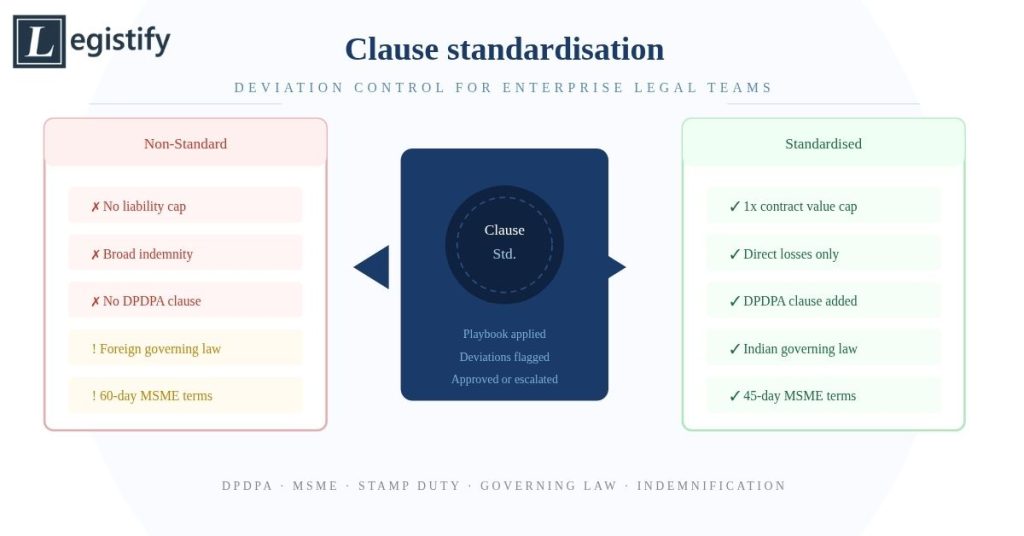
Clause standardisation is the process of defining approved language for the key provisions in an organisation’s contracts, establishing fallback positions for negotiation, and building systems to ensure that deviations from those standards are identified, escalated, and documented. For enterprise legal teams managing high volumes of contracts across multiple business units, clause standardisation is the foundation on which contract governance is built.
Without standardised clauses, every contract negotiation starts from scratch. Different lawyers apply different language to the same clause type. Business teams agree to non-standard terms without realising they deviate from the organisation’s risk position. Variations accumulate across the contract portfolio over time, creating inconsistency that is invisible until a dispute surfaces it. With clause standardisation, the legal team defines the acceptable range of language once, and the system enforces it consistently across all contracts and all business units.
This article covers what clause standardisation involves, how a clause library and playbook are structured, what deviation control looks like in practice, and the India-specific considerations that shape clause standards for enterprise legal teams operating in the Indian regulatory environment.
What Clause Standardisation Is
Clause standardisation defines three things for each key contract provision:
The standard clause. The preferred language the organisation uses when drafting its own contracts or when reviewing incoming contracts from counterparties. The standard clause reflects the organisation’s optimal risk position for that provision.
Fallback positions. The alternative language the organisation is willing to accept during negotiation, in order of preference. A fallback position acknowledges that counterparties will sometimes push back on standard language, and defines in advance how far the organisation is willing to move from its preferred position.
Escalation thresholds. The point at which a proposed clause deviates so far from the standard that it requires senior legal review or executive approval before it can be accepted. Escalation thresholds prevent business teams from agreeing to unacceptable terms without legal oversight.
These three elements together create a structured framework for contract negotiation that does not depend on individual lawyers remembering what is and is not acceptable for each clause type.
Why Clause Standardisation Matters for Multi-Business-Unit Enterprises
For enterprises operating across multiple business units, subsidiaries, and geographies, the challenge of clause consistency is compounded by the number of people involved in contracting. A procurement team in one business unit may have a different approach to liability caps than a commercial team in another. A regional legal team may apply different standards to indemnification clauses than the group legal function expects.
Organisations lose an average of 8.6% of total spending annually to contract cost leakage according to research on legal operations. A large portion of this leakage comes from non-standard contract terms that were agreed during negotiation without full understanding of their financial or compliance implications.
High-volume agreements like NDAs are negotiated only 25% of the time according to contracting benchmark data, meaning the majority of counterparties accept standard terms without pushback. This finding has a practical implication: for high-volume contract types, the investment in developing strong standard clauses produces a direct return. Counterparties who would accept the standard language receive it, reducing the negotiation burden on the legal team while maintaining the organisation’s risk position.
For the contracts that are negotiated, standardised fallback positions ensure that deviations from the standard are managed within defined parameters rather than through individual lawyer judgment on each occasion. The result is more consistent outcomes across negotiators and business units, with less risk that a one-off concession creates a precedent that gets applied more broadly.
The Clause Library: Structure and Content
A clause library is a centralised, version-controlled repository of pre-approved contract language that serves as the single source of truth for the organisation’s contract drafting and review. A well-designed clause library contains:
Clause types by contract category. Standard clauses are organised by contract type, because the appropriate language for a liability cap in a technology services agreement differs from the appropriate language in a manufacturing supply agreement. The clause library should cover each of the organisation’s main contract categories: customer agreements, supplier agreements, employment contracts, distribution agreements, NDAs, and any other recurring contract types.
Standard and fallback language for each clause type. For each clause type within each contract category, the library contains the standard language and the defined fallback positions. The fallback positions are typically organised in tiers: Tier 1 fallback is what the lawyer can agree to without escalation; Tier 2 fallback requires senior legal sign-off; beyond Tier 2 requires executive approval.
Guidance notes. Each clause entry in the library includes a note explaining the rationale for the standard position, what risk the clause is designed to protect against, and what the implications of the defined fallbacks are. This context is particularly important when business teams use the clause library directly, and for onboarding new lawyers to the legal team’s risk positions.
Version history. The clause library needs version control so that the current approved language is always distinguishable from previous versions, and so that changes to approved language are tracked and can be reviewed.
The clause library is the reference document. The playbook is the operational tool that connects the clause library to the contract review process.
The Contract Playbook: Connecting Standards to Review
A contract playbook translates the clause library into a structured guide for reviewing and negotiating contracts. It defines, for each clause type, what the reviewer should look for, how to assess what a counterparty has proposed, what fallback options are available, and when to escalate.
In a practical review workflow, the playbook is applied at the point of incoming contract review. The reviewer goes through the counterparty’s draft clause by clause, compares each provision to the playbook position for that clause type, identifies deviations, and either proposes the standard fallback or escalates, depending on the severity of the deviation.
A contract playbook for an enterprise legal team typically covers the following clause categories, among others:
Limitation of liability. The playbook defines the acceptable liability cap as a multiple of contract value or a fixed amount, specifies the exceptions to the cap (such as gross negligence, wilful misconduct, or fraud), and identifies the circumstances in which uncapped liability may be accepted.
Indemnification. The playbook defines the scope of indemnification the organisation is willing to provide, the reciprocal indemnification it requires from counterparties, and the conditions under which indemnification applies. Broad indemnification for consequential losses, lost profits, and third-party claims requires escalation.
Termination. The playbook defines acceptable notice periods for termination for convenience, the trigger conditions for termination for cause, and the financial consequences of termination that are acceptable. Termination provisions that impose substantial costs on exit or that limit the right to terminate require escalation.
Governing law and dispute resolution. The playbook specifies the preferred governing law and dispute resolution forum for each contract type and geography. For Indian enterprises, this typically means Indian law with arbitration under specified Indian arbitration rules, or jurisdiction of a specific High Court. Deviations to foreign governing law or arbitration seated outside India require escalation.
Intellectual property. The playbook defines the IP ownership position for contracts involving development work, licensing, or access to proprietary information. Work-for-hire clauses, broad IP assignment provisions, and licences with restrictions on the organisation’s ability to use its own IP all require careful playbook positions.
Confidentiality. The playbook defines acceptable confidentiality term lengths, the scope of confidential information covered, permitted disclosures, and the return or destruction of confidential information at contract end. Perpetual confidentiality obligations or unusually broad definitions of confidential information are common deviation points.
Data protection. For contracts involving the processing of personal data, the playbook defines the required data processing provisions: DPDPA compliance obligations, data localisation requirements, breach notification timelines, and data return and deletion obligations at contract end.
Deviation Control: How It Works in Practice
Deviation control is the set of processes that identify, escalate, and document departures from standard clause positions. Without deviation control, standardised clauses exist on paper but have no enforcement mechanism.
At the drafting stage
When the organisation’s team drafts a contract from a template, deviation control is primarily a template governance issue. Templates need to be maintained so that they always reflect the current standard language. Business teams who modify templates to accommodate individual deals need a process for documenting those modifications and obtaining legal sign-off where the change represents a deviation from the standard.
At the review stage
When the organisation is reviewing an incoming contract from a counterparty, deviation control is applied through the playbook review process. The reviewer identifies deviations from the standard, classifies them by severity, and either accepts within the defined fallback positions or escalates. Every deviation accepted outside the standard should be documented, noting why the deviation was accepted and what the business justification was.
Portfolio-level deviation analysis
At the portfolio level, deviation control produces data on which clause types generate the most negotiations, which business units or contract categories have the highest deviation rates, and which counterparties push back most consistently on specific clause types. This data supports two things: periodic review and update of clause standards, to ensure that fallback positions reflect actual market practice; and identification of systemic issues, where a high deviation rate on a particular clause type across multiple business units may indicate that the standard position is too aggressive relative to market norms.
AI-assisted contract review supports portfolio-level deviation analysis by applying the playbook consistently to all contracts, identifying deviations automatically, and recording them in a structured format that enables aggregate analysis. With 28% of legal professionals identifying contract review as their most impactful AI use case according to the 2025 State of AI in Legal report, deviation flagging and playbook enforcement are among the highest-value applications.
India-Specific Considerations for Clause Standardisation
Clause standardisation for Indian enterprise legal teams needs to account for regulatory requirements and commercial practices that are specific to the Indian legal environment.
DPDPA data processing clauses
The Digital Personal Data Protection Act, 2023 creates a new category of mandatory clause requirements for contracts that involve the processing of personal data of Indian citizens. Data processing agreements between data fiduciaries and data processors need to include provisions covering purpose limitation, data retention, breach notification timelines, data return and deletion obligations, and audit rights.
Clause standardisation for Indian enterprises needs to include a standard DPDPA data processing clause and defined fallback positions for each element of the clause. Given that the DPDPA framework is still evolving through implementing rules and regulatory guidance, the clause library entry for DPDPA provisions needs to be reviewed and updated more frequently than for more established clause types.
Stamp duty compliance clauses
Many Indian commercial contracts include stamp duty clauses that define which party is responsible for payment of applicable stamp duty, the process for obtaining the correct stamp, and the remedies if stamp duty is not correctly paid. These clauses need to account for the multi-state nature of stamp duty in India, where the applicable state, the instrument classification, and the rate all vary.
Standard stamp duty clauses for Indian enterprises need to address contracts executed across multiple states, and the clause library should contain state-specific variations for the states in which the organisation most frequently executes contracts.
MSME payment obligation clauses
Contracts with MSME suppliers attract specific payment obligation requirements under the MSME Development Act, including the 45-day payment window and the compound interest consequences of late payment. Standard clause language for procurement contracts with MSME suppliers should reflect these obligations, and the clause library should include a specific entry for MSME payment terms that can be applied consistently across all relevant contracts.
Regulatory compliance provisions for regulated sectors
For enterprises in financial services, insurance, or other regulated sectors, contracts with regulatory-sensitive counterparties or involving regulated activities need to include specific compliance provisions. Banks contracting with Lending Service Providers need to include the specific provisions required by the RBI’s Digital Lending Directions. Insurers contracting with distribution channels need to include provisions required by IRDAI’s Fraud Monitoring Framework Guidelines. The clause library for enterprises in these sectors needs to maintain standard regulatory compliance clauses that are updated as the relevant regulatory frameworks evolve.
Arbitration and governing law for cross-border contracts
For Indian enterprises contracting with international counterparties, governing law and dispute resolution clauses require specific consideration. Indian law and Indian arbitration forums are the standard for domestic contracts. For international contracts, the counterparty may push for foreign governing law or arbitration in Singapore, London, or another international centre. The playbook needs to define the organisation’s position on each, and the escalation threshold for accepting foreign governing law or non-Indian arbitration should reflect the additional enforcement complexity and cost that these provisions create.
Building a Clause Standardisation Programme
For legal teams that do not yet have a formal clause library and playbook, the practical starting point is not to build a comprehensive programme from scratch, but to identify the highest-frequency and highest-risk clause types in the organisation’s contract mix and standardise those first.
For most Indian enterprise legal teams, the clause types that most justify early standardisation are: limitation of liability and indemnification (highest financial impact of non-standard terms), governing law and dispute resolution (highest enforcement cost if non-standard), data protection and DPDPA provisions (highest regulatory risk if non-standard), and MSME payment terms (highest regulatory penalty risk if non-standard).
Once these core clause types are standardised and the playbook is in use, the programme can be extended to additional clause types based on the legal team’s experience of where the most problematic deviations arise in practice.
The clause library and playbook should be reviewed at least annually, and updated when regulatory changes require new standard provisions, when accumulated deviation data suggests that fallback positions need adjustment, or when the organisation enters new markets or contract categories that require new clause types.
Legistify’s contract management platform supports clause library management and playbook-based contract review, with AI-assisted deviation flagging that applies the organisation’s approved positions consistently across incoming contracts, connected to the obligation tracking and portfolio analytics layer.
Conclusion
Clause standardisation is not primarily about efficiency, though it does make the contracting process faster. It is primarily about control. When standard clause positions are defined, documented, and enforced through a playbook and deviation control process, the legal team has a basis for managing contract risk consistently across the organisation, regardless of which lawyer, business unit, or geography is involved in a given contract.
For Indian enterprise legal teams, the clause standardisation programme needs to incorporate India-specific requirements that global frameworks do not cover: DPDPA data processing provisions, MSME payment obligations, multi-state stamp duty compliance, and sector-specific regulatory requirements from RBI, SEBI, IRDAI, and other bodies. A clause library built for the Indian regulatory environment produces better contract governance outcomes than one adapted from a global template.
Frequently Asked Questions
What is clause standardisation in contract management?
Clause standardisation is the process of defining approved language for key contract provisions, establishing fallback positions for negotiation, and building systems to ensure that deviations from those standards are identified, escalated, and documented. It gives the legal team a consistent basis for drafting and reviewing contracts across business units and contract types, reducing the variability that arises when individual lawyers apply different language to the same clause type.
What is a contract playbook?
A contract playbook is an operational guide that translates the clause library into a structured framework for reviewing and negotiating contracts. It defines, for each clause type, what the standard position is, what fallback options are available, and when a deviation from the standard requires escalation to senior legal review or executive approval. Playbooks are applied at the point of incoming contract review to ensure that deviations from the standard are identified and managed consistently.
What is deviation control in contract management?
Deviation control refers to the processes that identify, escalate, and document departures from standard clause positions. It operates at the drafting stage through template governance, at the review stage through playbook-based review of incoming contracts, and at the portfolio level through analysis of deviation patterns across the contract mix. Effective deviation control ensures that non-standard terms are either rejected, replaced with approved fallback language, or accepted with documented business justification and appropriate approval.
What India-specific clauses need to be standardised for enterprise legal teams?
India-specific clauses that require standardisation for enterprise legal teams include DPDPA data processing provisions for contracts involving personal data, MSME payment obligation clauses for procurement contracts with MSME suppliers, stamp duty compliance provisions reflecting multi-state stamp duty frameworks, sector-specific regulatory compliance clauses for regulated industries (banking, insurance, financial services), and governing law and arbitration provisions for contracts with domestic and international counterparties.
How often should a clause library be reviewed and updated?
A clause library should be reviewed at least annually. It should also be updated when regulatory changes introduce new mandatory clause requirements, when accumulated deviation data suggests that fallback positions are out of line with market practice, when the organisation enters new markets or contract categories, and when significant disputes or audit findings reveal gaps in the existing clause positions. For India-specific clauses linked to evolving regulatory frameworks such as the DPDPA, more frequent review is appropriate as implementing rules and regulatory guidance are issued.