

Considering investing in a franchise or expanding your business through franchising? Before you even open your store or install your signboard, one document governs everything: the franchise agreement.
In simple terms, a franchise agreement is a contract between the person who owns the brand and the person who operates the individual business. It sets out what each party will do, what each party will pay, and how the business will be operated. This typically includes fees, the territory in which you may operate, and what happens if either party wants to end the relationship.
This guide breaks down what a franchise agreement is, the key terms to understand, and how the entire process works, without legal jargon or complicated language.
What Is a Franchise Agreement?

A franchise agreement is a legal contract between the owner of the brand, referred to as the franchisor, and the owner of the outlet, referred to as the franchisee. Put simply, a franchise agreement defines how a particular franchise business operates, and outlines the responsibilities and guidelines that govern that relationship.
Essentially, the contract establishes the terms of the working relationship between the parties. The franchisor grants the franchisee the right to use the brand name, trademark, and established manner of operation. In return, the franchisee agrees to follow the brand’s rules, maintain consistent quality, and pay the agreed fees.
One useful way to think about a franchise agreement is as a rulebook that governs the franchise, covering everything from day-to-day operations and staff training to how the business is marketed. It also addresses what happens if either party wishes to end the relationship.
Through this agreement, the franchisee gains access to an already established business model, systems, brand, and support. In return, the franchisee pays an upfront fee along with ongoing charges. This relationship helps brands grow more quickly, while giving business owners a comparatively safer route into running a business under an already recognised name.
Legal Framework Governing Franchise Agreements in India
Unlike some other countries, India has no single, dedicated franchise law comparable to the FTC Franchise Rule in the United States or the Franchising Code of Conduct in Australia. There is no legal requirement to register a franchise, and franchisors are not obligated to provide a Franchise Disclosure Document, though offering one has become common industry practice as a way to build trust and reduce the risk of future disputes.
Instead, franchise agreements in India are governed by a combination of general laws that apply depending on the subject matter involved:
- The Indian Contract Act, 1872 is the primary statute governing the franchise agreement itself. It determines how the agreement is formed, its validity and enforceability, and the rules around offer, acceptance, consideration, breach, and termination.
- The Competition Act, 2002 prevents anti-competitive practices within franchise arrangements, such as unfair territorial restrictions, resale price maintenance, or exclusive supply arrangements that could harm competition in the wider market.
- The Trade Marks Act, 1999, the Copyright Act, 1957, the Patents Act, 1970, and the Designs Act, 2000 govern the intellectual property licensed to the franchisee, including the brand name, logo, proprietary recipes, or processes.
- The Consumer Protection Act, 2019 can hold franchisors accountable for the quality and safety of products and services delivered through their franchise network.
- The Foreign Exchange Management Act, 1999 (FEMA) applies specifically to international franchises, governing the remittance of franchise fees and royalties out of India.
Indian courts have also weighed in on how franchise agreements should be interpreted. In McDonald’s India Private Limited v Vikram Bakshi, the Delhi High Court examined questions of arbitration and jurisdiction in the context of an international franchise dispute, establishing that anti-arbitration injunctions require exceptional circumstances to succeed. Courts have also confirmed that reasonable restrictions on a franchisee’s ability to deal in competing goods, where designed to support distribution of the franchisor’s own products, do not automatically amount to an unlawful restraint of trade.
Because no single law consolidates these obligations, franchisees and franchisors operating in India should ensure their agreement is reviewed against each of these frameworks individually, rather than assuming general contract principles alone will cover every risk.
Why Franchise Agreements Are Important
Having a franchise agreement is valuable because it keeps everything clear and organised between the brand owner and the franchise owner.
For the franchisor, or brand owner, the franchise agreement works to protect the brand. It defines how the business must be operated, including standards for operations, quality, marketing, and customer service, ensuring each franchise operates consistently regardless of location.
For the franchisee, or business owner, the agreement acts as a clear blueprint that spells out what they should be doing, what they should be receiving from the brand, and what remains their own responsibility, since everything is set out in writing.
Because the contract explicitly states fees, geographical territory, duties, and the process for exit, there is far less room for confusion and disputes. Both parties understand the parameters of the relationship from the outset.
Key Terms in a Franchise Agreement
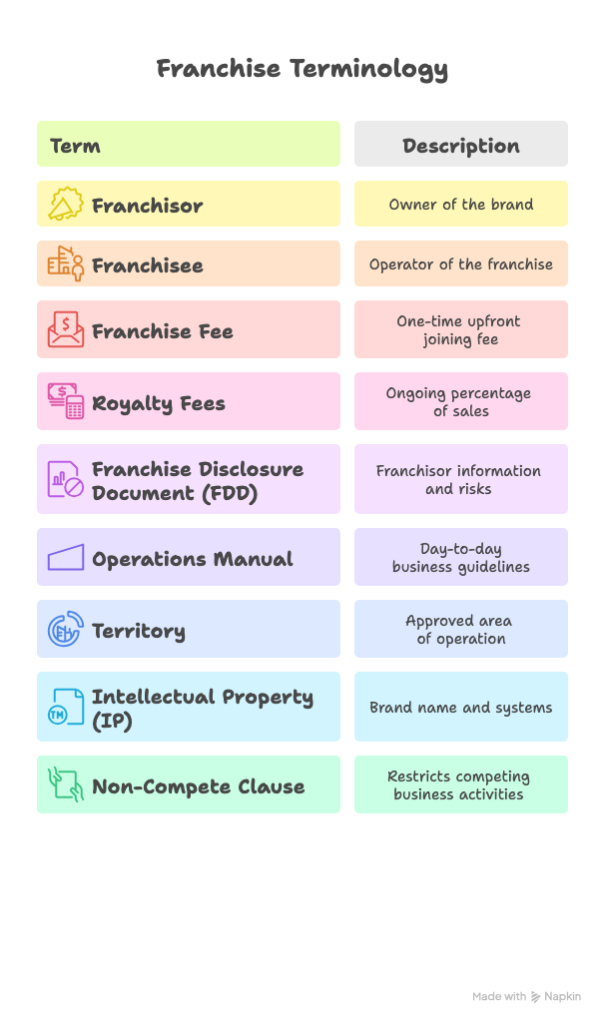
Common Clauses You’ll Find in a Franchise Agreement
Even though no two franchise agreements are identical, several common clauses appear across most franchise relationships, defining the arrangement from opening the business through to an eventual exit.
1. Term and Renewal
This clause indicates how long the franchise agreement runs, any rights to extend it further, and any costs associated with renewal.
2. Training and Support
This section sets out what assistance the franchisor will provide, typically covering startup support, help running day-to-day operations, and ongoing guidance.
3. Marketing and Advertising Contributions
This section covers marketing costs, including whether the franchisee must contribute to national or regional advertising, undertake local marketing of their own, and how the brand may be used in that marketing.
4. Compliance and Audits
This clause ensures the franchisee complies with branding standards, and gives the franchisor the right to inspect business records or the franchise outlet itself to confirm everything is running according to plan.
5. Termination and Exit Conditions
This section describes when and how the agreement can end, and the consequences that follow, including scenarios such as non-payment, default, or underperformance, along with post-termination obligations like ceasing use of the brand and its logo.
6. Dispute Resolution
This clause sets out how disputes will be resolved, whether through discussion, mediation, arbitration, or court proceedings, and typically specifies which law will govern that process.
Together, these clauses give both parties a clear understanding of the relationship and help avoid misunderstandings throughout the franchising process.
Examples of Franchise Agreements Across Industries
Franchise agreements can be found across many industries. While the basic structure remains similar, the specific focus of the agreement depends on the type of business.
1. Food & Restaurants

In food and restaurant franchises, the focus is mainly on taste, quality, and customer experience. Well-known brands such as McDonald’s, Subway, and KFC operate very detailed franchise agreements.
These agreements clearly govern menu items, food quality, ingredient sourcing, cleanliness, staff training, and service standards, ensuring customers get a consistent food and service experience at every outlet, regardless of location.
2. Retail

Retail franchises centre on the marketing of goods with the support of a recognised brand name. 7-Eleven franchises and automobile franchises are good examples, with contracts that set out rules and standards for store layout, merchandise design, and pricing structure.
This ensures every store looks and feels consistent, helping the brand expand quickly across locations.
3. Services

Service-based franchises span hospitality, fitness, real estate, cleaning, education, and other similar industries. Well-known examples include Marriott in hospitality, RE/MAX in real estate, and Anytime Fitness in the fitness sector.
These franchise agreements place strong emphasis on service quality, customer interaction, and brand image, with explicit guidance on service delivery to ensure customers receive a consistent standard of service at any outlet.
How a Franchise Agreement Works in Practice
The franchise agreement acts as the overall roadmap for the entire franchise relationship, from the initial investment decision through the operating phase to eventual closure or renewal.
1. Before Signing
Before entering into the agreement, anyone considering a franchise should do their homework. This includes reading the agreement carefully and reviewing the Franchise Disclosure Document, where one is provided, to understand how the business actually operates.
It’s important to be clear on the full cost picture, including initial charges, ongoing payments, territorial rights, and any restrictions, since all of these factors influence the profitability of the business. This is also a good stage to seek guidance from solicitors or accountants, who can help identify potential issues before they become costly surprises.
2. After Signing
Once the agreement is signed, the franchisee can begin setting up the business according to the brand’s guidelines. This involves training, establishing the outlet, and following the operational standards laid out in the agreement.
The franchisee receives support from the franchisor in the form of direction, marketing assistance, and ongoing contact, but must still meet the agreement’s requirements around reporting, timely payments, and maintaining the required standards.
3. Exit or Renewal
When the franchise term expires, the agreement sets out what happens next. If the relationship has gone well, the franchisee may have the option to renew, subject to certain conditions.
If the franchise relationship ends, the agreement outlines the exit process, which typically involves ceasing use of the trademark and returning confidential information in line with post-exit obligations. These provisions help ensure a clean, orderly exit for both parties.
Common Misconceptions About Franchise Agreements
Franchise agreements are common, but they are also frequently misunderstood. Here are a few myths worth clearing up.
1. “It’s just a brand licence”
This is one of the most common misconceptions. A franchise agreement goes far beyond simply granting the right to use a brand name or logo. It also governs day-to-day operations, including training, workflow, marketing, and reporting, effectively regulating nearly every aspect of the franchise beyond the brand itself.
2. “All franchise agreements are the same”
Every franchise agreement is unique. Even when agreements appear similar on the surface, the underlying terms can vary considerably depending on the industry, the level of support provided, and the specific exit arrangements involved.
3. “There’s no room for negotiation”
Some assume franchise contracts are entirely non-negotiable, but this isn’t always true. While most terms are standardised, there can be room for negotiation, particularly for an experienced franchisee or a second location. Territory, renewal terms, royalties, and deadlines can sometimes be flexible if you know what to look for and ask.
Things to Consider Before Signing a Franchise Agreement
Entering into a franchise agreement is a significant, long-term investment. Before finalising anything, take time to consider the following factors.
1. Financial Commitments
A franchise involves costs well beyond the initial investment figure. Expect ongoing monthly royalties, advertising contributions, operational costs, and upfront setup charges. All of these ultimately determine your actual take-home profit.
2. Level of Control vs. Independence
A franchise gives you an existing, proven business system, but with rules attached. You’ll likely need to follow set processes around design, pricing, and working style. Consider whether you’re comfortable trading some independence for the support and structure a strong brand provides.
3. Long-Term Commitment
Franchise contracts are typically long-term and can be difficult and costly to exit early. It’s worth understanding exactly how long the agreement runs and whether an early exit is possible before you sign.
4. Legal Review and Professional Advice
Franchise agreements can be complex and lengthy documents. Having a lawyer and a financial advisor review the agreement can help identify potential issues early and support a well-informed decision.
Conclusion
A franchise agreement gives you instant access to a well-known brand and a ready-made business system, but it also comes with long-term responsibilities. It’s important to know exactly what you’re signing up for: how much control you’ll have, what rules you must follow, and what commitments you’re making.
A clear understanding of the agreement lets you move forward with confidence, without unwelcome surprises later on. A strong franchise relationship works best when opportunity and responsibility stay balanced for both parties from day one.
FAQs
What is a franchise agreement?
A franchise agreement is a legally binding contract between a franchisor and a franchisee, which outlines the rights, responsibilities, and obligations.
What are the key components of a franchise agreement?
Some key components include fees, territory, term and renewal, brand usage, operational standards, training, termination, and dispute resolution.
What is a franchise with an example?
A franchise refers to a business model where an individual operates under an established brand, like a McDonald’s outlet that a franchisee runs.
What are the terms of a franchise agreement?
The terms include the length of the agreement, fees, operational control, brand usage, renewal conditions, and exit or termination rules.
Is there a specific franchise law in India?
No. India does not have a single, dedicated franchise law. Franchise agreements are instead governed by a combination of general laws, including the Indian Contract Act 1872, the Competition Act 2002, the Trade Marks Act 1999, and the Consumer Protection Act 2019, along with FEMA for international franchises.