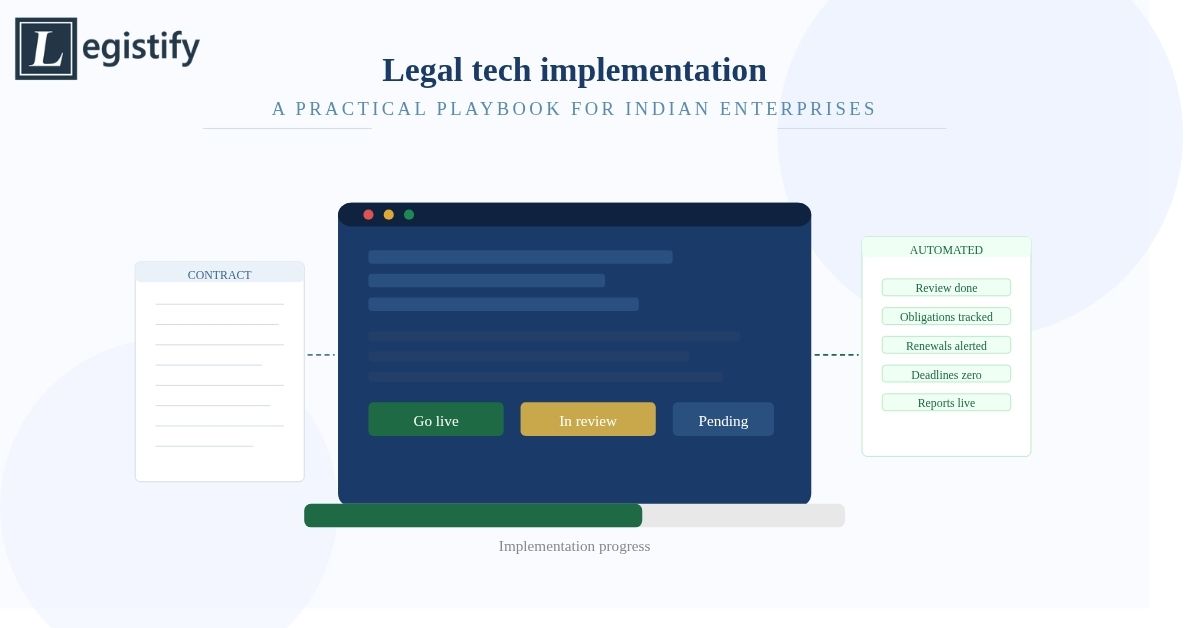
India has 805 active legal technology companies as of 2026. The Indian legal AI market, valued at around USD 29.5 million in 2025, is projected to cross USD 106.3 million by 2030. Enterprise investment in legal technology is accelerating, driven by regulatory complexity, growing contract volumes, and the widening gap between what manual legal operations can handle and what the business needs.
And yet, legal tech implementations fail more often than they succeed. Not because the technology does not work, but because enterprise legal teams approach implementation the way they would approach a software purchase, rather than the way they should approach an operational transformation.
This playbook covers why legal tech implementations in Indian enterprises go wrong, and what the organisations that get it right do differently.
Why Legal Tech Implementation in India Fails
The most common failure mode in legal tech implementation is not technical. It is organisational.
A CLM platform is purchased because the General Counsel has seen a demo and the contract management process is visibly broken. The vendor’s implementation team configures the system, runs a few training sessions, and hands over the keys. Six months later, the platform is being used by three people, contracts are still being managed in email, and the organisation is paying a significant annual licence fee for a tool that has not changed how the legal function works.
This pattern repeats across contract management, litigation tracking, legal notice management, and compliance tools. The technology is not the problem. The implementation model is.
The specific reasons legal tech implementations fail in Indian enterprises fall into predictable categories.
No defined process before the tool. Legal tech automates processes. If the process does not exist in a defined form before the tool is implemented, the tool has nothing to automate. It becomes a more expensive version of the spreadsheet it was meant to replace. Before any legal tech platform is implemented, the process it is intended to support needs to be mapped, documented, and agreed upon.
Adoption treated as a training problem. Most implementations end with a training session. The assumption is that if people know how to use the tool, they will use it. In practice, adoption requires more than training. It requires the old way of working to become harder than the new way. If a lawyer can still email a contract to a counterparty directly, they will, regardless of whether they know how to use the CLM. Adoption requires the workflow to change, not just the knowledge.
Implementation scoped too broadly. Enterprise legal tech vendors have large feature sets, and the temptation at implementation is to configure everything at once. The result is a complex, partially configured system that no one fully understands. The organisations that implement legal tech most successfully start with one use case, get it working properly, build adoption, and expand from there.
No internal ownership. Legal tech implementation requires someone inside the organisation to own it, not just the vendor. This person does not need to be technical. They need to understand the legal team’s workflow, have the authority to define how the new process works, and be accountable for adoption. Implementations without internal ownership stall when the vendor’s involvement reduces after go-live.
Change management underestimated. Senior lawyers in Indian enterprises have, in many cases, worked the same way for decades. The introduction of a technology platform that changes how contracts are created, reviewed, and stored is not a minor adjustment. It requires sustained change management, visible sponsorship from the General Counsel, and a clear communication of why the change is happening and what it means for how people work day to day.
The Indian Enterprise Context
Legal tech implementation in India has specific characteristics that generic implementation frameworks do not always account for.
Regulatory complexity creates urgency but also scope creep. India’s regulatory environment is one of the most demanding in the world for enterprise legal teams. The DPDPA, the RBI’s digital lending framework, IRDAI guidelines, Companies Act obligations, and SEBI listing requirements all create compliance demands that legal tech is well-placed to address. But the temptation to implement a platform that solves every regulatory problem at once is one of the most common sources of implementation failure. Regulatory urgency should sharpen focus, not expand scope.
Multi-jurisdictional operations complicate configuration. Indian enterprises operating across multiple states face stamp duty variations, different regulatory notification requirements, and varying court and tribunal jurisdictions. A CLM or litigation management platform needs to be configured to reflect these variations, not just the general case. Configuration that ignores the multi-state reality produces a system that works for some business units and not others.
Legacy contract repositories are large and messy. Most large Indian enterprises have contract repositories built up over many years, stored across shared drives, email archives, and physical files. Migrating these to a new system is one of the most time-consuming and underestimated parts of any CLM implementation. Scanned PDFs, contracts in regional languages, and documents with handwritten amendments all require specific handling. A realistic migration plan, rather than an optimistic one, is a prerequisite for a successful implementation.
Legal team capacity is limited. In-house legal teams at Indian enterprises are consistently under-resourced relative to the volume of work they manage. Implementation requires time from the legal team for process definition, configuration review, data migration, testing, and training. This time needs to be explicitly allocated in the project plan. Implementations that assume the legal team will absorb implementation activity alongside their existing workload consistently run over schedule.
A Practical Implementation Framework
Phase 1: Define before you configure
The first phase of a legal tech implementation should involve no technology at all. It should involve mapping the current process, identifying the specific problems the technology is intended to solve, and defining what the new process will look like.
For a CLM implementation, this means documenting how contracts currently move through the organisation: who initiates them, who drafts, who reviews, who approves, how they are executed, where they are stored, and how obligations are tracked after execution. Every step where the current process breaks down is a problem the CLM is intended to fix. Every step that works well is a process that the CLM needs to support without disrupting.
This phase should produce a process map, a list of configuration requirements, and a set of success metrics: what does good look like six months after go-live, in concrete, measurable terms.
Phase 2: Start with one use case
The most common implementation mistake is to go live with everything at once. The most effective implementations go live with one use case, build adoption and confidence, then expand.
For most Indian enterprises, the highest-value starting point for a CLM implementation is one of two use cases: standard contract generation for high-volume, low-complexity contract types, or contract repository migration and search for the existing portfolio.
Standard contract generation delivers visible, immediate value. Legal teams that previously spent days drafting NDAs and vendor agreements can generate them in minutes from approved templates. The time saving is tangible, the process change is manageable, and the adoption case is clear.
Contract repository migration is higher effort but produces a foundation that every subsequent use case depends on. An organisation with all its executed contracts in a structured, searchable repository has eliminated the most significant source of data loss and context loss in the contract lifecycle.
Phase 3: Drive adoption before expanding
Go-live is not implementation success. Adoption is. The measure of a successful implementation is not whether the platform is configured and accessible, but whether the legal team uses it as their primary way of working.
Adoption in Indian enterprise legal teams requires three things. The first is visibility from leadership. If the General Counsel continues to manage contracts by email, the rest of the legal team will read this as a signal that the new platform is optional. Visible use of the platform by senior team members is the strongest adoption driver available.
The second is friction removal. Every point at which using the new system is harder than the old way is a point where adoption will fail. During the first few months after go-live, the implementation owner should actively identify and remove these friction points.
The third is measurement. The success metrics defined in Phase 1 should be tracked and reported regularly. When the data shows that contract turnaround time has reduced, that obligation deadlines are no longer being missed, or that the legal team is spending less time on document retrieval, this evidence reinforces adoption and builds the case for expansion.
Phase 4: Expand systematically
Once the initial use case is working and adoption is stable, expansion to additional modules and use cases is straightforward. The process definition and change management work done in Phases 1 to 3 creates an implementation capability that makes subsequent expansions faster and less disruptive.
The sequence for expansion in a CLM context typically follows this order: template management and standard generation first, then repository migration, then approval workflows and e-signature integration, then obligation tracking, then analytics and reporting. Each stage builds on the previous one and adds value incrementally rather than all at once.
For organisations implementing litigation management alongside CLM, the integration between the two should be planned from the start even if it is implemented in a later phase. The data architecture decisions made during CLM implementation affect how easily litigation data can be connected later.
Measuring Legal Tech Implementation Success
The success of a legal tech implementation should be measured against specific, pre-defined outcomes, not against platform usage metrics alone.
For CLM implementations, relevant outcome metrics include contract cycle time from initiation to execution, the volume of contracts managed outside the platform, the number of obligation deadlines missed in a given period, and the time taken to retrieve a specific contract or contract data point. These outcomes measure whether the implementation has changed how the legal team works and how the business is affected by the legal function, rather than just whether the platform is being logged into.
For litigation management implementations, relevant metrics include the number of hearing dates missed, the time from case filing to case entry in the system, the accuracy of contingent liability estimates, and external counsel spend against budget.
Over 40% of general counsels are now testing AI-powered legal technology in beta, and over 50% say that leveraging AI-powered applications is a top priority. The organisations that move from testing to successful deployment are those that treat implementation as an operational transformation, not a software rollout.
Common Mistakes to Avoid
Buying for features, not for fit. A platform with more features is not necessarily a better platform for your legal team. The relevant question is whether the features that matter for your specific workflows are well-implemented and well-supported. A CLM with a strong contract generation module and weak obligation tracking is the wrong choice for an organisation whose primary problem is missed obligations, regardless of how comprehensive the feature list looks.
Underinvesting in data migration. The contract repository migration is consistently the part of CLM implementations that takes the longest, costs the most, and produces the most post-go-live problems when done poorly. Invest in it properly at the start, rather than treating it as an afterthought.
Ignoring the business functions. Contracts and litigation affect finance, procurement, sales, and operations as much as they affect the legal team. Legal tech implementations that are scoped only to the legal function miss the integration points with business systems, the change management requirements for non-legal users, and the reporting needs of functions outside legal. The most effective implementations include business function stakeholders from the process definition phase.
Assuming the vendor’s template will work. Legal tech vendors have implementation templates developed for their median customer. Your organisation’s contract types, approval structures, regulatory requirements, and business workflows are specific to you. The vendor’s template is a starting point, not a solution. Configuration to reflect your actual process is not optional, it is the work.
Legistify is built for Indian enterprise legal operations, with implementation support that covers process definition, configuration, data migration, and adoption, designed for the specific regulatory and operational context that Indian legal teams work in.
Conclusion
Legal tech implementation success in Indian enterprises is determined less by which platform is chosen and more by how implementation is approached. The technology available to enterprise legal teams in India in 2026 is capable of transforming how contracts are managed, how litigation is tracked, and how compliance is maintained. The gap between this capability and actual outcomes in most organisations is an implementation gap, not a technology gap.
The organisations that close this gap share a common approach: they define the process before configuring the technology, they start with one use case and build from there, they invest seriously in adoption rather than treating it as a training exercise, and they measure success against outcomes rather than activity. These are not complex principles. They are consistently underweighted in how enterprises approach legal tech investment.