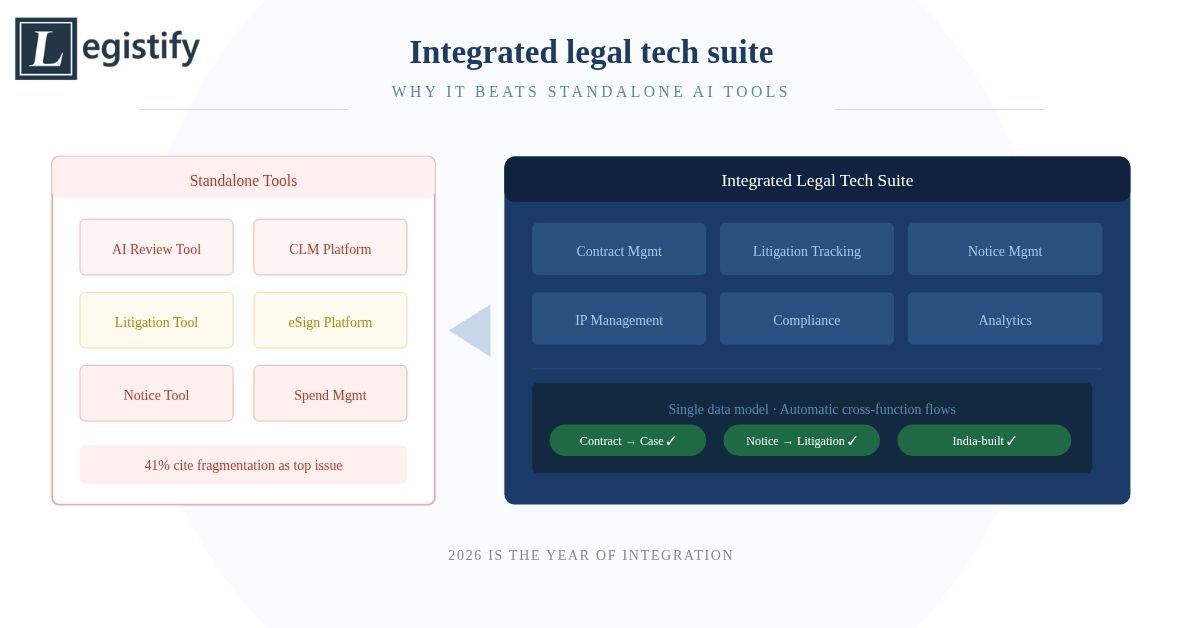
The legal technology market in 2026 offers enterprise legal teams an abundance of choice. There are AI tools for contract drafting, separate tools for contract review, different tools for litigation analytics, standalone e-signature platforms, document automation tools, and legal research assistants. Each of these solves a specific problem well. And yet, 41% of firms cite fragmented tools as their primary technology challenge, making integration between systems a top priority.
The paradox is predictable. Each new tool was adopted because it addressed a genuine pain point. But the cumulative effect of multiple standalone tools is a fragmented data environment where information does not flow between systems, integrations require maintenance, and the legal team spends significant time managing tools rather than using them to do legal work.
2026 is the year of integration. Firms will demand platforms that unify tools and streamline collaboration across every litigation phase. This shift is not just a preference. It reflects a structural problem with the point solution approach that becomes more visible as legal tech adoption matures.
Every tool creates a new data silo
A standalone AI contract review tool processes a contract and produces a risk summary. That summary lives in the contract review tool’s interface. The contract lives in the CLM. The related matter lives in the matter management system. The external counsel briefing lives in email. When a lawyer needs to understand the full context of a dispute, they are pulling information from four different systems.
Data silos are not a minor inconvenience. They represent the information fragmentation that makes legal teams reactive rather than proactive. When the contract record is in one system and the case record is in another, the legal team cannot see the relationship between a contract breach and the litigation it produces. When obligation tracking is in the CLM and compliance reporting is in a separate tool, the compliance function does not have visibility into contractual obligations. The data exists. The connection does not.
Integration is harder than vendors suggest
Every standalone tool claims to integrate with everything else. In practice, integrations are rarely as seamless as advertised. They require setup and maintenance. When one vendor updates their API, the integration with another tool may break. When data schemas differ between systems, mapping information across them requires manual adjustment. When neither vendor owns the integration, both point to each other when something goes wrong.
Law firm technology in 2026 ranks as a higher priority than managing caseloads: 54% of legal teams cite technology decisions as their biggest challenge, surpassing work volume at 52%. A significant part of this challenge is the integration overhead that comes with running multiple standalone tools.
For Indian enterprise legal teams, integration complexity is amplified by the India-specific requirements that most global tools do not natively support. Connecting a global CLM to an Indian court tracking system, to an India Post dispatch module, to an Aadhaar eSign workflow, to a multi-state stamp duty assessment tool requires integrations that each standalone vendor will handle differently, and none of them will own.
Workflow gaps appear at the boundaries between tools
The most significant failures in legal operations happen at the transitions between tools. A contract dispute that should move from the CLM to the matter management system requires a manual handoff. A case that needs the underlying contract record requires switching to a different system and searching for the relevant document. A notice that precedes litigation needs to be tracked in a notice management tool, then connected to the case record manually.
These boundary failures accumulate. The legal team develops workarounds: copy-pasting information between systems, maintaining separate tracking spreadsheets to connect data that does not flow automatically, and relying on individual lawyers to remember which system holds what information. The efficiency gains from each standalone tool are partially offset by the overhead of managing the boundaries between them.
Total cost of ownership increases with every tool
Each additional standalone tool carries its own licence cost, implementation cost, training requirement, and ongoing maintenance overhead. The sum of licences for four or five specialist AI tools frequently exceeds the cost of an integrated suite that covers all the same functions. And the integration costs are not typically included in the vendor’s price comparison.
For enterprise legal teams that need to justify technology spend to leadership, the cost narrative for a fragmented tool stack is difficult to tell. The efficiency gains from each individual tool are real but hard to measure in isolation. The total cost is higher than anticipated. And the strategic value of the technology investment is diluted by the time the legal team spends on tool management rather than legal work.
What an Integrated Suite Does Differently
A single data model across all functions
An integrated legal tech suite maintains a single data model that connects contract data, case data, matter data, notice data, and compliance data in one system. When a contract dispute becomes a case, the connection is automatic. When a notice is sent in relation to a contract breach, it is part of the contract record. When a compliance obligation is embedded in a contract, it is visible to the compliance function without a separate data transfer.
This connected data model is what enables the portfolio-level visibility that standalone tools cannot produce. The question “what is our total contingent liability from litigation arising from contracts of type X” requires data from the CLM and the litigation module. In an integrated suite, this query is straightforward. In a fragmented tool stack, it requires manual data assembly from two systems.
Consistent user experience across functions
When all legal operations functions are in one platform, the lawyer learns one interface, one search paradigm, one workflow model. The cognitive overhead of switching between different tools with different UX conventions is eliminated. This matters more than it sounds: context-switching between tools is a consistent source of friction that slows individual lawyers down and increases the error rate in information retrieval.
For onboarding new lawyers to the legal team, a single platform is significantly easier to train on than a collection of five separate tools. For organisations with high turnover in the legal function, this reduces the institutional knowledge risk that comes from a fragmented technology environment.
No integration maintenance burden
An integrated suite is maintained by one vendor. When the contract module updates, the integration with the litigation module is the vendor’s responsibility to maintain, not the legal team’s. When a regulatory change requires an update to the stamp duty assessment logic, the vendor pushes the update across all relevant functions simultaneously.
The legal team does not manage integrations. The legal team uses the software. This distinction sounds minor but represents a significant reduction in the operational overhead that comes with a fragmented tool stack.
Workflow automation that crosses functional boundaries
The most powerful workflow automation in legal operations is not within individual functions. It is across them. A contract obligation failure that automatically creates a notice, which automatically feeds into a case when the notice goes unanswered. A new case filing that automatically retrieves the relevant contract and attaches it to the case record. A contract renewal alert that automatically connects to the matter management workflow for the renewal negotiation.
These cross-functional automations are only possible when the underlying data and workflows are in a single system. Standalone tools can automate within their own function. An integrated suite automates across functions.
The India-Specific Case for Integration
The argument for integrated legal tech suites is stronger for Indian enterprises than for most other markets, because the Indian legal environment creates more cross-functional dependencies that standalone tools cannot handle.
Litigation originates in contracts
Most commercial litigation in India originates in a contract breach. The legal team managing the case needs the underlying contract. When CLM and litigation management are in separate tools, this connection is manual. When they are integrated, the contract is automatically accessible from the case record from the moment the case is created.
India’s court system adds further complexity. Automated case updates from the Supreme Court, High Courts, District Courts, NCLTs, consumer forums, and tribunals are a core requirement for Indian enterprise litigation management. This is a capability that requires specific Indian court integration. A global standalone litigation tool with no Indian court connectivity, integrated with a global CLM, does not cover this requirement. An integrated suite built for India covers both in a single system.
Notice management connects contracts to litigation
In Indian commercial law, legal notices are frequently the link between a contract breach and formal litigation. Section 80 CPC notices, Section 138 cheque bounce notices, and SARFAESI notices are all pre-litigation steps that need to be tracked as part of the dispute history. When notice management is a separate tool from CLM and litigation management, the three-stage history of breach, notice, and case is reconstructed manually every time it is needed. In an integrated suite, it is automatic.
Regulatory compliance spans all functions
India’s regulatory environment creates compliance obligations that span contracts, litigation, and notices simultaneously. An RBI Digital Lending Direction creates obligations in the loan contract, in the KFS notice sent to the borrower, and in the audit trail maintained for regulatory inspection. An IRDAI requirement creates obligations in the distribution channel agreement, in the notice management process, and in the fraud monitoring record. Managing these cross-functional regulatory obligations requires a system where the data and the compliance tracking are in one place.
Standalone tools for each function, connected by integrations, do not support the regulatory audit trail that Indian regulators expect. An integrated suite, where the contract, the notice, and the compliance record are all connected by design, does.
The Market Signal: Integration Is Winning
The market evidence from 2026 supports the integrated suite argument. In 2026, the emphasis is shifting to augmentation: using technology to enhance human expertise, not replace it. And the tools that support augmentation most effectively are those that give the lawyer a connected view of their work, not a collection of point solutions that each show one piece of it.
Thomson Reuters CoCounsel, which integrates AI research and drafting with the Westlaw research database rather than operating as a standalone AI tool, is one of the most widely adopted platforms in the market. The integration with the underlying research database is precisely what makes it more useful than a standalone AI research tool: the outputs are grounded in authoritative legal sources, the citations are verifiable, and the workflow is connected to the lawyer’s existing research process.
The same principle applies to contract management, litigation tracking, and notice management. Tools that are integrated with the underlying data and workflow are more useful than tools that require the lawyer to import data, export results, and manually connect the output to the systems where legal work actually happens.
What to Look for in an Integrated Legal Tech Suite
For enterprise legal teams evaluating whether to move from a fragmented tool stack to an integrated suite, the following questions are most useful.
Does the integration cover all functions you need? An integrated suite that covers CLM and matter management but not litigation tracking does not eliminate the need for a standalone litigation tool. The integration needs to cover the full scope of the legal team’s workflow.
Is it built for your legal environment? For Indian enterprises, the suite needs to cover Indian court integrations, multi-state stamp duty, Aadhaar eSign, India Post dispatch, and India-specific regulatory compliance workflows. A globally oriented suite with partial Indian coverage is a fragmented solution with a unified interface, not a genuinely integrated platform.
Is the data model truly unified? Ask specifically how data flows between functions. Can you query across contract and litigation data in a single report? Does a notice created in the notice module automatically appear in the contract record? Does a new case alert pull the relevant contract automatically? These questions reveal whether the integration is genuine or cosmetic.
What is the total cost of ownership? Compare the fully loaded cost of the integrated suite against the sum of licence costs, implementation costs, and integration maintenance costs for the equivalent standalone tools. In most cases, the integrated suite is more cost-effective at the total portfolio level, even if individual module costs appear higher.
Legistify’s platform integrates contract management, litigation management, notice management, and IP management in a single system designed for the Indian enterprise legal environment, with data flowing automatically across all functions and Indian regulatory requirements built into the core product rather than added as integrations.
Conclusion
Standalone AI tools solve specific problems well. The challenge is that enterprise legal teams do not have specific problems in isolation. They have a connected set of legal operations requirements that span contracts, litigation, notices, compliance, and external counsel management. When each of these is addressed by a different standalone tool, the connections between them require manual effort, integration maintenance, and workarounds that offset the efficiency gains each tool delivers individually.
An integrated legal tech suite addresses the same requirements in a connected system where data flows automatically between functions, workflow automation crosses functional boundaries, and the lawyer has a single interface for all legal operations work. For Indian enterprise legal teams operating in a complex, multi-forum, multi-regulatory environment, the case for integration is even stronger. The fragmentation cost of standalone tools is higher when the underlying legal environment creates more cross-functional dependencies.