Most enterprises in India now have an AI use policy. Very few have successfully educated their employees about what it says. The policy exists in a document. It has been communicated in a company-wide email. And then, in most organisations, it sits there while employees continue to use AI tools in ways that may or may not comply with what the policy requires.
This gap between policy and practice is not a compliance oversight. It is an education problem. Employees who do not understand why the AI use policy exists, what it specifically prohibits, and what it requires from them in their daily work cannot comply with it consistently. A policy that is not understood is not followed.
For enterprise legal and compliance teams, closing this gap is increasingly urgent. AI use is growing rapidly: AI adoption in legal departments has grown from 44% to 87% in one year. The DPDPA’s coming enforcement, the risk of confidential data being processed by external AI tools, and the reputational risk of AI-generated content presented as authoritative without verification all create real consequences for organisations whose employees are using AI without understanding the guardrails.
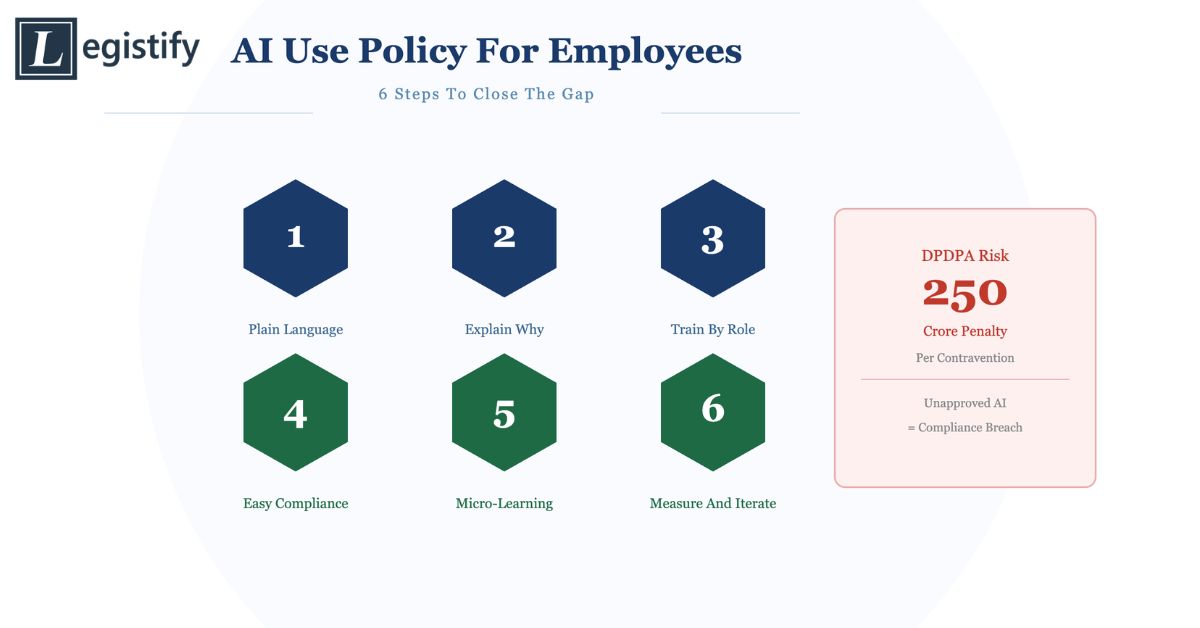
Here are six practical steps that legal, compliance, and HR teams can use to educate employees about the AI use policy and build genuine compliance behaviour.
Step 1: Write the Policy in Language Employees Can Actually Understand
The first problem with most AI use policies is that they are written for lawyers, not for the people who need to follow them. A policy that describes “unauthorised processing of personal data through third-party LLM APIs” is not a policy that a sales manager or a customer service team member can apply to their daily work.
Before any education programme, the policy itself needs to be understandable. This means:
Use plain language. Translate legal and technical concepts into language that reflects how employees actually think about their work. “Do not paste customer data into external AI tools” is more actionable than “do not upload data subjects’ personally identifiable information to systems not approved under the organisation’s data processing framework.”
Be specific about what is and is not permitted. Vague policy language creates uncertainty that employees resolve by defaulting to whatever is most convenient. The policy should list specifically which AI tools are approved for which purposes. It should be clear about what categories of information are never permitted to be entered into external AI tools: customer data, employee data, unreleased financial information, deal terms, and confidential strategy.
Give examples. Employees understand policy rules better when they see them applied to realistic scenarios. “Using ChatGPT to draft a marketing email is permitted. Pasting a customer’s contract into ChatGPT to get a summary is not permitted” is a more effective communication than a general prohibition on processing personal data through external AI.
Address the specific tools employees are already using. Employees are using AI tools whether or not they have been formally approved. The policy is more credible and more followed when it acknowledges the tools people actually use and addresses them specifically.
Step 2: Explain the Why, Not Just the What
Employees who understand why a rule exists are significantly more likely to follow it than those who experience rules as arbitrary restrictions. An AI use policy that simply lists prohibitions without explaining the reasoning behind them is experienced as bureaucratic rather than protective.
The why behind AI use policies in Indian enterprises in 2026 is specific and compelling:
DPDPA compliance. When an employee pastes customer data into an external AI tool, they may be creating a DPDPA compliance breach. The data is being processed by a third-party system that is not a contracted data processor, without the customer’s consent for that processing, and potentially outside India in violation of data localisation requirements. The penalty for the organisation can be up to INR 250 crore per contravention. Employees who understand this are more likely to treat the restriction as meaningful rather than arbitrary.
Confidentiality obligations. Contracts, deal terms, and strategic information entered into external AI tools may be used to train the AI model or may be accessible to other users. For organisations with confidential information obligations to clients, counterparties, or regulators, this creates a direct breach of those obligations. Employees who understand the confidentiality risk are more likely to apply the policy consistently.
Accuracy risk. AI-generated content can be confidently wrong. In legal and compliance contexts, AI hallucinations present specific risks: a legal position that is stated with confidence but is based on non-existent case law, a contract clause drafted using language that does not reflect Indian law, or a regulatory summary that omits a material requirement. The policy’s requirements around verification and review before external use of AI outputs exist precisely because of this risk.
When the education programme explains these reasons, employees understand that the AI use policy protects them, the organisation, and its customers, not just compliance checklist items.
Step 3: Train by Role, Not by Organisation
Generic AI policy training delivered to the entire organisation simultaneously is the least effective approach. A warehouse manager and a contracts lawyer face completely different AI use scenarios. Training that addresses both with the same content is either too abstract for the warehouse manager or too basic for the lawyer.
Role-based training addresses the specific AI use scenarios that are relevant to each function:
Legal and compliance teams. AI tools for contract review, legal research, and document drafting. The specific risks of using AI for legal work: accuracy verification requirements, attorney-client privilege implications, DPDPA obligations for any personal data in reviewed documents.
Sales and commercial teams. AI tools for proposal drafting, CRM data analysis, and customer communication. The specific risks: customer data in external AI tools, confidential deal information in AI prompts, accuracy of AI-generated claims about the organisation’s products.
Finance teams. AI tools for financial modelling, report drafting, and analysis. The specific risks: unpublished financial information, sensitive transaction data, accuracy requirements for financial outputs.
HR teams. AI tools for recruitment, performance management, and employee communication. The specific risks: employee personal data under DPDPA, bias in AI-assisted screening, accuracy of AI-generated HR documentation.
Each function’s training should address the AI tools most relevant to their work, the specific scenarios where policy requirements apply, and the practical steps for compliance in those scenarios.
Step 4: Make Compliance the Path of Least Resistance
The most consistent finding in compliance research is that employees follow the policies that make their work easier and circumvent those that make it harder. An AI use policy that requires significant additional effort to comply with will be systematically circumvented by employees under time pressure.
This has practical implications for how the AI use environment is structured:
Approved tools should be accessible and effective. If the organisation has approved specific AI tools, those tools need to be available, integrated into the workflow, and capable of doing the work employees need done. If approved tools are less effective than unapproved alternatives, employees will use the unapproved alternatives.
Data classification guidance should be easy to apply. The policy’s requirements about what data can and cannot be entered into AI tools need to be operationalised through clear data classification: which systems hold sensitive data, what categories of information are restricted, and how employees identify restricted information in their daily work. If applying the policy requires employees to make complex judgments in the moment, those judgments will be made inconsistently.
Approval processes for new AI tools should be fast. Employees who want to use a new AI tool and cannot get approval within a reasonable time will use the tool anyway. A clear, fast approval process for new AI tools reduces the shadow AI problem more effectively than prohibition alone.
Reporting AI policy concerns should be safe and easy. Employees who observe AI policy violations need a clear, safe mechanism for reporting them. If reporting is complicated or carries perceived risk, concerns go unreported and policy violations accumulate.
Step 5: Run Ongoing Micro-Learning, Not Annual Training
Annual compliance training is the standard model in most enterprises. It is also among the least effective approaches to building durable compliance behaviour. A one-hour annual session on the AI use policy produces compliance awareness that fades over the following weeks as employees return to their daily workflows.
Micro-learning, delivered in short, specific, role-relevant formats at regular intervals, builds compliance habits more effectively.
Practical micro-learning approaches for AI use policy education:
Monthly scenario prompts. A short scenario delivered by email or Slack: “An employee is drafting a response to a customer complaint and wants to paste the customer’s complaint history into Claude to generate a draft response. Is this permitted under the AI use policy? What should they do instead?” A brief explanation follows. This takes two minutes to read and addresses a specific, realistic situation.
AI use case approvals as learning moments. When an employee requests approval for a new AI use case, the approval process includes a brief explanation of why the specific use is or is not permitted. The individual learns from the specific decision, not from a general policy statement.
Incident debrief communications. When an AI policy incident occurs, an anonymised summary of what happened, why it was a policy issue, and what the correct approach should have been is shared with the relevant team. This turns incidents into learning opportunities rather than purely enforcement events.
Policy updates communicated through examples. When the AI use policy is updated, the communication explains what changed, gives a concrete example of how the change affects daily work, and explains the reason for the change.
Step 6: Measure Compliance and Iterate
An education programme that is not measured cannot be improved. Compliance with AI use policy needs to be tracked, and the education programme needs to be adjusted based on where compliance is weakest.
Measurement approaches for AI use policy compliance:
Approved tool usage tracking. Monitor whether employees are using approved AI tools or attempting to access unapproved alternatives. A significant proportion of employees regularly attempting to access unapproved tools signals either that the approved tools are inadequate or that the policy is not understood.
Incident tracking by type. Track AI policy incidents by type and by function. Patterns reveal where the policy is poorly understood or where the compliance environment makes non-compliance likely. A high rate of customer data incidents in the sales team signals a training gap specific to that function.
Annual policy acknowledgement with spot checks. Annual policy acknowledgement confirms that employees have read the policy. Periodic spot checks, where employees are asked to apply the policy to a specific scenario, reveal whether they understand it.
Manager reporting. Managers are often the first to observe AI policy compliance issues in their teams. Regular check-ins with managers about AI use patterns in their functions provide early warning of emerging compliance gaps.
The measurement data should drive iteration: where compliance is weakest, training should be more frequent, more specific, and more role-relevant. Where approved tools are consistently avoided in favour of unapproved alternatives, the approved tool set or the approval process may need to be reviewed.
Building an AI Use Policy Culture
The six steps above are operational. Underneath them is a more fundamental objective: building an organisational culture in which using AI responsibly is the norm, not the exception.
This culture emerges when employees understand why the guardrails exist, when the guardrails themselves are designed to enable rather than simply restrict, and when leadership is visibly committed to AI governance. A GC or CISO who uses approved AI tools and applies the policy visibly sets a tone that policy communications cannot match.
For Indian enterprises navigating the DPDPA, managing sensitive commercial information, and operating in regulated sectors under RBI, SEBI, and IRDAI oversight, AI use policy is not just a compliance exercise. It is a component of the organisation’s overall data governance and risk management posture. Building genuine employee understanding of the policy is an investment in that posture.
Conclusion
The gap between having an AI use policy and having employees who follow it is closed through education, not enforcement. The six steps above, covering plain-language policy writing, explaining the why, role-specific training, making compliance easy, ongoing micro-learning, and measurement, provide a practical framework for moving from a policy that exists in a document to one that shapes how employees use AI in their daily work.
For Indian enterprise legal and compliance teams, this framework is particularly relevant given the DPDPA enforcement timeline, the regulatory environment across BFSI and other sectors, and the rapid pace of AI adoption across all enterprise functions. The organisations that build AI use cultures now, before enforcement begins in earnest, will be the ones that manage AI governance as an operational strength rather than a recurring compliance gap.