Litigation tracking is not a feature most CLM platforms are built for. The leading contract lifecycle management tools in the market today are designed around the contract lifecycle: drafting, negotiation, approval, execution, obligation tracking, and renewal. What happens after a contract dispute moves into active litigation is outside the scope of what most CLM platforms are designed to handle.
For enterprise legal teams in India, this gap has consequences. India has over 50 million pending cases across its court system, and commercial disputes involving contractual obligations form a large proportion of the case portfolios managed by large enterprise legal teams. Managing this volume through a CLM platform that is not designed for litigation, or through spreadsheets and email alongside a CLM, creates exactly the kind of fragmented, manual-heavy workflow that both systems were supposed to eliminate.
This blog looks at what end-to-end litigation tracking actually requires, where generic CLM platforms fall short, and what a purpose-built litigation tracking system covers that CLM alone cannot.
What Litigation Tracking Requires
Litigation tracking and contract management share some data, specifically the contract that underlies a dispute, but they require fundamentally different capabilities.
Contract management is concerned with what parties have agreed to, what obligations arise from that agreement, and whether those obligations are being met. Litigation tracking is concerned with what happens when the agreement breaks down and the dispute enters a formal legal process.
The data required for litigation tracking includes:
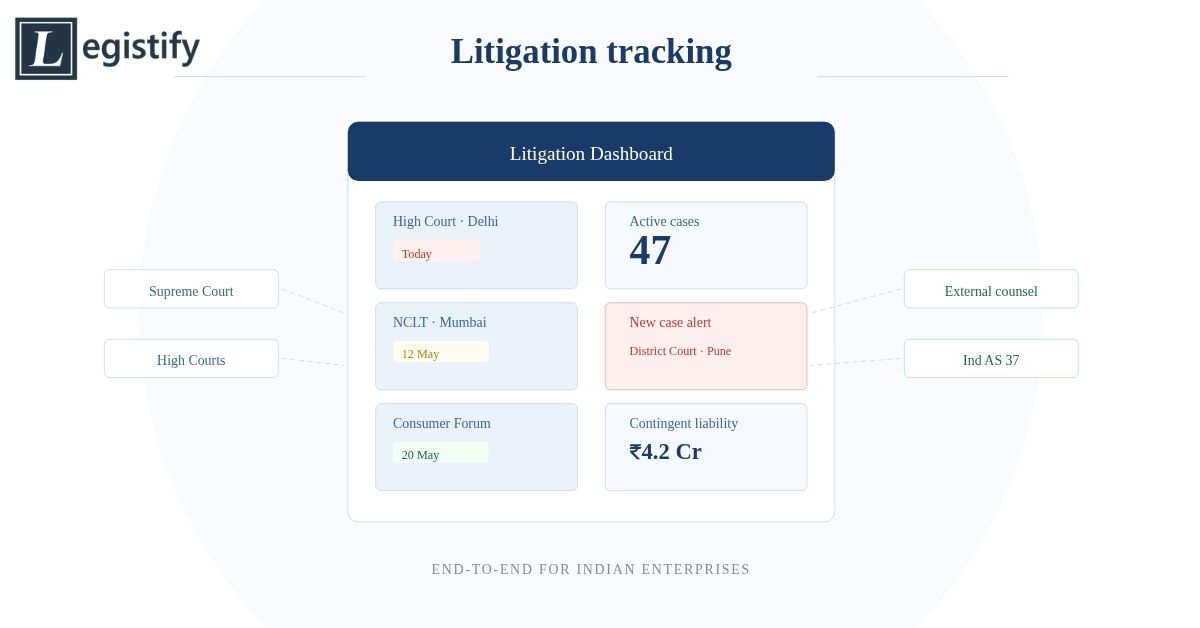
Case identification and registration. When a case is filed, it needs to be logged immediately with the relevant details: case number, forum, filing date, parties, subject matter, and the underlying contract or dispute. For enterprises with subsidiaries and group companies, new case alerts (automated notifications when a case is filed against any named entity) are a critical requirement. Discovering a case after an ex parte order has been passed is a failure that litigation tracking is specifically designed to prevent.
Forum-specific case status tracking. Indian enterprises manage litigation across a wide range of forums: the Supreme Court, High Courts across multiple states, District Courts, the National Company Law Tribunal and its Appellate Tribunal, consumer forums, labour tribunals, and sector-specific regulatory bodies. Each forum has its own cause list format, its own case numbering system, and its own update frequency. A litigation tracking system needs to pull case status updates from all relevant forums automatically, not require manual checking of multiple court portals.
Hearing date management. Missed hearings are among the most damaging and avoidable failures in litigation management. A litigation tracking system needs to track upcoming hearing dates across all active cases, send automated alerts to responsible team members at defined intervals before the hearing, and escalate when no acknowledgment is received. In India’s court system, hearing dates can be updated at short notice and cause lists are published the evening before. Manual tracking of these dates is consistently unreliable at enterprise scale.
Document management for case files. Every case generates documents: pleadings, orders, judgments, notices, correspondence with external counsel, and internal notes. A litigation tracking system needs to maintain a structured document repository for each case, with version control and access restrictions appropriate to the sensitivity of the material. When a case involves a contract, the relevant contract documents need to be accessible from the case record without manual retrieval.
External counsel management. Most enterprise litigation is managed through external advocates. Briefing, instruction, billing, and performance oversight of external counsel require structured workflows. Stage-linked billing, where payment is tied to defined case milestones rather than time spent, connects financial management directly to case progress. Performance tracking over time allows the legal team to allocate matters based on track record rather than familiarity.
Financial exposure and contingent liability tracking. Active litigation creates contingent liabilities that need to be disclosed in financial statements under Ind AS 37. A litigation tracking system needs to capture claim amounts, assess the likelihood of adverse outcomes, and produce portfolio-level contingent liability estimates that the finance team can rely on for reporting purposes.
Audit trail and records. When a case reaches judgment or settlement, the complete record of what happened, from the original dispute through the notice exchange, the pleadings, the hearing history, the orders, and the final outcome, needs to be preserved and producible. For regulatory reviews and subsequent disputes, this audit trail is essential.
50% of initial contract lifecycle management implementations are still failing, according to Gartner. One reason implementations fail is that legal teams discover, after go-live, that the CLM does not cover the workflows they actually need. Litigation tracking is one of the most common of these gaps.
CLM platforms are not connected to Indian court systems
The most fundamental limitation of generic CLM platforms for litigation tracking in India is that they have no connection to Indian court systems. They cannot pull case status updates from the Supreme Court or any High Court portal. They cannot track cause lists. They cannot generate new case alerts when a filing is made against a named entity.
This is not a configuration issue. It is an architectural one. Generic CLM platforms were not built to integrate with Indian court infrastructure, and retrofitting this capability through manual data entry reintroduces the exact manual overhead that automation is supposed to eliminate.
A purpose-built litigation tracking system for India is designed with Indian court integrations as a core feature, covering the Supreme Court, High Courts, District Courts, NCLTs, consumer forums, and tribunals. Case updates arrive automatically. Hearing dates are pulled from cause lists without manual checking. New case filings against named entities trigger immediate alerts.
CLM platforms handle contract data, not case data
The data model of a CLM platform is built around contracts: parties, dates, clauses, obligations, approvals, and renewals. The data model required for litigation tracking is different: case numbers, forum classifications, cause of action, stage of proceedings, orders passed, appeals filed, external counsel assigned, and financial exposure.
These are not simply additional fields in a contract record. They are a different type of data, with different relationships, different update frequencies, and different reporting requirements. A CLM platform extended to handle litigation data by adding custom fields produces a system that is neither a good CLM nor a good litigation tracker. The workflow is awkward, the reporting is limited, and the integrations with court systems do not exist.
External counsel management in CLM is inadequate for litigation
Most CLM platforms have some form of matter or spend management module. These are generally designed around the outside counsel relationship in the context of contract review and drafting: briefing an advocate to review a contract, tracking time spent, and processing the invoice.
Litigation counsel management is more complex. A litigation matter may involve multiple advocates across different forums, with different briefing requirements, different stage-linked billing milestones, and different performance metrics. The brief itself is more detailed: it needs to include pleadings filed, orders passed, the current stage of proceedings, and the legal team’s instructions on strategy and settlement authority.
CLM platforms that offer spend management do not typically provide the structured briefing and stage-linked billing workflows that litigation counsel management requires. The litigation team ends up managing external counsel through email and separate expense systems, defeating the purpose of having a centralised platform.
Contingent liability reporting from CLM is incomplete
CLM platforms track contract obligations and financial terms. They do not track litigation exposure. A CLM system that shows all active contracts and their financial terms cannot tell the finance team what the organisation’s total contingent liability from litigation is, because that information does not live in the contract. It lives in the case.
For Indian enterprises subject to Ind AS 37 disclosure requirements, the contingent liability estimate needs to cover both contractual exposure, which CLM can support, and litigation exposure, which requires a separate data source. When these two sources are not integrated, the finance team produces contingent liability estimates through manual reconciliation, which is slow, incomplete, and produces a point-in-time snapshot rather than a live view.
What End-to-End Litigation Tracking Looks Like
A purpose-built litigation tracking system covers the full lifecycle of a dispute, from the point at which a contractual failure gives rise to a potential claim through to case resolution.
Pre-litigation. The system flags obligation failures from the contract record, covering missed payments, delivery failures, and breach of agreed terms, that are likely to escalate into disputes. Automated notice management ensures that pre-litigation notices are sent, tracked, and documented before a case is filed. When a legal notice leads to a case filing, the case record is created with the pre-litigation history already attached.
Case management. The system automatically pulls hearing dates and case status updates from Indian court portals across all relevant forums. New case alerts notify the legal team when a filing is made against any named entity, including subsidiaries and group companies. The case record maintains the full document history, from pleadings through orders and judgments, with version control and access restrictions.
External counsel. Briefing workflows ensure that external counsel receives complete, structured instructions when a matter is assigned. Stage-linked billing ties payments to defined milestones in the case lifecycle. Performance data accumulates over time, giving the legal team a track record for each advocate on the panel.
Financial reporting. The system maintains claim amounts and likelihood assessments for all active cases, and produces portfolio-level contingent liability estimates for finance team reporting. When a case is connected to a contract, the financial exposure from the case is visible alongside the contractual obligations from the related agreement.
Integration with contracts and notices. When a case is connected to an underlying contract, the relevant contract record is accessible directly from the case. Notices sent in connection with the dispute are linked to the case record, creating a connected audit trail from the original agreement through the dispute resolution process.
The Cost of Managing Litigation Outside a Dedicated System
Enterprise legal teams that manage litigation through CLM platforms extended with custom fields, or through spreadsheets alongside their CLM, carry operational costs that are easy to underestimate.
Manual hearing date tracking produces missed hearings. Even a small rate of missed hearings, across a portfolio of hundreds of active cases, represents real litigation risk. An ex parte order passed because no one checked the cause list is not just an operational failure. It is a legal failure that can set a case back materially.
Manual new case discovery means cases are sometimes found late, after an adverse order has already been passed. For enterprises with many group companies and subsidiaries, monitoring for new filings manually is not feasible at the required frequency.
Manual contingent liability estimation for Ind AS 37 purposes is slow and produces incomplete results. The finance team reports a number that does not reflect the full portfolio, because not all cases have been captured or assessed.
Manual external counsel management means that performance data does not accumulate. The legal team continues to allocate matters to advocates based on relationships and familiarity rather than demonstrated performance, with no data to support a different approach.
Each of these is a cost that a purpose-built litigation tracking system eliminates. The investment in dedicated litigation tracking pays off not in one large visible outcome but in the consistent elimination of smaller, recurring failures that add up to real litigation exposure and operational inefficiency over time.
Legistify’s litigation management module is built for the Indian court system, with automated case updates across the Supreme Court, High Courts, District Courts, NCLTs, consumer forums, and tribunals, integrated with contract and notice management so that the full dispute lifecycle is tracked in one place.
Conclusion
Litigation tracking and contract management are related but distinct functions. They share some data, specifically the contract that underlies a dispute, but they require different capabilities, different data models, and different integrations. Generic CLM platforms are built for the contract lifecycle. They are not built for what happens when a contract dispute becomes a case.
For enterprise legal teams in India managing high volumes of litigation across multiple forums and jurisdictions, the gap between what a CLM platform provides and what litigation tracking requires is wide enough to produce consistent operational failures: missed hearings, late case discovery, incomplete contingent liability reporting, and inadequate external counsel management.
A purpose-built litigation tracking system closes these gaps. It does not replace the CLM. It works alongside it, connected to the contract record, so that the full lifecycle of a commercial relationship, from contract execution through dispute resolution, is visible in one place.