Legal work has always been document-heavy, detail-driven, and time-intensive. Whether the task is to review contracts, perform research, check compliance, or get ready for court cases, the number of tasks that legal professionals need to accomplish every day is enormous. And most of these tasks are repetitive.
This is where AI legal assistants are making their mark. They are helping lawyers and in-house legal teams save time and be more productive by letting them focus on the tasks that need their real expertise.
This guide is designed to provide the reader with the definition of AI legal assistant, how it works, where it is used, and what legal professionals need to know about AI legal assistant.
What Is an AI Legal Assistant?
An AI legal assistant is a software tool that utilises artificial intelligence to enable legal professionals to complete their work in a more efficient manner. It can read, interpret, summarise, write, and analyse legal documents, all at a pace that is unmatched by human processes.
Unlike other legal software, which stores legal documents and retrieves them, an AI legal assistant can process legal information. It can comprehend, recognise, detect, and produce legal documents, summaries, research, and clauses.
These tools are not meant to replace lawyers. Rather, they’re meant to allow lawyers to spend less time on low-complexity, high-volume work, so they have more time for work that requires legal judgment.
To put it simply: An AI legal assistant is a technology that sits alongside an existing lawyer’s workflow, helping with groundwork so that the lawyer can focus on decision-making.
The Problem with Traditional Legal Workflows
Before we dive into how AI legal assistants can help, let’s first look at the inefficiencies they solve.
- Manual, time-consuming document review
Document review, such as reviewing contracts, performing due diligence, or ensuring compliance, usually entails reviewing hundreds, if not thousands, of documents. This is currently done manually, which is slow, labor-intensive, and often prone to human error, especially in a hurry.
- Scattered and unstructured data
Data in the legal sphere is never neatly organised. Contracts are in email threads, on shared drives, or in filing cabinets. Precedents are in individual folders. Research materials are scattered throughout various documents. Access to the right information at the right time is a constant headache.
- High cost of repetitive tasks
A considerable portion of billable hours or working hours for legal teams is often spent on tasks like key clause extraction, tracking obligations, summarising text, and managing deadlines. These tasks are important but don’t require extensive legal reasoning.
- Pressure on in-house teams
In-house legal teams often face resource constraints compared to the volume of work that is coming in. They need to review more contracts, manage more vendors, and comply with regulations in more jurisdictions – often with fewer resources.
According to the American Bar Association’s 2024 Legal Technology Survey Report, AI adoption among law firms nearly tripled year over year, rising from 11% in 2023 to 30% in 2024. The increase was far more pronounced at larger firms, with adoption among firms of 500 or more lawyers reaching nearly 48%, compared to much lower rates at smaller practices. The trend is only set to increase as the underlying issue, too much work, too little time, is not going away.
How Does an AI Legal Assistant Work?
An AI legal assistant is powered by a variety of technology that, in total, enables it to read and understand legal language in the same way that a human professional would – only quicker and at greater scale.
- Natural Language Processing (NLP)
NLP allows an AI assistant to read and understand human language, as opposed to simply searching for keywords. This technology allows it to understand sentence structures and intent. This is what allows an AI assistant to search through a 200-page contract and find a specific clause without being directed to it.
- Machine Learning (ML)
Machine learning algorithms are fed vast amounts of data – contracts, case law, regulatory filings, and other information. Over time, these algorithms are able to recognise patterns – what an indemnification clause looks like, what language is associated with risk, and what terms are non-standard.
- Large Language Models (LLMs)
Large Language Models, such as those used in tools such as ChatGPT or legal models designed specifically for this purpose, can be used to generate text. In the context of law, this means generating clauses of text, summaries, answering research-based questions, and creating draft documents based on prompts.
- Retrieval-Augmented Generation (RAG)
One of the key technologies used in legal AI tools is RAG. RAG is used to ensure that AI outputs are tied to specific source documents or data. This is particularly useful in legal contexts, in which accuracy and attribution are key.
Together, these technologies enable an AI legal assistant to perform tasks such as: extracting all termination clauses from 50 contracts in parallel, identifying those which vary from a desired template, and creating a summary table – in minutes.
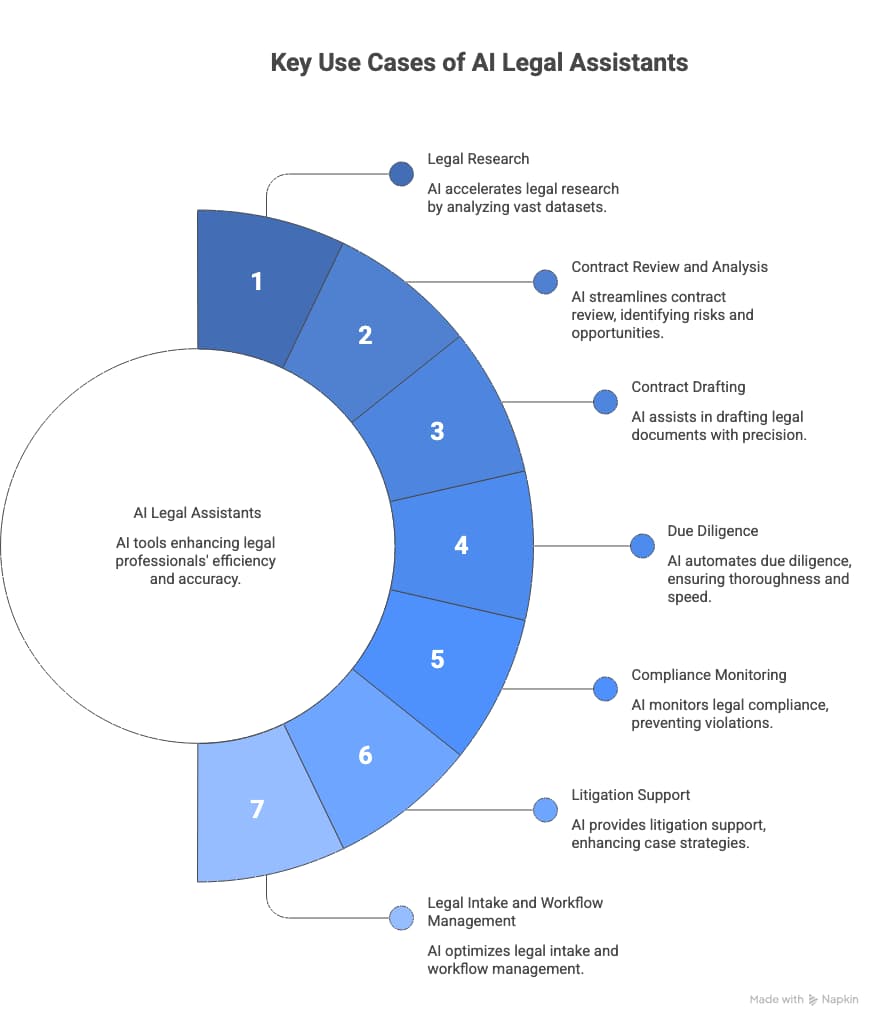
Key Use Cases of AI Legal Assistants
1. Legal Research
Legal research usually involves sifting through case laws, reading up on judgments, filtering relevant precedents, and integrating all that in an easily consumable format. This usually takes days.
An AI legal assistant can quickly scan legal data, condense relevant case laws, pinpoint jurisdiction-specific precedents, and produce well-structured legal research memos in a small fraction of that time. The legal expert makes the call; the AI performs the groundwork.
Example: A legal team in-house wants to get an overview of the enforceability of a non-compete clause in three states. An AI legal assistant can quickly fetch relevant case laws, legal provisions, and recent court judgments in all three states.
2. Contract Review and Analysis
One of the most time-consuming activities for law firms and in-house legal teams is the review of contracts. AI assistants can be used to analyse the contracts and check for any variations against the standard playbook.
This does not replace the need for the lawyer to review the contract. Instead, it helps them do it faster. The lawyer now has the time to concentrate on the issues that the AI assistant has flagged rather than having to read the entire document.
Some of the common activities that AI assistants perform during the review of contracts:
- Determine if any clauses are missing or unusual
- Determine the key dates and details in the contracts
- Flag liability caps and termination rights
- Compare the contracts with the standard playbook
There are various AI-based tools that can be used for the management of contracts, such as Legistify.
3. Contract Drafting
AI legal assistants can be used to generate first drafts of standard contracts such as NDAs, employment contracts, vendor contracts, etc. The AI assistants do this by leveraging the data they were trained on and the instructions provided to them.
This is beneficial to in-house legal teams that deal with high volumes of standard contracts and do not have the bandwidth to outsource all these contracts.
4. Due Diligence
In the context of M&A deals, investment rounds, and vendor relationships, due diligence entails the review of vast numbers of documents. AI legal assistants can review hundreds of documents at once and identify issues.
This process that previously took several weeks for several legal minds can now be completed in a fraction of the time.
5. Compliance Monitoring
Regulations are constantly changing. Keeping up with the changes in multiple jurisdictions is one of the greatest challenges for in-house legal and compliance professionals. AI assistants can be used to monitor changes in regulations and connect the changes with the organisation’s policies.
This is particularly important for highly regulated sectors such as finance, healthcare, data privacy, and manufacturing.
6. Litigation Support
AI assistants can be used to assist the litigation team in reviewing documents in the discovery process, evaluating the relevance of the evidence, and predicting the outcome of the case based on the historical data. AI assistants can also be used to assist the litigation team in the deposition process.
7. Legal Intake and Workflow Management
AI legal assistants can be used for first-level legal intake, which involves routing legal requests, gathering data, tracking progress, and even sending reminders. This is helpful in reducing the workload on legal operations.
Benefits of Using an AI Legal Assistant
- Speed and efficiency
Artificial intelligence can accomplish tasks in a fraction of the time that would be required by humans. Examples include legal research, document review, and first-draft writing.
- Improved accuracy and consistency
Artificial intelligence is not susceptible to fatigue. It applies the same rules to the 500th document as it did to the first document. This minimises the probability of overlooking clauses, inconsistencies, and human error.
- Cost reduction
Artificial intelligence legal assistants reduce the cost per case for law firms that charge clients and in-house legal departments that must manage budgets.
- Scalability
A legal AI assistant may be able to deal with ten contracts or ten thousand contracts in the very same way. This makes it especially useful for growing companies, busy transactions, and for legal teams that have to deal with a high volume of documentation.
- Better use of legal talent
The less time lawyers spend on reviewing documents, the more they can focus on advisory work, which requires judgment, client relations, and complex problem-solving.
Important Considerations and Limitations
While AI legal assistants are powerful tools, there are limitations that need to be grasped by legal practitioners before adoption.
- AI outputs require human verification
While AI tools are effective, it is also possible for them to generate incorrect or incomplete information, especially in highly nuanced and new areas of law. Legal practitioners need to verify and validate information generated by AI tools.
- Hallucinations and accuracy risks
There is also the possibility that large language models could generate information that is not accurate and could be entirely false, such as false case citations. This is one of the limitations of the technology, and it is not optional.
- Data confidentiality and security
Legal work often involves sensitive data. Prior to using any AI tool, legal organisations must assess the vendor’s data security standards and ensure that they comply with all legal requirements regarding data privacy.
- Jurisdictional and domain limitations
AI legal assistants that have been trained on legal data from a particular jurisdiction may not be effective in other legal systems. There could also be differences in domains.
- Change management
Using AI tools is not just about training legal organisations on how to use them but also involves changing their work processes. AI tools must be used in conjunction with other processes, not in isolation.
Who Should Use an AI Legal Assistant?
AI legal assistants are applicable in various legal scenarios, including:
- Law firms dealing with high-volume cases, such as documents, client advice, or research
- In-house legal teams dealing with contracts, legal compliance, and legal intake
- Legal operations professionals seeking to improve their workflows
- Corporate legal teams dealing with M&A, fundraising, or vendor growth
- Compliance teams dealing with various regulations in various jurisdictions
The common factor in all of these scenarios is volume. AI legal assistants can be most useful in scenarios where there is a high volume of documents, cases, or data.
How Legistify Approaches AI for Legal Teams
Legistify is a legal technology platform that is designed to cater to the needs of in-house legal teams and enterprises in India. The platform’s contract management and legal workflow features utilise AI to assist legal teams in reviewing and organising contracts.
For legal teams that deal with an increasing number of contracts and vendor agreements, Legistify provides an organised way of integrating AI into the legal workflow without interrupting the current process.
Conclusion
AI legal assistants are not a futuristic concept but are currently in use in law firms, in-house, and legal ops groups. The value proposition of AI legal assistants is simple: they automate the mundane, document-based groundwork of legal work, allowing lawyers to concentrate on what only they can do.
While there are limitations to the use of AI, including the need to validate results, security, and planning, for any legal team that faces high volumes, tight deadlines, and resource constraints, the argument for adopting AI-based legal tools is no longer a debate. No longer a debate, but a discussion of how to adapt to AI.