Legal work has always been demanding—long hours, high-stakes decisions, and an ever-growing volume of documents, deadlines, and regulations. For decades, the tools available to lawyers remained largely the same: word processors, databases, and email. But that’s changing rapidly.
Artificial intelligence is now making its way into law firms, corporate legal departments, and in-house legal teams worldwide. According to Thomson Reuters’ Future of Professionals Report, effective use of AI in legal practice can free up nearly 240 hours of manual work per professional per year—the equivalent of six weeks. That’s not a marginal gain. It’s a fundamental shift in how legal work gets done.
This guide is for lawyers, legal teams, and law firms who want to understand what AI actually is, how it works in a legal context, where it adds real value, and what limitations to be aware of. No technical background required.
What Is AI in the Legal Context?
Artificial intelligence is, at its heart, a term that describes computer systems that are capable of performing tasks that would normally require human intelligence, such as reading and understanding written text, recognising patterns, making predictions, and understanding the meaning of data.
What does this mean for the legal industry? Well, for a start, Artificial Intelligence doesn’t mean that robots will be replacing lawyers. It means that computer systems will be developed that are capable of performing particular, well-defined tasks, such as reviewing a contract, providing case law, highlighting compliance issues, or reading through hundreds of documents.
The most relevant types of AI for legal professionals are:
- Natural Language Processing (NLP): It allows computers to read, comprehend, and analyse written language, including contracts, court documents, laws, and emails.
- Machine Learning (ML): It refers to computers that can learn and improve on their own by analysing large data sets.
- Generative AI: It includes large language models (LLMs) that can generate written text, answer questions, and summarise information upon request. This type of AI has seen the fastest adoption by legal professionals since 2023.
It is essential to note that these types of AI are rarely used in isolation; most legal AI applications integrate two or more of these types of AI to analyse documents, extract information, and generate insights at speeds that no human can match.
How Does AI Work in Legal Practice?
Legal AI tools are usually built on huge sets of legal documents, including contracts, cases, and regulatory filings. This process helps the system learn what different clauses mean, how different cases have been decided on different topics, and what language indicates potential risk.
When a lawyer enters a document into an AI tool, the tool:
- Reads and interprets the document, analysing its components, such as clauses, parties, obligations, and dates.
- Uses patterns learned from thousands of similar documents, comparing the language used in the document being analysed.
- Flags, extracts, or summarises relevant information, unusual clauses, omitted provisions, or potential issues.
- Shows the insights to the lawyer, sometimes with confidence scores, highlights, and indications of where in the document the issue was detected.
The lawyer considers, decides, and acts. The AI does not make decisions, but it accelerates the process considerably.
The Current Reality: Challenges in Traditional Legal Workflows
Before diving into the possibilities of AI, let’s be realistic about the problems that exist in the current state of affairs. The problems that face the legal profession are:
- Overload: We have contracts, regulatory texts, discovery materials, research briefs, and the volume of written information that lawyers have to deal with has increased exponentially, whereas the number of lawyers has not.
- Time wasted on repetitive tasks: Senior lawyers are often seen to be working on tasks that are, at heart, repetitive, whether it is pulling out key date information from contracts, conducting routine due diligence, or formatting research briefs.
- Inconsistency at scale: When ten reviewers are tasked with reviewing thousands of documents manually, inconsistency is inevitable. Various reviewers may focus on different things, understand words differently, and may have different standards for consistency.
- Turnaround time: Delayed turnaround times for transactions, disputes, or responses to regulatory requirements may compress the review period in a way that heightens risk.
- Rising client expectations: Clients expect law firms to provide faster and more cost-effective services than ever before. Law firms that fail to meet expectations in this area risk being undercut by firms that can.
These are the actual challenges that AI solutions are meant to solve.
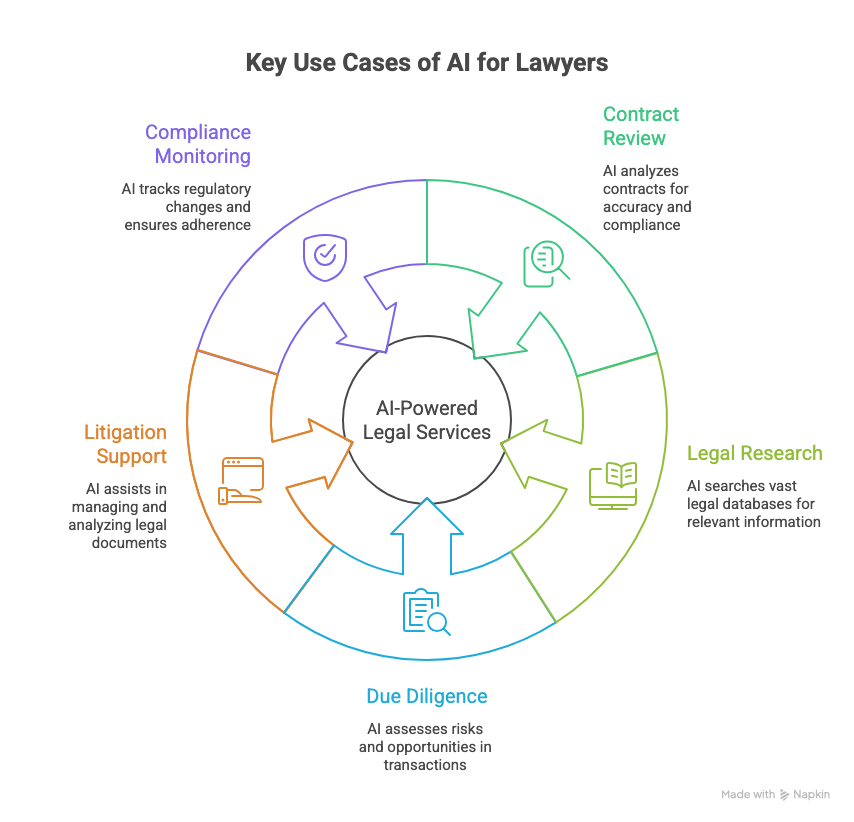
Key Use Cases of AI for Lawyers
1. Contract Review and Analysis
One of the most common and established uses of AI is the review of contracts. This can be done by the use of AI tools to read through the contracts and automatically perform the following tasks:
- Extract key information from the contract
- Compare the contract to a preferred template
- Identify clauses that are not standard
- Identify clauses that are potentially risky
- Compare the contract to a preferred template
- Identify clauses that are missing from the contract
- Summarise the obligations and rights under the contract
This is particularly relevant for high-volume use cases like vendor agreements, NDAs, or procurement contracts, whereby manually reviewing all these documents is time-consuming but commercially important. A team of lawyers might take two weeks to review all these, but AI-assisted tools can do this in a matter of hours.
Legistify is a platform for AI-based contract management, which helps legal teams centralise, review, and monitor their contracts in a much more efficient manner.
2. Legal Research
Legal research has traditionally been a laborious task involving hours spent scouring legal databases such as Westlaw or Lexis Nexis to find relevant legal cases, statutes, and regulations. AI is changing this process in two ways:
Search and Retrieval: AI-based search technologies understand the meaning of the search query rather than the words. This enables legal professionals to locate relevant legal cases even if the wording is slightly different.
Summarisation and Synthesis: AI can read a number of cases, understand the legal principle involved, and generate a summary of the cases—significantly reducing the time required to write a legal research document.
However, the legal research done by AI still needs human verification. There have been instances where AI legal research tools have been shown to “hallucinate” cases that do not exist. Legal professionals need to verify the authenticity of the cases before using them for legal submissions.
3. Due Diligence
In a merger and acquisition situation, a private equity investment, or a finance deal, for example, the process of due diligence involves reviewing a large number of documents, often running to the thousands. This is an area where AI can help significantly.
With the help of AI, due diligence can be conducted in the following ways:
- Classify a large quantity of information according to type (e.g., lease, employment agreement, IP assignment, etc.)
- Extract key information from a set of information pertaining to a given type
- Identify concerns on a set checklist
- Create a report on due diligence
What may have taken a whole team weeks to accomplish can be achieved faster with the help of AI, freeing up lawyers’ bandwidth for the areas where judgment is actually needed, rather than information extraction.
4. Litigation Support and eDiscovery
In litigation, there is often a need for discovery, which can involve reviewing massive volumes of emails, documents, and communications to determine what is relevant, privileged, or significant. This is an area where AI has been used for the longest period and in the most extensive manner within the legal industry.
Some of the key areas of AI use are as follows:
- Predictive Coding/Technology Assisted Review (TAR): AI is trained on a lawyer’s initial review decisions and can apply them across a large volume of documents.
- Email Threading/Deduplication: AI can group related emails and eliminate duplicates.
- Privilege Log Generation: AI can help identify privileged communications.
- Complaint Response Drafting: AI can draft a response to a complaint in under 10 minutes, reducing a time of 16 hours of associate time.
5. Compliance Monitoring
For in-house legal departments or regulated industries, keeping pace with changing regulations can be a constant challenge, and here, AI tools can help in monitoring the regulations, identifying the changes, and comparing these with the existing in-house policies, thereby keeping pace with compliance rather than trying to catch up with it.
How AI Improves Legal Work: Key Benefits
- Efficiency
AI works through time-consuming and repetitive tasks at a faster rate compared to humans. For instance, reviewing documents, which could take days, could now take hours. This means lawyers could focus on tasks that demand a lot of legal expertise and client engagement.
- Accuracy and Consistency
AI ensures consistency and accuracy through every document within a group of documents. This is hard to achieve when working with a large number of lawyers. Furthermore, it cannot get bored or distracted while working. This ensures that a critical issue cannot be overlooked.
- Scalability
It is not necessary to increase the headcount of a team to make it scalable. A small team working with AI could work through a large amount of work.
- Cost Reduction
More efficient processes also mean cost reduction for law firms, i.e., fewer billable hours, and for clients, i.e., fewer legal fees. The in-house team can handle more work without having to increase their budget proportionally.
- Better Risk Identification
The AI system, having been exposed to large quantities of legal data, would be able to spot risks that an inexperienced human reader might not be able to spot. This would be beneficial for risk assessment during contract review, due diligence, etc.
Challenges and Limitations of Legal AI
Just as important as knowing what AI can do is knowing what it cannot do.
Accuracy Is Not Guaranteed
AI tools are not infallible. In fact, generative AI tools are likely to generate inaccurate information, including fictional case citations. This does not mean the information is not stated confidently.
Lack of Legal Judgment
AI can spot a non-standard clause but cannot evaluate whether it would be commercially viable to accept the clause from a relationship, business dynamics, and client risk assessment point of view. This is a legal judgment that only a human can provide.
Data Privacy and Confidentiality
Uploading client documents to AI platforms also raises data security and confidentiality concerns for the lawyer. The lawyer should understand where their data is going and whether using a particular platform is consistent with their obligations to maintain client confidentiality.
Ethical and Professional Responsibility
Several jurisdictions’ bar associations have started to issue guidelines on the use of AI in the practice of law. Lawyers remain responsible for the accuracy of their submissions, with or without the assistance of AI.
Resistance to Adoption
Cultural resistance to change is a reality that many organisations have to contend with. Lawyers are a conservative bunch and tend to be risk-averse individuals who are naturally wary of new technology that they may not fully understand. Building trust in AI platforms requires time, training, and a proven track record.
Getting Started: What Lawyers Should Know
If you are a legal professional or a team of lawyers looking into AI tools, here are a few practical suggestions:
Start with specific use cases. Don’t attempt to use AI for everything at once. Start with the specific use case that is most time-consuming and repetitive. It might be contract review, research, or due diligence. Look for tools that are specific to this use case.
Prioritise tools that are built for legal. General-purpose AI tools, such as chatbots for consumers, are not designed with legal-specific data, confidentiality, or standards in mind. They are not as useful for legal practice as tools specifically designed for legal use.
Implement a verification process. Whatever the AI tool produces, a qualified legal professional should verify it before relying on it. This should be built into your process from the start.
Know your data obligations. Prior to uploading client documents on a platform, know the data handling practices of that vendor and assess if they align with your obligations.
Invest in team training. AI tools are only as good as the people who use them. Training your team not only on how to use an AI tool but also on how to critically think about the results of the AI tool is vital.
Conclusion
AI is not a future technology for the legal profession; it is a current one. Its adoption is happening at a rapid rate, and the difference between those who use it well and those who do not is already tangible in terms of speed, cost, and quality of output.
To lawyers and legal teams new to the topic of AI, the most important thing to understand is a conceptual one. The most important thing to understand is that AI is not a substitute for expertise. It is a facilitator of expertise by eliminating friction in areas where it can be applied.
By beginning with a solid understanding of the use case, the tools, and the importance of human verification, lawyers and legal teams can reap the benefits of AI without the risks of bad or unstructured adoption.
The legal profession is a profession of adaptation. The next tool to adapt to is AI. The first step to using it well is to understand it well.