Registering a trademark is the beginning of brand protection, not the end of it. A registration in India lasts for a fixed term and must be renewed to stay in force, and even a valid registration loses value if conflicting marks are allowed to proceed unchallenged or if the mark itself is not being used. For an enterprise with dozens or hundreds of marks across multiple classes, these obligations create a steady stream of deadlines that no individual can reliably track from memory.
This guide covers the three disciplines that keep an enterprise brand portfolio protected after registration: renewal, watch and monitoring. It sets out the Indian rules for each, the costs of getting them wrong and the systems a legal team needs in place to manage them at scale.
Part One: Renewal
How long a registration lasts
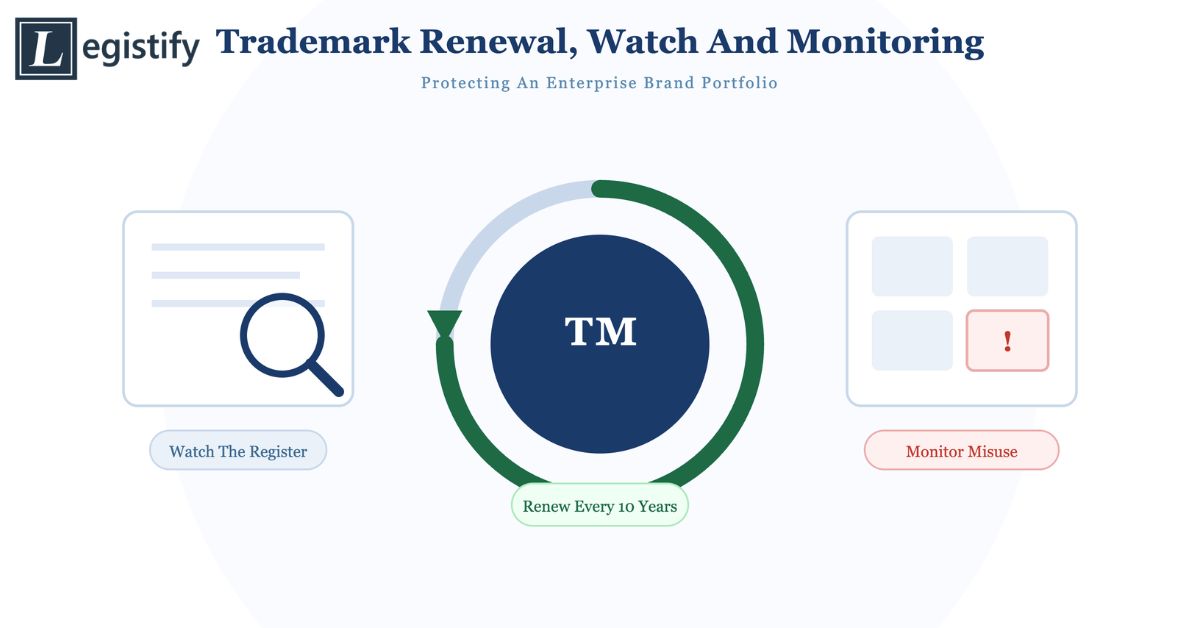
A registered trademark in India is valid for 10 years and can be renewed indefinitely for further periods of 10 years. The term runs from the date of the original application, not from the date the certificate is issued. A mark that took two years to reach registration therefore has eight years of its first term remaining when the certificate arrives, and the renewal date should be calculated from the filing date.
The renewal timeline
Renewal is filed on Form TM-R through the IP India e-filing portal. The timeline has three stages, and the cost rises at each one:
| Stage |
Form |
Official fee per class (online) |
| Up to 12 months before expiry |
TM-R |
₹9,000 |
| Within 6 months after expiry |
TM-R with surcharge |
₹9,000 plus ₹4,500 surcharge |
| Between 6 months and 1 year after expiry |
TM-R for restoration and renewal |
₹9,000 renewal plus ₹9,000 restoration |
If a registration is not renewed in time, the mark is removed from the register. It can be restored within one year of expiry under Section 25(4) of the Trade Marks Act, 1999, but restoration is at the Registrar’s discretion and is not automatic. Fees are charged per class, so a mark registered in several classes multiplies the cost of every stage. A lapsed mark also leaves the brand open to others adopting the same or a similar name during the gap.
Common renewal failures in enterprise portfolios
Expiry dates calculated from the wrong date. Teams that count from the certificate date rather than the filing date will file late.
Outdated ownership records. Renewal must be filed by the registered proprietor. If the mark has passed through a merger, name change or group restructuring and the register has not been updated, the renewal can be delayed while the record is corrected. Ownership changes should be recorded with the Registry well before the renewal date.
Multi-class marks renewed inconsistently. Where a mark is registered in several classes, each class must be renewed, and a decision to drop an unused class should be made deliberately and not by omission.
Reliance on an external agent without internal tracking. Agents change, and files are transferred. An enterprise that does not hold its own record of renewal dates depends entirely on the diligence of whoever currently holds the file.
Part Two: Watch
A watch service monitors new trademark applications and flags those that are identical or similar to the enterprise’s marks, so that the enterprise can act before a conflicting mark is registered.
Why the opposition window matters
When an application is accepted, it is advertised in the Trade Marks Journal. Any person can then file a notice of opposition within three months of the date of advertisement, extendable by one month on filing the prescribed form. That window is the cheapest and most effective opportunity to stop a conflicting mark. After registration, the enterprise must pursue rectification or cancellation proceedings, which are slower, more expensive and less certain.
An enterprise that does not review the Journal has no way of knowing that the window is open. A watch service solves this by checking each new publication against the enterprise’s marks and escalating potential conflicts for review.
What a watch programme should cover
- Identical and similar word marks. Spelling variants, phonetic equivalents and marks that share a dominant element.
- Device marks and logos. Conflicts are assessed on visual similarity, so these need separate review from word marks.
- Relevant classes and related classes. Conflicts can arise outside the exact class of registration when goods or services are related.
- Your own pending applications. Tracking the status of the enterprise’s applications through examination, advertisement and opposition belongs in the same process.
Deciding which marks to watch
Watching every mark at the same intensity is rarely justified. A sensible approach is to rank marks by commercial importance, with the primary house brand and flagship product names under the broadest watch and lower-value or legacy marks monitored more selectively. Marks planned for international extension deserve attention early, since a conflicting domestic filing can complicate later expansion.
Part Three: Monitoring Use and the Market
Watch deals with the register. Monitoring deals with what is happening in the market, and it addresses two separate risks.
Third-party misuse
Infringing use can appear on marketplaces, in domain names, on social media handles and in advertising keywords without any corresponding trademark application. Monitoring these channels allows the enterprise to send takedown requests and cease-and-desist notices before the misuse becomes established. Records of when the enterprise first became aware of the misuse, and how it responded, also matter if the dispute later reaches court, because delay in acting can weaken the case.
Your own use of the mark
A registration can be vulnerable if the mark is not actually used. A third party may apply for removal of a registered mark on the ground of continuous non-use, and a period of five years is the benchmark in the Act. Enterprises with large portfolios often hold marks that were registered for planned products and never launched. Reviewing each mark periodically to confirm that it is in use, and collecting evidence of that use, protects the registration against a non-use challenge. Evidence should include dated invoices, advertising, packaging and sales records for each class.
International marks
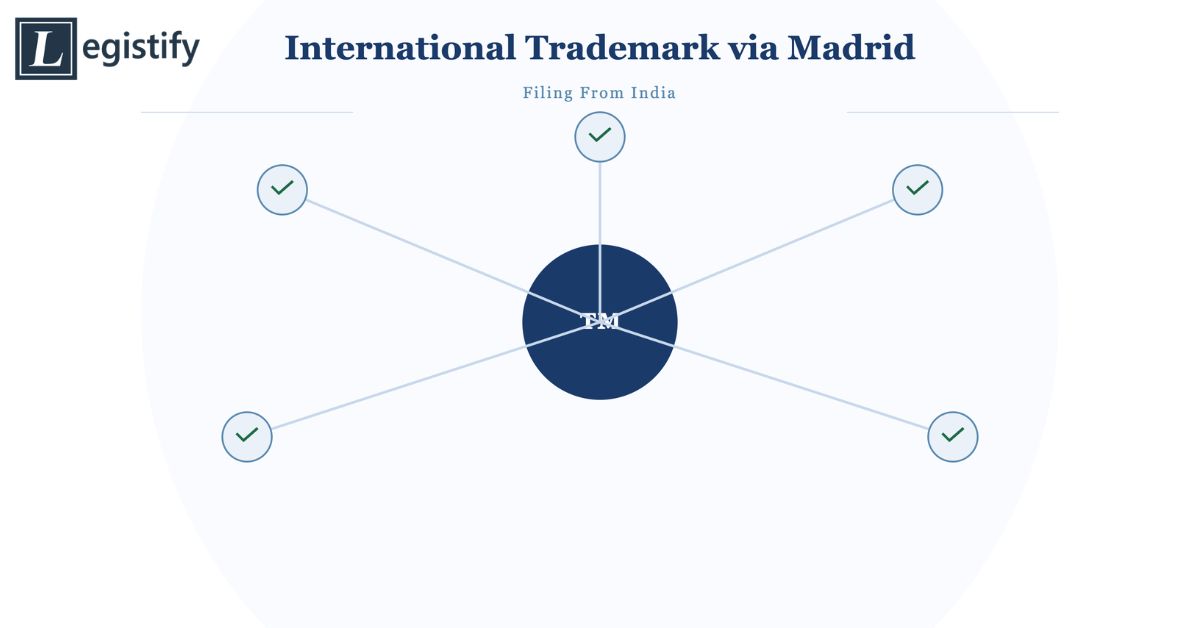
Marks protected abroad through the Madrid Protocol require a separate renewal, made centrally through WIPO every 10 years, in addition to any local requirements in designated countries. For the first five years the international registration also depends on the Indian basic mark, so an Indian renewal or opposition lapse can affect every designated country.
Building a Portfolio Management Process
Create a single register of every mark. Record the mark, classes, application and registration numbers, filing date, calculated renewal date, status, owner of record and the agent currently handling the file.
Set alerts well ahead of each deadline. Trigger alerts at 12, 6 and 3 months before renewal, so that the filing is made before the surcharge period begins.
Assign an internal owner for each mark. The owner is accountable for confirming use, authorising renewal and deciding whether to drop classes.
Review watch results on a fixed cycle. Conflicting applications should be triaged within days, since the opposition period is short.
Keep use evidence current. Collect it as part of the annual review and not when a challenge arrives.
Link trademarks to related contracts. Licences, co-existence agreements and assignments affect who may use a mark and who must renew it. They should be visible alongside the registration record.
Where Contract and IP Management Software Fits
A manual spreadsheet can hold a list of marks but cannot reliably prompt action on the dates that matter. As portfolios grow, enterprises need a system that calculates renewal dates automatically, tracks every stage of an application, connects trademark records to the licences and agreements that depend on them, and raises alerts to the right person.
Legistify’s IP management platform tracks trademark portfolios from application through registration, opposition, renewal and restoration, with automated alerts ahead of each statutory deadline and a connected view of the licences, assignments and agreements attached to each mark. International filings made through the Madrid Protocol can be tracked in the same record, including the five-year dependency on the Indian basic mark.
Conclusion
Protecting a brand after registration depends on three routines running together. Renewal keeps the registration alive, watch stops conflicting marks while the opposition window is open and monitoring catches misuse and confirms that the mark is genuinely in use. Each has its own deadlines and its own cost of failure, and enterprises that rely on memory or scattered files will eventually miss one. A single portfolio register with alerts, internal ownership and regular review is the practical foundation for keeping a brand portfolio secure.