Choosing the right way to file a patent can shape the entire commercial future of an invention. File too early without enough technical detail, and the resulting protection may be weaker than the enterprise assumes. Wait too long to file at all, and a competitor working on a similar idea could reach the patent office first. For enterprises with an active R&D pipeline in India, the decision between filing a Provisional Patent Application and filing a Complete Patent Application directly is one of the most consequential, and most frequently misunderstood, strategic calls in the entire patent process.
This guide breaks down both routes under the Indian Patents Act, 1970, what each option actually requires, the genuine trade-offs, and how enterprises specifically, as distinct from individual inventors, should think about the choice.
What a Provisional Patent Application Is
A Provisional Patent Application is an initial filing that secures an early priority date for an invention without requiring the applicant to submit a complete specification at the time of filing. Under Section 9 of the Indian Patents Act, 1970, this route is specifically designed for situations where the invention is not yet fully developed, but the applicant wants the invention’s earliest possible date on record before disclosing it further or before a competitor files something similar.
A provisional application must disclose the invention sufficiently to demonstrate that the applicant is genuinely in possession of the invention as of the filing date. It requires a description of the invention but does not require formal claims or detailed technical drawings, which is precisely what makes it faster and less expensive to prepare than a complete specification.
Key characteristics of a provisional filing:
It secures the priority date immediately. From the moment of filing, the invention is protected from that date forward, which matters considerably in India’s first-to-file patent system, where being first to the patent office, not first to invent, generally determines priority in a dispute.
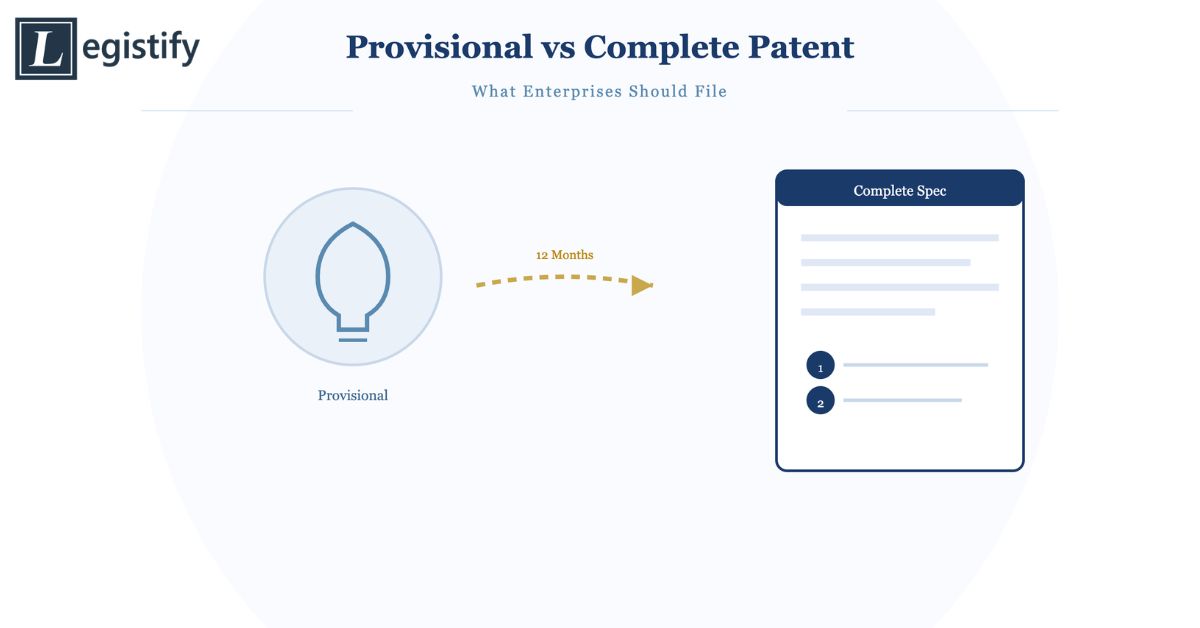
It buys 12 months of development time. The applicant has a full year from the provisional filing date to refine the invention, complete testing or prototyping, and finalise the technical and commercial details before committing to the more demanding complete specification.
It is significantly less expensive at the outset. Official filing fees for a provisional application are lower than for a complete specification, and the reduced drafting requirement, no formal claims, no mandatory drawings, means lower professional fees as well.
The 12-month deadline is strict and largely non-negotiable. If the complete specification is not filed within 12 months of the provisional filing date, the application is deemed abandoned, and the priority date secured by the provisional filing is lost entirely.
What a Complete Patent Application Is
A Complete Patent Application is the comprehensive, legally operative filing required to actually secure a patent grant in India. Unlike a provisional application, it must include a full, detailed description of the invention, formal patent claims defining precisely what legal protection is being sought, drawings where necessary to illustrate the invention, and an abstract summarising the invention. This document is the legal foundation of the patent rights that will ultimately be granted, and it is what the Indian Patent Office actually examines for novelty, inventive step, and industrial applicability.
A complete specification can be filed in one of two ways: directly, as the applicant’s first and only filing for that invention, or as the required follow-up to an earlier provisional filing, in which case it must correspond to and build upon the invention disclosed in that provisional application.
The Direct Comparison
| Factor |
Provisional Application |
Complete Application |
| Formal claims required |
No |
Yes |
| Drawings required |
Only if helpful, not mandatory |
Yes, where necessary to illustrate the invention |
| Cost at filing |
Lower |
Higher |
| Speed of preparation |
Faster |
Slower, requires full technical and legal detail |
| Secures priority date |
Yes, immediately |
Yes, immediately |
| Grants immediate examination eligibility |
No |
Yes |
| Deadline consequence |
Must file complete specification within 12 months or lose priority |
Proceeds directly to examination |
| Best suited for |
Inventions still in development, urgent priority-date needs |
Inventions that are technically finalised and ready for commercialisation |
Why Enterprises Should Think About This Differently Than Individual Inventors
Most guidance on provisional versus complete patent filing is written primarily for individual inventors and early-stage startups, where cost sensitivity and genuine technical uncertainty about the invention’s final form are the dominant considerations. Enterprises with dedicated R&D functions and existing patent counsel relationships face a different set of practical trade-offs.
Speed to file versus completeness of protection. For an enterprise racing to secure a priority date ahead of a known competitor, or ahead of an imminent public disclosure such as a product launch, conference presentation, or investor pitch, a provisional filing is often the only realistic option on the actual timeline available, even where the enterprise’s patent counsel would, in an unconstrained world, prefer to file a complete specification directly.
Internal coordination overhead. Preparing a complete specification, with fully drafted claims that define the precise legal scope of protection being sought, typically requires closer, more iterative collaboration between the inventing team and patent counsel than a provisional filing does. For enterprises with inventions spanning multiple technical teams or business units, this coordination overhead is a genuine, practical factor in deciding whether a provisional filing, buying time to complete that coordination properly, is the more realistic path.
Portfolio-level filing strategy. An enterprise managing a genuine patent portfolio, rather than filing on an invention-by-invention basis, often benefits from a consistent, disciplined provisional-first strategy specifically because it decouples the priority-date decision, which is frequently urgent, from the complete-specification decision, which benefits from more considered legal and commercial input about claim scope, jurisdiction strategy, and competitive positioning.
The commercial readiness question. Complete applications suit inventions that have moved firmly out of pure research and into a stage where the enterprise is confident about the invention’s final technical form and has a clear view of its commercial direction. Filing a complete specification too early, before the invention’s final form is genuinely settled, risks drafting claims that are either too narrow (missing later refinements made during the 12-month development window a provisional filing would otherwise have provided) or too broad in ways that create validity risk during examination.
When Enterprises Should File a Provisional Application
The invention is still evolving and the enterprise needs to lock in a priority date now. This is the classic use case, and it applies with particular force to enterprises operating in fast-moving technical fields where a competitor filing even weeks earlier could materially affect the commercial value of the eventual patent.
A public disclosure is imminent. Product launches, trade show demonstrations, academic publications, or investor presentations all create prior art risk once they occur. Filing a provisional application before any of these events secures the priority date without requiring the invention to be technically finalised first.
The technical team needs more development time before claims can be responsibly drafted. Where the invention’s final architecture, key technical parameters, or scope of application are still being actively refined, filing formal claims prematurely risks either missing protectable improvements made during that refinement, or drafting claims narrower than the invention ultimately warrants.
Budget timing matters. For enterprises managing patent filing budgets across a fiscal year or a specific R&D allocation cycle, the lower upfront cost of a provisional filing, with the larger complete-specification cost deferred by up to 12 months, can be a genuine, legitimate budgeting consideration, not simply a cost-cutting shortcut.
When Enterprises Should File a Complete Application Directly
The invention is technically finalised and ready for commercialisation. Where there is no meaningful development uncertainty remaining, and the enterprise’s patent counsel already has the information needed to draft properly scoped claims, filing the complete specification directly avoids the administrative overhead of a two-stage process and gets the invention into formal examination sooner.
There is no urgent priority-date pressure requiring an immediate provisional filing. Where no competitor threat or imminent disclosure event is forcing an accelerated timeline, the benefit of buying additional development time through a provisional filing is reduced, and going directly to a complete specification, with claims properly drafted from the outset, is often the more efficient path.
The enterprise wants to begin the examination clock immediately. A complete application proceeds directly toward the Patent Office’s substantive examination process, whereas a provisional filing does not begin that examination timeline until the complete specification is eventually filed, meaning the direct route can, in some circumstances, reach a granted patent faster overall.
Common Mistakes Enterprises Make in This Decision
Treating the 12-month deadline as flexible. It is not. If the complete specification is not filed within 12 months of the provisional filing date, the application is deemed abandoned in its entirety, and the priority date is lost, with no general extension mechanism available under the Act.
Filing a provisional application with insufficient technical disclosure. A provisional application still needs to disclose the invention sufficiently to demonstrate genuine possession of it as of the filing date. A provisional filing that is too thin, treated as a placeholder with minimal real content, can create real disputes later about whether the eventual complete specification’s claims are actually supported by, and entitled to the priority date of, the original provisional disclosure.
Losing track of the 12-month window across a multi-invention portfolio. Enterprises filing multiple provisional applications across different inventions and different R&D teams need a systematic way to track each invention’s independent 12-month deadline, since a missed deadline on any single provisional filing results in the permanent loss of that specific invention’s priority date, with no relationship to how well other, unrelated filings in the same portfolio are progressing.
Defaulting to provisional filing as a habit rather than a decision. Some enterprises adopt provisional-first filing as a blanket internal policy without reassessing, invention by invention, whether the underlying rationale, an unfinished invention or urgent priority-date pressure, actually applies in each specific case, which can introduce unnecessary administrative overhead and delay for inventions that were genuinely ready for direct complete filing.
Managing Patent Filing Deadlines at Enterprise Scale
For an enterprise with an active patent filing pipeline, the operational discipline required goes beyond the individual provisional-versus-complete decision for any one invention. It requires systematic tracking of every provisional filing’s 12-month conversion deadline, coordination between the inventing technical teams and patent counsel to ensure complete specifications are drafted and ready well before that deadline arrives, and portfolio-level visibility into which inventions are in provisional status, which have converted to complete specifications, and which are progressing through examination, all tracked against their own independent timelines.
Legistify’s IP management platform supports this kind of systematic patent portfolio tracking for enterprise legal and R&D functions, with automated deadline alerts for the 12-month provisional-to-complete conversion window, a centralised record connecting each provisional filing to its technical disclosure and eventual complete specification, and portfolio-level reporting that gives legal and R&D leadership a consolidated view of filing status across every active invention, rather than tracking each one independently through separate, disconnected records.
Conclusion
The choice between a provisional and a complete patent application in India is not primarily about cost, though cost is a real factor; it is about matching the filing strategy to the actual state of the invention and the actual commercial pressure the enterprise is under. A provisional filing is the right tool when an invention is still developing and a priority date needs to be secured urgently. A complete application filed directly is the right tool when the invention is technically finalised and there is no benefit to be gained from the additional 12 months a provisional filing would otherwise buy. For enterprises managing multiple inventions simultaneously, the discipline that matters most is not getting the individual decision right once, but tracking every subsequent provisional filing’s strict 12-month deadline reliably across the full portfolio.