An Indian brand grows quickly online, and while the business is still focused on domestic operations, someone notices, sees the mark has not been registered internationally, and files it first in a market the business intended to enter eventually. In countries including China, the UAE, and most of Europe, trademark rights go to whoever files first, not whoever used the mark first. This happens to expanding Indian businesses more often than most founders and legal teams expect, and it happens precisely because international trademark filing gets treated as a “later” problem rather than a parallel workstream to domestic growth.
The Madrid Protocol exists to make the “now” version of this decision genuinely practical. India acceded to the Madrid Protocol on 8 July 2013 through the Trade Marks (Amendment) Act, 2010, and since then, Indian applicants have been able to use their domestic trademark application or registration as the foundation, referred to as the basic mark, for seeking protection across a large number of jurisdictions through a single, centrally administered filing.
What the Madrid Protocol Actually Is
The Madrid Protocol is an international treaty, administered by the World Intellectual Property Organization’s International Bureau in Geneva, that allows a trademark owner to seek protection across multiple member countries through one international application filed via their national Registry, known as the Office of Origin. As of 2026, the Madrid System covers 116 members spanning 132 countries, encompassing most major global markets: nearly all of Europe (including the entire European Union through a single EUIPO designation), North America, China, Japan, Russia, Australia, major Latin American economies, and a growing number of jurisdictions across Africa and the Middle East.
A critical point that is frequently misunderstood: the Madrid Protocol does not create a single, unified worldwide trademark. Each country designated within the application is examined independently by that country’s own trademark office, applying that country’s own substantive law, and may accept, limit, or refuse protection entirely on its own terms. What Madrid consolidates is the administrative process, one application, one language, one set of fees paid in a single currency, not the substantive legal outcome in each market.
Who Can File and What Is Required
Any individual, startup, or business entity that holds at least a pending Indian trademark application or an existing Indian registration can file an international application through the Madrid Protocol, using the Indian Trade Marks Registry as the Office of Origin. The applicant must be the person or entity in whose name that Indian application or registration actually stands, and must qualify to use India as the Office of Origin through a genuine connection to India, whether nationality, domicile, or an actual commercial establishment in the country.
Before filing, the essential prerequisites are: a certified copy of the existing Indian trademark registration certificate or the pending application receipt, a Power of Attorney in favour of the trademark agent or attorney handling the international filing, a clear trademark specimen in the required digital format, a complete list of goods and services classified under the Nice Classification system (currently in its 12th edition), identity and incorporation documentation for the applicant, and, where relevant, a priority claim document if the applicant is claiming priority from an earlier filing in another jurisdiction.
The Filing Process, Step by Step
Step 1: Establish the basic mark in India
The Indian domestic application or registration is the foundation for everything that follows. The international application must correspond to this basic mark in terms of the mark itself, the applicant, and the goods and services covered, which can be the same scope as the base mark or a narrower subset of it, but not broader.
Step 2: Prepare the international application (Form MM2)
The international application is submitted through the Indian Trademark Office on Form MM2, which must correspond precisely to the basic Indian mark. This is where careful review of the goods and services classification against the WIPO Nice Classification database matters, since discrepancies between the domestic specification and the international application specification are a common source of delay.
Step 3: Select the countries to designate
The application should designate the specific member countries or regional offices where commercial protection is genuinely required, selected based on the organisation’s actual launch, manufacturing, licensing, distribution, and enforcement plans, rather than a broad, undifferentiated selection of every available jurisdiction. Each additional designation adds its own official fee and may bring its own local examination standards, opposition risk, use requirements, and ongoing maintenance obligations, so designation choices should be a deliberate commercial decision, not a default maximalist one.
Certain designations carry specific additional requirements: a United States designation, for example, requires a declaration of intention to use the mark, filed on Form MM18 under the WIPO Common Regulations, a requirement that does not apply uniformly across every other designated member.
Step 4: Pay fees in Swiss francs
Madrid System fees are payable in Swiss francs, by bank transfer or credit card, which means the actual INR cost fluctuates with the prevailing exchange rate at the time of payment. Budgeting for this filing should account for this currency exposure rather than assuming a fixed INR figure will hold from initial planning through to actual filing.
Step 5: WIPO examination and forwarding to designated offices
Once WIPO’s International Bureau confirms the application meets the formal requirements, it forwards the application to each of the designated national or regional trademark offices for their own independent substantive examination.
Step 6: Monitor the provisional refusal window in each designated country
Each designated office has a defined window, either 12 or 18 months depending on the specific country, to notify WIPO of any provisional refusal or objection. If no refusal is communicated within that window, the mark is generally deemed accepted in that jurisdiction. This is the single most important deadline category to actively monitor across the full portfolio of designated countries, since a provisional refusal that goes unanswered within the response window can result in permanent refusal in that specific market, quite apart from and unaffected by how the mark is faring in every other designated country.
The Central Attack Risk: The Single Biggest Trap for Enterprises
The most significant and most frequently underestimated risk in Madrid Protocol filing is the central attack provision. For the first five years after the international registration date, the international registration remains legally dependent on the underlying Indian basic mark. If that Indian basic mark is cancelled, withdrawn, refused, restricted in scope, or allowed to expire within this five-year window, whether through a successful opposition, a cancellation action, or simple non-renewal, the international registration is proportionally cancelled across every single designated country simultaneously, regardless of how well the mark is otherwise performing in those individual markets.
This creates a specific, concrete strategic implication for enterprises: the Indian basic mark needs to be actively defended and properly maintained for the full five-year dependency period, not simply filed and then deprioritised once the international filing is underway. An enterprise that treats its Indian trademark as a formality once the Madrid filing has been submitted, and then loses that Indian mark to an opposition or a renewal oversight, can lose its entire international portfolio in one stroke, across every designated country, as a direct and automatic consequence.
Common Mistakes Enterprises Make With Madrid Protocol Filings
Filing internationally before the domestic mark is stable. Filing a Madrid application against an Indian basic mark that is itself facing an active opposition or a contested examination report significantly increases central attack exposure during the critical first five years.
Over-designating countries without a genuine commercial rationale. Designating every available jurisdiction “to be safe” multiplies filing fees, ongoing local maintenance obligations, and monitoring burden across markets where the business may have no realistic plans to operate, without a corresponding strategic benefit.
Treating the provisional refusal window passively. Because each designated country’s refusal window runs independently, on its own timeline, an enterprise managing designations across a dozen or more countries needs a systematic, centralised way to track each country’s specific deadline, rather than relying on periodic, ad hoc checks of the WIPO portal.
Neglecting the Indian basic mark once international filing is complete. As covered above, this is the single highest-consequence mistake, given the central attack mechanism’s five-year reach across the entire international portfolio.
Underestimating local requirements within each designation. Some designations carry specific additional obligations, such as the US intention-to-use declaration, that a generic, one-size-fits-all filing approach will miss if the specific requirements of each designated country are not reviewed individually.
Managing a Madrid Protocol Portfolio at Enterprise Scale
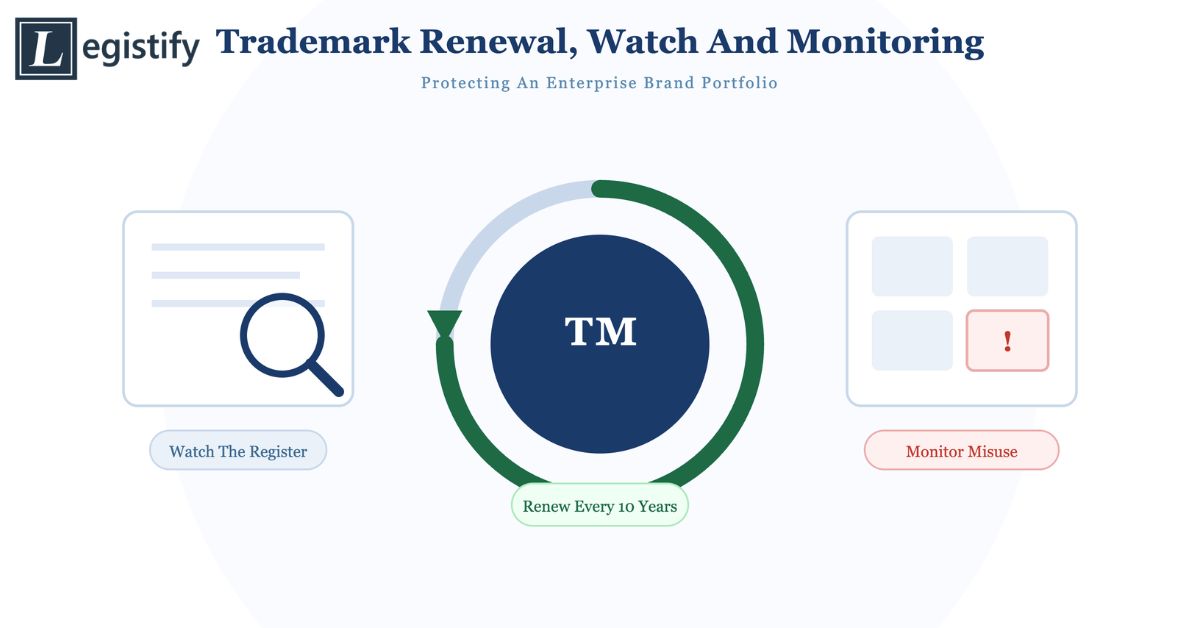
For an enterprise with trademark protection sought across a meaningful number of Madrid-designated countries, the operational challenge shifts from the filing itself to ongoing portfolio management: tracking the provisional refusal window independently for each designated country, monitoring the five-year central attack dependency period against the health of the Indian basic mark, and managing the subsequent renewal cycle, since Madrid registrations require renewal every 10 years centrally through WIPO, distinct from any local renewal requirements that individual designated offices may separately impose.
Without systematic tracking, an enterprise with international trademark protection across 15 or 20 countries is effectively managing 15 or 20 separate deadline streams, each on its own independent timeline, with a single point of catastrophic failure sitting in the health of the one underlying Indian basic mark that most legal teams are least likely to be actively monitoring once the international filing appears, on the surface, to be complete.
Legistify’s IP management platform tracks international trademark portfolios filed through the Madrid Protocol specifically, including per-country provisional refusal deadlines, the five-year central attack dependency window tied to the underlying Indian basic mark’s status, and the centralised 10-year renewal cycle, giving enterprise legal teams a single, consolidated view of an international portfolio that would otherwise require monitoring dozens of independent jurisdictional timelines manually.
Conclusion
The Madrid Protocol gives Indian enterprises a genuinely efficient route to trademark protection across more than 130 countries through a single, centrally administered application, but efficiency in filing does not eliminate the need for active, ongoing portfolio management. The central attack provision in particular means that international protection filed through Madrid is only as secure as the underlying Indian basic mark for the first five years, making disciplined maintenance of that Indian registration, alongside systematic tracking of each designated country’s independent provisional refusal window, the two non-negotiable disciplines for any enterprise building an international brand presence through this route.