Litigation means the formal process of resolving a legal dispute through the court system. It begins when one party files a lawsuit against another and ends when the court delivers a final judgement or the parties reach a settlement. The term covers everything that happens in between: filing documents, gathering evidence, pre-trial hearings, the trial itself, and any appeals that follow.
In everyday usage, litigation and lawsuit are often used interchangeably, but they are not the same thing. A lawsuit is the specific legal action filed with the court. Litigation is the entire process that the lawsuit sets in motion.
What Is the Meaning of Litigation?
The word litigation comes from the Latin “litigatio,” meaning dispute or quarrel. In legal terms, it refers to the process by which parties use the court system to enforce or defend their legal rights.
The plural form, litigations, refers to separate legal proceedings, for example when a company is party to several lawsuits at the same time. A matter that is under litigation is one that is currently before a court and has not reached a final judgement.
Litigation can involve individuals, companies, or government bodies. It can arise from contract disputes, property conflicts, employment disagreements, personal injury claims, or criminal charges. Regardless of the subject matter, the process follows a structured set of legal procedures governed by the rules of the court in which it is filed.
In India, civil litigation is primarily governed by the Code of Civil Procedure (CPC), 1908. Criminal litigation is governed by the Code of Criminal Procedure (CrPC), 1973, now largely replaced by the Bharatiya Nagarik Suraksha Sanhita (BNSS), 2023.
Types of Litigation
1. Civil litigation
Civil litigation covers disputes between individuals, companies, or organisations where one party seeks compensation or a specific remedy from the other. It does not involve criminal charges. Common examples include contract disputes, property disagreements, consumer complaints, and employment disputes. Civil litigation is the most common type of litigation in India.
2. Criminal litigation
Criminal litigation involves the state prosecuting an individual or organisation for an act considered a crime. Unlike civil cases, the government is always one of the parties. Examples include theft, fraud, assault, and corporate offences. The burden of proof is higher in criminal cases than in civil ones.
3. Commercial litigation
Commercial litigation is a subset of civil litigation specifically dealing with disputes that arise from business transactions. This includes shareholder disputes, breach of contract between companies, intellectual property infringement, and insolvency matters. In India, commercial disputes above a certain value are handled by dedicated Commercial Courts established under the Commercial Courts Act, 2015.
4. Constitutional and administrative litigation
This involves challenging the actions of government bodies or testing the validity of laws against the Constitution. Writ petitions filed before High Courts and the Supreme Court of India fall into this category.
Examples of Litigation in India
The examples below show how each type of litigation appears in practice.
- Civil: A landlord files a suit in a civil court to recover possession of a property from a tenant who has stopped paying rent.
- Commercial: A company files a suit before a Commercial Court against a supplier that failed to deliver goods under a supply contract.
- Consumer: A buyer files a complaint before a Consumer Commission over a defective product.
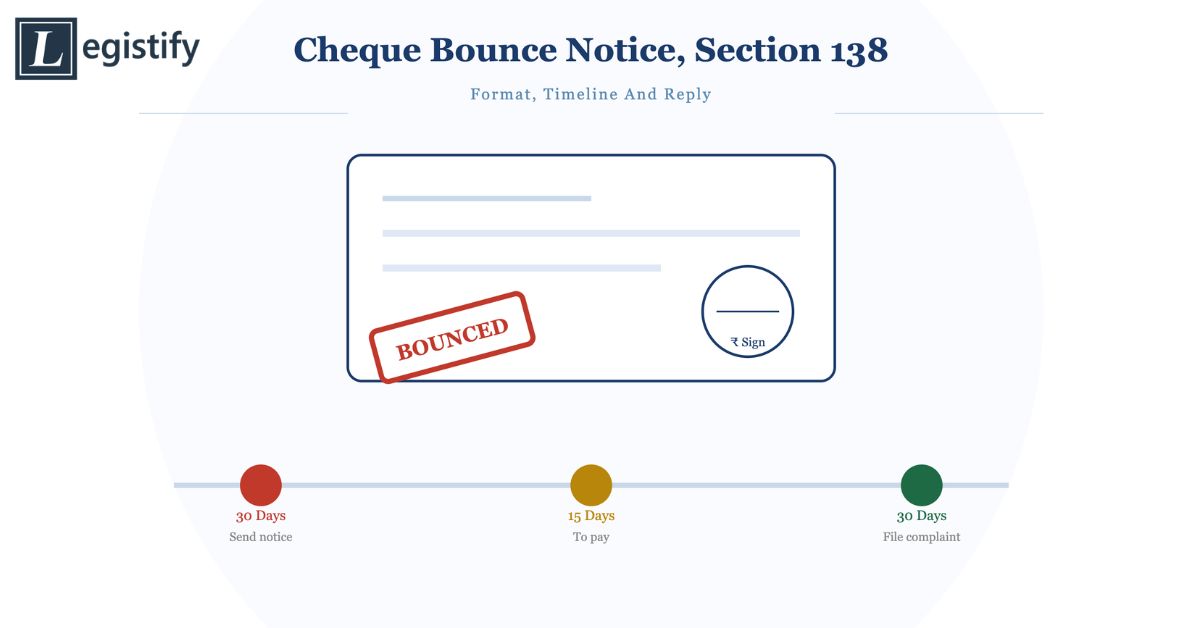
- Cheque bounce: A payee files a complaint under Section 138 of the Negotiable Instruments Act after a cheque is dishonoured and the drawer does not pay within 15 days of the demand notice.
- Debt recovery: A bank files a recovery application before a Debts Recovery Tribunal, as explained in the guide to debt recovery in India.
- Criminal: The state prosecutes a person accused of fraud before a criminal court.
- Constitutional: An individual or organisation files a writ petition before a High Court under Article 226 challenging a government order.
The Litigation Process Step by Step
Understanding what actually happens during litigation helps set realistic expectations about time, cost, and outcome.
Step 1: Pre-litigation
Before filing a case, the aggrieved party typically sends a legal notice to the other side. In India, this step is often mandatory for certain types of disputes. It gives the other party an opportunity to resolve the matter without going to court. Many disputes are settled at this stage.
Step 2: Filing the case
If the matter is not resolved, the plaintiff (the party bringing the case) files a plaint or complaint with the appropriate court. The court must have territorial and subject matter jurisdiction over the dispute.
Step 3: Service of summons
The court issues a summons to the defendant (the party being sued), notifying them of the case and requiring them to appear or respond within a set timeframe.
Step 4: Written statements and pleadings
The defendant files a written statement responding to the claims. The plaintiff may then file a replication. This exchange of documents defines the issues in dispute.
Step 5: Discovery and evidence
Both parties gather and exchange evidence relevant to the case. This includes documents, witness lists, expert opinions, and any other material that supports their respective positions.
Step 6: Trial
The case is presented before a judge. Each side presents evidence, examines and cross-examines witnesses, and makes legal arguments. At the end of the trial, the judge delivers a judgement.
Step 7: Judgement and execution
The court delivers its decision. If the losing party does not comply voluntarily, the winning party can apply to the court for execution of the decree.
Step 8: Appeals
Either party can appeal the judgement to a higher court if they believe there was a legal error. In India, the hierarchy runs from District Courts to High Courts to the Supreme Court.
How Long Does Litigation Take in India?
This is one of the most common questions people have about litigation, and the honest answer is: it varies significantly.
Simple civil cases in lower courts can take anywhere from two to five years. Complex commercial disputes, particularly those involving multiple parties or appeals, can run for a decade or longer. India has a well-documented backlog of cases across its court system, with over five crore cases pending according to the National Judicial Data Grid (NJDG).
Factors that affect the timeline include the complexity of the dispute, the court’s case load, the number of adjournments, whether appeals are filed, and how cooperative both parties are in the process.
For businesses and enterprises managing multiple live cases, this unpredictability makes systematic case tracking essential.
Litigation vs Lawsuit: What Is the Difference?
People use these two terms as if they mean the same thing, but they describe different things.
A lawsuit is the specific legal action one party files against another in a court. It is a single event: the moment the complaint is filed, the lawsuit exists.
Litigation is the entire legal process triggered by that lawsuit. It includes all the steps before, during, and after the trial, including pre-litigation notices, discovery, hearings, the trial itself, the judgement, and any appeals. A lawsuit is the starting point. Litigation is the journey.
Disputes do not always have to go through the court system. Understanding the alternatives helps in deciding which path makes most sense for a given situation.
|
Litigation |
Arbitration |
Mediation |
| Venue |
Court |
Private arbitral tribunal |
Neutral third-party facilitator |
| Decision maker |
Judge |
Arbitrator(s) |
Parties themselves |
| Process |
Formal, governed by court rules |
Formal but more flexible |
Informal and voluntary |
| Outcome |
Legally binding judgement |
Legally binding award |
Voluntary settlement |
| Privacy |
Public proceedings |
Usually private |
Private |
| Cost |
Can be high, especially if prolonged |
Moderate to high |
Generally lower |
| Timeline in India |
Often slow due to court backlog |
Faster than courts |
Fastest of the three |
| Best suited for |
Disputes requiring public record or precedent |
Commercial and contractual disputes |
Relationship-preserving disputes |
In India, arbitration is increasingly preferred for commercial contracts. Many agreements include an arbitration clause that requires parties to take disputes to arbitration before approaching a court. Online dispute resolution (ODR) is also gaining traction for smaller commercial and consumer disputes.
Is Litigation Public or Private?
Litigation in Indian courts is a matter of public record. Court hearings are generally open to the public, and case documents filed with the court can typically be accessed by interested parties. Judgements delivered by High Courts and the Supreme Court are publicly available online through official court databases.
This is one reason some parties prefer arbitration or mediation for sensitive commercial disputes, since those processes are private by default.
What Are the Advantages and Disadvantages of Litigation?
Advantages
- Produces a legally binding and enforceable judgement
- Allows for discovery, which can compel the other party to disclose evidence
- Judgements set legal precedent that can benefit future cases
- Access to the court system is a constitutional right and available to all parties
Disadvantages
- Can be expensive, particularly in complex or long-running matters
- India’s court backlogs mean cases often take years to resolve
- Proceedings are public, which may not suit businesses with sensitive disputes
- The adversarial nature of litigation can permanently damage business relationships
When Should You Consider Litigation?
Litigation is not always the first or best option, but it is the right one in certain situations:
- When the dispute involves a significant amount of money or rights that cannot be compromised
- When the other party has acted in bad faith and is unlikely to negotiate
- When you need a binding legal precedent or a court order to enforce your rights
- When other methods like mediation or arbitration have already been attempted and failed
- When the matter involves criminal conduct that must be reported to the authorities
For enterprises managing multiple disputes simultaneously, having a clear and consistent approach to deciding when to litigate versus when to settle is a significant part of legal operations strategy.
How Enterprises Manage Litigation at Scale
For individuals, a single lawsuit is a significant event. For large enterprises in India, litigation is an ongoing part of operations. Banks, insurance companies, telecom firms, and large manufacturing groups routinely manage hundreds or thousands of active cases at any given time.
Managing litigation at scale introduces challenges that go beyond what any individual lawyer or spreadsheet can handle: tracking hearing dates across courts in multiple cities, monitoring case stages, managing payments to external counsel, and reporting on litigation risk to the leadership team.
This is where litigation management software becomes relevant for enterprises. Platforms like Legistify provide in-house legal teams with centralised visibility across all active disputes, automated hearing alerts, document storage, and spend tracking, replacing the fragmented combination of emails, spreadsheets, and manual follow-ups that most teams still rely on.