Effective Intellectual Property (IP) portfolio management is key to protecting and maximising the value of a company’s IP assets. In-house legal teams play a central role in this process, facing challenges that arise from the breadth of IP types, the pace of regulatory change, and the complexity of global operations. This article covers the most common IP portfolio management challenges in-house legal teams face and how AI addresses them.
IP Portfolio Management Challenges Faced by In-House Legal Departments
The challenges in-house legal teams face when managing IP portfolios are often complex and multifaceted. From diverse portfolios to global jurisdictional requirements and the pace of technological change, each area requires a strategic and adaptive approach. Addressing these challenges protects a company’s innovation and supports its long-term growth.
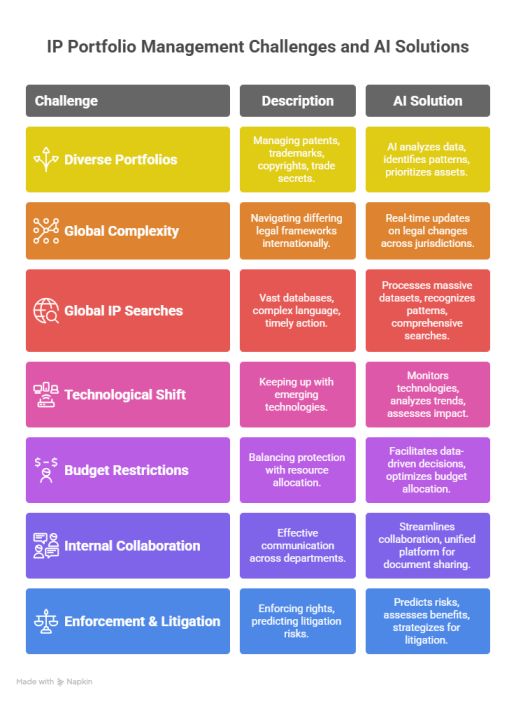
Diverse and Expansive IPR Portfolios
In-house legal teams often manage extensive and diverse IP portfolios encompassing patents, trademarks, copyrights, and trade secrets. Managing this broad spectrum requires not only legal expertise but also a thorough understanding of the company’s business objectives. Balancing the need to protect various types of IP while aligning with strategic goals is an ongoing challenge.
AI IPR management software addresses the complexities inherent in IP portfolio management by giving in-house legal teams a single platform to improve efficiency, strategic decision-making, and overall effectiveness.
AI IPR management software processes and analyses large datasets quickly and accurately. Using machine learning algorithms, it automatically analyses the diverse components of an IP portfolio, identifies patterns, and prioritises assets based on strategic relevance. This automation reduces the burden on legal teams, allowing them to focus on higher-value work rather than manual data processing.
Globalisation and Jurisdictional Complexity
In-house legal teams must navigate jurisdictional complexities in IP protection as enterprises operate internationally. Differing legal frameworks, timelines, and registration processes across multiple countries require IP strategies to align with global standards while adapting to local requirements.
AI IPR management software provides real-time updates on changes in legal frameworks across jurisdictions. By integrating data from global patent offices and legal databases, the software offers insights that enable in-house legal teams to make informed decisions aligned with both global standards and local nuances — supporting effective IP protection across markets.
Conducting Global Searches for IP Prosecution
Global IP searches present challenges around the volume of databases to cover, complex legal language, and the need for timely action. Traditional manual review of extensive databases is time-consuming and prone to human error.
AI-based IPR tools improve the accuracy and efficiency of IP searches. One of the primary challenges is the sheer volume of data dispersed across patent offices and legal databases worldwide. AI addresses this by using machine learning algorithms to process and analyse large datasets quickly, allowing for comprehensive searches that reduce the time and effort required for manual review.
AI also addresses the risk of oversight that comes with the complexity of patents and prior art. Machine learning models can identify subtle connections between different patents, supporting a more thorough search for relevant prior art and reducing the likelihood of missing critical information. As IPR management software continues to learn, AI-driven IP searches improve over time, adapting to changes in legal language, industry terminology, and patent trends.
Technological Shift
The pace of technological innovation has created a challenging environment for IP portfolio management. In-house legal teams must keep abreast of emerging technologies, assess their impact on existing IP assets, and develop strategies to protect novel innovations — while also anticipating the legal implications of technological change.
A proactive approach is required to address these challenges. AI-powered IPR management software can continuously monitor emerging technologies, analyse industry trends, and assess the potential impact on existing IP assets. This real-time surveillance enables legal teams to anticipate future challenges and adapt their strategies accordingly.
Budget Restrictions and Resource Allocation
Budget constraints force in-house legal teams to balance protecting IP assets against optimising resource allocation. Deciding which IP assets to prioritise, where to invest in protection, and when to enforce rights all require strategic judgment. Demonstrating the value of IP investments within defined budgets adds further pressure.
AI IPR management software supports data-driven decision-making on resource allocation. By assessing the value and strategic importance of each IP asset, these tools help optimise budget allocations. This allows in-house legal teams to focus resources on protecting high-priority assets and maximise the impact of their IP protection efforts within budget constraints.
Internal Collaboration and External Communication
Effective communication and collaboration are critical for managing IP portfolios well. In-house legal teams must work closely with R&D, marketing, and other departments to align IP strategies with overall business objectives. Bridging the gap between legal language and the language of other stakeholders is an ongoing challenge that directly affects IP protection outcomes.
AI IPR management software supports cross-departmental collaboration by providing features that facilitate communication between legal, R&D, and business teams. A unified platform for collaboration and document sharing ensures all stakeholders remain aligned on IP strategies and objectives.
Enforcement and Litigation-related IP Portfolio Management Challenges
Enforcing IP rights in the face of infringement requires in-house legal teams to weigh litigation risks against enforcement benefits. The evolving landscape of IP litigation, including the role of emerging technologies such as AI, adds unpredictability and requires teams to be agile in their approach to dispute resolution.
AI IPR management software assists in predicting litigation risks and assessing enforcement options. These tools analyse historical litigation data, identify potential risks, and estimate the likelihood of legal disputes. This foresight enables in-house legal teams to address issues proactively, plan for potential litigation, and consider alternative dispute resolution methods.
IP Portfolio management challenges & AI Solutions
Solving the Challenges with IPR Management Software
AI IPR management software gives in-house legal teams the tools to address IP portfolio management challenges more effectively. From automated analysis and global intelligence to better resource allocation and cross-team collaboration, these platforms support a more structured and efficient approach to IP management. Tools like LegisTrak help in-house legal teams manage their portfolios with greater control, positioning their enterprises for sustained innovation and growth.
Frequently Asked Questions
What are the most common IP portfolio management challenges for in-house legal teams?
The most common challenges are managing diverse and expansive portfolios spanning patents, trademarks, copyrights, and trade secrets; navigating jurisdictional complexity across multiple countries; conducting thorough global IP searches; keeping pace with rapid technological change; operating within budget constraints; maintaining collaboration across legal, R&D, and business teams; and managing enforcement decisions and litigation risk.
How does AI help with diverse IP portfolio management?
AI IPR management software processes and analyses large volumes of IP data automatically, identifying patterns and prioritising assets based on their strategic relevance. This reduces the manual burden on legal teams and allows them to focus on higher-value decisions rather than routine data processing tasks.
How does AI address jurisdictional complexity in global IP protection?
AI IPR management tools integrate data from global patent offices and legal databases, providing real-time updates on regulatory changes across jurisdictions. This gives in-house legal teams the information they need to align IP strategies with both international standards and country-specific requirements, reducing the risk of compliance gaps across markets.
How can AI improve IP search accuracy and efficiency?
AI uses machine learning to process and analyse large patent databases quickly, identifying connections between patents and prior art that manual searches are likely to miss. As the system learns over time, it adapts to changes in legal language, industry terminology, and patent trends, improving both speed and accuracy compared to traditional manual review.
How does AI support IP enforcement and litigation risk management?
AI IPR management software analyses historical litigation data to identify potential risks and estimate the likelihood of legal disputes. This enables in-house legal teams to assess enforcement options proactively, prepare for potential litigation, and evaluate alternative dispute resolution approaches before committing to a course of action.
Ashutosh Sharma is a skilled Content specialist based in Gurugram, Haryana. He likes creating clear, engaging content that speaks directly to readers. Ashutosh focuses on delivering valuable and trustworthy information, especially for education and technology audiences.