Let’s be honest, contract management has never been the most thrilling aspect of legal work. Drafting, reading, analyzing, and tracking, as well as chasing down approvals, are all crucial, but also repetitive and mundane.
That’s changing fast.
AI is revolutionizing the way contract management is handled by offering automation, intelligent insights, and the ability to work in real time. This enables the legal department to shift its focus away from routine work and concentrate on what is significant.
The Evolution of Contract Management
For years, contract management has remained manual. This has included the legal team finding clauses from previous contracts, searching through lengthy email chains, using different versions from Word, and storing contracts in various folders. This process has been inefficient as the businesses scaled.
Traditional challenges
- Legal team time was taken up with drafting and evaluating contracts
- Language differed in different agreements because it had not been standardized
- Review cycles took a long time, with endless emails and confusion about ownership
- Contracts existed in different locations, making tracking difficult
- Unclear visibility on approvals, risks, and deadlines
This left legal teams reactive, overloaded, and constantly firefighting.
Why traditional CLMs weren’t enough
Contract Lifecycle Management software had aided in the centralization of documents and templates; however, they were highly labor-intensive. They are highly structured systems but lack intelligence.
Workflows were inflexible, adoption rates were poor, and such systems were not capable of analyzing contracts and assessing risk at any scale. Quite often, they remediated the problem without solving it.
The shift toward AI-powered workflows
AI revolutionizes the contract management process completely. Before contract management used to mean storing contracts, AI can now produce, scan, analyze, and inform contracts in real-time, making contract management quicker, smarter, and more strategic.
What AI Brings to Contract Management
AI transforms the contract management process by actively engaging with legal teams throughout the entire process. At a broader level, AI offers five basic benefits:
- Automation: Automates drafting, reviewing, extracting information from data, and approvals by significantly reducing labor and cycle time.
- Intelligence: Capable of understanding contract language, pointing out risks, proposing alternatives, and learning from the past.
- Consistency: This involves ensuring that the terms of the contract comply with pre-approved templates, clauses and internal policies.
- Collaboration: Allows an integrated workspace environment for legal, sales, and finance groups.
- Governance & Risk Control: Offers insight into deviations, compliance, and risk for the entire portfolio.
How AI Is Changing Contract Management
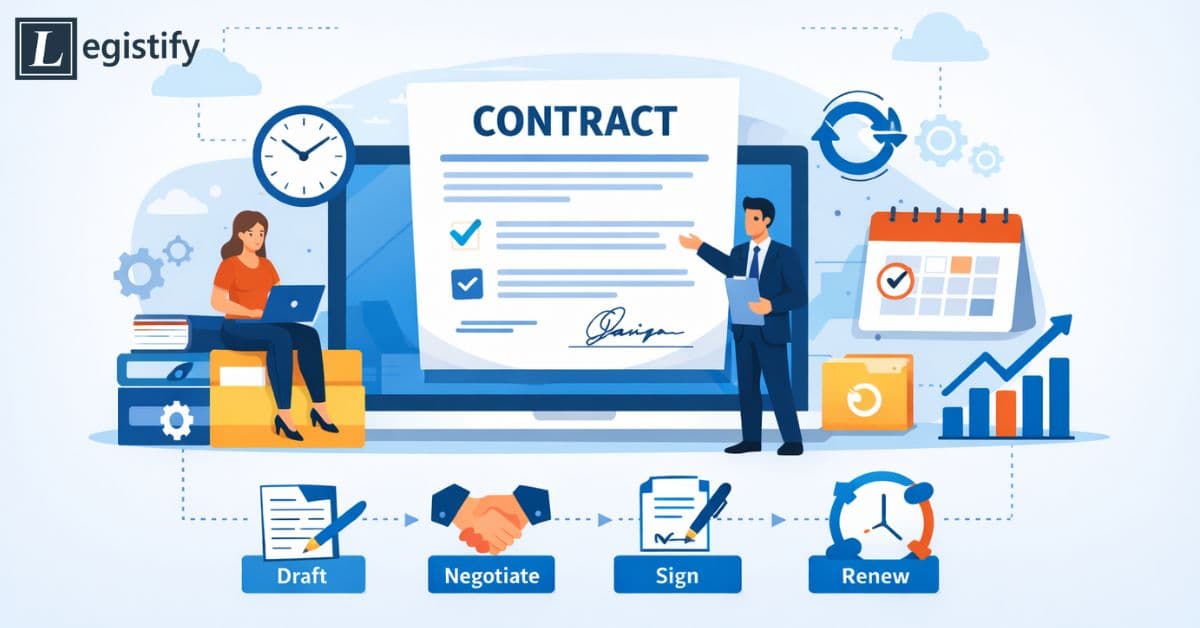
AI contract management systems today bring intellect into every step of the contract management life cycle. By integrating the strengths of automation with those of the legal mindset, AI contract management systems today assist in contract management from end to end reducing risk, accelerating deal cycles, and enabling legal teams to focus on higher-value strategic work.
Automated Drafting and Review
AI-driven platforms streamline drafting and first-round reviews by generating complete contracts in seconds using approved templates. Key details such as party names, dates, terms, and jurisdictions are auto-filled, while AI reviews documents for missing clauses, inconsistent language, and formatting issues. Deviations from internal playbooks are flagged early, significantly reducing review cycles and rework.
Enhanced Risk Management
AI points out clauses which need to be reviewed carefully like indemnities, limits of liability, termination rights, and auto-renewal clauses based on comparison with company policies, precedents, and regulations. The AI system also proposes other clauses for reducing risks while ensuring consistency between contracts.
Improved Accuracy and Consistency
AI makes sure the templates are uniform and libraries of approved clauses are used throughout. When internal policies or regulations change, AI-driven updates help to keep contracts compliant, misunderstanding, disputes, and post-signature issues at bay.
Better Data, Insights & Governance
AI extracts critical metadata, such as obligations, renewals, payments, and SLAs, and puts that information into a centralized, searchable repository. At the portfolio level, AI surfaces trends in recurring risks or regularly negotiated clauses that enable smarter negotiations and more proactive governance.
AI in Contract Negotiations
AI-assisted negotiations offer benefits to the legal and business teams involved by recommending fallbacks on the basis of the corporate playbooks and outcomes already achieved. It minimizes back and forth, identifies potential responses, and also helps the negotiations remain on track and within approved channels to close deals faster without the possibility of increased risk.
Streamlined Collaboration Across Teams
AI-driven platforms provide a source of truth for all contracts in a single system, so that legal and business professionals work from a common source all the time. AI-generated summaries help sales, procurement, or finance professionals quickly grasp contract-related risks and obligations, and there are no delays in communication related to contract changes or approvals.
Post-Signature Contract Management
AI continues to increase value once agreements are executed, as it tracks commitments, renewals, SLAs, and dates of compliance. It is proactive, ensuring milestones are not forgotten, and the tracking of related documents, for example, MSAs to SOWs, ensures adherence is maintained during the lifecycle of operation.
How Legistify Brings This to Life
This is the kind of AI-powered capability that is put into practice today by platforms such as Legistify for real-world legal teams. With the intelligent integration of automation into legal workflows, Legistify was designed to help organizations manage contracts from end to end-improving visibility, consistency, and control across the entire lifecycle.
For instance, Dabur India uses Legistify to track more than 2,000 contracts in such a way that no renewals are ever missed and the contractional obligations are systematically tracked. This structured AI-driven approach helps the legal teams stay compliant with reducing risks, thus supporting business operations at scale without adding manual efforts or headcount.
How AI Shifts the Role of Legal Teams

Through automation of repetitive work, AI enables lawyers to concentrate on high-stakes negotiations, risk planning, and compliance strategy. Lawyers transform from administrators to strategists and advisors for business expansion without adding to their already high labor budget and making proactive and informed decisions.
Challenges and Considerations
When adopting AI, implementation of best practices must be followed. Clean data, structured templates, and strong governance policies play an imperative role. Human judgment is also not eliminated but complemented by AI since they do not replace but only complement legal know-how.
The Future of AI-Powered Contracting
The future of AI in contracting will be more autonomous and predictive. Functions like automation will be performed by agentic processes, prediction will be driven by analytics, and avoiding non-compliance will be real-time. AI copilots will be incorporated in all stages of the life cycle of all contracts.
Conclusion
AI is redefining the management of contracts from drafting and negotiation stages right through to managing a contract after it is executed. Legal departments are able to work more efficiently, analyze risks more effectively, and provide insights that would not have been possible otherwise. The message is clear: AI does not diminish the role of lawyers, it complements it and causes the legal function to become a strategic partner for the business.