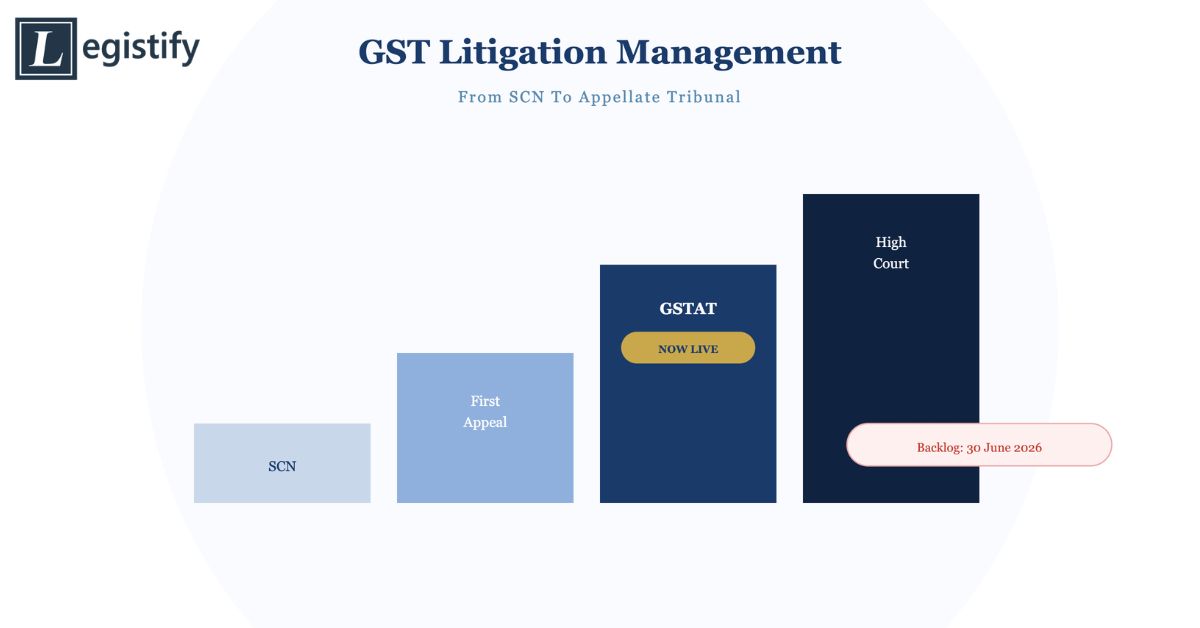
For nearly eight years, GST disputes in India had no dedicated second appellate forum. The GST Appellate Tribunal, provided for under Section 109 of the CGST Act, simply did not exist as an operating institution, leaving businesses either stuck at the first appellate stage or forced into High Court writ petitions for relief the statute always intended a tribunal to provide. That changed on 24 September 2025, when GSTAT’s e-filing portal went live, with adjudicatory operations commencing on 16 February 2026. The result is a genuinely new litigation landscape, and one with an unusually compressed timeline: over four lakh appeals accumulated during the tribunal’s absence now have a filing pathway, with a hard deadline of 30 June 2026 for backlog matters where the underlying order was communicated before 1 April 2026.
This guide covers the full arc of GST litigation for enterprises, from the initial show-cause notice through the newly operational appellate tribunal, and what a systematic management approach actually requires given how compressed the current filing window is.
The GST Dispute Lifecycle: Four Stages
Stage 1: Show-cause notice (DRC-01). The dispute begins when a GST officer issues a show-cause notice under Section 73 (non-fraud), Section 74 (fraud), or Section 74A (the unified framework for FY 2024-25 onwards), alleging unpaid, short-paid, or wrongly availed input tax credit. The taxpayer has a defined window, generally 30 days, to file a reply in Form DRC-06, and the outcome is either a closure (Form DRC-05) or a confirmed demand (Form DRC-07).
Stage 2: First Appellate Authority (Section 107). If the DRC-07 demand is adverse, the taxpayer can appeal to the Commissioner (Appeals) within 3 months, extendable by a further month on sufficient cause, subject to a mandatory pre-deposit of 10% of the disputed tax (capped at ₹25 crore CGST plus ₹25 crore SGST). The First Appellate Authority’s decision is issued as an Order-in-Appeal in Form APL-04.
Stage 3: GST Appellate Tribunal (Section 112). An adverse Order-in-Appeal, or an adverse revision order under Section 108, can now be challenged before GSTAT, filed electronically in Form APL-05, requiring an additional pre-deposit of 20% of the disputed tax under Section 112(8), with the aggregate pre-deposit across both appellate stages capped at ₹50 crore CGST plus ₹50 crore SGST. Note that a taxpayer generally cannot skip the first appeal and go directly to GSTAT; the tribunal reviews orders passed by appellate or revisional authorities under Sections 107 and 108, not the original adjudication order itself.
Stage 4: High Court and Supreme Court. A substantial question of law arising from a GSTAT order can be further appealed to the relevant High Court, and ultimately to the Supreme Court.
GSTAT’s Structure and What It Means for Case Strategy
GSTAT operates through 31 State Benches, handling appeals from the first-appellate authorities within each respective state, alongside a Principal Bench. Within the State Benches, matters are further classified: Division Benches hear appeals involving questions of law or where the disputed amount exceeds ₹50 lakh, while Single Benches handle matters primarily involving questions of fact below that threshold. From April 2026, the Principal Bench of GSTAT additionally serves as the National Appellate Authority for Advance Rulings, harmonising divergent advance rulings issued across different states, a function that previously had no dedicated forum at all.
This bench structure has direct strategic implications. Enterprises with GST disputes spread across multiple states now need to track proceedings across potentially many different State Benches simultaneously, each operating on its own cause list and hearing schedule, and the Division versus Single Bench classification, driven by the disputed amount, affects both the composition of the bench hearing a matter and, in practice, the depth of legal argument the matter is likely to receive.
The Critical, Time-Bound Backlog Window
Because GSTAT did not exist as an operating body for eight years, more than four lakh appeals accumulated at the First Appellate Authority stage with no forum to escalate to. GSTAT’s operationalisation has opened a specific, time-limited window to file these backlogged appeals, with an outer limitation deadline of 30 June 2026 for appeals where the underlying order was communicated before 1 April 2026. To manage the resulting surge in filings without overwhelming the newly operational digital infrastructure, GSTAT has permitted staggered filing up to that same 30 June 2026 deadline, based on when the order being appealed was actually communicated.
For enterprises with GST matters currently pending as writ petitions before a High Court specifically because no functional tribunal existed to hear them, this creates a genuinely important, time-sensitive decision. It is worth taking active stock of any such pending writ petitions and assessing whether continuing with the writ route remains the right strategy, or whether relegating the matter to GSTAT now, within this specific window, is the more efficient path forward, particularly for petitions still at the admission stage where no constitutional, jurisdictional, or natural justice issue is genuinely in play.
From April 2026 onward, once the backlog window closes, GSTAT appeals revert to following the regular Section 112 timeline like any other tribunal, with no extended filing deadline available for matters arising after that point.
The Pre-Deposit Cost Structure: A Real Financial Planning Issue
GSTAT’s operationalisation has reset the appellate economics of GST litigation, and enterprises need to budget for this deliberately rather than treating pre-deposit as an afterthought once a dispute has already progressed.
| Stage |
Provision |
Pre-deposit |
Cap |
| First Appeal (Appellate Authority) |
Section 107(6) |
10% of disputed tax |
₹25 crore CGST + ₹25 crore SGST |
| GSTAT |
Section 112(8) |
Additional 20% of disputed tax |
Aggregate ₹50 crore CGST + ₹50 crore SGST (with first appeal) |
For a mid-size enterprise, the practical cost of pursuing a dispute through both appellate stages compounds quickly once accrued interest and professional fees across each stage are added. A representative cost breakdown for an SME-scale dispute over a multi-year resolution period shows interest at 18% per annum over roughly 30 months adding a substantial sum on its own, the additional 20% GSTAT pre-deposit locking up further capital, and professional costs across the SCN reply, first appeal, and GSTAT stages adding a meaningful cumulative total, with the full process from SCN issuance to GSTAT order commonly running 30 to 48 months. This is precisely why an enterprise’s decision to contest a GST demand rather than pay and move on needs to be a deliberate, cost-modelled decision at the outset, not a default response taken without weighing the full multi-year financial exposure involved.
Why GSTAT Appeals Fail on Procedure, Not Merits
A specific and recurring risk in GSTAT appeals deserves direct attention: most filing defects at this stage do not arise from weaknesses in the underlying tax position at all. They arise from structural filing errors. GSTAT functions as a second appellate authority, meaning it examines only the impugned order and its legality, not the entire assessment or show-cause notice history that preceded it. Drafting a GSTAT appeal as though it were a fresh challenge to the original SCN, rather than a focused challenge to the specific findings in the First Appellate Authority’s order, is one of the most consistently identified causes of procedural failure at this stage.
A GSTAT appeal is assessed as a complete electronic litigation record, not a narrative submission, and the practitioner workflow that produces a strong filing typically starts with a focused analysis of the First Appellate Authority’s order within days of receipt, identifying the two to four strongest, most specific grounds to challenge, rather than attempting to relitigate every point that was ever contested at the earlier SCN and first-appeal stages.
A Practical Framework for Enterprise GST Litigation Management
Track every SCN centrally from the moment it is issued, not just once a dispute becomes serious. The 30-day DRC-06 reply window is the first and most consequential deadline in the entire lifecycle, and a systematic intake process, capturing the notice, its section (73, 74, or 74A), the deadline, and the assigned internal owner, prevents the kind of early-stage miss that forecloses options later.
Model the full pre-deposit and interest exposure before deciding whether to appeal. Given the compounding cost structure across the first appeal and GSTAT stages, a documented cost-benefit assessment at each escalation decision point, rather than an instinctive decision to fight it, produces more defensible outcomes for the business overall.
Maintain a state-by-state and bench-by-bench view of active matters. With 31 State Benches each running independent cause lists, enterprises with a multi-state GST footprint need consolidated visibility across every relevant bench, not a fragmented, region-by-region tracking process.
Actively review any pending writ petitions against the GSTAT backlog window now. For matters currently before a High Court specifically due to GSTAT’s prior non-existence, this is a time-sensitive, one-time strategic decision that should be made deliberately before the 30 June 2026 deadline closes.
Draft GSTAT appeals as order-focused challenges, not SCN-based narratives. Since GSTAT reviews only the impugned appellate or revisional order, structuring an appeal around the two to four strongest specific findings in that order, rather than re-litigating the entire history of the dispute, is what determines whether the appeal is procedurally admitted in the first place.
Track the specific documentary record GSTAT expects. This includes the show-cause notice and reply, the original adjudication order, the First Appellate Authority’s order, the pre-deposit challan (Form DRC-03) with the correct reason code identifying it as a GSTAT pre-deposit, and the court fee payment receipt from the GSTAT portal’s payment gateway, all assembled and verified before filing rather than gathered reactively after a defect memo comes back.
Managing GST Litigation Portfolios at Enterprise Scale
For an enterprise with GST disputes spread across multiple states, multiple GSTINs, and multiple stages of the appellate process simultaneously, treating each matter as an individually tracked file misses the portfolio-level view that actually drives good decision-making: which disputes share a common underlying issue and could benefit from a coordinated legal strategy, which state benches are moving faster or slower on similar matters, and where the aggregate pre-deposit and interest exposure across the full portfolio is heading as more matters escalate from first appeal to GSTAT.
Legistify’s litigation management platform tracks GST disputes across their full lifecycle, from the initial DRC-01 notice through First Appellate Authority proceedings and GSTAT filings, with automated deadline tracking across every stage’s specific limitation period, portfolio-level visibility across multiple GSTINs and state benches, and a connected record linking each dispute back to its originating transaction, so the enterprise always has a current, consolidated view of total GST litigation exposure rather than a collection of disconnected individual case files.
Conclusion
GSTAT’s operationalisation in late 2025 and early 2026 has genuinely changed the shape of GST litigation in India, giving enterprises a functioning second appellate forum after eight years without one, while simultaneously creating a compressed, time-bound window for the substantial backlog of appeals that accumulated during that gap. For enterprise legal and tax teams, this means the discipline that matters most right now is not just handling the next individual notice well, but building a systematic view across the entire GST dispute portfolio: tracking every SCN reply deadline, modelling the real cost of escalation before committing to it, and drafting GSTAT appeals as focused, order-based challenges rather than broad relitigations of matters the tribunal is not actually positioned to reconsider.