India sees over 4 million cheque bounce cases annually, making Section 138 of the Negotiable Instruments Act, 1881 one of the most litigated provisions in Indian commercial law. For enterprises that rely on cheque-based payment from customers or vendors, understanding the exact statutory notice procedure is not optional legal detail. Without proof of a properly served notice, no court can take cognisance of a criminal complaint at all, regardless of how clear the underlying default is.
This guide covers the complete Section 138 process for enterprises on both sides: sending a notice as the payee seeking recovery, and responding to one as a drawer facing potential criminal prosecution.
What Makes a Cheque Bounce a Criminal Offence
Not every dishonoured cheque attracts criminal liability. Section 138 applies specifically where a cheque is dishonoured due to insufficient funds or because the amount exceeds the arrangement with the bank, for the discharge of a legally enforceable debt or liability. Cheques returned for reasons unrelated to the drawer’s financial capacity, such as a mismatched signature or a technical defect, do not attract criminal liability under this provision, though they may still support a civil recovery claim.
The Statutory Timeline: Three Strict Windows
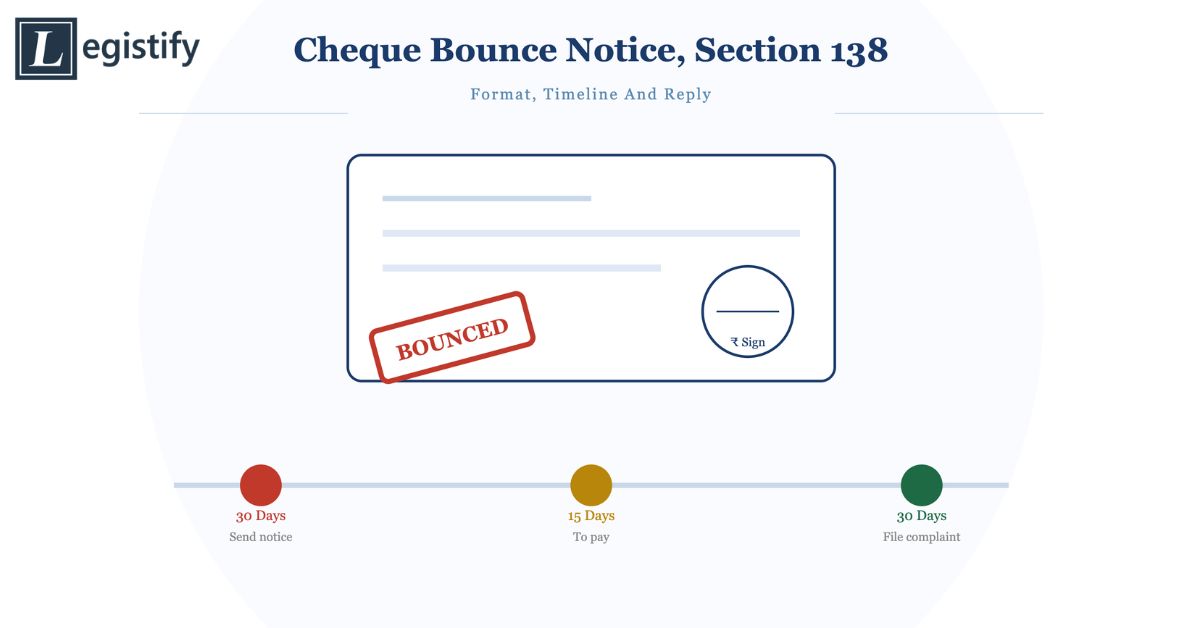
Section 138 proceedings are built around three sequential, strictly enforced timelines, and missing any one of them can permanently defeat the payee’s legal remedy.
Window 1: 30 days to send the legal notice. The payee must dispatch a written demand notice to the drawer within exactly 30 calendar days from the date of receiving the bank’s cheque return memo. This is calculated from the date the payee receives the return memo, not from the date the cheque was originally dishonoured by the bank. Sending the notice even one day late, on day 31, invalidates the entire Section 138 action.
Window 2: 15 days for the drawer to pay. Once validly served, the notice gives the drawer 15 days to make payment. If payment is made within this window, the matter is resolved and no criminal liability arises. Without proof of service of this statutory notice, a court cannot take cognisance of a criminal complaint at all, which is why proof of dispatch and delivery (or deemed delivery) needs to be preserved carefully.
Window 3: 30 days to file the complaint after the 15-day period expires. If the drawer does not pay within 15 days of receiving the notice, the payee has exactly one month, calculated from the date the 15-day period expired, to file a criminal complaint under Section 138 before the Magistrate’s Court with territorial jurisdiction over the bank branch where the payee holds the account, as amended by the Negotiable Instruments (Amendment) Act, 2015.
Missing any of these three deadlines can result in the complaint being dismissed on procedural grounds, regardless of the underlying merits of the payment dispute.
What the Legal Notice Must Contain
A Section 138 notice is not a general demand letter; it must satisfy specific statutory and judicial requirements to be valid.
The exact demand amount must match the cheque amount precisely. A significant 2025 Supreme Court ruling in Kaveri Plastics v Mahdoom Bawa held that the demand amount in the notice must exactly match the cheque amount, with even a small discrepancy, such as a mismatch of a single rupee, capable of invalidating the notice entirely. This makes drafting precision genuinely critical: interest, late fees, or other charges should not be blended into the principal demand figure in a way that creates ambiguity about the core cheque amount being claimed.
It must identify the cheque, the transaction, and the demand clearly. The notice should specify the cheque number, date, amount, the bank and branch it was drawn on, the date and reason for dishonour as stated in the bank’s return memo, and a clear statement that the drawer must pay the amount within 15 days of receipt, failing which legal action under Section 138 will follow.
It must be sent to the correct address, and proof of dispatch preserved. The notice should be sent by registered post with acknowledgement due to the address associated with the cheque or the drawer’s known address, and the postal receipt, tracking record, and any returned acknowledgement should be retained carefully, since this evidentiary trail is what establishes valid service if the matter proceeds to litigation.
Does the BNS/BNSS/BSA Overhaul Affect Section 138?
A common and important point of clarification for 2026: Section 138 of the Negotiable Instruments Act, 1881, along with the rest of Chapter XVII of that Act, is completely unaffected by the Bharatiya Nyaya Sanhita (BNS), the Bharatiya Nagarik Suraksha Sanhita (BNSS), or the Bharatiya Sakshya Adhiniyam (BSA). The NI Act is a separate, standalone central statute, and cheque-bounce proceedings, the notice procedure, the statutory timelines, and jurisdiction rules all remain identical to the pre-2024 framework.
Where the new codes do become relevant is in cases where a companion complaint for cheating is filed alongside the Section 138 proceeding, which happens in some larger-value cheque bounce matters. In that specific context, whether the IPC or the BNS applies to the cheating charge depends on the date the underlying offence was committed, not the date the complaint is actually filed, which matters for enterprises dealing with cheques issued before versus after 1 July 2024.
How to Reply to a Cheque Bounce Notice (For the Drawer)
If your organisation receives a Section 138 notice, the response strategy depends entirely on whether the underlying debt is genuinely owed.
Step 1: Verify the notice’s validity first. Check the dispatch date against the 30-day window from the cheque return memo, confirm the demand amount matches the cheque amount exactly, and confirm the notice was sent to a valid address. A defective notice, one sent late or demanding an incorrect amount, may itself be a valid ground for later challenging the proceedings.
Step 2: Decide between three options within the 15-day window. Pay the demanded amount, which resolves the matter entirely and prevents any complaint from being filed. Send a written reply disputing the claim, setting out the specific factual or legal basis for the dispute. Or take no action, which allows the payee to proceed to file a criminal complaint once the 15 days expire.
Step 3: If disputing the claim, draft a substantive, evidence-based reply. An effective reply does not merely deny liability; it lays out the specific defence, whether that is a dispute about the underlying transaction, an assertion that the debt was not legally enforceable, evidence of a prior settlement, or a challenge to the notice’s own validity, and does so in a way that anticipates the cross-examination points that will matter if the dispute proceeds to trial.
Step 4: Consider settlement and compounding at any stage. Section 147 of the NI Act permits compounding of the offence at any stage of the proceedings, including after a complaint has been filed. Indian courts increasingly encourage early settlement in Section 138 matters specifically to reduce caseload, and a well-organised settlement, formalised through a joint compounding application, resolves the matter definitively without a prolonged trial.
Filing a Complaint (For the Payee) if the Drawer Does Not Pay
If the 15-day payment window lapses without payment or a satisfactory response, the payee must move quickly. Gather the original cheque, the bank’s return memo, the copy of the legal notice, and proof of its delivery, then file a written complaint before the Magistrate’s Court with jurisdiction over the payee’s bank branch within 30 days of the 15-day period expiring. Missing this filing window is fatal to the complaint regardless of how strong the underlying case is.
Punishment under Section 138, if the complaint succeeds, can extend to imprisonment for up to 2 years, a fine of up to twice the cheque amount, or both.
Common Errors That Weaken a Section 138 Case
Sending the notice outside the 30-day window. This is the single most common and most fatal error, and it is entirely avoidable with proper tracking of the cheque return memo’s receipt date.
Demanding an amount that does not exactly match the cheque. Following the Kaveri Plastics ruling, this is now a clear, specific ground for invalidating the notice, and enterprises drafting these notices at volume need a checked, verified process rather than relying on a template that might include additional charges blended into the core demand.
Poor proof-of-service records. Without documented proof that the notice was properly dispatched and delivered (or deemed delivered), the foundational requirement for the criminal complaint cannot be established, regardless of how clear the underlying default is.
Filing the complaint too early or too late. A complaint filed before the 15-day payment window has actually expired, or filed after the subsequent 30-day filing window has closed, can be quashed on limitation or procedural grounds even where the underlying facts clearly favour the complainant.
Managing Cheque Bounce Notices at Enterprise Scale
For enterprises, particularly in BFSI and any business with meaningful cheque-based collections, Section 138 notices are not isolated, one-off events. They are a recurring, high-volume workflow that requires the same operational discipline as any other statutory notice category: accurate tracking of the cheque return memo date to calculate the notice deadline precisely, verified, checked demand amounts before dispatch, registered post dispatch with tracking preserved systematically rather than filed away informally, and a clear internal calendar tracking the subsequent 15-day and 30-day windows so no complaint filing deadline is missed across a portfolio that might include dozens or hundreds of active matters simultaneously.
Legistify’s notice management platform is built specifically for this kind of high-volume, statutory notice workflow, with bulk notice generation that pulls the correct cheque and account details automatically, built-in deadline tracking across all three Section 138 windows, India Post dispatch integration with delivery tracking preserved as evidence, and a direct connection to litigation management so that a notice that proceeds to a filed complaint carries its full documentary history forward automatically.
Conclusion
Section 138 is a procedure-driven remedy: the underlying debt can be entirely genuine and still be legally unrecoverable through this specific criminal route if the strict statutory timelines and notice content requirements are not followed precisely. For enterprises managing cheque-based collections at any volume, and for those on the receiving end of a notice, understanding the exact 30-15-30 day sequence, the precise demand-amount requirement following the 2025 Supreme Court ruling, and the documentation needed to prove valid service is what determines whether a Section 138 matter resolves cleanly or collapses on a technicality that had nothing to do with whether the money was actually owed.