Most procurement teams treat contracts as the end of a negotiation. The deal is done, the document is signed, and the focus shifts to the next sourcing event. This is where contract value is lost.
The value embedded in a signed contract is not automatic. Rebate thresholds need to be tracked against actual spend. Volume discount tiers need to be monitored to ensure the organisation claims the right rate. SLA obligations need to be enforced, not just referenced. Renewal windows need to be managed actively, not discovered after they close. Price escalation mechanisms need to be applied correctly on both sides. For Indian enterprises with large supplier portfolios, the gap between the commercial value negotiated into contracts and the value actually realised is one of the most consistent and least visible sources of financial leakage.
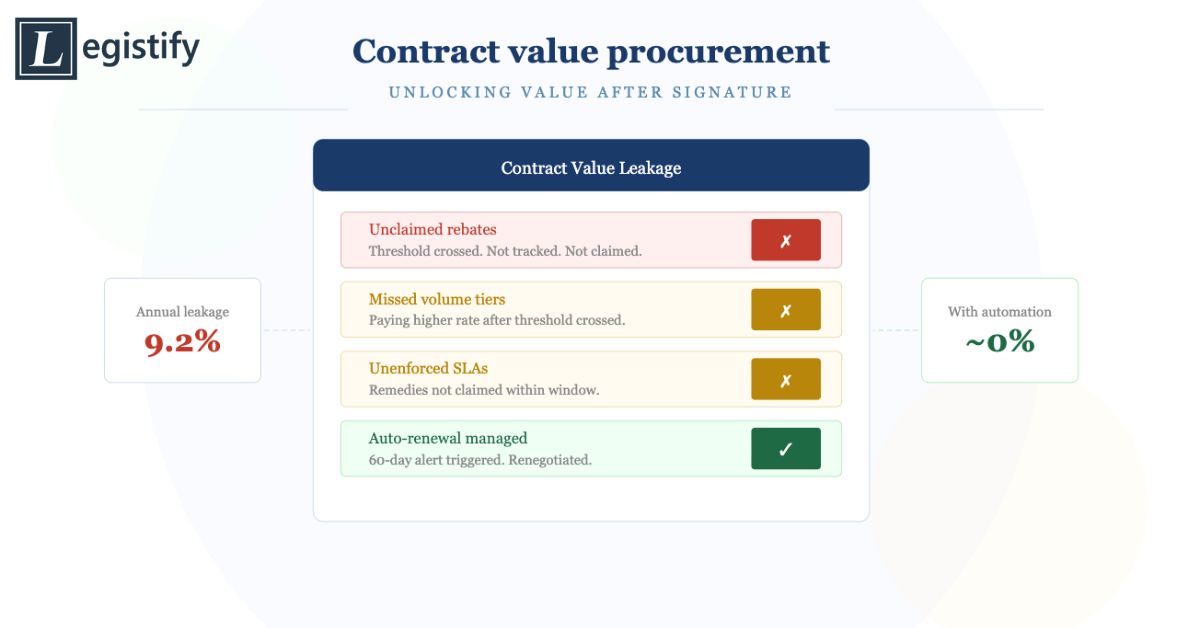
Research from World Commerce and Contracting estimates that organisations lose an average of 9.2% of annual contract value after signature due to poor post-execution management. For a procurement function managing INR 500 crore in annual supplier spend, this represents tens of crores of commercial value that was negotiated but never recovered.
This guide covers where contract value leakage occurs in procurement, and the specific practices that Indian enterprise procurement teams need to recover it.
Where Contract Value Leaks After Signature
Unclaimed rebates and volume incentives
Rebate structures are among the most common and most consistently underperforming commercial terms in supplier contracts. A rebate clause defines the percentage of spend that a supplier will return to the buyer once a defined spend threshold is crossed. In practice, the buyer needs to track actual spend against the threshold, calculate the rebate entitlement, and claim it from the supplier within the defined claim period.
When this tracking does not happen, rebates go unclaimed. The supplier is not going to notify the buyer that a threshold has been crossed and a rebate is due. The obligation to claim is on the buyer, and if the buyer does not have a system that tracks spend against contracted thresholds, the entitlement expires.
For Indian enterprises with complex supplier relationships, rebate structures can be layered: base volume rebates, category-specific incentives, early payment discounts, and annual performance bonuses all sitting within different contracts with different tracking requirements and different claim periods. The aggregate unclaimed value across a large supplier portfolio can be substantial.
Missed volume discount tiers
Many supplier contracts define tiered pricing: the unit price reduces once spend crosses defined volume thresholds within a period. If procurement does not track spend against these tiers in real time, the organisation continues to pay the higher rate even after the threshold has been crossed, until someone notices the discrepancy.
The supplier invoices at the agreed rate for the current period. Without visibility into where actual spend sits relative to the contracted tier, procurement has no basis to challenge the rate. The contract says one thing at a certain volume. The invoice reflects a different rate at a lower volume. The difference is contract value that the organisation negotiated but does not collect.
Unenforced SLA obligations
Service level agreements define the supplier’s performance commitments: uptime guarantees, delivery timelines, quality standards, response times, and resolution windows. When suppliers miss these commitments, the contract typically provides remedies: service credits, liquidated damages, or the right to terminate for cause.
Most procurement teams are aware of SLA obligations in principle. Fewer track them systematically. When SLA tracking relies on manual reporting from the supplier or on individual procurement managers remembering to follow up, non-performance goes undocumented and remedies go unclaimed. The supplier fails to meet the committed standard, the buyer absorbs the operational impact, and the commercial remedy that the contract was designed to provide is never exercised.
For Indian enterprises with technology service contracts, managed service agreements, and logistics arrangements, SLA credits and liquidated damages represent real contractual entitlements that systematic tracking would recover.
Auto-renewal at outdated rates
Auto-renewal clauses renew a contract for a further term, typically at the same price, unless the buyer serves non-renewal notice within a defined window. For contracts where market rates have moved down, or where the buyer’s requirements have changed, an auto-renewed contract at the original rate represents a pricing premium over what could have been negotiated.
Procurement teams that do not track renewal windows cannot engage in advance of the renewal date to renegotiate terms or issue non-renewal notice. The contract auto-renews, and another period of spend is committed at terms that the current market does not justify.
Unmonitored price escalation clauses
Many supplier contracts include price escalation provisions that allow the supplier to increase the contract price at defined intervals, subject to defined conditions: a percentage cap, a reference to a published index, or a mutual agreement mechanism. These clauses can work in either direction.
When escalation clauses are not monitored, two problems arise. The supplier may apply escalation that exceeds the contractually permitted amount, or applies escalation without satisfying the conditions. And the buyer may fail to exercise price reduction rights where the applicable index has moved in their favour.
For Indian enterprises with contracts that reference WPI, CPI, or commodity indices, escalation clause monitoring is a direct P&L item.
Expired warranties and performance bonds
Supplier contracts frequently include warranties, performance bonds, and bank guarantees that protect the buyer against non-performance, defects, or financial default. These instruments have expiry dates. When a warranty is about to expire on a long-term infrastructure or technology contract, procurement needs to decide whether to extend, claim, or allow the instrument to lapse.
Without tracking, warranties expire unnoticed. Claims that could have been made before expiry cannot be made after. Performance bonds that should have been renewed lapse. The commercial protection that was built into the contract disappears without the procurement team being aware of it.
Why This Happens: The Post-Signature Visibility Gap
The root cause of most contract value leakage is the same across all of these categories: the commercial intelligence embedded in signed contracts is not accessible to the people who need to act on it.
Once a contract is executed and stored, the data it contains, covering rebate thresholds, volume tiers, SLA commitments, renewal dates, price escalation terms, and warranty expiry dates, sits in document text. Accessing it requires opening the contract and reading it. At enterprise scale, with hundreds or thousands of active supplier agreements, this is not operationally feasible for the procurement team on an ongoing basis.
The gap is not between what was negotiated and what could have been negotiated. It is between what was negotiated and what was tracked, enforced, and claimed after signature. This is the post-signature execution gap that contract intelligence is designed to close.
How Indian Enterprise Procurement Teams Can Recover Contract Value
Step 1: Extract and structure contract data across the portfolio
The first step is to make the commercial terms in the supplier contract portfolio accessible as data. This means extracting key commercial terms from every active contract: rebate structures and thresholds, volume discount tiers, SLA commitments and remedy provisions, renewal and notice periods, price escalation mechanisms, warranty terms, and performance bond details.
For large portfolios, AI-powered contract intelligence tools extract this data automatically from contract text, across all formats and document types, and structure it into a searchable database. Once structured, the procurement team can query the portfolio in plain language: which contracts have volume rebates with thresholds above X, which SLA commitments have credits that have not been claimed, which contracts renew in the next 60 days.
This structured view is the foundation on which everything else depends. Without it, contract value management is reactive and selective, covering the contracts that happen to come to attention rather than the full portfolio.
Step 2: Track spend against commercial thresholds in real time
Rebate thresholds and volume discount tiers only deliver value if spend is tracked against them continuously, not at period end. This requires a connection between the contract data and the actual spend data from the ERP or accounts payable system.
When spend data flows against contracted thresholds automatically, procurement can see in real time where the organisation stands relative to each commercial trigger. Contracts approaching a volume threshold can be identified proactively, enabling procurement to consolidate spend across entities or categories to cross the threshold and claim the incentive. Contracts where the organisation has crossed a threshold but not yet been invoiced at the new rate can be flagged for supplier follow-up.
For Indian enterprises with multiple business units and purchasing entities, consolidating spend data across entities to assess portfolio-level threshold positions produces real commercial value. A volume rebate threshold that no single entity reaches individually may be reachable when spend across multiple entities in the same supplier relationship is consolidated.
Step 3: Implement automated SLA tracking and credit management
SLA tracking needs to be systematic, not ad hoc. The specific commitments in each supplier contract need to be extracted, and actual performance data needs to be measured against them. Where performance data comes from the supplier’s own reporting, independent measurement or right-to-audit provisions should be exercised where contractually available.
When SLA credits are earned, they need to be claimed within the contractually defined claim window. A credit entitlement that is not claimed within the defined period is typically forfeited. For organisations with many service contracts, maintaining a credit claim calendar that tracks when credits are earned and when they must be claimed prevents forfeiture through oversight.
Step 4: Manage renewal windows proactively
Every contract renewal is a commercial decision: renew at existing terms, renegotiate, or exit. Making this decision requires advance notice. For most contracts, the commercial decision needs to be made at least 60 to 90 days before the renewal date, to allow time for market benchmarking, supplier engagement, and if necessary, identification of alternative suppliers.
A contract renewal calendar, automated to send alerts at defined intervals before each renewal date, is the minimum infrastructure required for proactive renewal management. For high-value contracts, a more structured renewal process covering spend data analysis, market rate comparison, and assessment of supplier performance over the contract period produces better commercial outcomes than a reactive renewal triggered by a notice period that is already close to expiry.
Step 5: Monitor price escalation and indexation
Price escalation clauses need to be read carefully and tracked against the conditions they specify. The conditions for valid escalation commonly include: a minimum percentage threshold below which escalation cannot be applied, reference to a specific published index, a defined notification period before the new price takes effect, and a mutual agreement requirement.
When suppliers apply escalation, procurement needs to verify that the conditions have been satisfied: that the index movement justifies the percentage claimed, that the notification was given within the specified period, and that the escalation is within any contractually defined cap.
In the other direction, where contracts allow price adjustments based on index movements that favour the buyer, procurement needs to actively monitor the index and engage with the supplier when a price reduction is warranted.
Step 6: Govern MSME payment terms for compliance and relationship value
For Indian enterprises with MSME suppliers, the 45-day payment obligation under the MSME Development Act is both a compliance requirement and a commercial relationship management issue. Consistent, timely payment within the 45-day window builds supplier trust and positions the buyer for preferential treatment in supply allocation and pricing.
Where MSME payment terms are tracked and met consistently, procurement can use this track record in supplier negotiations. Where they are not, the compound interest penalties and SEBI disclosure obligations create financial and reputational costs that offset any cash flow benefit from delayed payment.
What This Looks Like in Practice
Consider an Indian enterprise with 400 active supplier contracts across 8 business units. The portfolio includes 35 contracts with volume rebate structures, 60 contracts with tiered pricing, 80 contracts with SLA commitments and remedy provisions, and 120 contracts with auto-renewal clauses.
Without contract intelligence, the procurement team manages this portfolio through a combination of contract summaries maintained by category managers, periodic manual reviews, and supplier-initiated communications. Rebates are claimed when someone remembers to follow up. SLA credits are exercised when a performance failure is serious enough to trigger a formal complaint. Renewal decisions are reactive, driven by supplier notifications rather than procurement planning. Volume discount tiers are applied based on supplier invoicing, not independently verified.
With contract intelligence, the commercial terms from all 400 contracts are structured and searchable. Spend tracking against the 35 rebate thresholds is automated, and the procurement function receives alerts when spend approaches each threshold. SLA performance is tracked against the 80 commitments, with credit entitlements calculated and claim windows managed automatically. Renewal alerts for the 120 auto-renewal contracts go out at 90, 60, and 30 days before each renewal date, giving procurement time to make informed commercial decisions.
The difference is not in the contracts. It is in the visibility and the systems that act on what the contracts contain.
Legistify’s contract management platform supports procurement contract intelligence, with structured data extraction from supplier agreements, spend tracking against commercial thresholds, obligation monitoring, and renewal management, connected to legal and finance workflows for complete post-signature contract value management.
Conclusion
Contract value for procurement teams is not created at signature. It is created in negotiation and recovered in execution. The gap between what is negotiated and what is actually recovered is one of the most consistent and least managed sources of financial leakage in enterprise procurement.
The practices that close this gap, including structured data extraction, automated threshold tracking, systematic SLA enforcement, proactive renewal management, and escalation clause monitoring, are not complex. They require visibility into what the contract portfolio actually contains, and systems that act on that visibility continuously rather than periodically. For Indian enterprises managing large supplier portfolios across multiple entities and regulatory frameworks, this visibility is the difference between contracts as administrative documents and contracts as commercial assets.