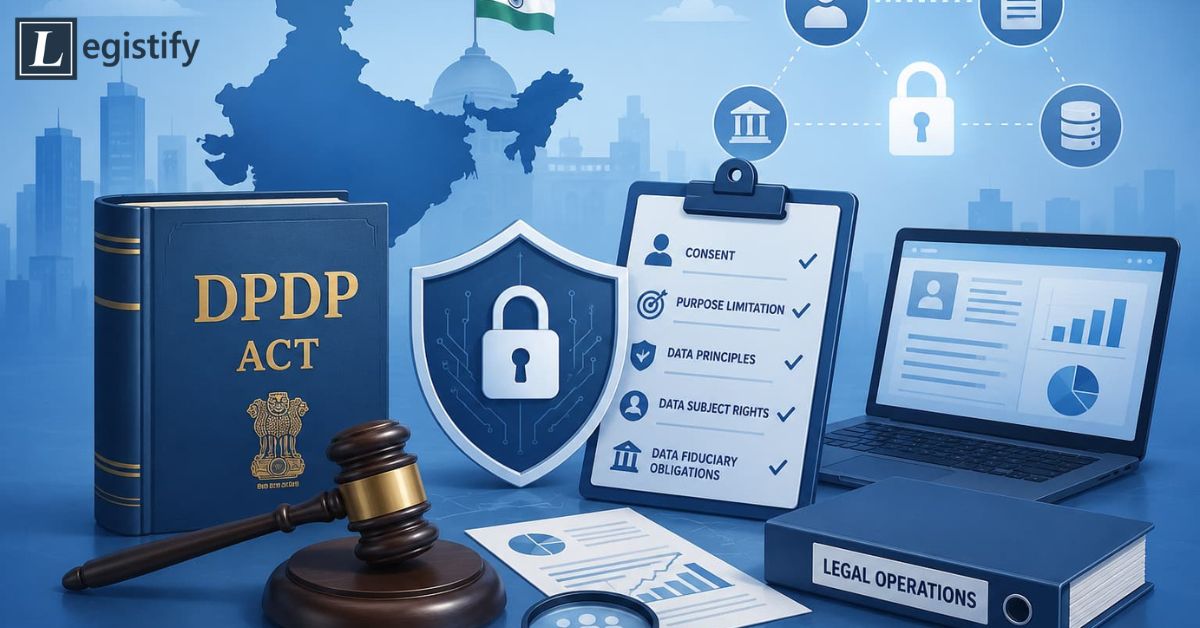
The DPDP Act is not primarily a legal problem. It is an operations problem. The Digital Personal Data Protection Act, 2023, which came partially into force in November 2025 with the publication of the DPDP Rules, creates compliance obligations that touch every function that processes personal data. For enterprise legal teams, the Act creates three distinct categories of operational change: new contractual obligations in every agreement involving personal data, new litigation and enforcement risk from the Data Protection Board of India, and new notice and documentation obligations that need to be tracked and managed at scale.
Most enterprise DPDP compliance discussions focus on the technical and governance dimensions: consent management systems, data inventory tools, privacy policy updates, and DPO appointments. The legal operations dimension receives less attention, but it is where the compliance risk most directly affects the enterprise’s existing workflows. An enterprise that has updated its privacy policy but has not updated its vendor contracts, its notice management workflows, or its litigation tracking to account for DPDP Act proceedings is operationally non-compliant regardless of its governance posture.
This blog covers what the DPDP Act requires specifically from an enterprise legal operations perspective, covering the contract, litigation, and notice management implications.
The DPDP Act Timeline: Where We Are Now
Before covering the operational implications, the timeline matters for understanding urgency.
The DPDP Rules were published on November 13, 2025. The Data Protection Board of India was established at the same time. Phase 2 of implementation, including the Consent Manager framework, becomes operational in November 2026. Full compliance, including consent, privacy notice, and security requirements, becomes mandatory from May 13, 2027. The Data Protection Board is expected to begin exercising its full adjudicatory and enforcement powers, including penalties of up to INR 250 crore per contravention, around the same time.
2026 is the build year. The enterprises that are operationalising DPDPA compliance now, across their contracts, their notice management, and their litigation tracking, will have a structured compliance posture when enforcement begins. Those that treat 2026 as another year of preparation are running out of runway.
What the DPDP Act Requires from Legal Operations
Contracts: Data Processing Agreements are now mandatory
The DPDP Rules expressly require appropriate security provisions in Data Fiduciary-Data Processor agreements. Compliance responsibility rests with the Data Fiduciary even where processing is carried out by a Data Processor. This means that every vendor contract, technology services agreement, and outsourcing arrangement where the counterparty processes personal data of Indian citizens now requires a DPDPA-compliant Data Processing Agreement.
For enterprise legal teams managing large vendor portfolios, this is a significant contract remediation exercise. The DPA needs to address: the scope and purpose of processing, the categories of personal data involved, data retention and deletion obligations, security safeguards, breach notification timelines (the Act requires notification to the Data Protection Board), restrictions on sub-processing, audit rights over the data processor, and data return or deletion at contract end.
This is not a one-time exercise. New vendor contracts need to include DPDPA-compliant DPAs from the point of execution. Existing vendor contracts with MSME suppliers, technology vendors, marketing partners, HR platforms, and any other counterparty that processes personal data need to be reviewed and updated. For a large enterprise with hundreds of active vendor relationships, this is a systematic contract remediation programme, not a legal team project that can be handled through ad hoc review.
The CLM implications are direct. Standard contract templates need to be updated to include DPDPA-compliant DPA provisions. Incoming vendor contracts need to be reviewed against a DPDPA playbook position that covers the mandatory DPA elements. Obligation tracking for DPA provisions, covering breach notification timelines, audit rights exercises, and data deletion obligations at contract end, needs to be built into the post-signature monitoring workflow.
Litigation and enforcement: Data Protection Board proceedings need to be tracked
The Data Protection Board of India is the enforcement authority under the DPDPA. It has authority to investigate complaints from data principals, levy penalties up to INR 250 crore per contravention, issue compliance directions, and maintain a public registry of enforcement actions. Appeals go to the Telecom Disputes Settlement and Appellate Tribunal.
For enterprise legal teams, the Data Protection Board is a new forum that needs to be incorporated into the litigation management framework. Proceedings before the Board are different from court litigation and tribunal proceedings, but they share the fundamental litigation management requirements: hearing date tracking, document management, legal team briefing, response deadline management, and exposure quantification.
The specific litigation management implications are:
New case alert requirements. When a data principal files a complaint with the Data Protection Board against an enterprise, the legal team needs to know immediately. The same new case discovery requirement that applies to District Court and DRT filings applies to DPBI complaints. Given that the Board is a relatively new forum and its complaint processes are still being established, the legal team needs a mechanism for monitoring DPBI filings rather than relying on notification through the formal process.
Response timeline management. Data Protection Board proceedings have defined response timelines. Missing a response window before the Board has the same consequences as missing a response window before any other regulatory body. These timelines need to be tracked in the litigation management system with the same rigour as court dates.
Exposure quantification. Penalties under the DPDPA are significant: up to INR 250 crore per contravention. For the enterprise’s contingent liability reporting under Ind AS 37, DPBI proceedings need to be assessed and quantified alongside civil and criminal litigation. The legal team needs a mechanism for capturing DPBI proceedings in the litigation management system and for assessing the financial exposure from each matter.
Settlement and compliance directions. The DPBI has the power to issue compliance directions that require the enterprise to take specific remedial action. These directions create operational obligations that need to be tracked and implemented. Compliance direction tracking is a category of obligation management that the legal team needs to incorporate into its post-proceeding workflow.
Notice management: Breach notification is a strict obligation
The DPDPA requires notification to the Data Protection Board of India in the event of a personal data breach. The notification obligation applies to Data Fiduciaries and is not conditional on the breach reaching a threshold of severity. The Rules set specific timelines for breach notification.
For enterprise legal teams, this creates a notice management obligation that is different from the voluntary or contractual breach notifications they may have managed previously. A DPDPA breach notification is a statutory notice with defined content requirements, a defined recipient (the DPBAI), and defined timelines. It is also a legal risk event: the content of the notification may be relevant to any subsequent enforcement action by the Board.
The breach notification workflow needs to be defined in advance, not improvised at the moment of a breach. The workflow should cover: who in the legal team is responsible for breach notification, how the legal team is notified when a security or IT team identifies a breach, what the notification content requirements are, what the legal review process for the notification is, how the notification is transmitted to the DPBAI, and how the notification record is preserved.
For BFSI enterprises, this overlaps with existing RBI breach reporting obligations. The interplay between DPDPA breach notification and RBI incident reporting needs to be mapped, and a co-ordinated notification workflow that satisfies both frameworks needs to be designed.
Data processors who have contractual breach notification obligations to their data fiduciary clients also need a parallel workflow: when the processor identifies a breach, how they notify the fiduciary within the contractually required window, and how the fiduciary then fulfils its DPBAI notification obligation within the statutory timeline.
The DPDPA’s Impact on Existing Legal Operations Workflows
Beyond the three primary categories above, the DPDPA affects several specific legal operations workflows that are in place in most Indian enterprise legal teams.
Employment contracts and HR data processing
Employment contracts involve the processing of substantial volumes of employee personal data: identity information, financial details, health data, biometric information for access control, and in some cases sensitive personal data. Under the DPDPA, employees are data principals with specific rights over their data.
Employment contracts need to be reviewed for DPDPA compliance: are the data processing activities described and consented to adequately? Are retention periods defined? Are deletion obligations at employment end addressed? For large enterprises with standardised employment contracts across multiple locations, this is a contract update programme, not individual contract review.
Customer-facing contracts and consent management
For enterprises that provide services to individuals, customer contracts define the data processing relationship. The DPDPA’s consent requirements, including the prohibition on bundling consent with service access, the requirement for unconditional consent, and the right to withdraw consent, need to be reflected in customer agreements and the consent management process.
For digital-first businesses, this is primarily a product and technology change. But the legal team needs to ensure that the contractual terms are consistent with the consent management implementation: the terms of service cannot grant processing permissions that the consent management system is not capable of obtaining in the required form.
Vendor and third-party risk management
The DPDPA’s data processor obligations extend the enterprise’s third-party risk management framework. Data processors are subject to the obligations that the data fiduciary imposes on them through the DPA. The data fiduciary is responsible for the processor’s compliance with those obligations. This creates a new category of third-party risk: DPDPA compliance risk from data processors that do not meet the required standards.
Third-party risk management for DPDPA needs to cover: pre-engagement due diligence on the potential data processor’s security practices and compliance capability, DPA provisions that impose the required obligations, audit rights that allow the fiduciary to verify compliance, and ongoing monitoring of the processor’s practices. The legal team’s third-party risk management framework needs to incorporate these elements alongside the existing operational, financial, and regulatory risk categories.
Litigation discovery and personal data
For enterprises involved in litigation that involves personal data, the DPDPA creates a new tension. Litigation may require producing personal data as evidence. Data principals have rights over their personal data that may conflict with the enterprise’s litigation obligations. The DPDPA’s exemptions for compliance with Indian law, court orders, and statutory obligations need to be understood and applied in the litigation context.
The legal team needs to have a clear position on when personal data can be disclosed in litigation contexts, what protective orders or redaction practices should be used, and how the data principal’s rights interact with the litigation disclosure requirement.
What Needs to Change in Legal Workflows Now
Given the DPDPA timeline, the following legal operations changes are the most urgent for 2026.
Update contract templates and playbook. All standard contract templates that involve personal data processing need to be updated to include DPDPA-compliant DPA provisions. The contract review playbook needs to include DPDPA DPA compliance as a standard review item for incoming contracts with data processing implications.
Audit existing vendor contracts. The vendor contract portfolio needs to be reviewed against the DPDPA DPA requirement. Contracts that lack compliant provisions need to be identified and remediation should be prioritised based on the volume of personal data processed and the regulatory sensitivity of the data categories.
Build the breach notification workflow. The DPDPA breach notification workflow needs to be documented, assigned, and tested before a breach occurs. The intersection with RBI and other sector-specific notification obligations needs to be mapped for regulated entities.
Incorporate DPBI proceedings into litigation management. The litigation management system should be configured to track DPBI proceedings alongside court and tribunal matters, with response deadline management, exposure quantification, and compliance direction tracking.
Train the legal team on DPDPA implications. The legal team needs to understand the DPDPA’s implications for the contract review, notice management, and litigation workflows they manage daily. DPDPA awareness at the operational level is different from governance-level compliance training.
Legistify’s contract management platform supports DPDPA-compliant DPA template management and obligation tracking. The litigation management module can be configured to track Data Protection Board proceedings alongside court and tribunal matters. The notice management module supports structured breach notification workflows with defined approval processes and audit trails.
Conclusion
The DPDP Act creates operational change requirements for enterprise legal teams that are as significant as any regulatory development in recent years. The contract, litigation, and notice management implications are concrete, time-sensitive, and directly connected to the daily workflows that legal operations teams manage.
2026 is the year to operationalise DPDPA compliance across legal workflows. The enforcement window opens progressively from November 2026, and the enterprises that have built structured, documented, auditable DPDPA compliance into their legal operations will be positioned to demonstrate compliance when the Data Protection Board begins exercising its enforcement powers. Those that have not will be making urgent changes under regulatory pressure rather than deliberate operational design.