Every contract management platform sold today leads with AI in its marketing: AI-powered drafting, AI-assisted review, AI-driven insights. At the product level, the differences behind these claims range from substantial to almost non-existent. For enterprise legal teams evaluating CLM platforms, “we have AI” has become one of the least useful things a vendor can say.
The more useful questions are specific. What the AI does, at which stage of the contract lifecycle it operates, what it requires from the legal team to produce useful output, and where it creates measurable value rather than just appearing on a feature list.
This blog looks at where AI in contract management is genuinely changing how enterprise legal teams work, and where the gap between marketing claims and operational reality is still wide.
What AI in Contract Management Covers
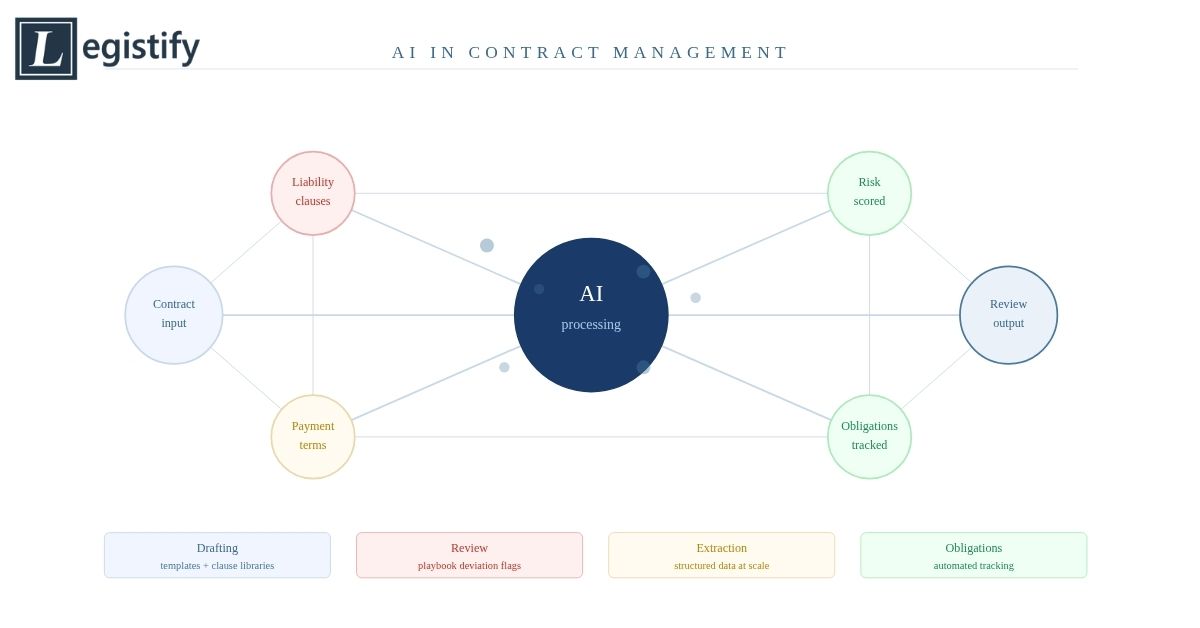
AI in contract management is not one thing. It is a set of distinct capabilities that apply to different stages of the contract lifecycle. Understanding which capabilities a platform has, and how well they work, matters more than whether the platform claims AI broadly.
Contract drafting and generation
AI-assisted drafting uses large language models and approved clause libraries to generate contract drafts from business inputs. A legal team member defines the contract type, the parties, key commercial terms, and relevant parameters, and the system produces a draft that reflects the organisation’s approved language.
The value here is speed and consistency. Standard contracts like NDAs, MSAs, and SOWs that follow predictable structures benefit most. AI CLM platforms targeting the Indian mid-market now benchmark contract turnaround times under seven days, against the 20 to 40 days that manual drafting cycles typically take. For high-volume, lower-complexity contract types, AI drafting produces material time savings.
The limitation is clear too. AI drafting works well within the boundaries of approved templates and standard clause libraries. Complex, high-stakes agreements, including acquisition agreements, structured finance documents, and bespoke commercial arrangements, still require substantial lawyer involvement. The claim that AI drafts contracts holds for a specific subset of contracts. For the most commercially significant ones, it does not.
Contract review and risk identification
AI-powered contract review analyses incoming contracts against the organisation’s playbook, flags clauses that deviate from standard positions, identifies missing provisions, and scores overall risk. A lawyer reviewing a vendor’s standard terms sees, within seconds, which clauses are non-standard, which are missing, and which carry risk levels that require escalation.
Generative AI contract review cycles can be accelerated by as much as 40% through optimised terms and conditions, standardised clauses, and intelligent flagging of non-compliant clauses. For legal teams processing large volumes of incoming contracts, this is a meaningful productivity gain.
The quality of AI review depends entirely on the quality of the playbook it operates against. A well-defined playbook with clear positions on each clause type produces useful, actionable output. A vague or incomplete playbook produces output that needs almost as much human judgment to interpret as reading the contract directly. The AI is only as good as the rules it is given.
Obligation tracking and monitoring
Once a contract is executed, AI obligation tracking extracts the commitments both parties have made, assigns them to responsible owners, and monitors compliance against deadlines. Payment milestones, delivery obligations, renewal notices, service level requirements, and regulatory compliance commitments are all tracked automatically, with alerts sent before deadlines are missed.
This is where AI in contract management creates some of its most consistent and measurable value. The alternative, manual tracking through spreadsheets or calendar reminders, fails predictably at scale. Auto-renewals on vendor contracts that no one is tracking cost organisations an estimated 3 to 7 percent of annual recurring revenue. Automated obligation tracking removes this category of loss directly.
For Indian enterprises, obligation tracking carries specific value in the context of regulatory compliance. Contracts with government bodies, regulated counterparties, and compliance-linked vendors often carry obligations tied to statutory or regulatory timelines. Tracking these manually across a large contract portfolio is a significant source of compliance risk.
Contract data extraction and analytics
AI data extraction pulls structured information from executed contracts at scale: party names, key dates, payment terms, liability caps, pricing structures, termination rights, governing law, and other defined data points. This turns a document repository into a searchable database of contract data.
The analytics layer uses this structured data to produce portfolio-level insights: liability exposure concentration across the vendor portfolio, contracts expiring in the next quarter, where pricing escalation clauses are concentrated, and total committed spend by contract type or business unit. These insights are only possible when contract data has been extracted consistently and at scale.
For Indian enterprises operating across multiple business units and geographies, with contracts spanning different regulatory regimes, this portfolio-level visibility is particularly valuable. The alternative, commissioning a manual contract audit whenever a portfolio-level question comes up, is slow, expensive, and produces a point-in-time snapshot rather than a live view.
Where the Gap Between Marketing and Reality Is Widest
AI accuracy in complex clause identification
Most AI contract review tools perform well on standard clause types with clear definitions: payment terms, termination clauses, governing law, non-compete provisions. They perform less well on contextually complex provisions, where the risk depends on how a clause interacts with other parts of the agreement, or on provisions unusual enough to fall outside the training data.
When evaluating a CLM platform’s AI review capability, legal teams should test it against their own contract types, including the most complex ones. A demo contract selected by the vendor is not a reliable indicator of how the AI performs on the agreements the legal team processes day to day.
Extraction accuracy on legacy contracts
Many enterprises hold contract repositories with legacy agreements in formats that are difficult for AI to process: scanned PDFs, handwritten amendments, documents with non-standard layouts, and contracts in regional Indian languages. AI extraction accuracy on clean, digitally-created contracts is typically high. On legacy documents, it can be significantly lower.
Before committing to a platform on the basis of its extraction capabilities, legal teams should test it against a representative sample of their own contract repository, including the most difficult documents. Extraction accuracy on that sample tells you far more about real-world performance than a vendor’s stated accuracy rate.
Obligation tracking completeness
AI obligation tracking is only as complete as the extraction that feeds it. If the AI misses or misclassifies a contract obligation during extraction, the obligation tracking system will not alert on it. Legal teams should verify whether obligation tracking covers all relevant obligation types for their specific contract mix, and whether it handles implicit obligations, where a party’s right to terminate or claim damages is triggered by a condition rather than an explicit commitment, as well as explicit ones.
What AI in Contract Management Cannot Replace
There are parts of contract management where AI supports legal judgment but does not replace it.
Negotiation strategy. AI flags deviations from the playbook and suggests fallback positions. It does not determine negotiation strategy, assess the commercial importance of a specific deal, or judge when to hold a position and when to compromise. These decisions remain with the lawyer.
Novel or complex drafting. AI drafts contracts within the boundaries of what it has been trained on. A genuinely novel commercial arrangement, a cross-border transaction involving unfamiliar legal systems, or a contract that creates a new type of obligation needs lawyer-led drafting that AI can assist but not replace.
Regulatory interpretation. AI flags regulatory compliance obligations in contracts. It does not interpret how a new regulatory development applies to an existing contractual arrangement, or advise on the legal implications of a regulatory change for the organisation’s contract portfolio. This is legal analysis that needs human judgment.
Dispute resolution. Once a contract dispute arises, the relevant question is usually not what the contract says, which AI can answer, but what it means given the specific facts and the applicable law. This is legal analysis for which AI is not yet a substitute.
When a CLM vendor says their platform has AI, the following questions produce more useful information than the claim itself.
What AI model powers the feature. Whether it is a proprietary model trained on contract data, a general-purpose large language model, or a rules-based system rebranded as AI affects both capability and reliability.
What the accuracy rate is, and on what dataset. Accuracy figures are meaningful only when measured on contract types similar to your own. An accuracy rate measured on English-language US commercial contracts says little about performance on Indian legal contracts with regional clause conventions.
What the AI requires from the legal team to function. AI contract review needs a well-defined playbook. AI obligation tracking needs defined obligation categories. AI drafting needs approved template libraries. The quality of AI output is directly tied to the quality of the input configuration. Vendors that understate this requirement are setting up implementation failures.
How the platform handles AI errors. Every AI system makes errors. What matters is how errors are surfaced, how they are corrected, and what the workflow looks like when the AI flags something incorrectly or misses something it should have caught. Platforms with good AI error management support efficient human review of AI output.
Whether the AI is India-specific in its training or configuration. For Indian enterprises, contract language, regulatory references, and clause conventions differ from the global context in which most AI CLM tools have been developed. Stamp duty compliance, Aadhaar eSign integration, DPDP Act compliance workflows, and Indian regulatory references need native support, not afterthought treatment.
The India-Specific AI Contract Management Requirement
For Indian enterprises, the AI contract management requirement has dimensions that global platforms do not always address adequately.
India’s stamp duty framework is a 25-plus state matrix where the applicable duty, instrument type, and execution formalities differ by state. For companies executing contracts across multiple Indian states, automated stamp duty identification and routing is a functional requirement, not an optional feature. AI that correctly identifies stamp duty implications for a contract executed in Karnataka may not carry the same accuracy for the same contract executed in Maharashtra.
The DPDP Act creates specific obligations around Data Processing Agreements. As the enforcement window for the DPDP Act approaches, enterprises need CLM platforms that support DPDP-compliant DPA templates, breach notification workflows, and data processing obligation tracking. Most global CLM tools have addressed this India-specific requirement only partially.
India’s multilingual contract environment also creates extraction challenges. Contracts in regional languages, bilingual agreements, and contracts with Hindi-language schedules need AI models trained on Indian language data, not just English-language capabilities.
Legistify’s contract management platform is built for the Indian legal environment, with support for Indian regulatory frameworks, stamp duty compliance, and the specific contract types that enterprise legal teams in India manage most frequently.
Conclusion
AI in contract management is real, and its impact on how enterprise legal teams work is growing. But the claim “we have AI” tells you almost nothing about whether a platform will create value for your legal team.
The value of AI in contract management is concentrated in specific applications: consistent drafting of standard contracts, faster review of incoming agreements against a well-defined playbook, automated obligation tracking, and portfolio-level data extraction and analytics. In each of these areas, the quality of the AI output depends on how well the platform has been configured and how well the AI has been trained on relevant contract data.
For Indian enterprises, the evaluation needs to go further than assessing generic AI capability. The India-specific requirements around stamp duty, DPDP Act compliance, regional language support, and local regulatory frameworks are not features that global platforms tend to lead with. They are the difference between a platform that works for an Indian enterprise and one that creates as many compliance problems as it solves.
The question worth asking is not whether a CLM platform has AI. It is what the AI does, how well it does it on contracts like yours, and whether it is configured for the legal environment in which your contracts are actually executed.