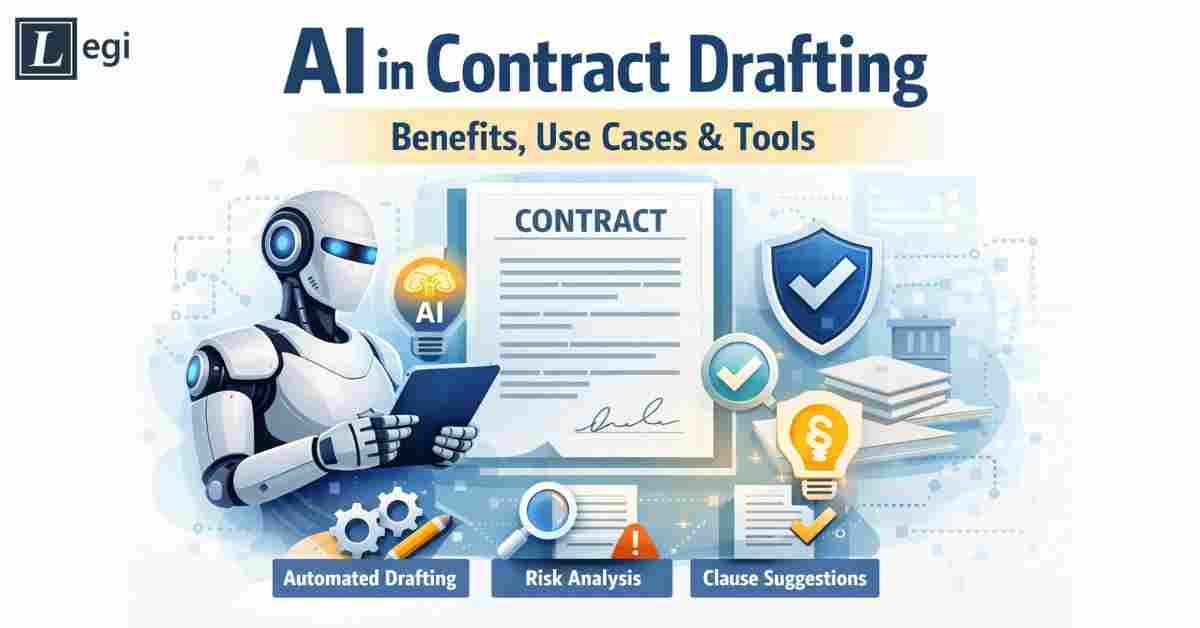
Contract drafting is considered one of the most labor-intensive activities that lawyers and legal professionals are involved in. For lawyers, in-house legal teams, and law firms, drafting one contract can be a labor-intensive process that involves hours of work, revisions, and coordination between different teams.
However, the way contract drafting is being carried out is changing with the advent of AI technology. Legal teams are now using AI-powered tools to draft contracts, which has the potential to save lawyers up to 4 hours per week, thereby creating around $100,000 in billable hours per lawyer annually, as per the Thomson Reuters report of 2024.
This guide discusses the meaning of AI in contract drafting, the technology, where it is being implemented, and the things that legal professionals should be aware of regarding this technology.
What Is AI in Contract Drafting?
AI in contract drafting is a term that refers to the application of Artificial Intelligence technologies, such as Natural Language Processing (NLP) and machine learning, to assist legal professionals in the process of creating, reviewing, and refining legal contracts.
This is not meant to replace legal professionals, but rather assist them in handling the more mundane, rules-based aspects of contract drafting, such as filling in standard clauses, flagging deviations from approved playbooks, and ensuring consistency between contracts. It is the legal professional’s responsibility to review, approve, and sign off on all contracts.
Contract drafting is a process that involves a broad range of different types of contracts, including non-disclosure agreements, service contracts, employment contracts, vendor contracts, licensing contracts, etc.
How AI Contract Drafting Works
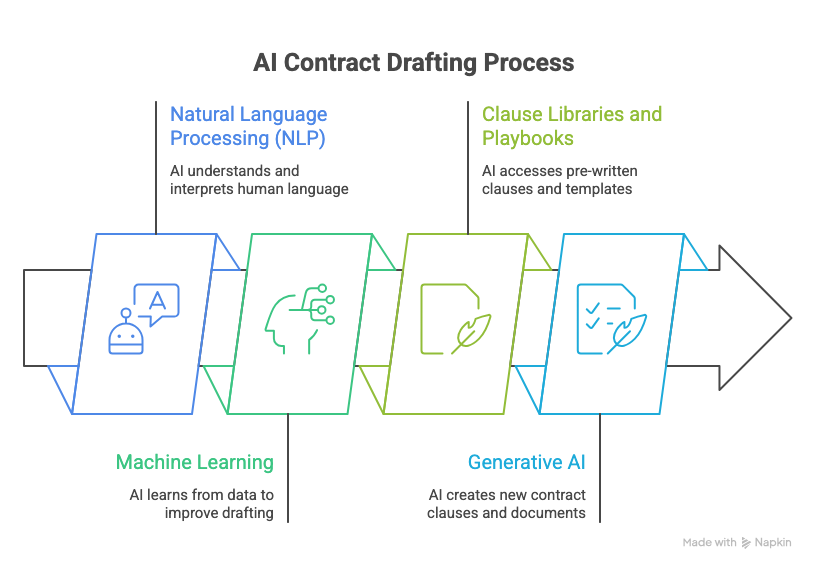
AI contract drafting tools use a variety of technologies, which combine to help them read, understand, and produce legal language.
1. Natural Language Processing (NLP)
NLP gives an AI system the ability to interpret a legal text in the same way as a human, understanding the meaning of clauses, defined terms, and how the use of language can affect the legal implications of a contract. This is why an AI system can highlight a high-risk clause or propose a preferred alternative from a set of approved clauses.
2. Machine Learning
Machine learning models are trained on vast amounts of data, including legal contracts, case laws, and regulations. Over time, these models learn what constitutes standard contract language, common deviations, and what is likely to cause legal issues. This is what enables AI systems to make relevant suggestions, not just text replacements.
3. Clause Libraries and Playbooks
The majority of AI drafting systems for enterprises have access to an organisation’s own clause library or legal playbooks. During contract drafting, AI systems use pre-approved content based on the type of deal, jurisdiction, and risk level of the counterparty. This ensures that all draft contracts are based on a standardised, legally vetted foundation.
4. Generative AI
The latest AI systems for contract drafting use LLMs, which can produce new content based on natural language inputs. A lawyer can input what they need in plain English, and the AI system can produce a draft. This is subject to review before use.
Challenges of Traditional Contract Drafting
To grasp the reasons behind the popularity of AI usage, it is helpful to understand the challenges that AI is helping to solve. Traditional contract development, still the dominant approach in many organisations, has a range of well-known inefficiencies.
- High Time Investment
Manually drafting contracts can be a slow process. A legal team must conduct research, pick the right clauses for the contract, and modify the wording according to the context. In addition, a single contract can take a legal team a few days to finalise. In a high-volume environment, where a legal team may need to handle hundreds of contracts a month, this can cause a considerable backlog.
According to a 2018 report by Gartner Research, lawyers in corporate legal teams spend between 25% and 40% of their time on tasks that do not require legal expertise. This includes drafting basic documents from scratch or reviewing repetitive contract wording.
- Inconsistency Across Documents
When different individuals draft contracts, without a common standard, inconsistency is a given. One group may use a particular version of a limitation of liability clause, while another group uses a different version. This, over time, results in a variety of contracts that are not only difficult to enforce, audit, or renegotiate but also make legal issues a challenge.
Another consequence of inconsistency is that non-standard language used in a particular clause may inadvertently alter risk, which is not immediately apparent and only becomes an issue in a dispute.
- Error-Prone Manual Processes
Copy-paste errors, incorrect template language, undefined terms, and undefined obligations are common in manually drafted contracts. These are not always detected during review, especially when time is of the essence or when reviewing many documents at once.
- Delays in Approval Cycles
The contract approval process involves many stakeholders, including legal, finance, procurement, and management. Each of these stakeholders will have their own review requirements. This can lead to additional delays, especially when there is no automation or standardisation. Delays in commercial contracts can have a direct impact on revenue.
- Compliance Blind Spots
Manually drafting contracts without a centralised approach can make it difficult for an organisation to ensure that all contracts are compliant with the latest laws and regulations. It can be especially difficult when there are changes in laws and regulations. Updating all existing contract templates can be a problem.
Key Use Cases of AI in Contract Drafting
- Automated Clause Generation
With the help of AI tools, it is possible to create individual clauses or even entire sections of a contract depending on the parameters set by the user for the specific deal. The user can input the type of deal, jurisdiction, information about the counterparty, and risk tolerance; the AI tool can generate a first draft using pre-approved clauses from the library.
For instance, while drafting an NDA, the AI tool can automatically insert clauses related to confidentiality obligations, permitted disclosures, duration, and return of information, etc., according to the standard positions taken by the organisation.
This saves a considerable amount of time required for the creation of the first draft.
- Template Population and Customisation
There are a lot of organisations that have a collection of templates for contracts. This is where the AI can take the templates and fill them out depending on the context. This means the lawyer does not have to manually fill out the templates.
Advanced tools can even modify the template depending on the specific contract. This means that if the other party is from a different jurisdiction, the AI can modify the governing law clause accordingly.
- Risk Detection and Clause Flagging
AI can review a proposed contract, whether it is one that has been drafted in-house or one that has been proposed by the counterparty, and highlight clauses that vary from standard positions taken by the business. These clauses may have high risk implications if included in a contract, for example:
- Unlimited liability clauses
- Autorenewing clauses that lack notice requirements
- IP assignment clauses that are more onerous than intended
- Payment clauses that breach company policy
- Indemnity clauses that are missing
- Dispute resolution clauses that are missing
Each clause highlighted for review may have a suggested alternative clause from the clause library with a rationale for the suggested change.
- Contract Standardisation
One of the most important operational cases where the use of AI can be significant is in the area of standardisation. The AI tools are useful in this area as they ensure that all the contracts, irrespective of who has drafted the contract, are written in the correct language and have the correct structure.
This is particularly important in large legal teams and law firms where many lawyers are working on the contract simultaneously. It also makes the contract management after execution simpler as it is easy to search the data in the contract if the structure of the contract is the same.
- Redlining and Negotiation Support
When a contract is received from a counterparty, AI systems can automatically redline the contract, comparing each clause against the organisation’s playbook and highlighting any deviations. This provides a structured document for the reviewing lawyer, rather than a clean document that has to be read from start to finish.
Some systems also include market data, which enables a lawyer to see how a particular clause compares to what is normal in a given market, which can help inform decisions about which issues to push back on and which issues to accept.
How AI Improves Contract Drafting: The Key Benefits
- Speed and Efficiency
The time to draft a first draft of a contract is significantly reduced by AI. It may take a lawyer several hours to select clauses, fill in templates, and verify standard terms. With AI, this process is reduced to just minutes. Industry benchmarks put the time savings at 60 to 85%, depending on contract type and complexity, with a 2025 Thomson Reuters survey finding lawyers using AI drafting tools completed first drafts 67% faster on average.
This means that for legal teams who need to process a lot of contracts, there is considerable potential for lawyers to review more contracts, move deals along faster, and reduce turnaround time for internal clients.
- Accuracy and Error Reduction
Manual copy-pasting and memory reliance are minimised. AI tools draw on a centralised library of clauses to ensure accuracy, currency, and internal consistency of language. In a widely cited LawGeex study benchmarking AI against 20 experienced lawyers on NDA review, the AI tool achieved 94% accuracy, matching the top-performing lawyer, while the attorneys averaged 85% accuracy, with the lowest individual score at 67%.
More accuracy means fewer errors and therefore fewer disputes.
- Cost Savings
Drafting can be done more quickly and fewer errors can be made, which can lower the cost of contract management. For legal teams within an organisation, AI can help them reduce the need for outside counsel for drafting work. For law firms, AI can enable their associates to handle more work without a corresponding increase in headcount. Organisations can save up to 40% on legal fees related to contract work.
- Scalability
As businesses expand, the number and complexity of contracts often follow. With the help of AI, legal teams can increase their output without necessarily increasing their headcount proportionally. A lean legal team can handle a much larger number of contracts if the right tools are implemented.
- Consistency and Compliance
By enforcing a standardised language in all contracts, AI eliminates the risk that arises due to inconsistent contract drafting. Organisations may also change their clause libraries centrally to ensure that any change in law or regulation is reflected in all contracts at once.
Limitations and Considerations
Whilst there are undeniably advantages to AI, it is equally important to be aware of where its limitations lie.
First and foremost, AI does not replace legal judgment. AI tools work best on the mechanical aspects of drafting: clause selection, template filling, and flagging of deviations. However, they do not lend themselves to the strategic aspects of contract negotiation: understanding the client’s business objectives, understanding the counterparty’s risk profile, and making judgment calls. These remain firmly in the lawyer’s domain.
The output of AI needs human review. The output of even the best AI contract drafting tool needs review before use. A qualified lawyer should review it. The risk of errors in AI-generated language, especially in generative AI, is significant. Accuracy also varies considerably by contract complexity: simple, template-based agreements such as NDAs tend to need only minor edits after AI drafting, while complex, bespoke agreements such as M&A contracts may only be 50 to 60% structurally useful and require substantial customisation. It is a risk if AI-drafted contracts of any complexity are assumed to be fit for use without review.
Data quality is important. AI is only as good as the data it is trained on. AI is also only as good as the clause libraries it is trained on. If an organisation’s playbook is out of date or incomplete, AI will draft contracts based on flawed standards. Clause libraries and playbooks need maintenance.
Ethical and confidentiality requirements. A legal practitioner should also consider the ethical requirements and confidentiality obligations. ABA Formal Opinion 512 (2024) specifically deals with this issue by emphasising the need for a legal practitioner to understand the information-processing capabilities of an AI tool before using the tool for a legal matter.
Jurisdictional complexity. Another factor to consider is the jurisdictional complexity. AI tools may not always consider jurisdictional requirements, especially for new markets. A legal practitioner should consider whether the language produced by the AI tool is appropriate for the legal context.
AI in Contract Drafting: The Role of the Lawyer
It is worth noting where AI can and cannot fit in the contract lifecycle.
AI can be particularly useful for the early stages of the contract lifecycle: creating a first draft, filling out templates, identifying issues, and making sure information is consistent. This is where the task is well-defined and the applicable standards are well-articulated in a playbook or a library of clauses.
The role of a lawyer, however, remains integral at all times. The responsibility of understanding the client’s needs, approving all outputs of AI, making judgments on disputed clauses, and overseeing the negotiation strategy falls on the shoulders of legal professionals. The AI does all the groundwork, and lawyers do all the decision-making.
The use of Legistify, for instance, facilitates AI-based contract drafting and review within a contract management system. This means AI is used for drafting and review, but within a system that also addresses other aspects of contract management.
Conclusion
AI in contract drafting is not a future concept; rather, it is currently in use in law firms, corporate legal departments, and procurement departments around the globe.
However, the use of AI in contract drafting should not be considered a replacement for legal expertise, as the value of AI in contract drafting lies entirely in its integration with the workflow of the lawyers.
For legal departments, the question of whether or not to use AI in contract drafting should be replaced with the question of how best to implement the use of AI in a way that is structured, ethical, and useful.
A good way to begin with the use of AI in contract drafting is with high-volume, mundane contracts, for example, NDAs, service contracts, vendor contracts, and so on, and then expand from there as the organisation becomes comfortable with the tools and the results.