Section 302 of the Indian Penal Code, 1860 is one of the most cited provisions of Indian criminal law. It prescribes the punishment for the offence of murder, which is separately defined in Section 300 of the same Code. Together, Sections 300 and 302 form the foundational statutory framework for the law of murder in India.
An important update: the Indian Penal Code, 1860 was repealed and replaced by the Bharatiya Nyaya Sanhita, 2023 (BNS), which came into force on 1 July 2024. Section 302 IPC is now replaced by Section 101 of the BNS, which contains substantially similar provisions for the punishment of murder. This article covers both the original IPC framework and the current BNS position.
What Does Section 302 IPC Say?
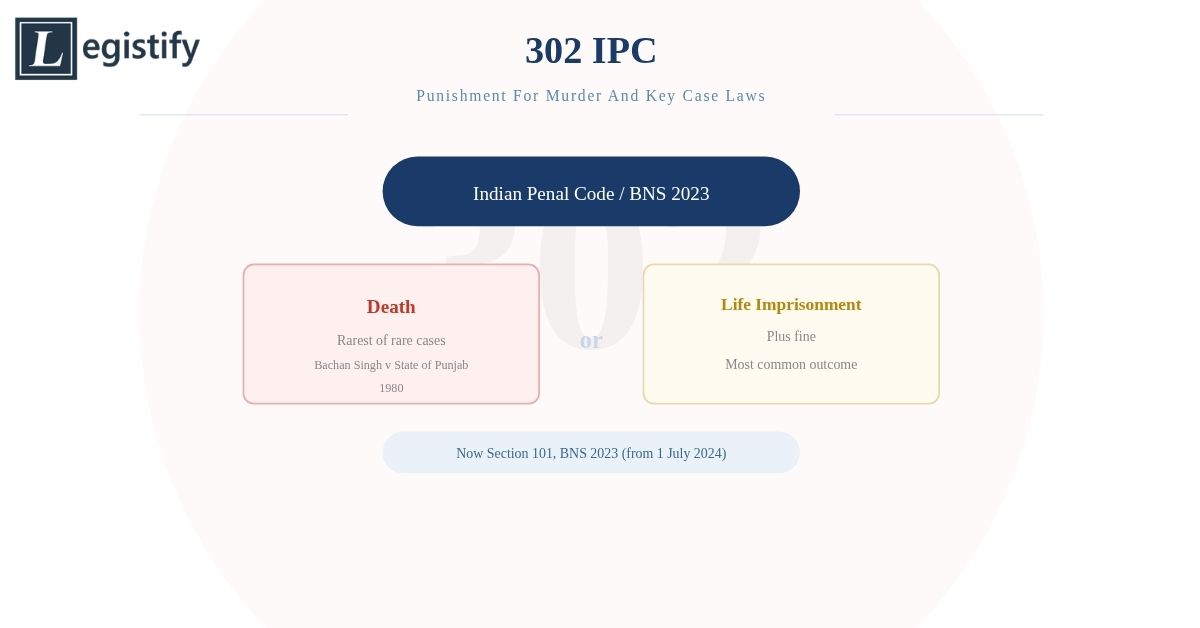
Section 302 of the Indian Penal Code states: “Whoever commits murder shall be punished with death, or imprisonment for life, and shall also be liable to fine.”
The provision prescribes two alternative punishments: death and imprisonment for life. The sentencing judge has discretion to impose either punishment, subject to the principles developed by the Supreme Court for the exercise of that discretion. In addition to death or life imprisonment, the convicted person is also liable to pay a fine.
What Is Murder Under Section 300 IPC?
The offence of murder is defined in Section 300 of the Indian Penal Code, not in Section 302. Section 302 only prescribes the punishment. Section 300 defines murder as a form of culpable homicide that meets specific conditions.
Culpable homicide becomes murder under Section 300 in the following circumstances.
When the act is done with the intention of causing death. Where a person causes death by an act done with the intention of killing, the act is murder. The intention to cause death is the clearest form of murderous intent.
When the act is done with the intention of causing such bodily injury as the offender knows to be likely to cause death. Where the offender intends to cause a specific injury, knowing that the injury is likely to kill the victim, the act is murder even if the offender did not necessarily intend the victim to die.
When the act is done with the intention of causing bodily injury and the injury intended to be inflicted is sufficient in the ordinary course of nature to cause death. This is sometimes described as objective intention: the offender intends to cause a specific injury, and that injury is objectively sufficient to cause death, even if the offender believed the victim might survive.
When the person causing the death knows that the act is so imminently dangerous that it must in all probability cause death or such bodily injury as is likely to cause death, and commits such act without any excuse. This covers cases of extreme recklessness where the person knows their act is almost certain to cause death.
Exceptions: When Culpable Homicide Is Not Murder
Section 300 IPC also provides five exceptions where culpable homicide, even if it satisfies the elements above, is not treated as murder. These exceptions reduce the offence from murder to culpable homicide not amounting to murder, which is punishable under Section 304 IPC rather than Section 302.
Grave and sudden provocation. Where a person is deprived of self-control by grave and sudden provocation, and causes the death of the person who gave the provocation (or another person by accident or mistake), the offence is culpable homicide not amounting to murder. The provocation must be sudden and grave, and the loss of self-control must be genuine. Planned responses to provocation do not fall within this exception.
Exceeding the right of private defence. Where a person exceeds the powers given by law for private defence of person or property without premeditation and without any intention of doing more harm than necessary for defence, the offence is culpable homicide not amounting to murder.
Public servant exceeding their power. Where a public servant acting for the advancement of public justice exceeds the powers given by law and causes death, believing in good faith that the act is lawful and necessary, the offence is culpable homicide not amounting to murder.
Sudden fight. Where the offence is committed without premeditation in a sudden fight in the heat of passion upon a sudden quarrel, and without the offender having taken undue advantage or having acted in a cruel or unusual manner, the offence is culpable homicide not amounting to murder.
Consent. Where the person whose death is caused is above eighteen years of age and consented to take the risk of death, the offence is culpable homicide not amounting to murder.
Punishment Under Section 302 IPC
Section 302 IPC prescribes death or imprisonment for life, with fine. The choice between the death penalty and life imprisonment is a matter of judicial discretion, guided by principles developed by the Supreme Court of India.
The Supreme Court has held that the death penalty should be imposed only in the rarest of rare cases. The principle was articulated in Bachan Singh v. State of Punjab (1980), where the Constitution Bench upheld the constitutional validity of the death penalty but restricted its application to cases where the crime is of such exceptional depravity that no other sentence would be adequate in the view of the sentencing court.
In Machhi Singh v. State of Punjab (1983), the Supreme Court elaborated on what constitutes the rarest of rare cases, identifying factors that bear on the choice between death and life imprisonment. These include the manner of the crime, the motive, whether the crime was committed with a professional approach, the nature of the victim, the possibility of reformation, and the overall circumstances of the offence.
In practice, the death penalty is imposed in a very small fraction of murder cases. The overwhelming majority of murder convictions result in life imprisonment.
Bail in Section 302 IPC Cases
Murder is a non-bailable offence. A person accused of murder cannot claim bail as a right. The grant of bail in a murder case is within the discretion of the court and is generally not granted during the trial stage except in exceptional circumstances.
The factors considered by courts when deciding bail applications in murder cases include the seriousness of the offence, the strength of the prosecution’s case, the risk of the accused absconding, the risk of the accused tampering with evidence or influencing witnesses, the health and personal circumstances of the accused, and the time already spent in custody.
The BNS 2023: What Replaced Section 302 IPC?
The Bharatiya Nyaya Sanhita, 2023 replaced the Indian Penal Code, 1860 with effect from 1 July 2024. The provisions dealing with murder have been reproduced with substantially the same content in the new Code.
Section 101 of the BNS replaces Section 302 IPC. It states that whoever commits murder shall be punished with death or imprisonment for life, and shall also be liable to fine.
Section 100 of the BNS replaces Section 300 IPC on the definition of murder, with substantially the same provisions for the elements of murder and the five exceptions.
Courts that are dealing with offences committed before 1 July 2024 continue to apply the IPC provisions. The BNS applies to offences committed on or after 1 July 2024.
Key Case Laws Under Section 302 IPC
Bachan Singh v. State of Punjab (1980)
The Supreme Court’s landmark judgment upholding the constitutional validity of the death penalty under Section 302 IPC while restricting it to the rarest of rare cases. The judgment reviewed the framework for sentencing in murder cases and established the principle that the choice between death and life imprisonment requires weighing the aggravating and mitigating circumstances of the specific case.
Machhi Singh v. State of Punjab (1983)
The Supreme Court elaborated on the rarest of rare doctrine by identifying categories of cases that may warrant the death penalty. These included murders involving extreme brutality, murders involving exceptional depravity, murders of defenceless victims, murders that attract public attention and create terror, and murders committed with the intent of permanently preventing future prosecutions.
Santosh Kumar Satishbhushan Bariyar v. State of Maharashtra (2009)
The Supreme Court reiterated that the death penalty should be imposed only where the crime and the criminal are both at the extreme end of culpability, and where the sentencing court can conclude beyond reasonable doubt that no circumstances exist that would justify a lesser sentence.
K.M. Nanavati v. State of Maharashtra (1962)
One of India’s most famous criminal cases, involving the trial of a naval officer for the murder of his wife’s lover. The case was significant for ending the jury system in India and for its discussion of the sudden provocation exception. The Supreme Court held that the provocation in that case did not meet the standard required for the exception to apply.
State of Maharashtra v. Manjabai (1981)
The Supreme Court discussed the distinction between culpable homicide and murder in the context of a domestic violence case. The case addressed the question of whether an act done in the heat of passion following a quarrel could qualify for the exception to murder and be treated as culpable homicide not amounting to murder.
Difference Between Murder (Section 302) and Culpable Homicide (Section 304)
The distinction between murder under Section 302 and culpable homicide not amounting to murder under Section 304 is one of the most litigated questions in Indian criminal law.
Murder requires a higher degree of intent or knowledge. Culpable homicide not amounting to murder covers situations where the element of intent is present but the case falls within one of the five exceptions, or where the knowledge of the likelihood of death is present but the specific intent to cause death is absent.
Section 304 prescribes a maximum of life imprisonment for culpable homicide with the intent to cause death or likely bodily injury (Part I), and a maximum of ten years for culpable homicide without such intent but with knowledge that the act is likely to cause death (Part II). Both alternatives carry lower maximum sentences than Section 302.
Courts have consistently emphasised that the distinction between murder and culpable homicide not amounting to murder is one of degree rather than kind, and that the circumstances of each case must be examined to determine which provision applies.
Conclusion
Section 302 IPC, now replaced by Section 101 of the Bharatiya Nyaya Sanhita 2023, is the cornerstone provision of Indian homicide law. Its application requires careful analysis of the definition of murder in Section 300 IPC (Section 100 BNS), the exceptions that reduce murder to culpable homicide, and the Supreme Court’s developed jurisprudence on the choice between death and life imprisonment. The rarest of rare doctrine ensures that the death penalty, while available, is reserved for cases of exceptional gravity where no lesser sentence would be adequate.