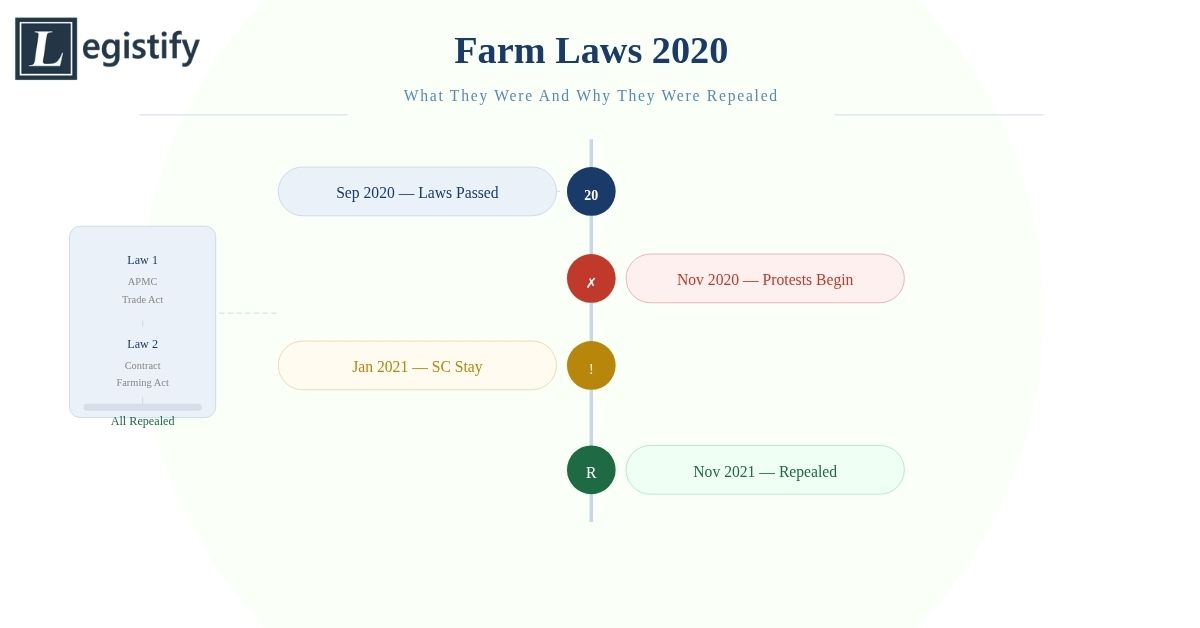
Farm Laws 2020 were three pieces of legislation passed by India’s Parliament in September 2020 that were intended to reform the country’s agricultural marketing system. They became the subject of one of the largest and longest protest movements in post-independence India, culminating in their repeal by the central government in November 2021.
Understanding what the farm laws actually said, why the farming community opposed them, and what the repeal meant for Indian agriculture policy is useful context for anyone following Indian agricultural policy, constitutional law, or the history of large-scale civil protest in democratic India.
Background: The Agricultural Marketing System Before 2020
Before the farm laws were enacted, agricultural trade in India was governed by the Agricultural Produce Market Committee (APMC) system, which varies by state. Under the APMC system, farmers were generally required to sell their produce within designated markets known as mandis. Prices in these mandis were determined through auction, and traders needed licences to operate within the mandi system.
The APMC framework created a structured market but also created a degree of monopoly for licensed traders and commission agents (arhatiyas) within the mandi system. Farmers selling outside designated mandis could face penalties. The system was credited with providing price discovery and protection for farmers, but was criticised for creating intermediaries who captured a portion of the value between farm and consumer.
The Minimum Support Price (MSP) system, under which the government announces minimum prices for certain crops, operated within this framework. While MSP is a policy mechanism rather than a legal guarantee, it provided a price floor for farmers selling through government procurement channels.
The Three Farm Laws 2020
The three farm laws passed in September 2020 were:
1. The Farmers’ Produce Trade and Commerce (Promotion and Facilitation) Act, 2020
This Act permitted farmers to sell their produce outside the APMC mandi system without paying market fees. Under the Act, any trader holding a PAN card could purchase farmers’ produce in any area beyond the physical mandi, including through electronic trading platforms.
The Act explicitly prohibited state governments from levying any market fee, cess, or other charge on farmers and traders for trading conducted outside the notified APMC market areas.
The stated objective was to break the monopoly of the mandi system and allow farmers to access better prices through competition among buyers, including from buyers in other states. Supporters argued this would allow surplus-producing regions to directly reach deficit markets and give farmers access to a wider buyer base.
2. The Farmers (Empowerment and Protection) Agreement on Price Assurance and Farm Services Act, 2020
This Act created a national framework for contract farming, allowing farmers to enter into agreements with buyers, including large retailers, processors, exporters, and agribusiness firms, before the crop season. The price for the produce was to be agreed before sowing, transferring market risk from the farmer to the buyer.
The Act specified that the farming agreement could cover inputs such as seeds, fertilisers, and technical advice provided by the sponsor, and that the quality standards for the produce were to be defined in the agreement. Dispute resolution was to proceed through a conciliation mechanism first, followed by the Sub-Divisional Magistrate and then the Collector.
The Act specifically prohibited the buyer from taking possession of the farmer’s land, and made clear that land could not be used as collateral or be subject to any charge or mortgage under a farming agreement.
3. The Essential Commodities (Amendment) Act, 2020
This Act amended the Essential Commodities Act, 1955 by removing several agricultural commodities from the list of essential commodities that the government could regulate for stock limits and pricing. The commodities removed included cereals, pulses, oilseeds, edible oils, onion, and potatoes.
Stock limits on these commodities could only be imposed under extraordinary circumstances such as war, famine, or a steep and extraordinary price rise. The Act was intended to attract private investment into agricultural storage and processing infrastructure by reducing the risk of sudden stock limit orders that could make large-scale storage commercially unviable.
The Farmers’ Protests: What Farmers Were Concerned About
Farmers, particularly from Punjab, Haryana, and parts of western Uttar Pradesh, launched sustained protests against the three farm laws beginning in November 2020. The protests were organised primarily by farm unions operating under the umbrella of the Samyukta Kisan Morcha and involved large gatherings at the borders of Delhi that continued for over a year.
The concerns raised by protesting farmers centred on several issues.
The future of the MSP system. Farmers were concerned that allowing private trade outside the APMC system would, over time, weaken the mandi infrastructure and reduce the government’s ability to procure at MSP. If mandis declined in significance, the MSP mechanism would have less reach, and farmers who needed the guaranteed price floor would have no alternative. The farm laws did not include any provision for statutory protection of MSP, and the government’s assurances that MSP would continue were treated as insufficient by farming unions that wanted a legal guarantee.
The power imbalance in contract farming. While the contract farming Act prohibited land acquisition and provided a dispute resolution mechanism, farmers were concerned about the practical implications of entering into agreements with large corporate buyers. The concern was that in a negotiation between an individual farmer and a large agribusiness firm, the farmer would be at a structural disadvantage in determining price and quality standards, and that the dispute resolution mechanism would be difficult for individual farmers to access and navigate effectively.
The removal of essential commodity protections. The removal of cereals, pulses, oilseeds, and other commodities from the essential commodities list meant that private traders could stockpile these commodities without restriction. Farming unions were concerned that this would give large traders the ability to control supply and influence prices, potentially to the detriment of both farmers and consumers.
The pace and process of legislation. The three Acts were passed in the Rajya Sabha through a voice vote in September 2020 in circumstances where the opposition demanded a division of votes. The process was seen by critics as procedurally improper and as bypassing meaningful parliamentary debate on legislation that would have significant consequences for Indian agriculture.
The Supreme Court Stay and the Committee
In January 2021, the Supreme Court of India stayed the implementation of the three farm laws, noting concerns about the manner of their passing and the ongoing protests. The Court formed a four-member expert committee to study the farm laws and submit recommendations.
The committee submitted its report, but the full contents were not made public. The stay on implementation remained in place while discussions between the government and farming unions continued through most of 2021.
The Repeal: November 2021
On 19 November 2021, Prime Minister Narendra Modi announced in a nationally televised address that the three farm laws would be repealed. He acknowledged that the government had been unable to convince a section of farmers about the merits of the laws, and that the country needed to move forward.
The Farm Laws Repeal Bill, 2021 was passed by Parliament in November 2021, within days of the announcement. The three farm laws were repealed with effect from the date of the original legislation.
The farming unions continued their protests for several weeks after the repeal announcement, pending additional demands including a legal guarantee for MSP and withdrawal of cases against farmers who had been arrested during the protests. The protests formally concluded in December 2021, after the government issued a statement addressing several of the remaining demands.
What the Farm Laws Controversy Revealed About Agricultural Policy in India
The farm laws episode revealed several tensions in India’s approach to agricultural reform that have not been resolved by the repeal.
The MSP question. The demand for a legal guarantee of MSP across all crops purchased by all buyers remains unresolved. MSP applies to 23 crops under the current system, but actual government procurement is heavily concentrated in wheat and paddy, and primarily in Punjab and Haryana. Farmers in other states and growing other crops have limited access to MSP procurement. The question of how to extend meaningful price support to a more diverse agricultural sector without creating market distortions remains open.
Centre-state jurisdiction over agriculture. Agriculture is a state subject under the Seventh Schedule of the Indian Constitution. The farm laws used the constitutional entry for trade and commerce to argue that inter-state and intra-state trade in agricultural produce was within the Centre’s legislative competence. Several state governments, including Punjab and Chhattisgarh, passed legislation to counter the effect of the central farm laws within their territories. The constitutional questions about the boundary between the Centre’s trade and commerce powers and the states’ agriculture powers were not definitively resolved before the repeal.
The pace and process of significant agricultural reform. The farm laws experience demonstrated that agricultural reforms of significant scale require sustained consultation with farming communities across different regions and crops before legislation is introduced. The political coalition that opposed the farm laws extended well beyond the farming communities most directly affected.
The Legal Status Now
With the repeal of the three farm laws in 2021, the legal framework governing agricultural trade in India reverted to the pre-2020 position. The APMC system, as modified by state-level reforms in various states, continues to govern agricultural marketing. The Essential Commodities Act, 1955 was effectively restored to its pre-amendment position with respect to the decontrolled commodities. Contract farming frameworks that existed at state level before the central law continue to operate where they were enacted.
Conclusion
The farm laws 2020 represent one of the most significant and contested legislative episodes in recent Indian history. The three Acts aimed at a structural reform of agricultural markets that their supporters argued would have benefited farmers through greater competition and access to private capital. The opposition from farming communities, particularly in Punjab and Haryana, reflected deep concerns about the future of the MSP system, the power imbalance in contract farming, and the process by which the laws were passed.
The repeal demonstrated the significant political and constitutional constraints on top-down agricultural reform in India, and left the underlying questions about agricultural marketing, price support, and rural income unanswered.