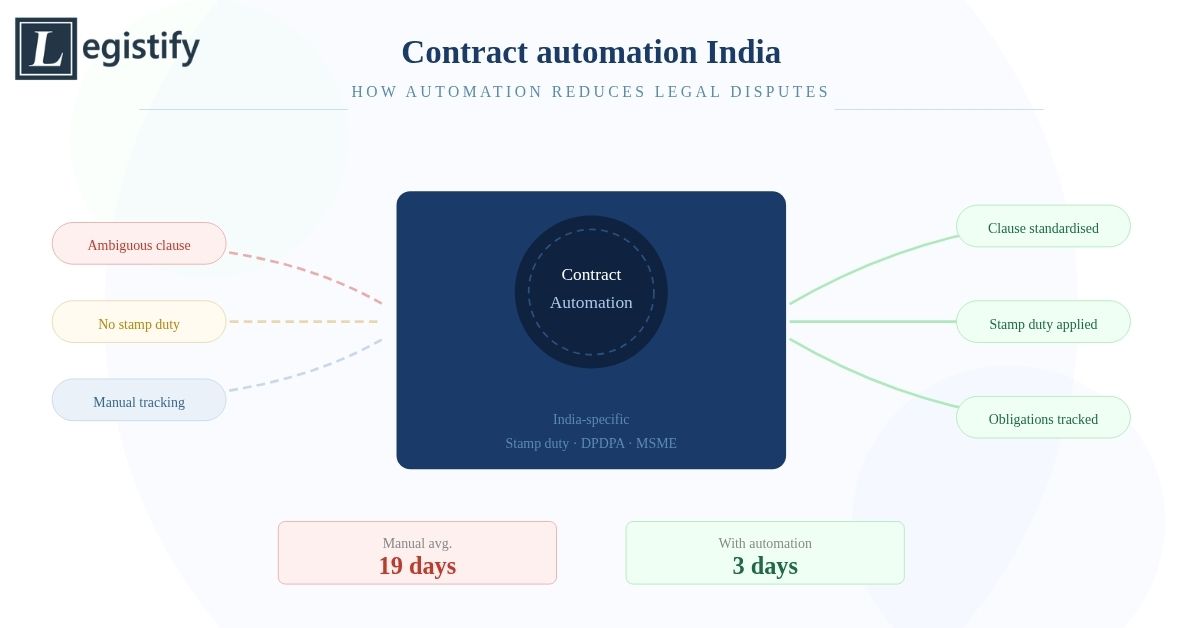
Contract automation in India is often positioned as an efficiency story: faster drafting, quicker approvals, shorter cycle times. These benefits are real. Manual contracting averages 19 days from initiation to execution, while automation brings this down to approximately 3 days. For enterprises executing hundreds of contracts per year, the time saving is real and measurable.
But the more important story is the risk story. Most commercial disputes in India have a contract at their origin, and most of those contracts failed not because the deal was bad but because the document was imprecise, the obligations were poorly tracked, or the execution process created a gap in what was agreed versus what was provable. Contract automation addresses these failure points directly, not by making lawyers faster but by removing the conditions that produce disputes in the first place.
This blog covers the specific ways contract automation in India reduces contract risk and the incidence of legal disputes, with attention to the India-specific failure modes that generic automation content does not address.
The Root Causes of Contract Disputes in Indian Enterprises
Understanding how automation reduces disputes requires understanding what causes them. The most common causes of commercial contract disputes in Indian enterprises are not bad faith negotiation or deliberately unclear terms. They are operational failures: obligation tracking failures, interpretation disputes arising from ambiguous language, execution defects that affect enforceability, and compliance failures that create regulatory exposure.
Obligation ambiguity. When a contract does not precisely define what each party must do, when, and under what conditions, disputes arise at the point of performance. “Best efforts” versus “reasonable efforts”, undefined measurement criteria for SLAs, payment terms that reference “completion” without defining it, and delivery obligations that do not specify standards all create interpretation disputes that could have been avoided with clearer drafting.
Missed obligations. When obligations are not tracked after signature, they are not met. A payment milestone missed because no one was tracking it. A notice period overlooked because the contract was filed and forgotten. A regulatory compliance obligation embedded in contract language that was never connected to the compliance function. Each of these creates a breach that gives rise to dispute or regulatory action.
Execution defects. Contracts executed without the correct stamp duty, without appropriate authority, without the correct form of electronic signature, or without satisfying form requirements under applicable law create enforceability risks. A contract that cannot be admitted in evidence because it was not correctly stamped is a contract that provides no protection when a dispute arises.
Non-standard terms accepted without oversight. When business teams negotiate contract terms without legal review, or when legal review is cursory because of volume and bandwidth constraints, non-standard clauses enter the portfolio. Liability caps that are disproportionate. Indemnification provisions that are broader than the organisation’s risk appetite. Governing law clauses that require dispute resolution in inconvenient forums. These non-standard terms become the basis for disputes when a relationship deteriorates.
Regulatory compliance failures. For Indian enterprises, contracts with MSME suppliers, regulated counterparties, or obligations linked to RBI, SEBI, IRDAI, and other regulatory frameworks create compliance obligations that need to be managed. When these obligations are not tracked and met, regulatory disputes and penalties arise from contractual failures that automation would have caught.
How Contract Automation Reduces Each Category of Risk
Reducing obligation ambiguity through standardised drafting
The first line of defence against ambiguity disputes is consistent, precise contract language. Contract automation applies approved templates and clause libraries to the drafting process, ensuring that standard obligations are expressed in precise, tested language rather than drafted freshly for each transaction.
When a payment term is pulled from a pre-approved template rather than drafted ad hoc, it uses language that the legal team has reviewed for precision and that the organisation has experience enforcing. When an SLA is defined using a standard measurement methodology from the clause library rather than a one-off description, it is less likely to generate an interpretation dispute when performance falls short.
For Indian enterprises, this matters for clause types that are particularly prone to ambiguity disputes: delivery terms for cross-border supply chains, SLA measurement criteria for technology services, and payment milestone definitions for project-based engagements. Standard, tested language for each of these reduces the surface area for interpretation disputes.
Reducing obligation tracking failures through automated monitoring
Once a contract is executed, automated obligation tracking extracts the commitments both parties have made and monitors them against deadlines. Payment milestones, delivery schedules, service level requirements, compliance reporting obligations, renewal notice windows, and warranty periods are all tracked automatically, with alerts sent to responsible owners before deadlines arrive.
The efficiency gap in post-signature obligation management is larger and more consequential than the drafting cycle time improvement. A missed payment triggers interest and potential default. A missed renewal notice locks the organisation into a further term at outdated rates. A missed SLA reporting obligation gives the supplier grounds to contest any remedy claim. A missed regulatory compliance deadline generates regulatory exposure.
Automated obligation tracking eliminates the category of disputes that arises from obligations that were agreed but not monitored. This is one of the most consistent and measurable ways contract automation reduces legal disputes for Indian enterprise legal teams.
Reducing execution defects through workflow enforcement
Contract execution workflows enforce the steps required for a legally valid agreement. Approval routing ensures that contracts above defined value thresholds go through the required sign-off chain before execution. E-signature workflows ensure that the correct form of signature is applied for each contract type. Stamp duty assessment and routing ensures that contracts are correctly stamped before execution.
For Indian enterprises, stamp duty compliance is a specific execution risk. A contract executed without the correct stamp, or stamped at the wrong rate under the wrong state’s law, is inadmissible as evidence in Indian courts and carries penalty exposure. Automated stamp duty assessment, applied within the contract execution workflow rather than as a post-execution afterthought, eliminates this category of execution defect.
Approval routing that enforces board-level authority requirements for high-value contracts, and e-signature workflows that apply IT Act-compliant digital signatures where required, ensure that execution defects do not create enforceability gaps that become relevant when disputes arise.
Reducing non-standard clause risk through playbook-based review
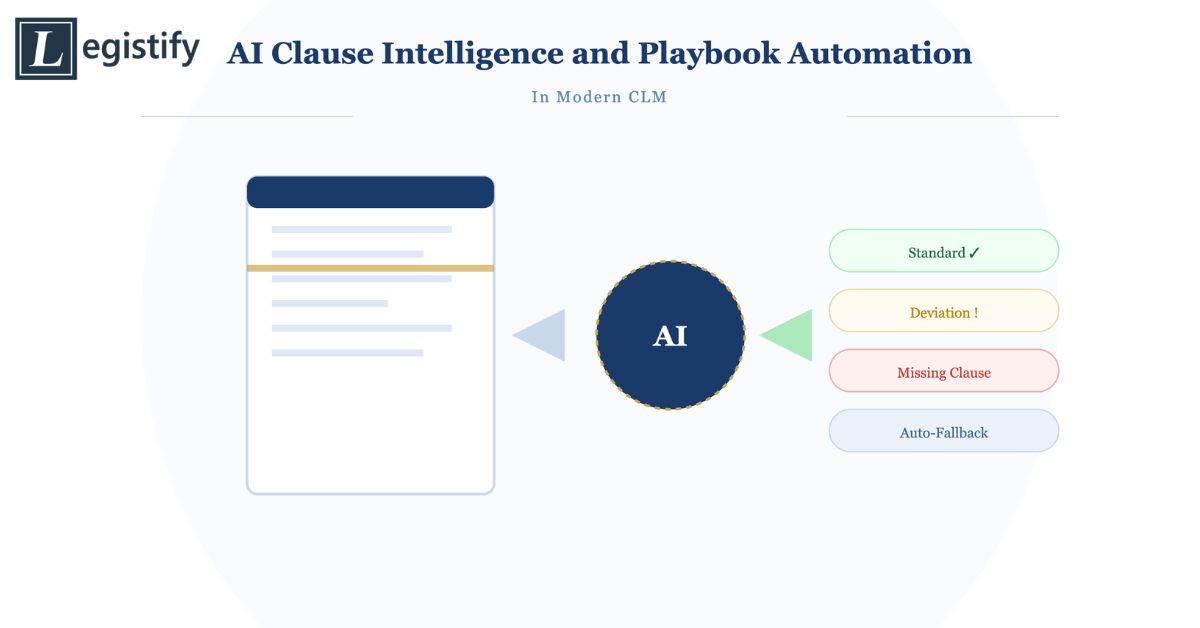
AI-assisted contract review, applied to all incoming contracts against an approved playbook, identifies non-standard clauses and flags them for escalation before execution. Instead of relying on a lawyer’s judgment on each occasion, the playbook defines what is acceptable for each clause type, and the AI applies this consistently across the full volume of incoming contracts.
For Indian enterprises, this is particularly valuable for clauses that carry India-specific risk. Indemnification provisions that expose the organisation to GST-related tax claims. Warranty clauses that create extended liability without the corresponding protection. Dispute resolution clauses that require arbitration in a foreign seat without adequate protections for the Indian party. Systematic playbook-based review catches these before execution. Ad hoc review under time pressure misses them.
Reducing regulatory compliance risk through obligation linkage
Many contracts in India create regulatory compliance obligations that extend beyond the contract itself. MSME payment terms create obligations under the MSME Development Act. Data processing agreements create obligations under the DPDPA. RBI-regulated agreements create obligations under sector-specific directives. GST-related clauses create obligations linked to the filing and reporting framework.
When these obligations are tracked only within the contract and not connected to the compliance function, they are systematically overlooked. The contract says one thing. The compliance calendar does not reflect it. The regulatory obligation is missed.
Contract automation that connects obligation tracking to compliance workflows ensures that regulatory obligations embedded in contract language reach the compliance team. MSME payment deadlines are tracked against the 45-day window. Data processing obligations are connected to the DPDPA compliance calendar. RBI-related contractual obligations are visible to the compliance function alongside the other regulatory requirements they manage.
This linkage between contract obligations and compliance management is one of the most direct ways contract automation reduces regulatory disputes and enforcement actions for Indian enterprise legal teams.
Specific Dispute Categories That Contract Automation Addresses
Cheque bounce and payment disputes
Payment disputes are the most common category of commercial litigation in India. Section 138 proceedings under the Negotiable Instruments Act and DRT recovery cases often originate in contractual payment obligations that were disputed, delayed, or defaulted.
Contract automation that tracks payment milestones, triggers demand notices automatically when payment is overdue, and maintains a complete audit trail of the payment obligation and demand history improves the legal team’s position in recovery proceedings. The notice is sent on time. The documentation is complete. The statutory requirements are met. Cases that would previously have been weakened by procedural failures in the notice process are stronger at the point they are filed.
SLA and performance disputes
Technology services and outsourcing disputes in India frequently originate in SLA commitments that were imprecisely defined, inconsistently measured, or inadequately documented. When performance falls short and the buyer seeks to enforce remedies, the dispute often centres not on whether performance was poor but on whether the measurement methodology was applied correctly and whether the remedy was validly claimed.
Contract automation that standardises SLA measurement criteria, tracks performance data against the contracted standard, and manages the credit claim process within defined windows produces an evidentiary record that is harder for the supplier to contest than a series of email exchanges and manual performance reports.
Regulatory enforcement actions from contractual non-compliance
For Indian enterprises in regulated sectors, regulatory enforcement actions frequently stem from contractual obligations that were not met. MSME payment defaults that trigger SEBI disclosure obligations. Data processing agreements that do not meet DPDPA requirements and are identified in a regulatory inspection. RBI Digital Lending compliance gaps in the documentation between Regulated Entities and their Lending Service Providers.
Contract automation that ensures regulatory compliance clauses are included in all relevant contracts, that obligations linked to regulatory requirements are tracked automatically, and that compliance deadlines are connected to the compliance calendar reduces the incidence of regulatory enforcement actions that originate in contractual non-compliance.
The India-Specific Implementation Requirements
Contract automation for Indian enterprises needs to address requirements that are not typically covered in globally oriented automation frameworks.
Multi-state stamp duty integration. Stamp duty assessment and routing needs to cover the variation across 25-plus states in India, not just apply a single rate. The automation needs to identify the applicable state, the correct instrument classification, and the applicable rate, and route the contract for appropriate stamping before execution.
Aadhaar eSign and DSC workflows. E-signature workflows need to support Aadhaar eSign for consumer-facing and many B2B contracts, and DSC-based signing where required by regulatory frameworks or by the nature of the document. The workflow needs to select the appropriate signing method for each contract type automatically.
DPDPA compliance in contract workflows. Data processing agreements need to be generated with DPDPA-compliant provisions, and the data protection compliance obligations they create need to be tracked through to the compliance function. For Significant Data Fiduciaries and enterprises processing large volumes of personal data, this is a specific workflow requirement.
MSME payment tracking. Payment tracking for MSME suppliers needs to be connected to the 45-day statutory window, with alerts to the finance function before the deadline and documentation of payment status that supports the compliance reporting obligation under SEBI’s listing regulations for listed companies.
Indian regulatory clause templates. Clause libraries need to include templates for regulatory compliance provisions specific to the Indian framework: RBI Digital Lending compliance clauses for BFSI, IRDAI Fraud Monitoring Framework clauses for insurance, SEBI-related disclosure obligations for listed entities. These are India-specific requirements that generic global clause libraries do not cover.
Legistify’s contract management platform addresses these India-specific requirements within its core automation capabilities, with multi-state stamp duty support, Aadhaar eSign integration, DPDPA compliance workflows, and clause libraries built for the Indian regulatory environment.
Conclusion
Contract automation in India reduces legal disputes by addressing the operational conditions that produce them. Standardised drafting eliminates the imprecision that creates interpretation disputes. Automated obligation tracking eliminates the missed deadlines that create performance disputes. Workflow enforcement eliminates the execution defects that create enforceability disputes. Playbook-based review eliminates the non-standard terms that create liability exposure. And regulatory compliance linkage eliminates the compliance gaps that create enforcement actions.
For Indian enterprise legal teams managing high-volume litigation portfolios alongside their contract operations, the risk reduction benefits of automation are more consequential than the efficiency gains. Every dispute that does not arise because a contract was precisely drafted, correctly executed, and monitored is a dispute the legal team does not need to manage, brief external counsel for, or track through the court system. At scale, across a large contract portfolio, this reduction compounds into a material difference in the organisation’s litigation exposure and legal operations costs.