Procurement contract risk is not a single problem. For Indian enterprises operating across multiple subsidiaries, joint ventures, and international entities, it is a set of overlapping problems: regulatory compliance obligations that differ by jurisdiction, supplier concentration risk that is invisible until it becomes a crisis, contractual commitments that are not monitored after signature, and financial exposure from obligations embedded in contract language that never reaches the finance team.
The organisations that manage procurement contract risk most effectively in 2026 do so not by having better legal templates or tougher negotiating positions. They do it by having visibility. Visibility into what every supplier agreement contains, what obligations have been created, what risks are embedded in the portfolio, and where exposure is concentrated across entities and geographies.
This guide covers the primary categories of procurement contract risk for Indian enterprises with global operations, and what a structured approach to managing them looks like.
Why Procurement Contract Risk Is Harder for Multi-Entity Indian Enterprises
Indian conglomerates, large family-owned groups, and listed enterprises with subsidiaries operate procurement functions that span legal entities across multiple states and, in many cases, multiple countries. Each entity may have its own procurement team, its own supplier relationships, its own contractual commitments, and its own regulatory obligations.
This creates a real risk management challenge. In 2026, procurement is expected to operate as a 24/7 risk-orchestrator role, not just a buyer that escalates when something breaks. For multi-entity enterprises, this requires a level of cross-entity visibility that most procurement functions do not currently have.
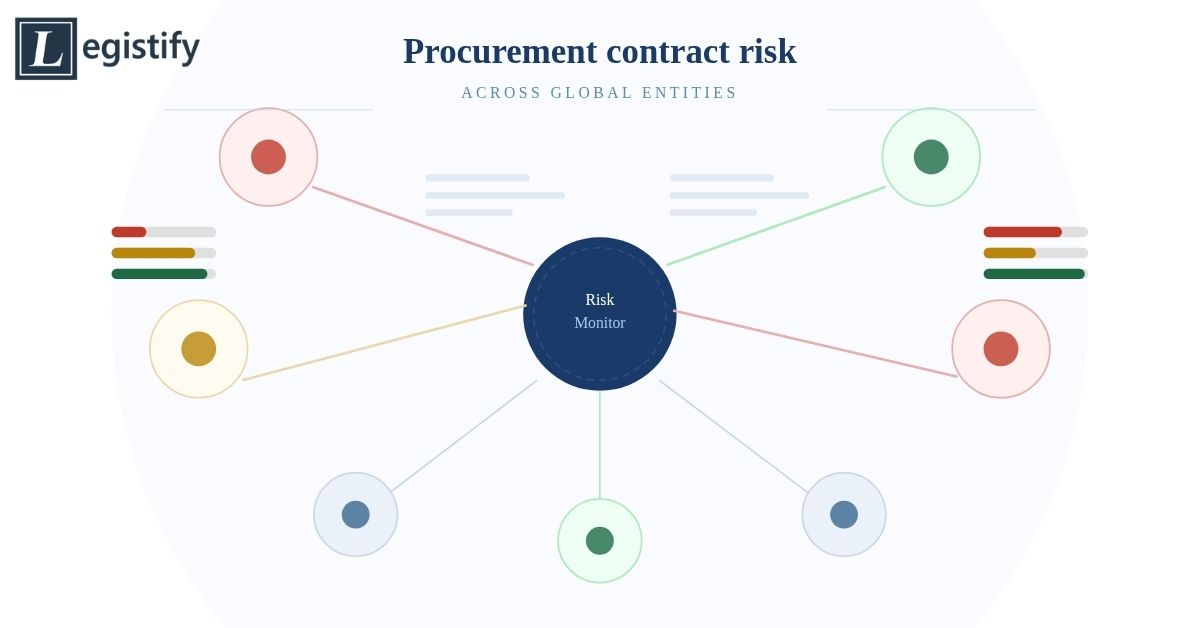
The specific risk categories that matter most for Indian enterprises with global entities include regulatory compliance risk, supplier concentration risk, obligation tracking risk, and financial exposure from contractual commitments.
Category 1: Regulatory Compliance Risk
Indian enterprises face one of the most demanding regulatory environments for procurement in the world. MSME payment obligations, GST compliance requirements, import-export regulations, sector-specific rules from RBI and SEBI, and the evolving DPDPA framework all create procurement compliance obligations that are embedded in supplier contracts and need to be managed actively.
MSME payment obligations
The MSME Development Act requires buyers to pay MSME suppliers within 45 days of delivery or acceptance of goods or services. Where payment is delayed beyond this period, the buyer is liable to pay compound interest at three times the bank rate notified by the RBI. For listed companies, delayed payments to MSME suppliers also create disclosure obligations under SEBI’s listing regulations.
For enterprises managing hundreds of supplier contracts across multiple entities, tracking MSME payment obligations manually is not feasible. The risk of inadvertent non-compliance is high, and the financial consequences from compound interest and regulatory exposure are material. Procurement contract risk management in this context requires the ability to identify which supplier contracts carry MSME obligations across the entire portfolio, and to track payment status against the 45-day window.
GST compliance clauses
Supplier contracts in India frequently include GST-related provisions: GST registration requirements for suppliers, GST number inclusion in invoices, input tax credit conditions, and reverse charge mechanism applicability. Where a supplier fails to comply with GST obligations and the buyer loses input tax credit as a result, the financial impact falls on the buyer.
Managing this risk requires contract terms that clearly define GST compliance obligations and remedies for non-compliance, and a monitoring mechanism that tracks supplier GST compliance status against the contract requirements.
Multi-state stamp duty compliance
Supplier agreements executed across multiple Indian states attract stamp duty at rates and instrument classifications that vary by state. An enterprise executing procurement contracts in Maharashtra, Karnataka, Delhi, and Tamil Nadu simultaneously faces four different stamp duty frameworks. Errors in stamp duty classification or execution are a compliance risk that becomes visible only when a document needs to be produced before a regulatory body or court.
Cross-border regulatory risk
For enterprises with international entities, supplier agreements that cross borders involve additional regulatory complexity: foreign exchange obligations under FEMA, transfer pricing requirements, import duties, and in some cases export control regulations. Each of these creates procurement contract risk that is embedded in the agreement and needs to be tracked against regulatory requirements.
Category 2: Supplier Concentration Risk
Supplier concentration risk refers to the financial and operational exposure an enterprise faces when a critical input, component, or service is sourced from too few suppliers.
Geopolitical change is now a constant and should be treated as such by procurement and risk management. Tariffs, export controls, and sanctions may have seemed sudden in 2025, but they should be expected in the years to come. For Indian enterprises sourcing from suppliers in geopolitically exposed regions, the risk that a single supplier’s inability to deliver creates a supply chain failure is real and growing.
The contract management dimension of supplier concentration risk is often overlooked. Procurement contracts define the exclusivity, minimum commitment, and alternative sourcing provisions that determine how quickly an enterprise can respond to a supplier failure. Enterprises with a large number of single-supplier arrangements, minimum purchase commitments that create switching costs, and no alternative sourcing clauses are operationally exposed in ways that the procurement team may not be able to assess without visibility into the full contract portfolio.
A supplier concentration analysis requires the ability to query the contract portfolio: which categories have single-supplier arrangements, what are the minimum commitment obligations that would make switching difficult, which suppliers serve multiple entities within the group, and where does delivery risk on one contract create downstream obligations on another.
For Indian enterprises operating across multiple entities, this cross-entity view is particularly important. A subsidiary’s over-reliance on a single technology supplier may not be visible at the group level if each entity manages its own procurement contracts independently.
Category 3: Obligation Tracking Risk
Procurement contracts create obligations that extend well beyond the point of signature. Payment milestones, delivery schedules, service level requirements, reporting obligations, warranty periods, and renewal notice windows are all commitments that need to be tracked and acted upon.
Organisations using advanced procurement platforms report 15-20% cost savings and 40% faster cycle times compared to those relying on traditional approaches. A significant part of this improvement comes from better obligation tracking: catching missed renewal windows, claiming rebate entitlements that would otherwise expire, and enforcing supplier SLA obligations before they accumulate into performance failures.
The obligation tracking risk for multi-entity enterprises is compounded by the fact that obligations are distributed across many contracts, managed by different procurement teams in different entities, with no centralised visibility. A renewal window that closes on a supplier agreement at one subsidiary may not be visible to group procurement until after the auto-renewal has triggered.
Renewal and termination risk
Many supplier agreements include auto-renewal clauses that renew the contract for a further term unless the buyer serves notice of non-renewal within a defined period. For enterprises with large supplier contract portfolios, tracking these renewal windows manually is not feasible. Auto-renewals that are not intended lock the enterprise into a further commitment at terms that may no longer reflect market rates or the organisation’s requirements.
The reverse also applies. Termination rights that are not exercised within the specified window are often lost. An enterprise that wants to exit a supplier relationship may find that the termination right has lapsed because no one was tracking the notice period.
Rebate and commercial entitlement risk
Volume-based rebates, discount thresholds, and commercial incentives negotiated into supplier contracts are frequently not claimed because no one is tracking progress against the thresholds. The rebate entitlement exists in the contract, but without a system that monitors committed and actual spend against the threshold, the entitlement goes unclaimed.
For large enterprises with significant supplier spend, unclaimed rebates represent a direct financial loss that is invisible without contract data tracking. The inability to track rebate entitlements across a portfolio of supplier agreements is a category of procurement contract risk with direct P&L impact.
Category 4: Financial Exposure from Contractual Commitments
Procurement contracts define financial commitments that need to be visible to the finance function for planning, reporting, and compliance purposes. Minimum purchase commitments, take-or-pay obligations, liability caps and indemnification obligations, and warranty exposure are all embedded in contract language and affect the organisation’s financial position.
For Indian enterprises subject to Ind AS 37, material contingent liabilities from procurement contracts need to be disclosed in financial statements. Indemnification obligations, guarantee commitments, and take-or-pay arrangements that have not been met are all potential contingent liabilities. Without visibility into the contract portfolio, the finance team’s contingent liability estimate is incomplete.
The cross-entity dimension adds further complexity. A group-level guarantee provided in support of a subsidiary’s supplier contract creates a parent-level liability that needs to be captured in the parent’s financial statements. When procurement contracts are managed at entity level without group-level consolidation, these cross-entity liabilities are systematically missed.
A Practical Framework for Managing Procurement Contract Risk
Step 1: Build a complete contract inventory
The starting point for procurement contract risk management is knowing what contracts exist. For multi-entity enterprises, this means consolidating the contract repository across all entities into a single system where the full portfolio is visible.
A complete contract inventory requires more than storage. It requires structured data extraction: which entity holds each contract, which supplier, what category of spend, what is the contract value, when does it expire, what are the auto-renewal provisions, and what are the key obligations. Without this structured data, the inventory is a document store rather than a risk management tool.
Step 2: Classify risk by category and entity
Once the inventory is complete, risk classification identifies where the concentration and compliance risks sit. Which supplier categories have single-source arrangements. Which contracts carry MSME payment obligations. Which contracts have take-or-pay commitments that create downside exposure. Which entities have the highest concentration of contracts approaching renewal without having been reviewed.
This classification does not need to be exhaustive from day one. The highest-value starting point is identifying the tail risks: the contracts with the most significant financial exposure, the shortest renewal windows, and the most complex compliance obligations.
Step 3: Implement automated obligation tracking
The identified obligations need to be tracked automatically, with alerts sent to responsible owners before deadlines are reached. Renewal notice periods, MSME payment deadlines, volume threshold milestones, and SLA review dates should all be tracked in a system that does not rely on manual calendar entries.
For multi-entity enterprises, obligation tracking needs to be consolidated at the group level as well as at entity level. The group procurement function needs to see upcoming obligations across all entities, not just within individual entity views.
Step 4: Connect contract data to financial reporting
The financial commitments in the contract portfolio need to flow to the finance function systematically. Minimum purchase commitments affect cash flow planning. Take-or-pay obligations affect cost forecasts. Contingent liabilities from indemnification clauses and guarantees affect the balance sheet. Connecting contract data to financial reporting is not a one-time exercise. It requires a live feed from the contract system to the financial planning and reporting workflow.
Step 5: Build procurement playbooks by category and entity
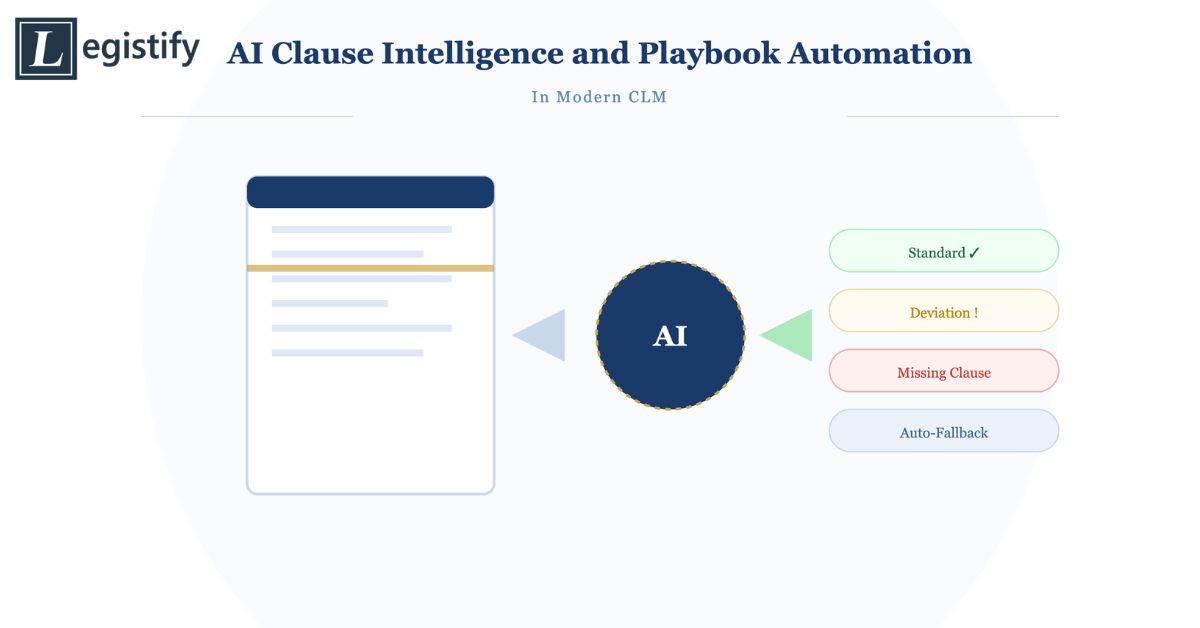
A procurement playbook defines the standard terms, approval thresholds, risk escalation requirements, and mandatory clauses for each procurement category and each operating jurisdiction. For Indian enterprises with entities in multiple states and countries, playbooks need to reflect the specific regulatory requirements of each jurisdiction: MSME provisions for domestic contracts, FEMA requirements for cross-border agreements, and local regulatory obligations for entities in specific sectors.
Playbooks applied consistently across entities reduce the risk of non-standard terms creating unexpected exposure, and make contract review faster because the lawyer knows exactly what to look for and flag.
Legistify’s contract management platform supports multi-entity contract portfolio management, structured data extraction, obligation tracking, and financial reporting integration, designed for the complexity of Indian enterprise legal operations across group structures and regulatory frameworks.
Conclusion
Procurement contract risk for Indian enterprises with global entities is a portfolio management problem as much as it is a legal or procurement problem. The risks are distributed across hundreds or thousands of contracts, managed by teams in different entities, creating exposure that is invisible without consolidated visibility into what every contract contains.
The organisations that manage this risk most effectively in 2026 are those that have moved from contract storage to contract intelligence: extracting structured data from the portfolio, tracking obligations automatically, identifying concentration and compliance risks proactively, and connecting contract data to financial planning and reporting. For multi-entity Indian enterprises, this is not a technology initiative. It is an operational imperative.