Due diligence sits at the centre of every merger, acquisition, partnership or investment. Before a deal closes, organisations must examine contracts, financial records and operational data to flag risks early.
This work has traditionally been slow and resource heavy. AI due diligence changes that by reviewing documents faster, widening coverage and surfacing risks that manual review often misses.
What is AI Due Diligence?
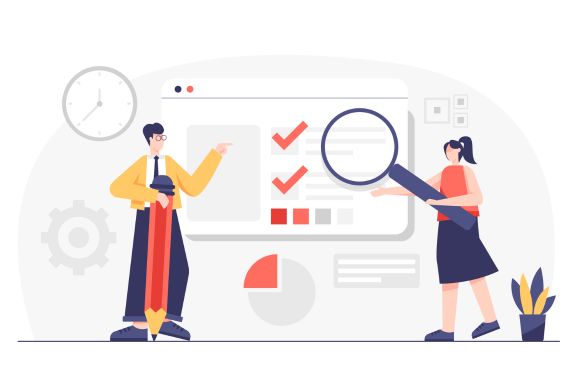
AI due diligence is the use of technologies such as machine learning and natural language processing to analyse documents and data during a business transaction.
Traditional due diligence relies on manual review, and time pressure usually limits that review to a small sample of the total document set, often just 5 to 10 percent. AI removes this constraint by reviewing every document in the dataset, giving organisations a complete view of obligations, liabilities and potential deal risks.
Common use cases include:
- Mergers and acquisitions
- Private equity investments
- Partnership evaluations
- Contract reviews
- Regulatory investigations
With AI handling the bulk of document review, legal and financial teams spend more time on interpretation and strategy instead of manual extraction.
Why Traditional Due Diligence Falls Short
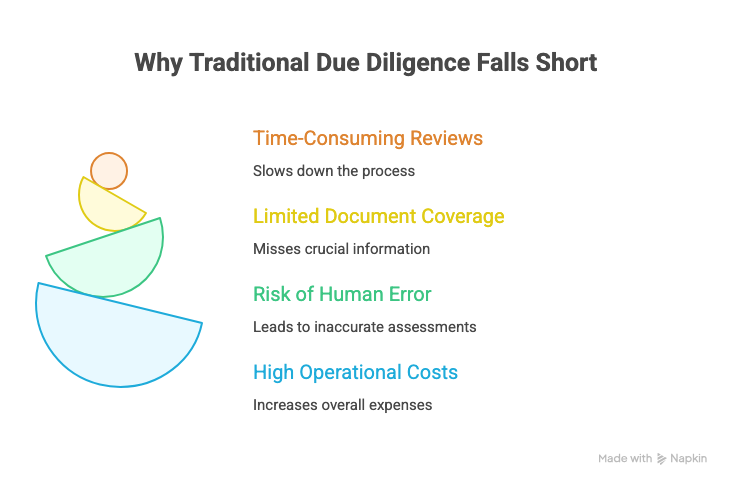
Traditional due diligence was built for a time when deal documentation was far smaller in volume. Today’s contract and data volumes have exposed several gaps in that approach.
The scale involved makes the problem clear. A mid-sized M&A transaction can generate anywhere from 50,000 to 100,000 documents, and larger deals run into the millions. Traditional due diligence timelines typically stretch across a minimum of 60 days, with total M&A transaction costs, including due diligence, commonly running 1 to 4 percent of the overall deal size. At that scale, a purely manual review is not just slow, it becomes structurally unable to examine everything that matters.
Time-Consuming Reviews
Lawyers, analysts and consultants must review contracts and financial reports one at a time. For large deals involving thousands of documents, this process can stretch across weeks or months.
Limited Document Coverage
Time constraints push teams towards sampling rather than full review. A sample may represent the broader set reasonably well, but it also risks missing details buried in the documents left unreviewed.
Risk of Human Error
Reviewer fatigue sets in with high document volumes, and different reviewers can interpret the same clause differently, creating inconsistency across a review.
High Operational Costs
Large review teams of lawyers and financial experts come at a price, and the time they spend on manual review adds directly to deal costs.
These limitations are exactly what pushed AI-based tools into the due diligence workflow.
How AI Due Diligence Works
AI due diligence tools combine machine learning and natural language processing to automate several stages of document review.
Data Ingestion and Organisation
AI tools ingest documents directly from a virtual data room or repository, then sort them by type, contracts, invoices, compliance records, and flag duplicates or gaps. This removes much of the manual sorting that normally precedes a review.
Intelligent Data Extraction
Natural language processing lets these tools pull specific data points out of complex contracts, including:
- Payment obligations
- Termination clauses
- Indemnity clauses
- Liability caps
- Service-level agreements
- Renewal terms
This makes searching and filtering across a large contract set far quicker than manual review.
Cross-Contract Analysis
AI can compare terms across an entire portfolio at once, picking up on inconsistencies such as:
- Differing pricing structures
- Differing liability limits
- Inconsistent termination provisions
- Differing service obligations
These patterns are easy to miss when contracts are reviewed individually.
Predictive Analytics
Some platforms also apply predictive analytics to flag risks and trends likely to emerge after the deal closes, including:
- Customer churn risk
- Vendor performance risk
- Regulatory exposure
- Bidder engagement risk
This gives organisations a forward-looking view before a deal is finalised.
Key Benefits of AI Due Diligence
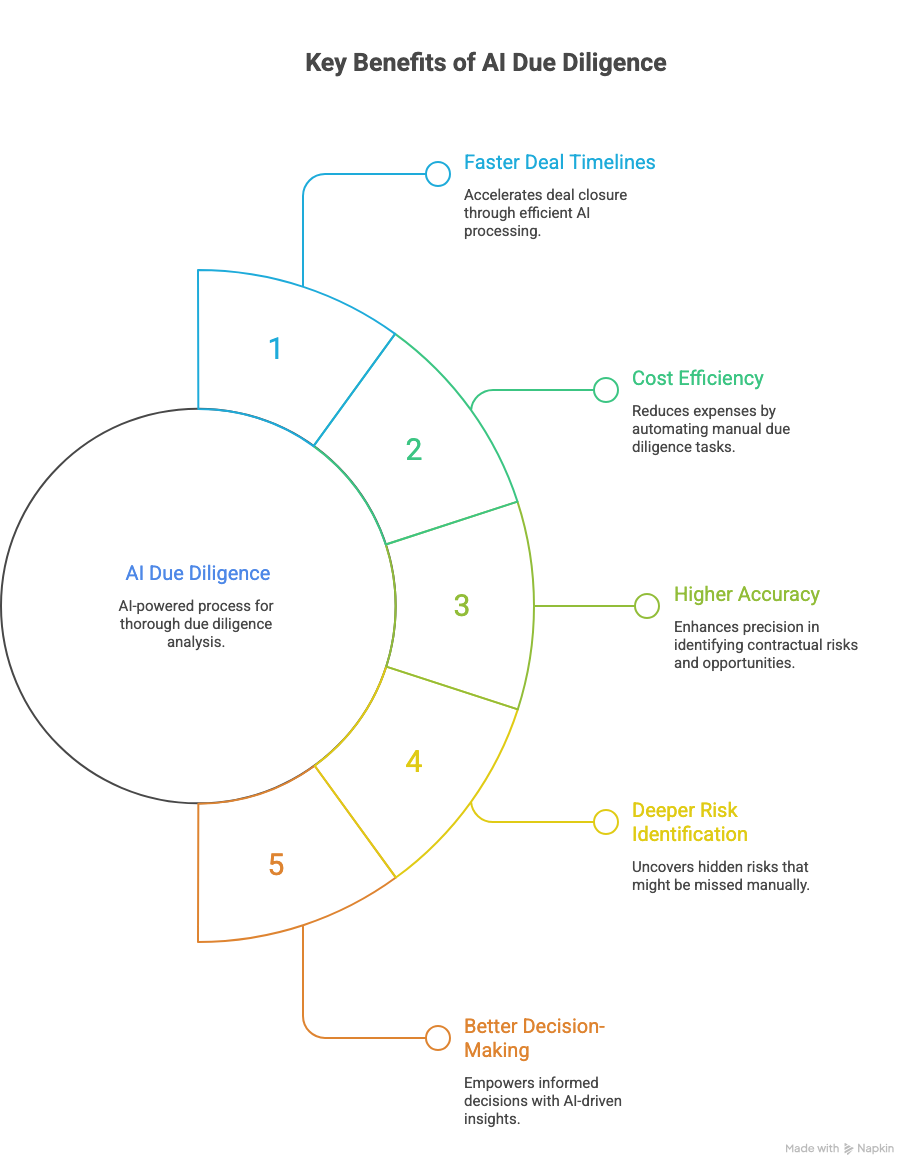
Faster Deal Timelines
Reviews that once took weeks can now be completed in hours or days, helping organisations move quickly in competitive deal environments.
Cost Efficiency
Less time spent on manual document assessment means lower overall review costs and more team capacity for strategic work.
Higher Accuracy
AI applies the same rules to every document without fatigue, reducing the chance that a risk or obligation gets missed.
Deeper Risk Identification
Full document coverage means AI-based reviews often surface significantly more issues than sample-based manual reviews.
Better Decision-Making
Structured reports let leadership review key issues directly, rather than working through thousands of pages themselves.
AI Due Diligence Checklist: Key Areas to Investigate
When evaluating an AI system as part of due diligence, or using one to conduct it, look closely at the following areas.
Data Governance and Training Data
Check where the system’s training data came from and whether it was lawfully obtained, properly licensed and free from bias.
Algorithm Performance and Scalability
Confirm whether the tool is a finished product or still a prototype, and whether it performs reliably at scale.
Regulatory Compliance
Review compliance with data privacy and AI governance requirements relevant to the industry and jurisdiction involved.
Intellectual Property Ownership
Establish clear ownership of the models behind the AI system to avoid disputes later.
Security and Data Protection
Assess encryption, access controls and how sensitive information is handled during processing.
Human Oversight
Confirm there is a clear process for human review, so findings are interpreted within the wider business context rather than taken at face value.
Traditional vs AI-Powered Due Diligence
Traditional due diligence depends almost entirely on manual document review, an approach that struggles to keep pace with today’s document volumes.
AI-powered due diligence reviews the entire document set rather than a sample, analyses large volumes quickly and identifies patterns and risks across contracts that manual review would likely miss.
Challenges of AI Due Diligence
AI due diligence is not without limitations. It cannot replace the judgment that legal and financial professionals bring to complex deals. In practice, the most effective deal teams treat this as a division of labour rather than a substitution: AI handles the “what” at scale, surfacing every relevant clause and inconsistency across the full document set, while human reviewers handle the “so what” and the “what now”, interpreting findings within the wider commercial and strategic context of the deal.
Output quality also depends on input quality, poorly scanned or low-quality data can affect accuracy. Organisations should additionally watch for “AI washing,” where a tool is marketed as AI-powered without the underlying capability to back that claim. Data security and privacy remain critical throughout, given the sensitivity of the corporate information involved.
Best Practices for Implementing AI Due Diligence
Treat AI as a complement to professional judgment rather than a replacement for it. Review the full document set where possible, since AI removes the need for sampling. Tailor the AI model to the specific transaction and its risk framework. Choose tools that explain their reasoning, so reviewers understand why a document or clause was flagged.
How Legistify Supports AI-Powered Due Diligence
Legistify combines contract management with AI-powered analytics to support due diligence at scale. The platform automatically extracts key contract information, including payment terms, liability conditions, termination clauses and renewal terms, giving deal teams clearer visibility into the documents they are reviewing and the risks attached to them.
The Future of AI in Due Diligence
As data volumes keep growing, AI’s role in due diligence will only expand. Advances in natural language processing and machine learning will support deeper analysis of legal, financial and operational data, while tighter integration with contract lifecycle management and enterprise data systems will let organisations monitor risk continuously rather than only at the point of a transaction. That shift should let companies move on opportunities faster, with a clearer view of the risks involved.
Conclusion
AI is reshaping due diligence through faster analysis, wider risk coverage and clearer insight into deal documents. Paired with human expertise, it gives deal teams a faster and more reliable way to investigate transactions before they close.