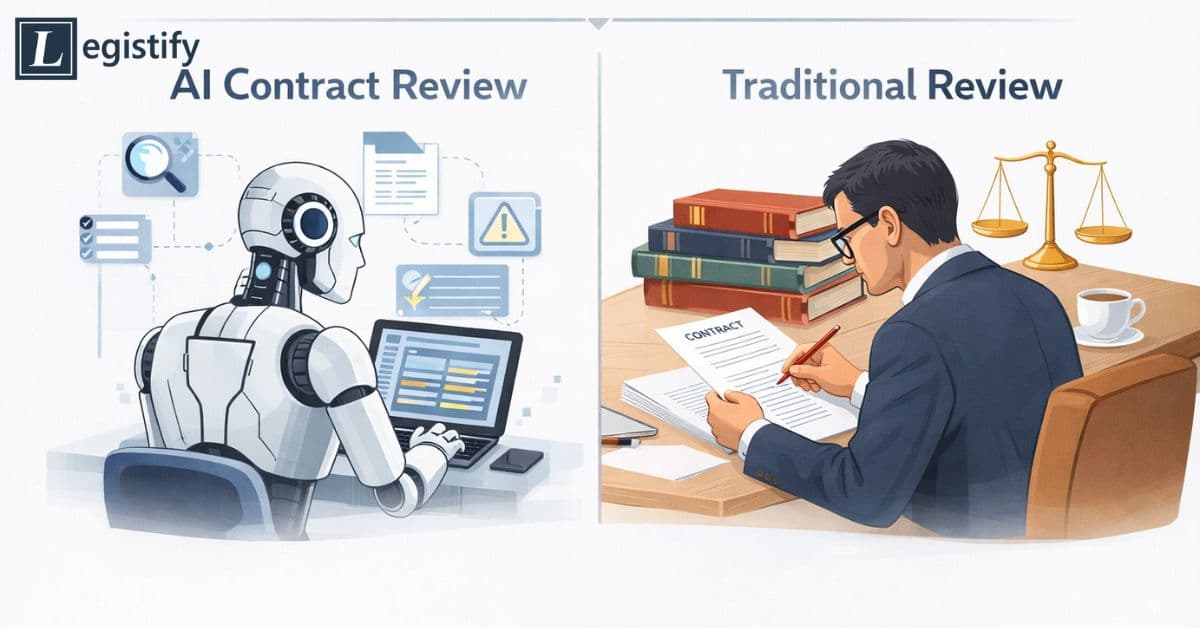
One of the most important, yet time-consuming, tasks for legal teams is contract reviews. This is especially true for businesses with a growing number of contracts, ranging from NDAs to vendor contracts. Manually reviewing each contract can be a laborious task for legal teams.
The emergence of AI-powered contract reviews is revolutionizing the way legal teams approach contract reviews. Although technology is a great enabler, traditional manual contract reviews also have a place in complex legal decisions. Knowing the strengths and limitations of both approaches can help businesses determine the best approach for managing contracts.
What is an AI Contract Review?
AI contract review is a process in which technologies such as machine learning and natural language processing are used to review and analyze contracts. Instead of reading and analyzing each clause in a contract, AI technologies review contracts and identify important provisions.
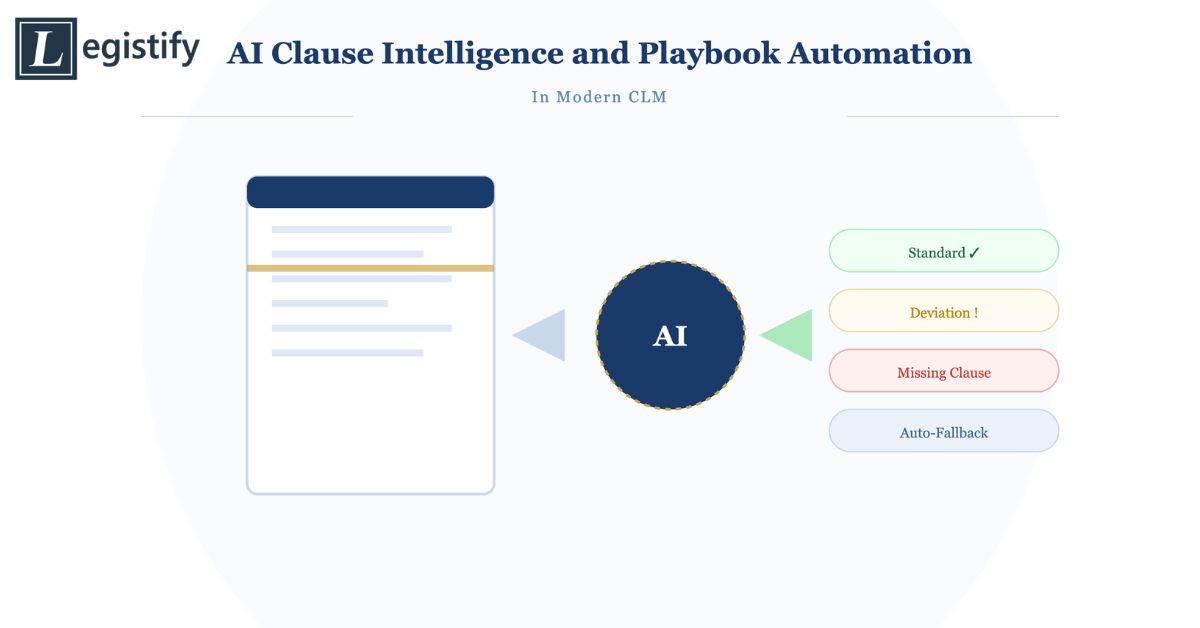
AI contract review tools have been developed to perform various functions in analyzing contracts, such as:
- Extracting clauses and important terms
- Identifying deviations from standard template contracts
- Flagging risky and unusual provisions
- Identifying missing provisions
- Summarizing important provisions in a contract
One of the most important benefits that AI-powered reviews have is that they can be processed in a matter of minutes. This means that legal teams can process contracts in much less time compared to traditional methods.
For instance, organizations may have to deal with hundreds of vendor contracts or NDAs every month. AI tools can be used to speed up the process by automatically reviewing the documents. This ensures that legal teams do not have to spend time reviewing irrelevant sections.
Another important benefit that AI-powered reviews have is that they can be used to increase visibility. This is because AI tools can be used to extract information from contracts.
What is Traditional Contract Review?
Traditional contract review is a process where legal experts manually review contracts. Here, lawyers read all the clauses of a contract, assessing possible risks, checking compliance, and ensuring that all contractual provisions are aligned to business needs.
This is not just about reading a contract. A lawyer is analyzing all legal and business implications of every clause while taking into account all aspects of a contract.
Common tasks involved in manual contract reviews include:
- Evaluating liabilities and risks
- Understanding legal language and legal definitions
- Negotiating contractual terms with parties
- Compliance with legal requirements
- Providing advice to parties regarding contractual obligations
Unlike automated tools, human contract reviews can take into account nuanced differences in language and the overall impact of contractual terms in relation to business strategy or industry requirements.
However, manual reviews can be time-consuming. Long contracts or large volumes of contracts need lawyer hours, which can be a cost factor.
Despite the challenges in manual reviews, they are critical for contracts that need strategic reviews or negotiation expertise.
AI Contract Review vs Traditional Review: Key Differences
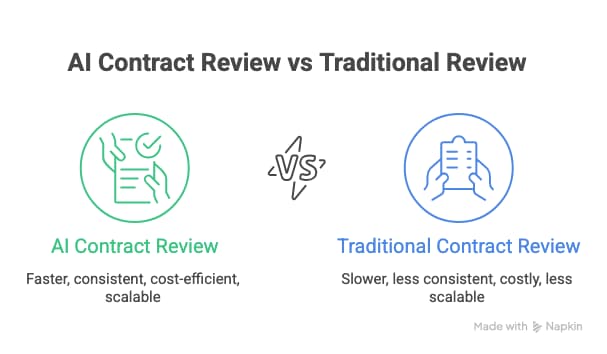
There are a number of differences between AI and traditional contract reviews, especially in relation to speed, consistency, cost efficiency, and scalability.
Speed
Industry benchmarks show AI can review contracts 60 to 90 percent faster compared to traditional methods, a range consistently reported across enterprise deployments. This is because AI does not have to go through the entire contract line by line but rather reviews the entire document and instantly recognizes relevant clauses or potential problems.
In traditional contract reviews, legal professionals have to carefully scrutinize the contract. Although this ensures a better understanding of the contract, it may take longer, especially if dealing with many contracts at once.
Consistency and Accuracy
Because AI tools apply the same review parameters to every document, they tend to be significantly more consistent than manual review at scale. Benchmark testing on standard clause identification, covering categories such as indemnification, limitation of liability, governing law, and termination, has found AI tools reaching 94 to 97 percent accuracy, compared to roughly 80 percent for experienced lawyers reviewing the same contracts.
Human reviewer accuracy also tends to drop further under time pressure or when reviewing large volumes of repetitive documents, which is precisely where AI’s consistency advantage matters most.
Cost Efficiency
Contract analysis is a common process, which can be time-consuming for the legal profession as a whole. When lawyers are spending hours poring over basic contracts, this could be time taken away from more important tasks.
AI can help reduce these costs as it can help automate the process, allowing lawyers to focus on the contracts that need negotiations, as opposed to simply reading through all the contracts.
Scalability
Additionally, AI systems are able to review thousands of contracts at once without requiring more human resources. This is one area where AI systems are quite useful, especially for big companies or industries with high contract volume.
On the other hand, the traditional way of reviewing contracts scales less efficiently. This is because it requires more human resources. If the number of contracts increases, more lawyers may be required.
When AI Contract Review Works Best
The effectiveness of AI contract review is enhanced in cases where an entity is required to deal with a number of contracts. This is because the majority of business contracts are similar and are drawn in a similar pattern. For instance:
Most business contracts are similar and drawn in a similar pattern. For instance:
- Non-Disclosure Agreements (NDAs)
- Vendor and Supplier Agreements
- Master Service Agreements (MSA)
- Software as a Service (SaaS) and Licensing Agreements
- Procurement Agreements
In these situations, an AI system can conduct an initial analysis of the contracts and identify clauses that demand legal attention. This minimizes the legal team’s time spent searching through contracts.
Another area where AI is useful is in contract due diligence. When an organization is involved in a merger, acquisition, or audit, it may be required to go through a large number of contracts within a specific timeframe. An AI system can assist by extracting specific data points from the contracts, for example, termination clauses, renewal dates, etc.
This helps organizations effectively go through a large number of contracts without losing any crucial information.
Limitations of AI Contract Review
While AI systems offer significant benefits in speed and efficiency, there are still limitations.
One such limitation is in understanding context and business intent.
Contracts often include language that requires interpretation based upon a broader business relationship between two parties.
Another limitation is in understanding nuanced language.
For example, legal language may vary by a word or two and have significant legal implications.
Similarly, the tools rely on the training data and the rules provided. However, if the rules provided are not adequate or not correctly set, the tools may not adequately identify the potential risks.
Based on the above factors, it is imperative to note that the role of AI in the legal profession is not to replace the legal practitioners but to act as a tool.
When Traditional Contract Review Is Essential
Manual contract review is still essential in cases where the contract needs deeper legal knowledge and negotiations.
Some cases where traditional review is important include:
- Complex business contracts
- Customized contracts
- Valuable contracts
- Strategic contracts
- Litigation contracts
In these cases, the lawyer must examine the agreement, as well as the business and legal implications of the clauses.
Negotiation skills are another asset that human reviewers possess, which AI systems are unable to offer. In the process of contract negotiations, the lawyer must weigh the need for legal protection with the need for business considerations, which calls for strategic thinking.
For contracts with high risk or financial value, human judgment is still essential.
The Hybrid Approach: Combining AI and Human Expertise
Many legal teams today are shifting towards a hybrid approach for contract reviews.
In this system, AI is used for efficient contract analysis, whereas human lawyers are used for high-level tasks.
The steps in a hybrid system for contract reviews are as follows:
- Perform the first pass contract analysis using AI
- Identify the clauses and highlight the potential risks using AI
- Review the flagged sections and validate the output using human lawyers
- Negotiate the contracts using legal teams
Such a system enables the streamlining of day-to-day contract analysis for the business while still allowing for legal oversight in areas where it matters the most.
This approach is also backed by measurable outcomes. Research from Deloitte found that organisations using a structured human-in-the-loop review process saw 34 percent fewer post-signature disputes compared to a fully manual review baseline, and 23 percent fewer disputes than organisations that had removed human review almost entirely. In other words, the hybrid model does not just save time, it produces better contract outcomes than either extreme on its own.
AI helps lawyers reduce the time they spend doing repetitive document analysis, also known as “document archaeology.” Estimates from Gartner suggest AI can reduce manual labour in the contract review process by around half, freeing legal teams to focus on negotiation and strategic judgment.
How Legal Teams Can Implement AI Contract Review
Organizations that are interested in exploring AI contract reviews should first identify areas where such reviews can bring maximum value to their organization.
A step-by-step implementation plan to use AI contract reviews can be as follows:
Identify high-volume contracts
Identify which contracts are reviewed most often, such as NDAs or contracts with vendors.
Automate routine reviews
Use AI tools to conduct first-pass reviews of standardized contracts.
Build clause libraries and review rules
Set up the system to include contract templates and predefined risk flags to help achieve better results.
Train legal teams on AI-assisted workflows
Educate legal professionals on how to effectively use AI contract reviews to make better decisions.
Maintain human oversight
While AI can help legal professionals make better contract reviews, it is important to maintain human involvement in contract reviews.
This will help in efficiently incorporating AI into the process of contract management without compromising legal accuracy.
Conclusion
AI in contract review ensures efficiency in the process, and traditional contract review ensures legal judgment and strategic insights. The most efficient legal department will be one that incorporates both AI and traditional contract review methods into its decision-making process.