The headcount problem facing Indian GCs in 2026 is structural, not temporary. Demand for legal work keeps rising: regulatory complexity is growing, commercial portfolios are expanding, litigation volumes are high, and the business expects the legal function to be a strategic partner rather than a cost centre. At the same time, the 2026 CLOC State of the Industry Report found that only 32% of legal departments expect attorney headcount to grow. Budgets are flat. Hiring freezes are common.
The result is a gap that cannot be closed by working harder. Indian enterprise legal teams are already working hard. The gap between what the legal function is expected to deliver and what it can deliver with current resources requires a different approach: doing more of the work without adding people to do it.
This is not a theoretical problem. It is the operational reality that most Indian GCs are managing right now. And there are concrete, practical ways to address it that do not require waiting for a budget approval for additional headcount.
The Indian GC’s Specific Capacity Challenge
Before covering solutions, it is worth being precise about what makes the Indian GC’s capacity challenge distinct from the general in-house legal team capacity challenge.
Indian enterprise legal teams operate across a regulatory environment that is simultaneously more demanding and more dynamic than most comparable markets. The DPDPA, RBI’s digital lending directions, IRDAI’s fraud monitoring framework, SEBI’s listing obligations, multi-state GST compliance, Companies Act requirements: each of these generates legal work. And each of them changes, through notifications, circulars, amendments, and judicial interpretations, at a pace that keeps the compliance function continuously occupied.
India’s court system generates high litigation volumes by any international comparison. A large Indian enterprise may manage dozens of active cases simultaneously across the Supreme Court, High Courts, District Courts, NCLTs, consumer forums, and tribunals in multiple states. This is not a transient situation. It is a permanent feature of operating at scale in India, and it consumes real legal team capacity.
Indian contracts have India-specific complexity: multi-state stamp duty requirements, MSME payment obligations, regulatory clause requirements, and a large volume of standard agreements across commercial relationships that are managed differently across different geographies and business units.
The GC who is managing all of this with a team of three or four lawyers, plus external counsel for specialist matters, is doing the work of a significantly larger team. The question is how to multiply that team’s output without multiplying its size.
Strategy 1: Automate the High-Volume, Low-Judgment Work
The first strategy is to identify the work that consumes the most time but requires the least legal judgment, and automate it.
In most Indian enterprise legal teams, this category includes:
Standard contract generation. NDAs, vendor agreements, standard service agreements, employment offer letters, and other high-volume contract types that follow predictable structures. When these are generated from approved templates with the right parameters filled in, a lawyer does not need to draft them. The time saving from template-driven contract generation for a legal team processing hundreds of standard contracts per month is substantial.
Contract approval routing. Contracts that follow standard terms above certain value thresholds require a defined approval sequence. Automating this routing, rather than managing it through email, eliminates the administrative overhead of tracking where a contract is in the approval process and chasing approvers who have not responded.
Court date tracking. Checking cause lists for hearing dates across multiple courts is a high-volume, zero-judgment task that automation handles more reliably than manual checking. Automated litigation tracking, integrated with Indian court systems, eliminates this from the legal team’s workload entirely.
Obligation alerts. Tracking contract renewal dates, regulatory compliance deadlines, and SLA review windows through a spreadsheet is administrative work. Automated obligation tracking delivers the same output without the administrative overhead.
As businesses accelerate, contract volumes scale exponentially, driven by more vendors, more partners, and more complex customer demands. Yet legal headcount remains largely flat. The traditional solution of working harder has hit a wall.
Automation does not eliminate legal judgment from the legal team’s work. It eliminates the administrative scaffolding that surrounds legal work, so that the lawyer’s time is spent on the work that actually requires their expertise.
Strategy 2: Use AI to Extend Each Lawyer’s Capacity
With 87% of legal departments now using generative AI (up from 44% in 2025), the what and how of daily legal work has dramatically shifted. For Indian GCs, the most immediately valuable AI applications are in contract review, legal research, and document drafting.
AI contract review applies the legal team’s approved playbook to incoming contracts automatically, flagging deviations from standard positions, identifying non-standard clauses, and scoring overall risk. A lawyer reviewing an incoming vendor agreement using AI assistance spends their time on the flagged deviations rather than reading the entire document. For a legal team reviewing dozens of incoming contracts per month, the time saving per contract compounds into real capacity gains.
One CLO at Zone & Co. described the effect precisely: his team of three lawyers was producing the work of five or six after adopting AI tools. A GC AI study of more than 100 active customer teams found 14 hours saved per lawyer per week, roughly a 35% reduction in time spent on the work AI now handles. At that rate, a team of three lawyers effectively has the capacity of four and a half.
For Indian GCs, the AI tools that deliver the most capacity benefit are those trained on Indian legal data and Indian contract conventions. Generic AI tools trained on Western contracts require more verification on Indian agreements, which partially offsets the efficiency gain. India-specific AI review, applied to Indian contracts with Indian regulatory clause types, produces higher-quality output with less verification overhead.
AI legal research reduces the time lawyers spend on regulatory research and precedent analysis. For a function that deals with the breadth of Indian regulatory frameworks, the ability to query regulatory developments, identify relevant case law, and synthesise legal positions quickly rather than through manual research produces real capacity gains.
AI drafting accelerates the production of contract language, legal opinions, and internal communications that follow predictable structures. This is not a replacement for lawyer judgment on complex matters. It is an acceleration of the production step on routine ones.
Strategy 3: Build a Self-Service Layer for Business Teams
A significant portion of the legal team’s workload in most Indian enterprises consists of questions and requests that do not require a lawyer to handle if the right infrastructure exists.
Contract requests that follow a defined template and fall within standard parameters. Approval requests for agreements that meet the standard terms. Questions about whether a specific action is permitted under the company’s standard contractual commitments. Regulatory questions about well-established frameworks.
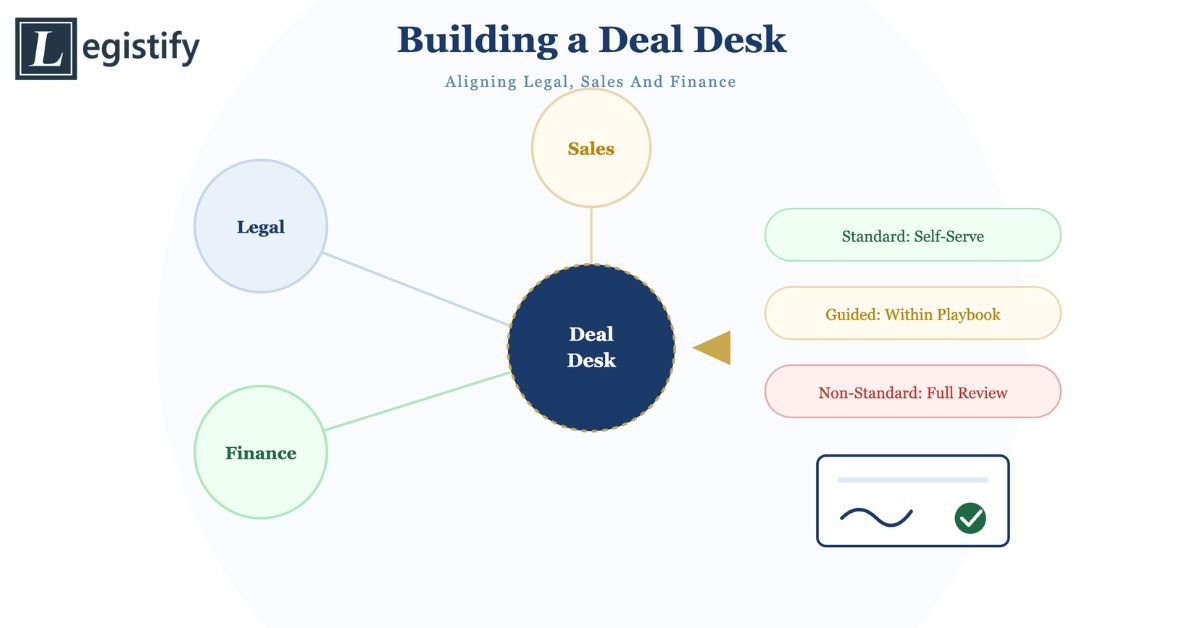
When the legal team handles these individually, one at a time, through email, they are a constant interruption. When the legal team builds a self-service layer, consisting of a contract request portal, a searchable contract repository, approved FAQ resources, and defined thresholds below which business teams can proceed without legal review, a significant portion of this workload is handled without the lawyer’s direct involvement.
The self-service layer does not eliminate legal risk. It concentrates legal attention on the work that actually needs it. Standard requests are handled through the system. Non-standard requests, high-value agreements, and regulatory matters are escalated to the lawyer.
For Indian enterprise legal teams managing intake from multiple business units across different geographies, a structured intake process also produces data: the volume and type of requests across the organisation, the cycle time for different request types, and the business units that generate the highest legal workload. This data is the basis for a resource allocation conversation with leadership that is grounded in evidence rather than anecdote.
Strategy 4: Manage External Counsel More Strategically
External legal spend is one of the most significant and most opaque cost items in the enterprise legal budget. For Indian enterprise legal teams, it is also one of the most significant sources of capacity: external counsel handles the work that the internal team does not have capacity for.
The question is whether that external spend is deployed effectively. Most Indian enterprise legal teams have panel arrangements with advocates across different forums and jurisdictions. But the data to assess whether the right matters are going to the right advocates, whether spend is concentrated in a way that creates risk, and whether performance is consistently tracked is rarely organised and available.
Strategic external counsel management frees internal legal capacity by ensuring that the matters external counsel handles are genuinely beyond internal capacity, not just familiar or urgent. It also reduces the administrative overhead of briefing, tracking, and billing external counsel, which in many legal teams consumes considerable lawyer time.
Stage-linked billing, where advocate payments are tied to defined case milestones rather than time spent, connects payment to progress and makes it easier to identify matters where external counsel costs are accumulating without corresponding case movement. This financial discipline is also a capacity tool: when external counsel is managed against outcomes rather than activity, the internal team spends less time on oversight and invoice review.
Strategy 5: Report on Legal Team Capacity to Leadership
Scaling a legal team without adding headcount requires visibility into what the team is actually doing and what the capacity ceiling is. Most Indian GCs manage legal team capacity informally, based on observation and individual workload conversations. This makes it difficult to make a data-backed case to leadership for investment in technology, process improvement, or, when genuinely necessary, additional headcount.
Legal operations metrics change this. When the legal team tracks contract cycle time, matter throughput per lawyer, external counsel spend against budget, compliance deadline hit rate, and case portfolio size, the GC has data that tells a specific story about capacity and output. When cycle time increases as volume grows, the data shows why. When throughput per lawyer improves after a technology implementation, the data shows the return on investment.
Legal ops is the reason a GC can report to the CFO with evidence rather than anecdote. This is not just about managing up. It is about having the information to make better decisions about where the legal team’s capacity goes, which matters are worth the cost of external counsel, and which technology investments will produce the most capacity return.
What This Looks Like in Practice for an Indian Enterprise GC
Consider an Indian enterprise GC managing a legal team of four lawyers, covering contracts, litigation, compliance, and general legal support for a mid-size conglomerate with operations across five states.
Without structured legal operations:
- Contract approval takes 3 to 4 weeks because approval routing is managed through email
- Court dates are tracked manually across spreadsheets maintained by two paralegals
- Standard contract requests arrive as emails and are handled in the order they arrive
- External counsel bills are reviewed and approved by the GC personally
- Compliance deadlines are tracked by individual lawyers who are responsible for their own areas
With structured legal operations:
- Standard contract approvals complete in 3 to 5 days through automated routing
- Court dates are tracked automatically with alerts 7 days before each hearing
- Standard contract requests go through an intake portal with predefined templates for standard types
- External counsel billing is managed through stage-linked billing with automated tracking
- Compliance obligations are tracked centrally with automated alerts to responsible owners
The same four lawyers are now managing a considerably higher volume of work with less administrative overhead. The GC’s attention is on matters that require GC-level judgment: complex negotiations, high-stakes litigation, regulatory engagement, and board-level risk reporting. Not on following up on email approvals or checking whether a hearing date has been updated.
Legistify’s legal operations platform supports this model for Indian enterprise GCs, with contract management, litigation tracking, notice management, and obligation monitoring integrated in a single system that is built for the regulatory and operational context of Indian enterprise legal teams.
Conclusion
Scaling a legal team without adding headcount is not about making lawyers work more hours. It is about removing the administrative overhead that prevents lawyers from doing legal work, using automation and AI to extend the capacity of each lawyer, building self-service infrastructure that handles standard requests without direct legal involvement, and managing external counsel strategically rather than reactively.
For Indian GCs operating in one of the most demanding legal environments in the world, the gap between what the legal function is expected to deliver and what a flat or frozen headcount can deliver is real and growing. The technology and the operational frameworks to close this gap are available. The GCs who invest in them are the ones who will be positioned to lead strategic legal functions, not just manage workload.