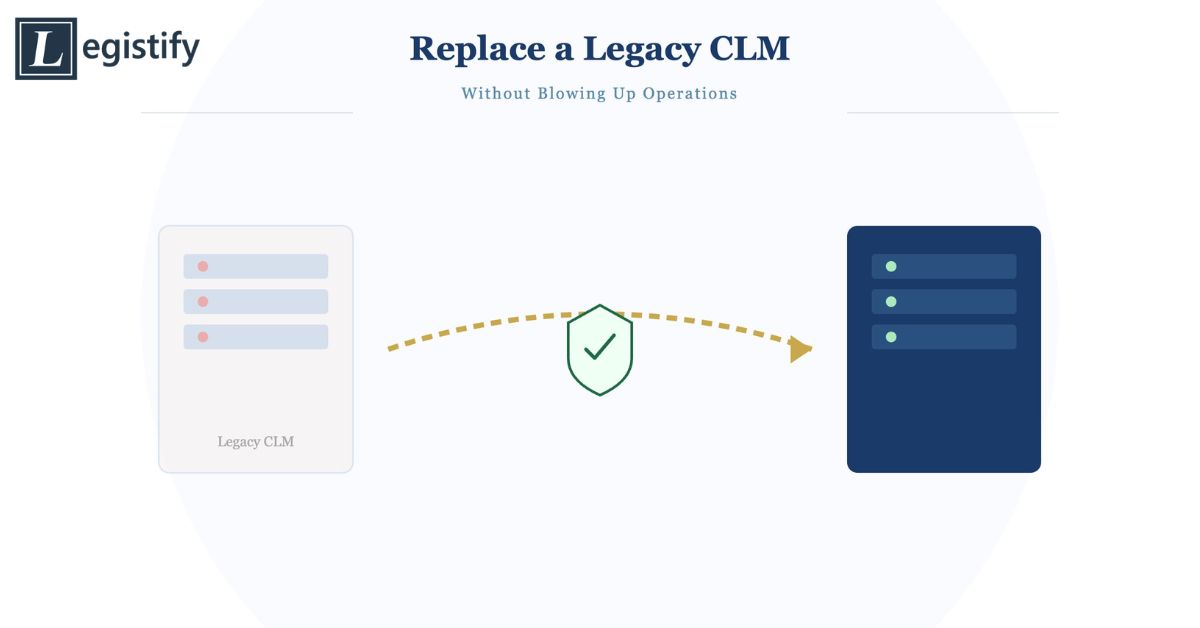
Replacing a contract lifecycle management system is one of the highest-risk technology transitions a legal team will undertake, not because the new software is complicated, but because the old system is holding live, active business. Contracts currently mid-negotiation, obligations counting down to a renewal date, and a legal team that has built years of institutional habit around the existing tool are all sitting inside the system you are about to switch off. Get the transition wrong and you do not just lose efficiency; you risk a missed renewal, a lost audit trail, or a deal that stalls because nobody can find the latest version of a contract during the changeover.
This guide sets out a practical, phased approach to replacing a legacy CLM that protects live operations throughout the migration, rather than treating the switch as a single, high-stakes weekend cutover.
Why “Rip and Replace” Is the Default, and Why It Is Risky
The most common approach to changing CLM platforms is what the industry generally calls “rip and replace”: removing the old system and standing up the new one, often within a relatively short timeframe. This strategy is common because it is conceptually simple and because most organisations are switching precisely because the old system has become genuinely unworkable, so there is little appetite to run two systems in parallel any longer than necessary.
The risk with rip and replace is not the strategy itself; it is executing it without the specific safeguards that prevent operational disruption during the transition window. A legacy platform has old data formats, business logic embedded in years of custom configuration, and workflows that the legal, sales, and procurement teams have built muscle memory around. Migrating this without careful handling is genuinely vulnerable to errors, data gaps, and the kind of unplanned interruption that halts regular contracting activity mid-transition.
The organisations that switch CLM platforms successfully do not avoid rip and replace; they de-risk it through careful sequencing, thorough preparation, and validation at every stage before the final cutover happens.
Step 1: Audit Everything Before You Touch Anything
Before any migration activity begins, the legal team needs a comprehensive inventory of what actually exists in the legacy system: every contract, catalogued by type (NDAs, vendor agreements, customer contracts, employment agreements), current status (active, expired, archived), and storage location, since legacy contracts are rarely all sitting in one place; some may be in the CLM itself, others in shared drives, email archives, or even physical files that were never digitised.
This audit should also capture the metadata fields the organisation actually relies on: which data points (often called smartfields) need to carry forward, such as contract value, renewal date, counterparty, and any custom fields specific to the organisation’s own workflows. Cataloguing this upfront, rather than discovering gaps mid-migration, determines whether the new platform will actually give the legal team the visibility it was purchased to provide.
Step 2: Clean Data Before It Moves, Not After
Cleaning up contract data before migration is one of the highest-leverage steps in the entire process, and one of the most commonly rushed. Moving inaccurate, duplicated, or incomplete data into a new platform does not fix the underlying data quality problem; it simply gives the organisation a more expensive, better-looking version of the same unreliable dataset.
This means resolving duplicate contract records, deciding which older or superseded versions of a document are actually the governing copy, standardising inconsistent naming conventions and metadata tagging, and identifying which legacy contracts are genuinely still active versus which have lapsed and can be archived rather than actively migrated. For a large enterprise, this cleanup phase is frequently where most of the calendar time in a migration project actually goes, and reducing this phase to save time is one of the most common causes of a migration that technically completes but leaves the legal team with an unreliable new system.
Before configuring the new CLM, the team should explicitly identify the pain points, bottlenecks, and missing functionality in the current system that the new platform needs to address. This sounds obvious, but skipping it is a common failure mode: teams migrate to a new platform and simply recreate their old workflows inside it, carrying forward the same inefficiencies in a new interface rather than actually solving the problems that motivated the switch in the first place.
This step should produce a specific list: what approval bottlenecks need to be fixed, what integrations were missing, what reporting the legal team could never get out of the old system, and what the measurable success criteria for the new platform will be. This list becomes the basis for configuration decisions later, rather than defaulting to whatever the new vendor’s out-of-the-box setup happens to look like.
Step 4: Choose a Migration Strategy That Matches Your Risk Tolerance
Not every organisation needs the same migration approach, and the right strategy depends on risk tolerance, the volume of active contracts, and how tightly the legacy system’s workflows are embedded in day-to-day business operations.
Phased execution over a “big bang” cutover. Rather than switching every contract type and every team over simultaneously, move systems and contract categories in smaller, manageable groups. This phased approach allows for continuous testing, validation, and correction along the way, and ensures that if something goes wrong, the blast radius is contained to one contract category or business unit rather than the entire organisation’s contracting activity.
Parallel running during the transition window. For a defined period, run the new system alongside the legacy platform rather than switching off the old one immediately. New contracts move into the new system; existing active contracts remain visible and manageable in the legacy platform until they are either completed or successfully migrated. This adds short-term complexity but removes the single point of failure that a hard, immediate cutover creates.
Scheduling migration activity during lower-activity periods. Where the business has predictable lower-volume periods, scheduling the more disruptive stages of migration during these windows, rather than during peak contracting season, reduces the operational exposure if something does not go entirely to plan.
Step 5: Migrate Live, In-Flight Contracts With Special Care
The contracts causing the most anxiety in any CLM migration are not the completed, archived agreements; they are the ones currently in active negotiation or mid-approval when the migration happens. These need a specific, protected handling path.
For contracts genuinely in flight, consider either completing the current negotiation round in the legacy system before migrating that specific contract, or migrating it early and deliberately, with the counterparty-facing team fully briefed on the platform change before the next round of redlines goes out. What should not happen is a contract silently disappearing from view during a mid-negotiation transition, with neither the internal team nor the counterparty clear on which system now holds the authoritative, current version.
Step 6: Validate Before You Cut Over, Not After
Before performing the final cutover from the legacy system, the migrated data and configured workflows need to be thoroughly tested in the new environment, not assumed to be correct because the migration tool reported success. This means validating that key contracts migrated with their metadata intact, that renewal and obligation alerts are actually firing correctly in the new system, that approval workflows route to the right people, and that integrations with CRM, ERP, or e-signature tools are functioning as expected.
A validation layer applied at every stage of the migration, rather than a single check at the very end, catches errors while they are still cheap and contained to fix, rather than after the legacy system has already been switched off and the only remaining record of the correct data is whatever made it into the new platform.
Step 7: Plan for User Adoption as Deliberately as You Plan for Data Migration
A technically flawless data migration that the legal, sales, and procurement teams do not actually use is not a successful migration. User adoption needs the same deliberate planning as the data and configuration work: training sessions structured around how each team actually works day to day, not a generic product walkthrough, clear internal communication about exactly when the switch happens and what changes for each user group, and an accessible support channel for the inevitable questions and friction points that arise in the first few weeks.
Organisations that treat adoption as an afterthought, assuming a well-configured system will be self-explanatory, consistently see slower time-to-value from the migration, because business teams route around a new platform they have not been properly onboarded to just as readily as they route around an old one they have outgrown.
What a Successful Legacy CLM Replacement Looks Like End to End
Pulling the steps above together, a well-run migration follows a consistent shape: a comprehensive audit and data cleanup phase before any migration tooling runs; explicit, documented objectives for what the new platform needs to fix; a phased, risk-appropriate migration strategy rather than an uncontrolled big-bang cutover; special, deliberate handling for contracts that are actively in negotiation during the transition window; thorough validation of migrated data and configured workflows before the legacy system is switched off; and a genuine, structured adoption plan that treats user training with the same seriousness as the technical migration itself.
For most mid-size to large organisations, this process realistically takes three to six months from initial audit through to full cutover and stabilisation, and organisations that compress this timeline significantly, particularly by skipping the data cleanup or validation stages, are the ones most likely to end up with a technically completed migration that still leaves the legal team with an unreliable system.
Legistify’s implementation team supports this kind of phased, validated migration specifically, with structured data extraction and cleanup from legacy contract repositories, parallel-run support during the transition window, and a go-live sequence that starts with one contract category or business unit before expanding, rather than requiring the organisation to switch everything over in a single, high-risk weekend.
Conclusion
Replacing a legacy CLM does not have to mean choosing between a disruptive rip-and-replace and simply tolerating a system the organisation has outgrown. The organisations that make this transition successfully treat it as a structured, phased project: audit and clean the data first, define what the new system actually needs to fix, migrate in controlled stages with special care for in-flight contracts, validate thoroughly before cutting over, and plan for adoption as deliberately as for data migration itself. Done this way, replacing a legacy CLM becomes a manageable operational project rather than the high-anxiety, business-halting event it is often assumed to be.